Caption and instructions
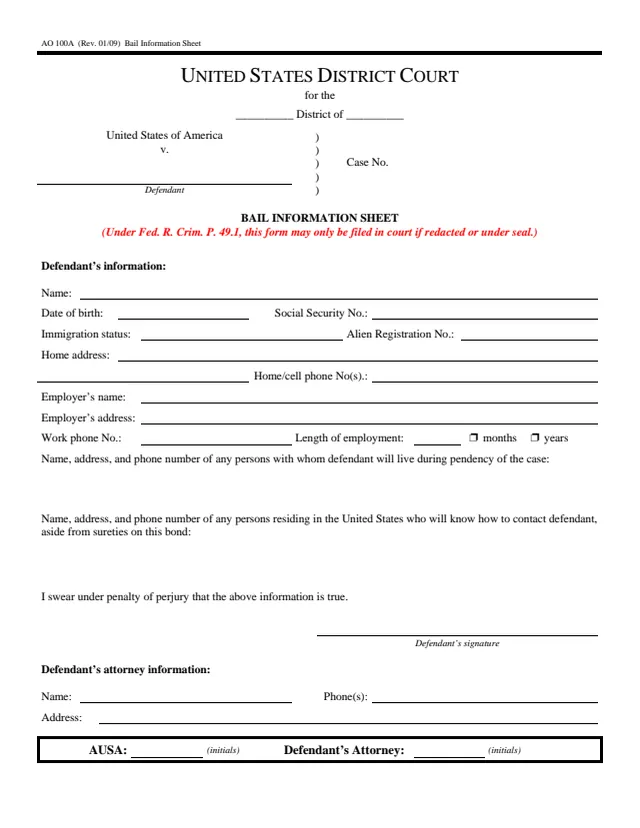
The district, case title and case number, the Rule 49.1 note, and the instructions to use a separate sheet for each surety and attach photocopies of two pieces of personal identification, including at least one picture i.d.
AO 100B
Surety Information Sheet
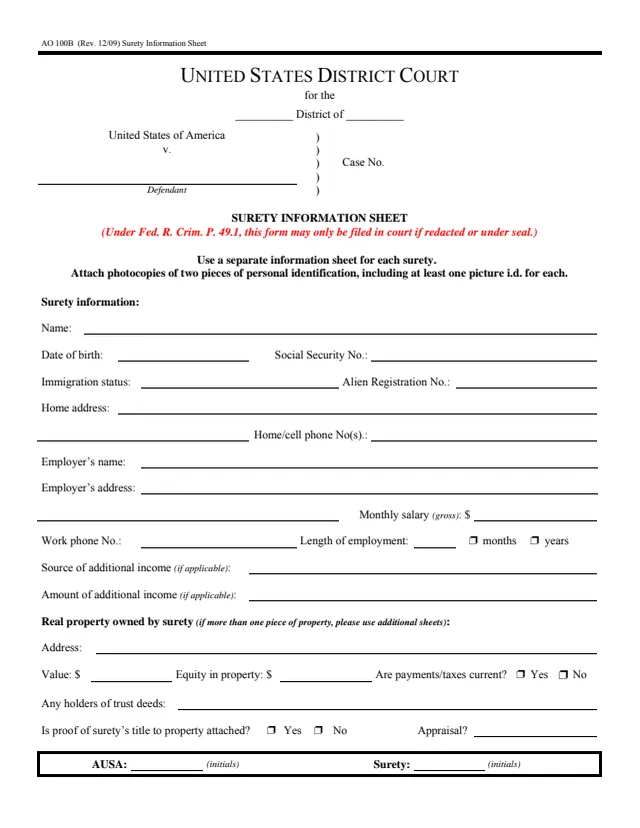
AO 100B, Surety Information Sheet, is a two-page form from the U.S. Courts used in a criminal case in a United States District Court, captioned United States of America v. the defendant. The U.S. Courts list it under Criminal Forms. The current version is Rev. 12/09, and the U.S. Courts page lists it as effective on December 1, 2009.
The form says to use a separate information sheet for each surety and to attach photocopies of two pieces of personal identification, including at least one picture i.d. for each. Page 1 collects the surety's personal, employment, income and real property details. Page 2 holds an Affidavit by Owner of Cash Security, completed if applicable, and the Justification of Surety and Surety Agreement, which the surety signs before a witness. The form says that under Fed. R. Crim. P. 49.1 it may only be filed in court if redacted or under seal.
This page explains the form in plain words and is not legal advice. You can fill it out free in your browser on this page and download the result without an account.
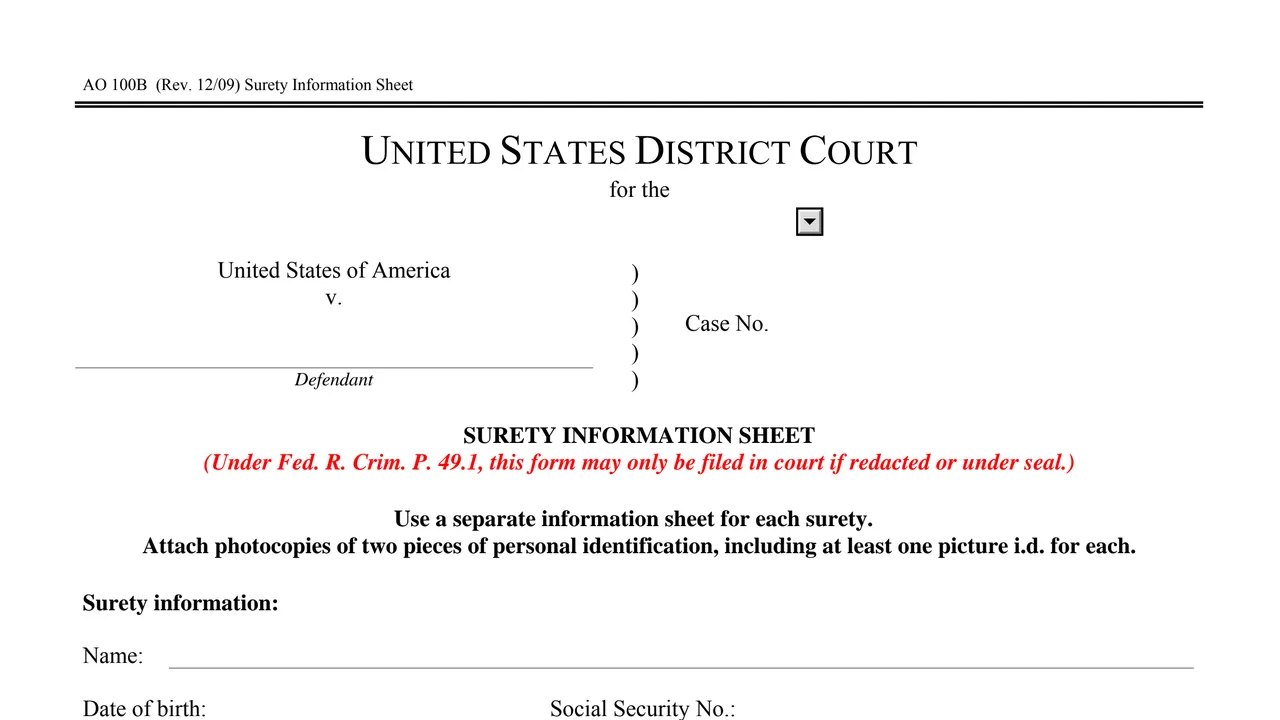
The district, case title and case number, the Rule 49.1 note, and the instructions to use a separate sheet for each surety and attach photocopies of two pieces of personal identification, including at least one picture i.d.
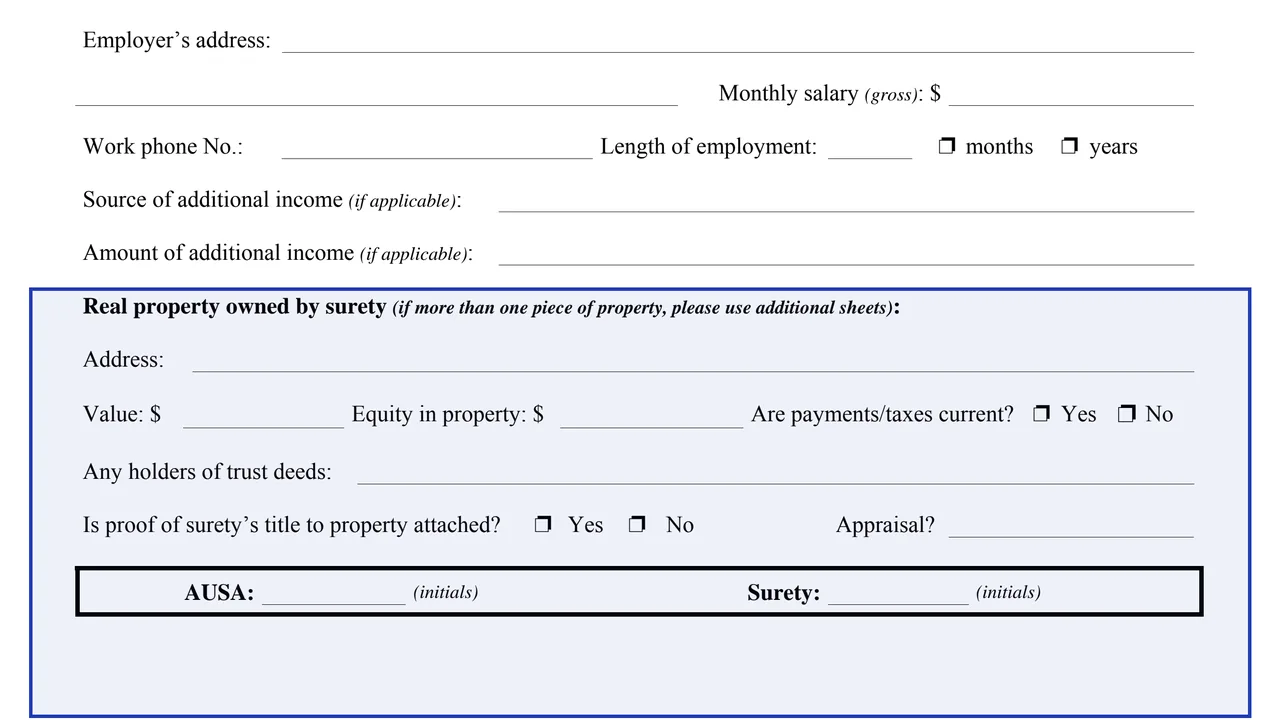
Name, date of birth, Social Security number, immigration status, Alien Registration number, home address and phones, employer's name and address, gross monthly salary, work phone, length of employment, and the source and amount of any additional income.
The address, value and equity of real property the surety owns, whether payments and taxes are current, any holders of trust deeds, whether proof of title is attached, and an appraisal. More than one property goes on additional sheets.
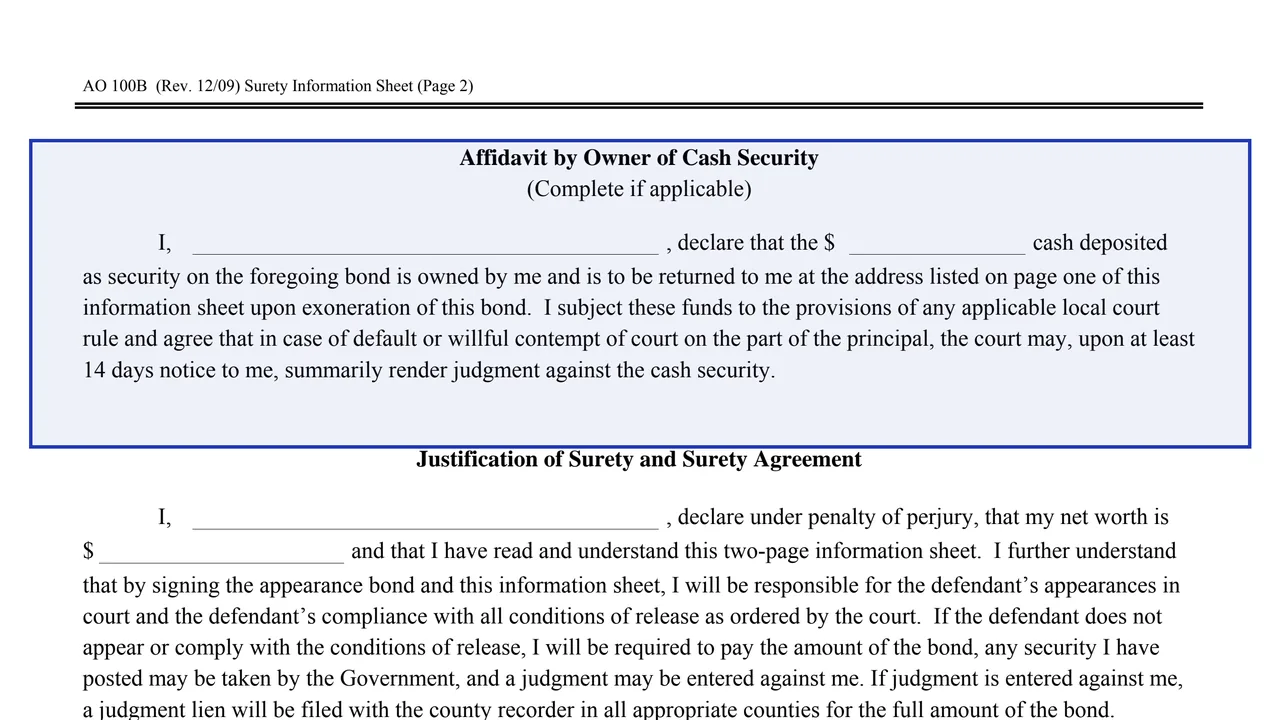
Completed if applicable. The owner declares that the cash deposited as security on the bond is theirs, to be returned to the address on page one upon exoneration of the bond, and agrees to the terms printed on the form.
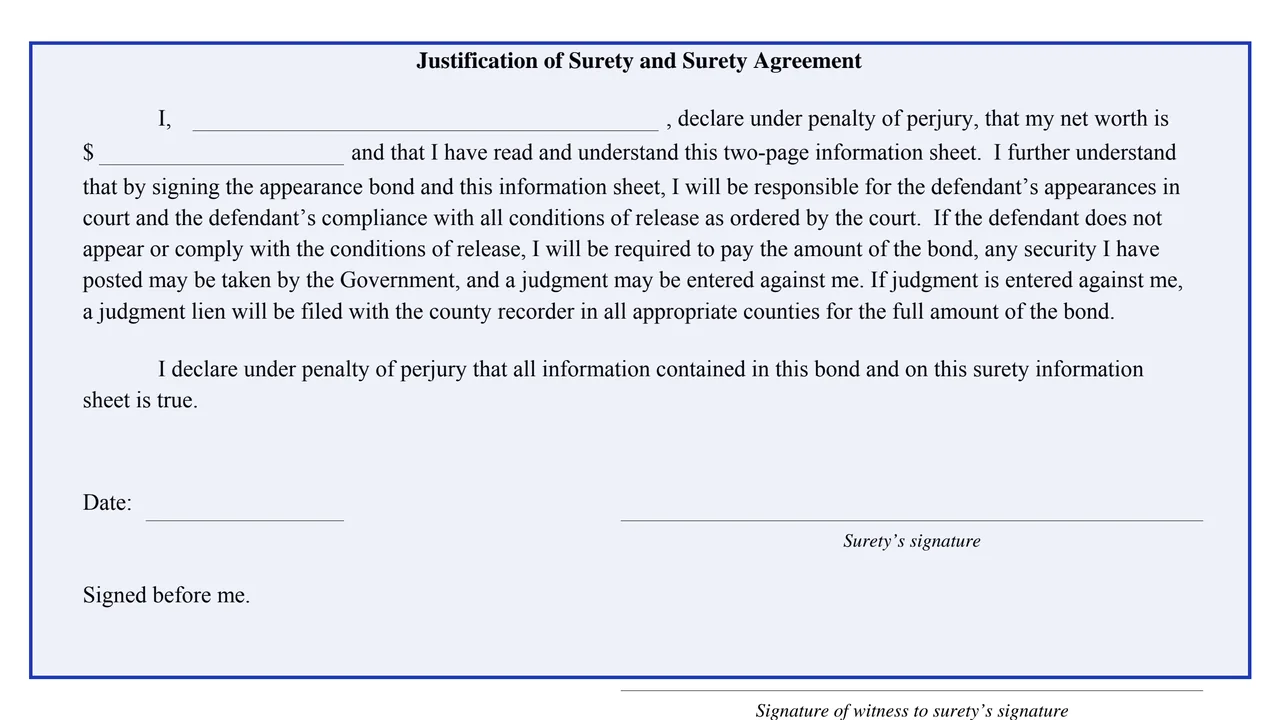
The surety states a net worth under penalty of perjury, says they have read and understand the two-page sheet, and accepts the responsibilities the form describes for the defendant's appearances and conditions of release.
The date, the surety's signature signed before a witness, the witness's signature, printed name and address, and initials lines for the AUSA, the surety and the defendant's attorney.
The form says to use a separate information sheet for each surety and to attach photocopies of two pieces of personal identification, including at least one picture i.d. for each.
Enter the caption, then the surety's personal, employment and income details on page 1.
List the address, value and equity of any real property, answer the yes or no questions on payments, taxes and proof of title, and use additional sheets for more than one property.
The Affidavit by Owner of Cash Security on page 2 is marked Complete if applicable. It names the owner and the amount of cash deposited as security.
The agreement says that by signing the appearance bond and the sheet, the surety will be responsible for the defendant's appearances in court and compliance with all conditions of release as ordered by the court.
The surety dates and signs the sheet, the witness signs and prints a name and address, and the AUSA, the surety and the defendant's attorney initial where marked.
You get the real form, filled in a browser tab, with nothing standing between you and the finished PDF.
The sheet is captioned for the United States District Court for the district named at the top, in the criminal case United States of America v. the defendant.
The form prints: "Under Fed. R. Crim. P. 49.1, this form may only be filed in court if redacted or under seal."
The form and its U.S. Courts page do not print a fee. The dollar lines on the form, for salary, property value, equity, cash security and net worth, are left blank for the surety to fill in.
The form says the surety will be required to pay the amount of the bond, any security posted may be taken by the Government, and a judgment may be entered against the surety, with a judgment lien filed with the county recorder in all appropriate counties for the full amount of the bond.
The cash affidavit says that in case of default or willful contempt of court on the part of the principal, the court may, upon at least 14 days notice to the owner, summarily render judgment against the cash security.
The sheet names the people who fill it in, sign it, witness it and initial it.
No tool matches that search.
One. The form says to use a separate information sheet for each surety.
The form says to attach photocopies of two pieces of personal identification, including at least one picture i.d., for each surety.
The form prints "Signed before me." with lines for the signature, printed name and address of the witness to the surety's signature. It does not say who the witness is.
Page 2 marks the Affidavit by Owner of Cash Security as Complete if applicable. It is for the person who declares that the cash deposited as security on the bond is owned by them.
The form says the surety will be required to pay the amount of the bond, any security posted may be taken by the Government, and a judgment may be entered against the surety. It adds that a judgment lien will then be filed with the county recorder in all appropriate counties.
The form says that under Fed. R. Crim. P. 49.1 it may only be filed in court if redacted or under seal. It asks for the surety's Social Security number and Alien Registration number.
No. This page explains the form in plain words and is not legal advice.