Beneficiary name and address
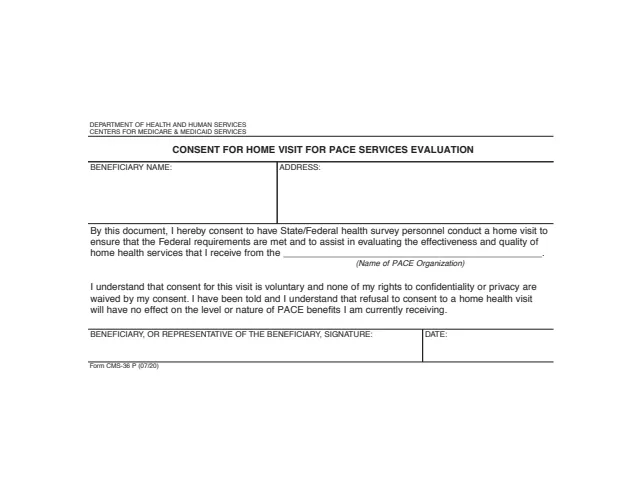
Two boxes at the top for the beneficiary's name and address.
CMS-36
CONSENT FOR HOME VISIT (English/Spanish)
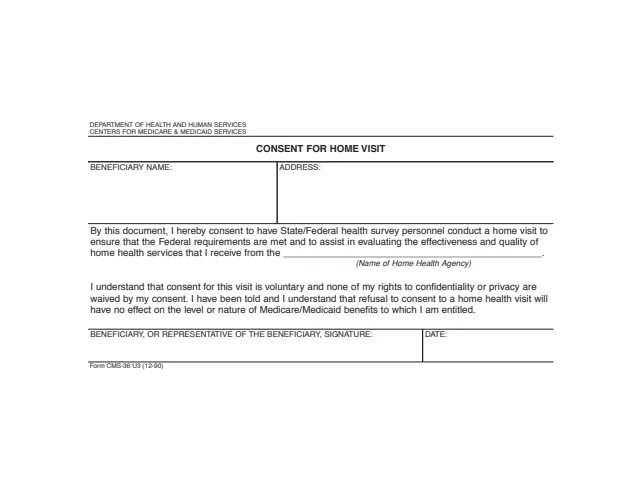
Form CMS-36 is the Consent for Home Visit from the Centers for Medicare & Medicaid Services (CMS), part of the U.S. Department of Health and Human Services. The CMS forms page lists it as one bilingual form, CONSENT FOR HOME VISIT (English/Spanish), with an English copy and a Spanish copy to download. The page lists the OMB number as EXEMPT, and the English copy is printed Form CMS-36 U3 (12-90).
It is a short, one-page consent signed by a beneficiary or a representative of the beneficiary. By signing, the beneficiary consents to have State/Federal health survey personnel conduct a home visit to ensure that the Federal requirements are met and to help evaluate the effectiveness and quality of the home health services they receive from the home health agency named on the form.
The form says consent for the visit is voluntary, that no rights to confidentiality or privacy are waived by consenting, and that refusing has no effect on the level or nature of Medicare/Medicaid benefits. You can fill it out free in your browser on this page and download the result without an account.
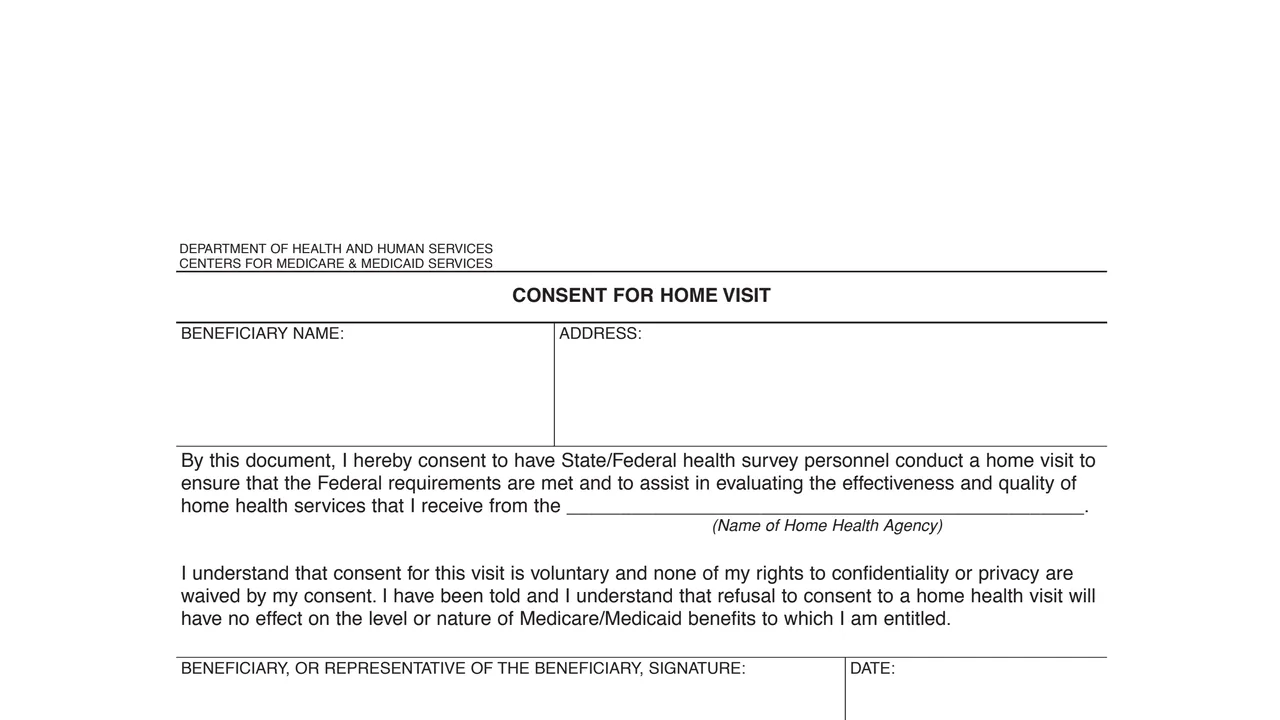
Two boxes at the top for the beneficiary's name and address.
A statement consenting to a home visit by State/Federal health survey personnel, with a blank for the name of the home health agency.
A statement that consent is voluntary, no confidentiality or privacy rights are waived, and refusal has no effect on the level or nature of Medicare/Medicaid benefits.
The signature of the beneficiary or the beneficiary's representative, and the date.
The form fits on one page.
The CMS forms page offers the form in English and in Spanish.
Fill in the two boxes at the top of the form.
Write the name of the home health agency that provides the services in the blank in the consent statement.
Read the consent and voluntary consent statements, then the beneficiary or their representative signs and dates the form.
You get the real form, filled in a browser tab, with nothing standing between you and the finished PDF.
The form says consent for the home visit is voluntary.
The form says refusing to consent to a home health visit has no effect on the level or nature of the Medicare/Medicaid benefits the beneficiary is entitled to.
The form says none of the beneficiary's rights to confidentiality or privacy are waived by consenting.
The form does not print a mailing address or say where the signed consent is sent.
The CMS forms page lists the OMB number as EXEMPT and links to the CMS Accessibility & Nondiscrimination for Individuals with Disabilities Notice.
The form is signed by a person who receives home health services, or their representative.
No tool matches that search.
It is the Consent for Home Visit, a one-page form in which a beneficiary consents to a home visit by State/Federal health survey personnel about the home health services they receive.
Yes. The CMS forms page lists it as one bilingual form, Consent for Home Visit (English/Spanish), with an English copy and a Spanish copy.
The form says refusal to consent to a home health visit will have no effect on the level or nature of Medicare/Medicaid benefits to which the beneficiary is entitled.
The signature line is for the beneficiary, or a representative of the beneficiary.
No. The form says none of the beneficiary's rights to confidentiality or privacy are waived by the consent.
The form says the visit is to ensure that the Federal requirements are met and to assist in evaluating the effectiveness and quality of the home health services the beneficiary receives.