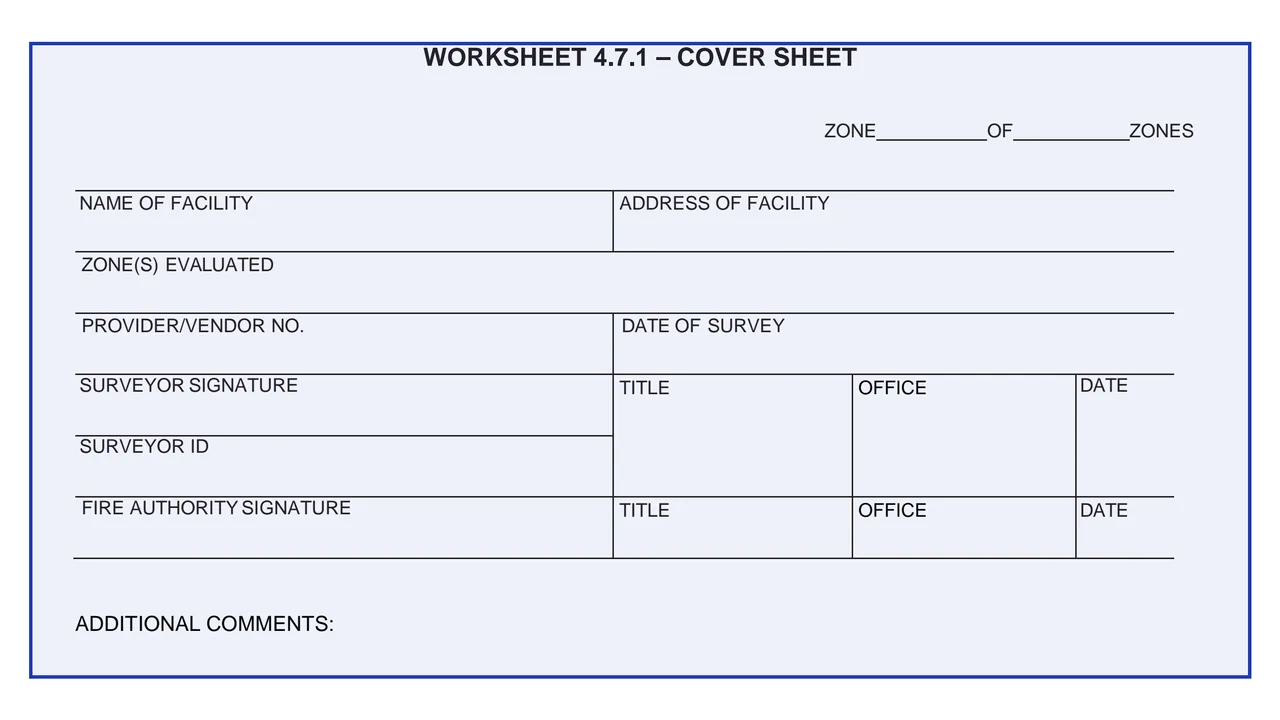
Worksheet 4.7.1: Cover sheet
Zone number and total zones, facility name and address, zone(s) evaluated, provider/vendor number, date of survey, surveyor and fire authority signatures, and additional comments.
CMS-2786T
Fire Safety Evaluation System - Health Care 2012 Life Safety Code
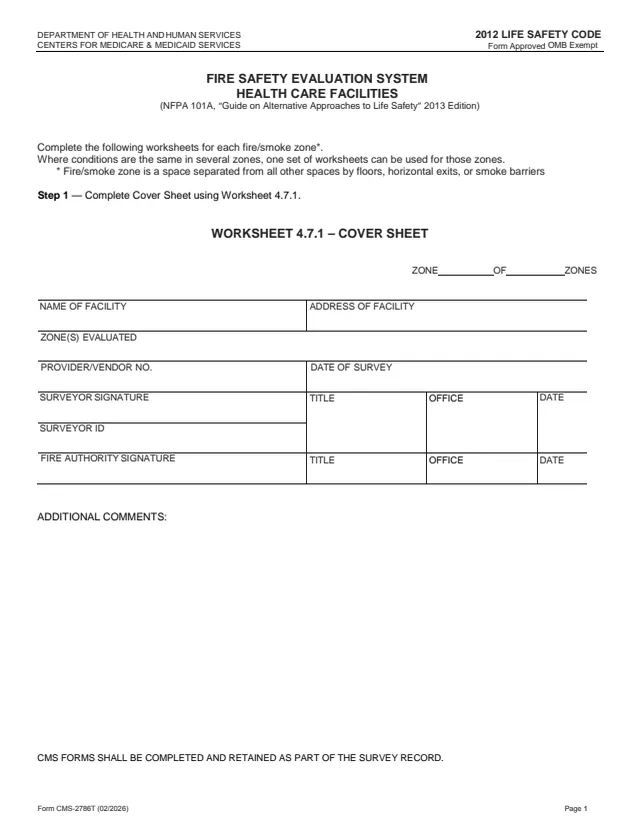
Form CMS-2786T is the Fire Safety Evaluation System for Health Care Facilities from the Centers for Medicare & Medicaid Services. It is marked 2012 Life Safety Code and Form Approved OMB Exempt, and it is based on NFPA 101A, Guide on Alternative Approaches to Life Safety, 2013 Edition.
The form is a set of worksheets completed for each fire/smoke zone, which it defines as a space separated from all other spaces by floors, horizontal exits, or smoke barriers. Where conditions are the same in several zones, one set of worksheets can be used for those zones. Ten steps lead from a cover sheet through occupancy risk and safety scores to a conclusion on whether the level of life safety is at least equivalent to that prescribed by the Life Safety Code.
The cover sheet says CMS forms shall be completed and retained as part of the survey record. You can fill it out free in your browser on this page and download the result without an account.
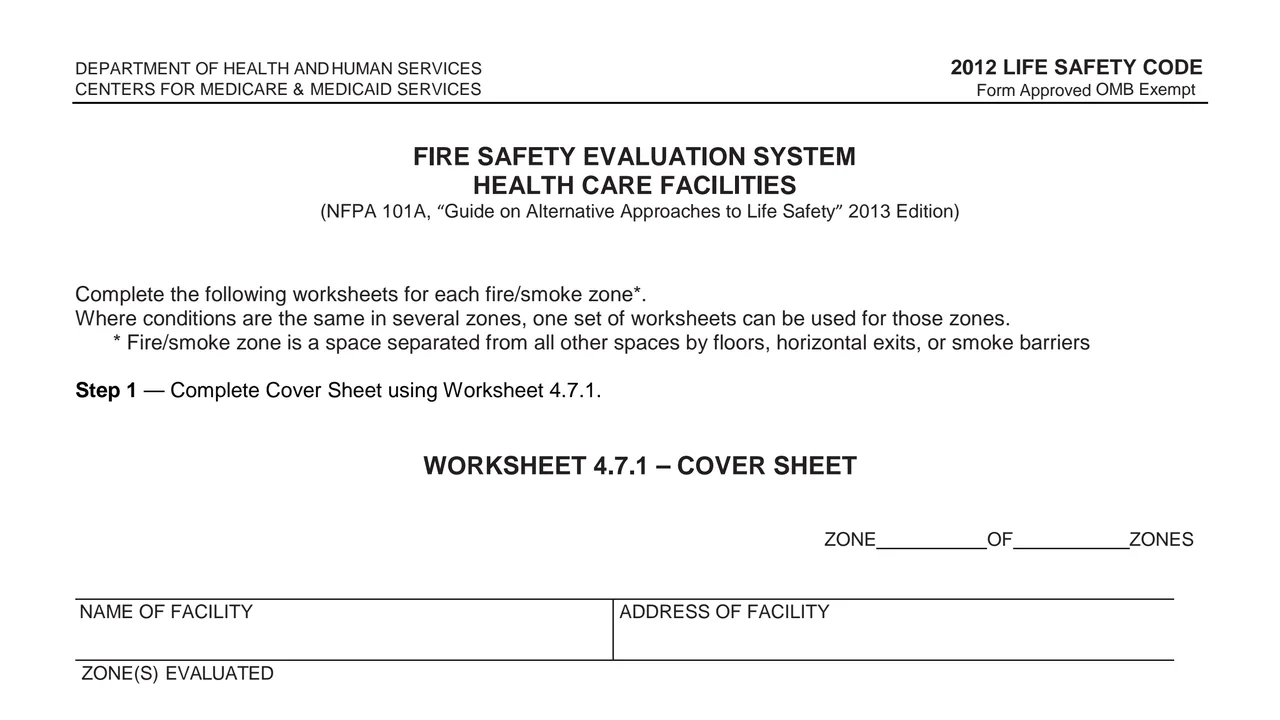
Zone number and total zones, facility name and address, zone(s) evaluated, provider/vendor number, date of survey, surveyor and fire authority signatures, and additional comments.
Five risk parameters: patient mobility (M), patient density (D), zone location (L), ratio of patients to attendants (T) and patient average age (A). Multiplying them gives the occupancy risk factor F.
The adjusted building status R: 1.0 x F for a building classified as New, 0.6 x F for Existing. The form says results are always rounded up.
Thirteen safety parameters, from construction and interior finish to smoke detection and automatic sprinklers, scored and totaled into containment (S1), extinguishment (S2), people movement (S3) and general safety (S4).
Mandatory safety requirement values Sa, Sb and Sc by facility type and floor, then S1 minus Sa, S2 minus Sb, S3 minus Sc and S4 minus R, each marked Yes or No.
Twelve facility fire safety requirements, A to L, each marked Met, Not Met or Not Applicable, then one of three written conclusions.
The form has seven pages of worksheets numbered 4.7.1 to 4.7.11.
Step 1: fill in Worksheet 4.7.1 for the zone, or for several zones with the same conditions.
Steps 2 and 3: circle one risk factor value for each of the five risk parameters, transfer them to Worksheet 4.7.3 and multiply to get F.
Step 4: use Worksheet 4.7.4 for a building classified as New or 4.7.5 for Existing, round up, and transfer R to Worksheet 4.7.9.
Steps 5 and 6: circle one value for each of the 13 parameters, choosing the lowest point value if two or more appear to apply, then add the four columns. The sprinkler value in the People Movement column is recorded as half.
Steps 7 and 8: pick Worksheet 4.7.8A, 4.7.8B or 4.7.8C by facility type, classification and floor. In Worksheet 4.7.9, check Yes if the answer is zero or greater and No if it is negative.
Steps 9 and 10: complete one copy of Worksheet 4.7.10 for each facility, then mark one of the three conclusions in Worksheet 4.7.11.
The form numbers its own steps 1 to 10. They are grouped here.
You get the real form, filled in a browser tab, with nothing standing between you and the finished PDF.
The cover sheet says CMS forms shall be completed and retained as part of the survey record. The form does not print a mailing address.
The worksheets are completed for each fire/smoke zone. One set can be used for several zones with the same conditions. Worksheet 4.7.10 is completed once for each facility.
The form is marked 2012 Life Safety Code and refers to NFPA 101A, Guide on Alternative Approaches to Life Safety, 2013 Edition.
The form is marked Form Approved OMB Exempt. It prints Form CMS-2786T (02/2026), and the CMS page lists a revision date of 2026-02-01.
The cover sheet has signature blocks for a surveyor and a fire authority. The mandatory safety worksheets name the facility types.
No tool matches that search.
The form defines it as a space separated from all other spaces by floors, horizontal exits, or smoke barriers.
The form says to complete the worksheets for each fire/smoke zone, but where conditions are the same in several zones, one set of worksheets can be used for those zones.
The form uses Worksheet 4.7.8B(1) for existing nursing homes that did NOT use the Fire Safety Evaluation System for compliance before July 5, 2016, and 4.7.8B(2) for those that did.
In Worksheets 4.7.4 and 4.7.5, the form says results are always rounded up, for example 3.2 is rounded to 4.0.
Worksheet 4.7.11 has three. Two say the level of safety is at least equivalent to NFPA 101, Life Safety Code, for health care occupancies. The third says it is not shown by this system to be equivalent.
The cover sheet has signature lines for the surveyor and for the fire authority, each with title, office and date.
No. The form is marked Form Approved OMB Exempt, and the CMS page lists the OMB number as Exempt.