Header
Taxpayer name, taxpayer identification number and tax year ("Año tributario").
886-H-DEP
Supporting Documents for Dependency Exemptions (Spanish Version)
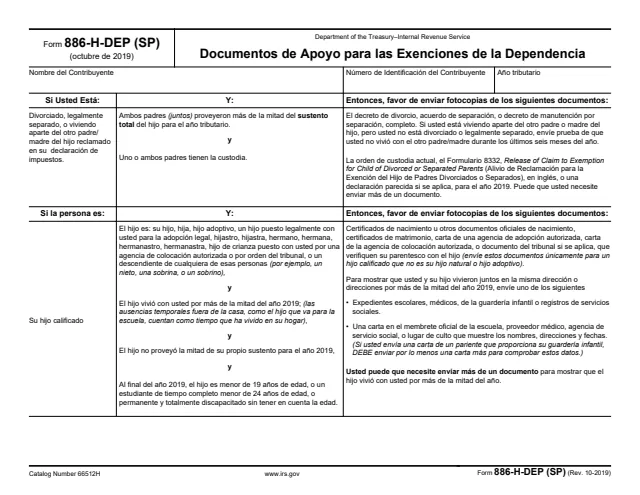
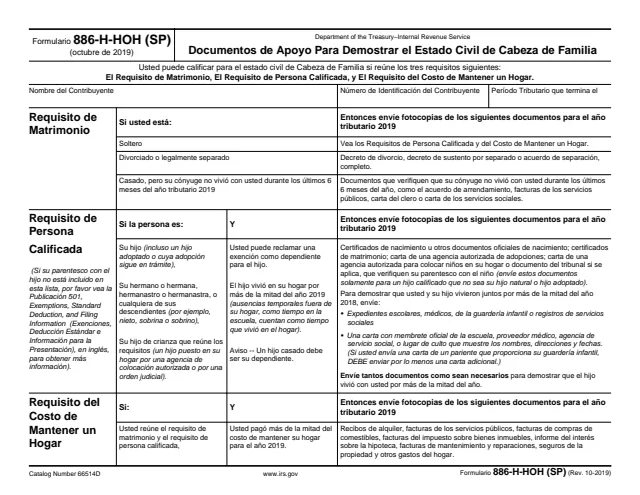
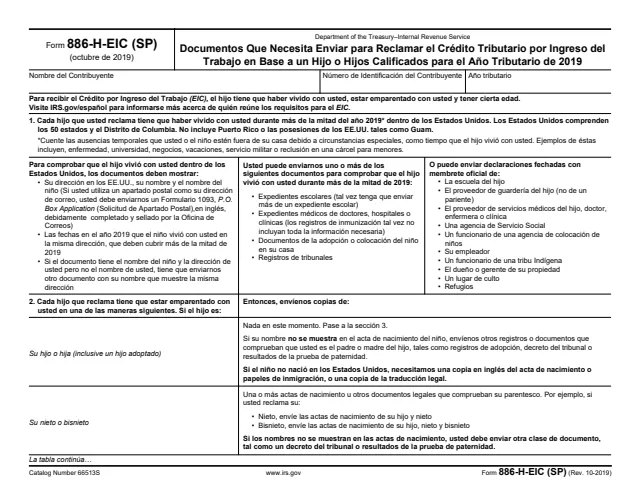
Form 886-H-DEP (SP) is the Spanish version of Form 886-H-DEP. Its Spanish title is "Documentos de Apoyo para las Exenciones de la Dependencia", Supporting Documents for Dependency Exemptions. It is a two-page IRS list, written in Spanish, of the photocopies to send as proof for a dependent claimed on a return.
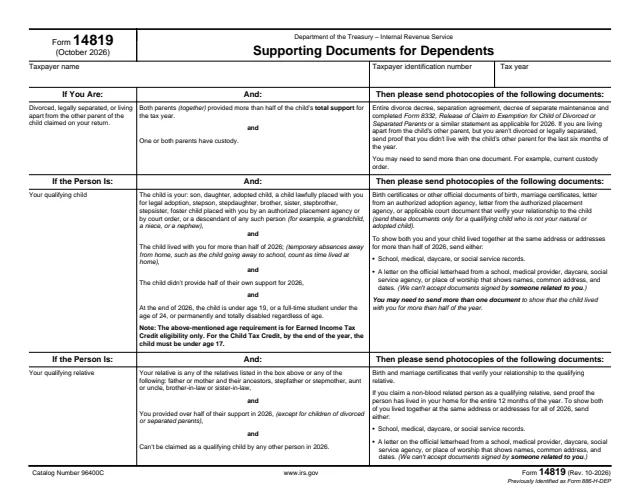
The top of page 1 has spaces for the taxpayer name, taxpayer identification number and tax year. Three tables match each case (a parent who is divorced, legally separated or living apart, a qualifying child, or a qualifying relative) with the documents the form asks for. Page 2 lists proof that the taxpayer provided more than half of the dependent's total support.
The header prints the date in Spanish, "octubre de 2019", the English footer reads Rev. 10-2019, and the tables refer to 2019. You can fill in the header free in your browser on this page and download the form without an account.
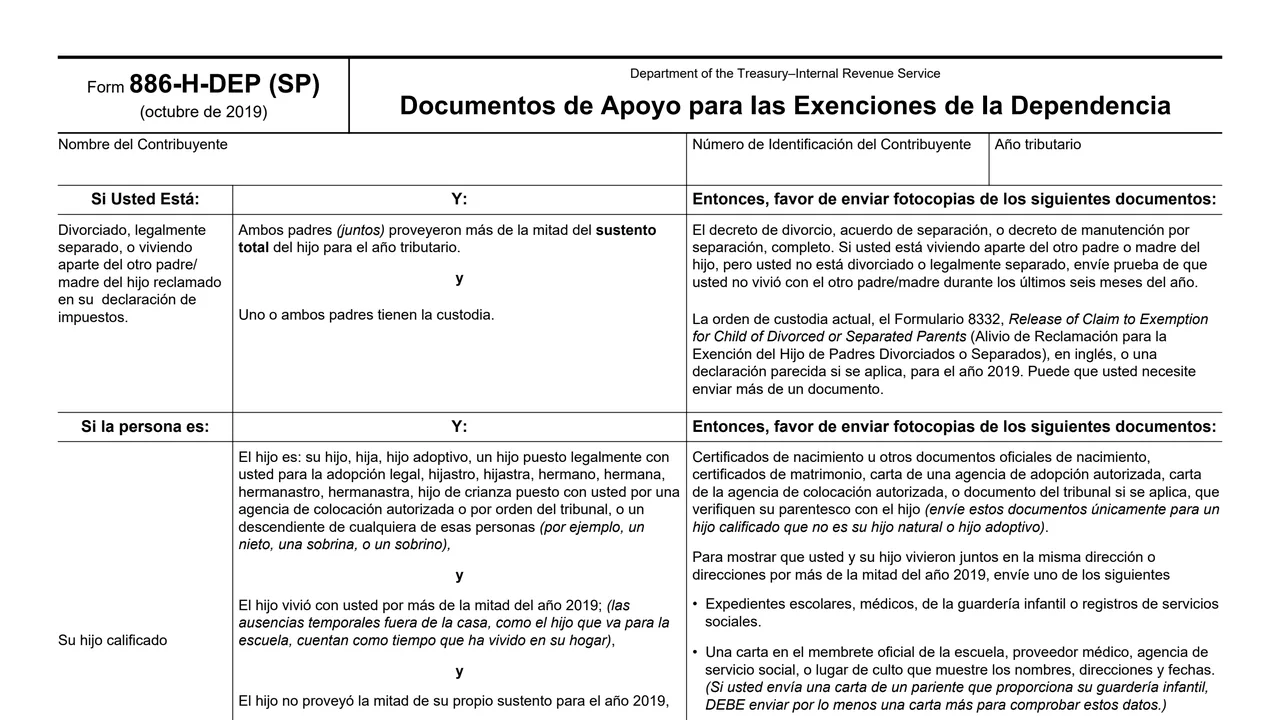
Taxpayer name, taxpayer identification number and tax year ("Año tributario").
Asks for the complete divorce decree, separation agreement or separate maintenance decree, plus the current custody order, Form 8332 or a similar statement as applicable for 2019.
Lists the relationship, residency, support and age tests for 2019, and the birth, marriage, adoption or placement papers and school, medical, daycare or social service records that show them.
Asks for birth and marriage certificates that verify the relationship and, for a person not related by blood, proof the person lived in the home for the entire 12 months of the year.
Six kinds of copies that show more than half of the dependent's total support, from child support and government benefit statements to rent, utility, school, medical and clothing bills.
The tables are in Spanish. The items below give their English meaning.
Enter the taxpayer name, taxpayer identification number and tax year at the top of page 1.
Read the "Si Usted Está" or "Si la persona es" column and the "Y" column, then use the documents in the right column for the row that fits.
For a qualifying child, the form lists birth or marriage certificates, adoption or placement agency letters or court documents, and says to send these only for a child who is not the taxpayer's natural or adopted child.
The form lists school, medical, daycare or social service records, or a letter on official letterhead showing names, addresses and dates. It says a letter from a relative who provides the child care is to be backed by at least one more letter.
Add copies from page 2, such as a child support agency statement, lease contracts, or utility, repair, daycare, school, medical and clothing bills with canceled checks or receipts.
Each table asks for photocopies, and the form notes that more than one document may be needed.
You get the real form, filled in a browser tab, with nothing standing between you and the finished PDF.
The form asks the taxpayer to send photocopies of the listed documents to the IRS. It prints no mailing address, deadline or fax number.
This revision refers to 2019 in its custody, residency, support and age tests. The qualifying relative support row prints 2018.
The form says a letter from a relative who provides the child care is to come with at least one more letter that confirms the same facts.
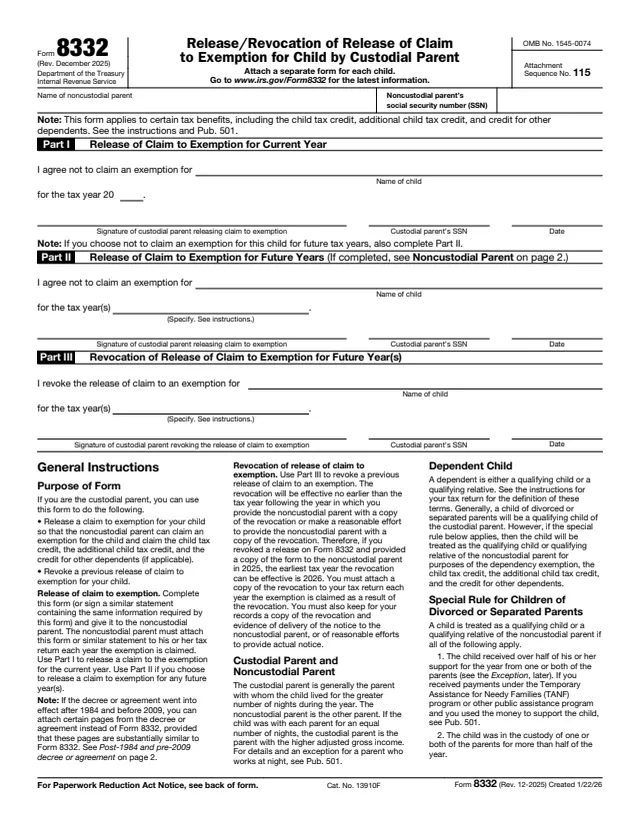
The first table names Form 8332, Release of Claim to Exemption for Child of Divorced or Separated Parents, noting that it is in English.
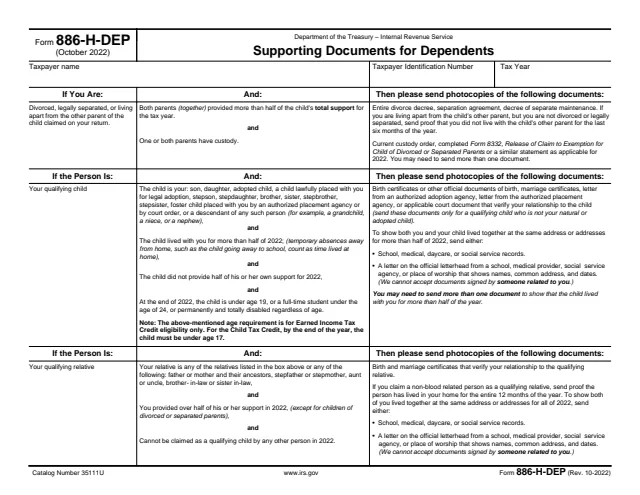
886-H-DEP
3 fields, 2 pages
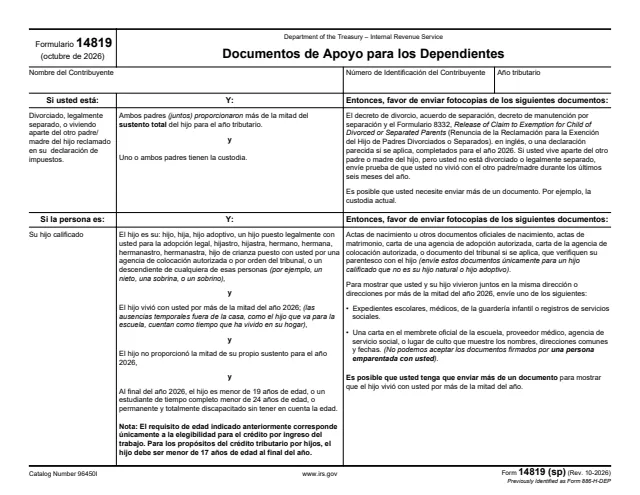
14819
3 fields, 2 pages
14819
3 fields, 2 pages
8332
11 fields, 2 pages
886-H-HOH
3 fields, 1 page
886-H-EIC
8 fields, 3 pages
The form is written to the taxpayer named at the top, who sends photocopies of the listed documents to the IRS ("Envíenos", send us). The header names the Department of the Treasury, Internal Revenue Service. The form does not say when the IRS issues it.
No tool matches that search.
The title, header and tables are in Spanish. The footer with the form and catalog numbers is in English. The English edition is Form 886-H-DEP.
No. Each table says to send photocopies of the documents it lists.
The form says that if a letter comes from a relative who provides the child care, at least one more letter is to be sent to confirm the same facts.
The form names Form 8332, Release of Claim to Exemption for Child of Divorced or Separated Parents, or a similar statement as applicable.
Page 2 lists child support agency statements, government benefit statements, lease contracts or fair rental value reports, and utility, repair, daycare, school, medical and clothing bills with canceled checks or receipts.
Rev. 10-2019 refers to 2019 in its tests, for example a child who lived with the taxpayer for more than half of 2019. One row, the qualifying relative support test, prints 2018.