Part I: should you file this form
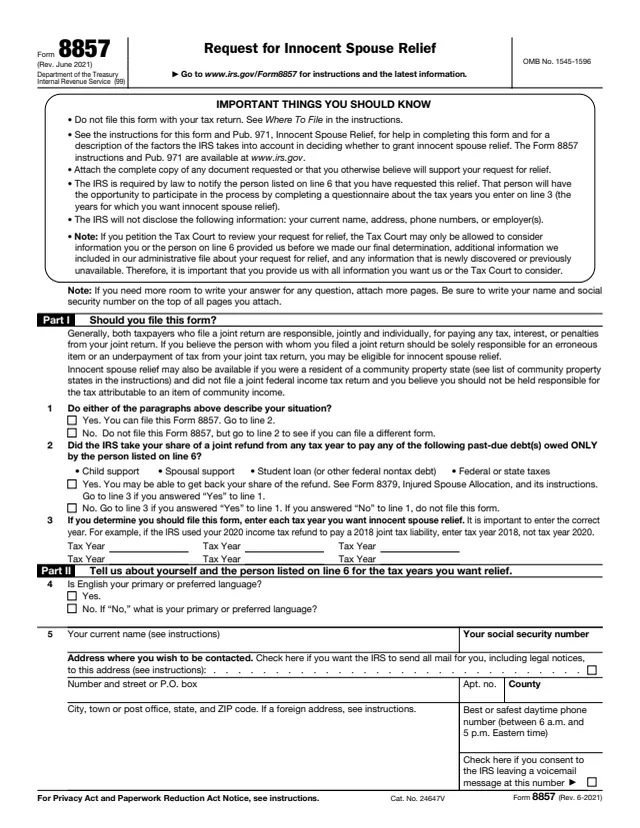
Line 1 asks whether the joint return or community property description fits you, line 2 asks about a refund used for the other person's debt, and line 3 lists the tax years for relief.
8857
Request for Innocent Spouse Relief (Spanish Version)
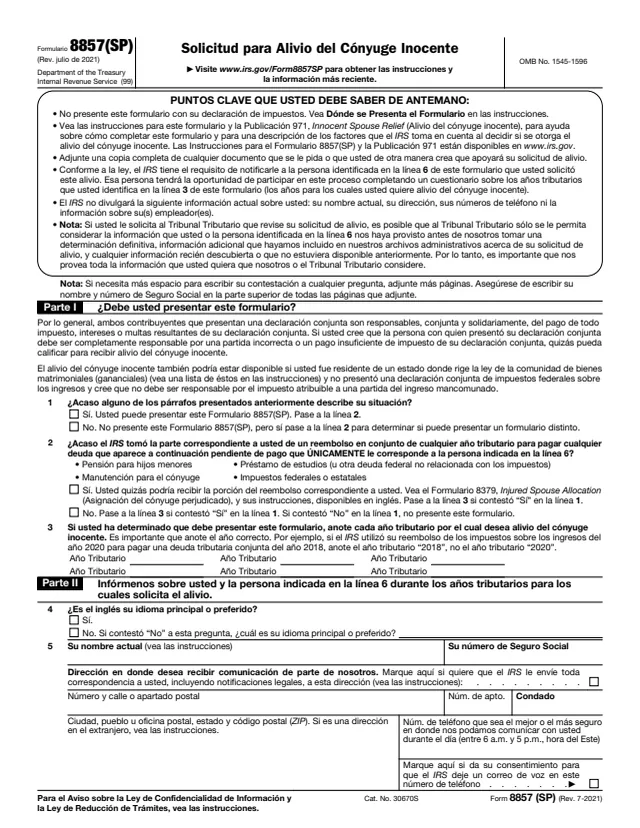
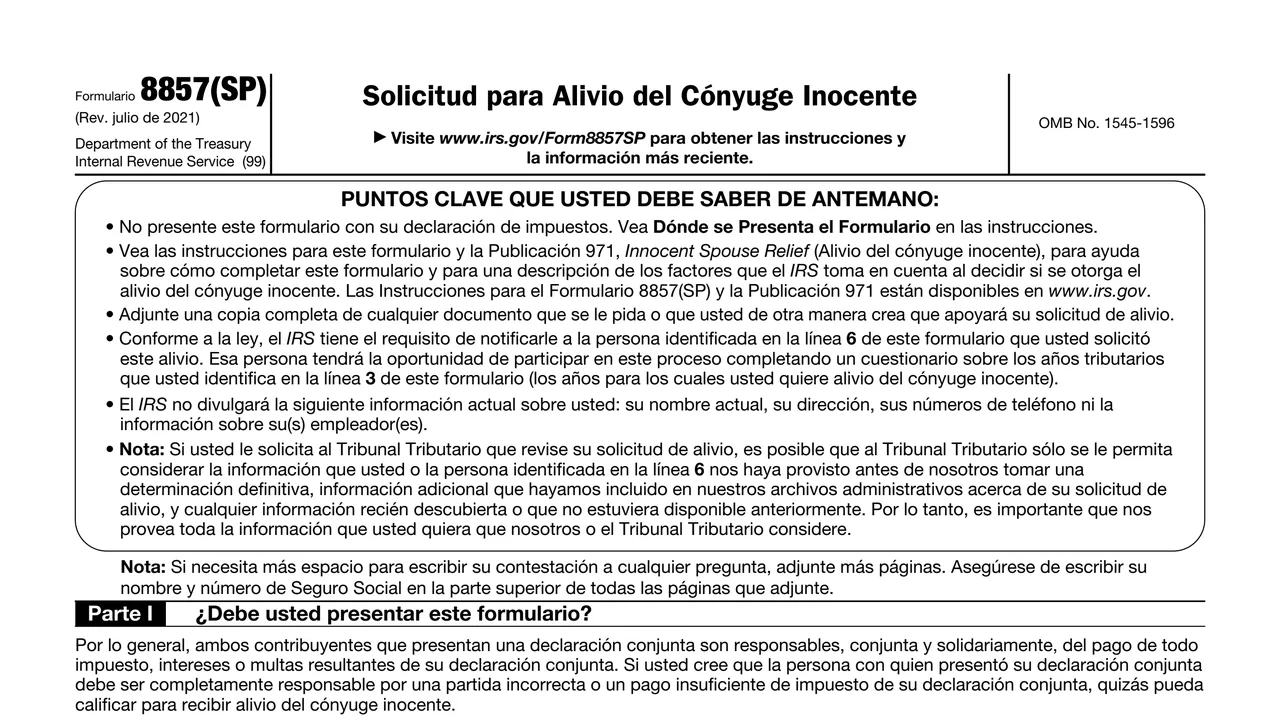
Form 8857 (SP) is the Spanish version of Form 8857, Request for Innocent Spouse Relief. The six-page PDF is titled "Solicitud para Alivio del Cónyuge Inocente" and is written in Spanish, for filers who read Spanish. It is dated julio de 2021 (Rev. 7-2021), and its header points to www.irs.gov/Form8857SP for instructions and the latest information.
The IRS About page says taxpayers file Form 8857 to request relief from tax liability, plus related penalties and interest, when they believe only their spouse or former spouse should be held responsible for all or part of the tax. Part I of the Spanish form explains that both people who file a joint return are generally jointly and severally responsible for the tax, interest and penalties from it.
A key points box at the top says not to file the form with your tax return, that the IRS is required by law to notify the person named on line 6, and that the IRS will not disclose your current name, address, phone numbers or employer information. The English edition, Form 8857, has its own page. You can fill out this Spanish PDF free in your browser on this page and download it without an account.
Line 1 asks whether the joint return or community property description fits you, line 2 asks about a refund used for the other person's debt, and line 3 lists the tax years for relief.
Lines 4 to 10: whether English is your primary or preferred language, your name, SSN, address and phone, the other person's details, marital status, education, health conditions, and information you would rather discuss.
Lines 11 to 19 ask whether you meant to file jointly, your part in preparing the returns, what you knew about the other person's income, balances due, household finances, large purchases and transferred assets.
Line 20 lists your assets with fair market value and loan balances, line 21 the number of people you support, and line 22 your household's average monthly income and expenses.
Optional questions on line 23 for a victim of domestic violence or abuse, with a list of documents to attach. It gives the National Domestic Violence Hotline, 1-800-799-7233 (1-800-799-SAFE), and TTY 1-800-787-3224.
Line 24 is space for anything else to consider. Line 25 is a box to ask for a refund if you qualify for relief and already paid the tax. Then the signature and paid preparer area.
If line 1 is no, the form says not to file Form 8857(SP) but to go to line 2 to see whether a different form applies.
Enter each tax year you want relief for. The form's example: if the IRS used your 2020 refund to pay a 2018 joint debt, enter 2018, not 2020.
Give your language, name, SSN, address and best daytime phone, then the line 6 person's details and your current marital status. The form asks for copies of a death certificate, separation agreement or divorce decree where they apply.
Answer each question in your own words. The form says to attach more pages if needed, with your name and SSN at the top of each one.
List assets, the number of people you support and average monthly income and expenses. The form says to count support from relatives or friends as gifts.
Check line 25 if you want a refund, then sign and date under penalties of perjury. The signature area says to keep a copy for your records.
You get the real form, filled in a browser tab, with nothing standing between you and the finished PDF.
The instructions say not to file it with your tax return or the Tax Court. By U.S. Postal Service: Internal Revenue Service, P.O. Box 120053, Covington, KY 41012. By private delivery service: Internal Revenue Service, 7940 Kentucky Drive, Stop 840F, Florence, KY 41042.
The instructions say the form and attachments can also be faxed to 855-233-8558.
The instructions say to file as soon as you become aware of the liability, and generally no later than 2 years after the first IRS attempt to collect the tax from you, with different deadlines for equitable relief and community income.
The form says to attach a full copy of any document requested or that supports your request, and to write your name and SSN on every added page.
The form says the IRS is required by law to tell that person about the request, and that it will not disclose your current name, address, phone numbers or employer information.
The header points to www.irs.gov/Form8857SP. The key points box says the Instructions for Form 8857(SP) and Publication 971 are available at www.irs.gov.
Part I of the Spanish form describes who may file it. The person filing is the spouse or former spouse asking for relief.
No tool matches that search.
Spanish. The PDF is titled "Solicitud para Alivio del Cónyuge Inocente" and every question on it is in Spanish. This page about it is in English.
Yes. The English edition is Form 8857, Request for Innocent Spouse Relief, which has its own page.
No. The key points box says not to file this form with your tax return.
Yes. The form says the IRS is required by law to notify the person on line 6, who can then complete a questionnaire. It also says the IRS will not disclose your current name, address, phone numbers or employer information.
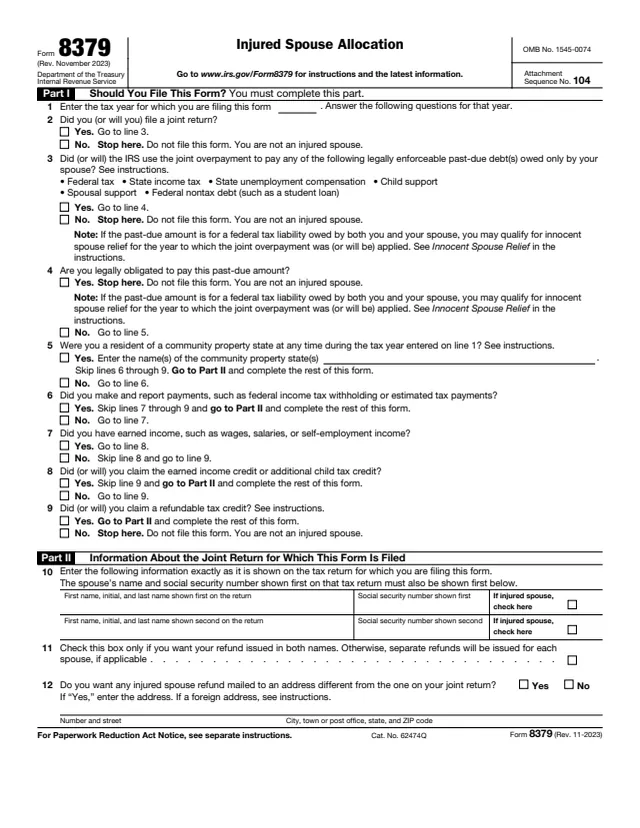
Line 2 points to Form 8379, Injured Spouse Allocation, and says its instructions are available in English.
Yes. Line 4 asks whether English is your primary or preferred language and, if not, which language is.