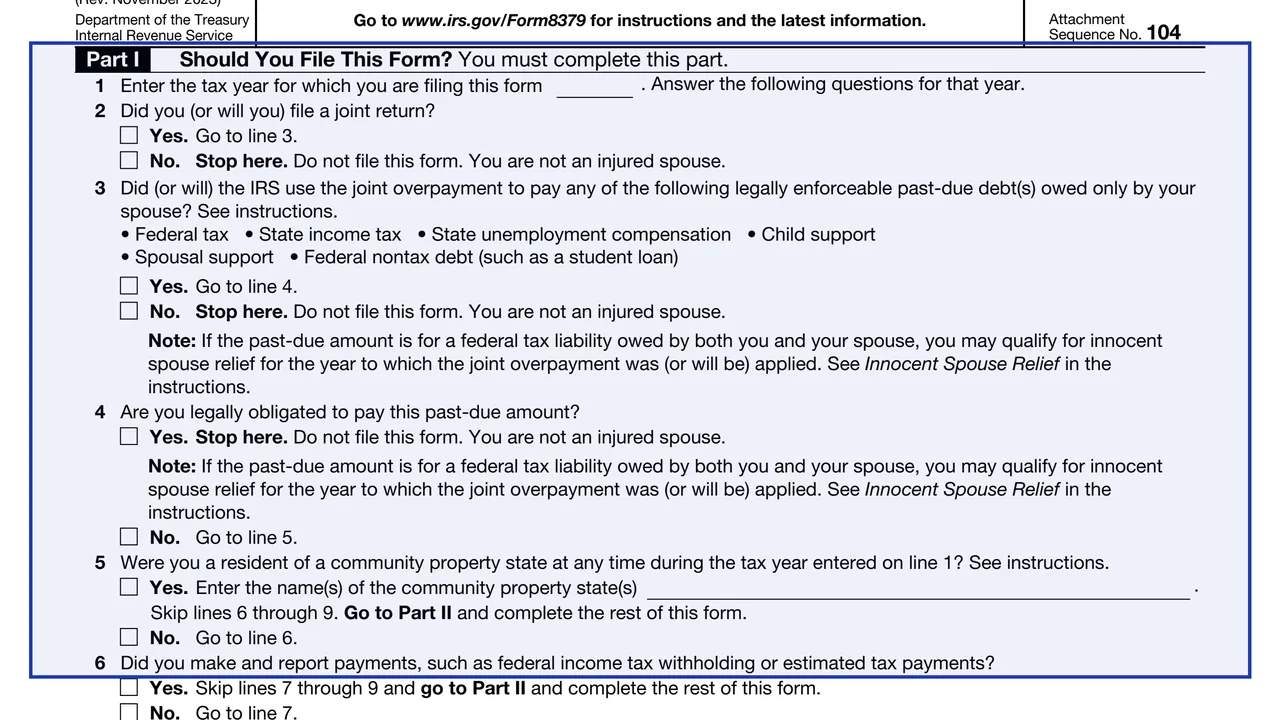
Part I: Should You File This Form?
Lines 1 to 9: the tax year, then Yes or No questions about the joint return, the type of past-due debt, who owes it, community property states, payments, earned income and refundable credits.
8379
Injured Spouse Allocation
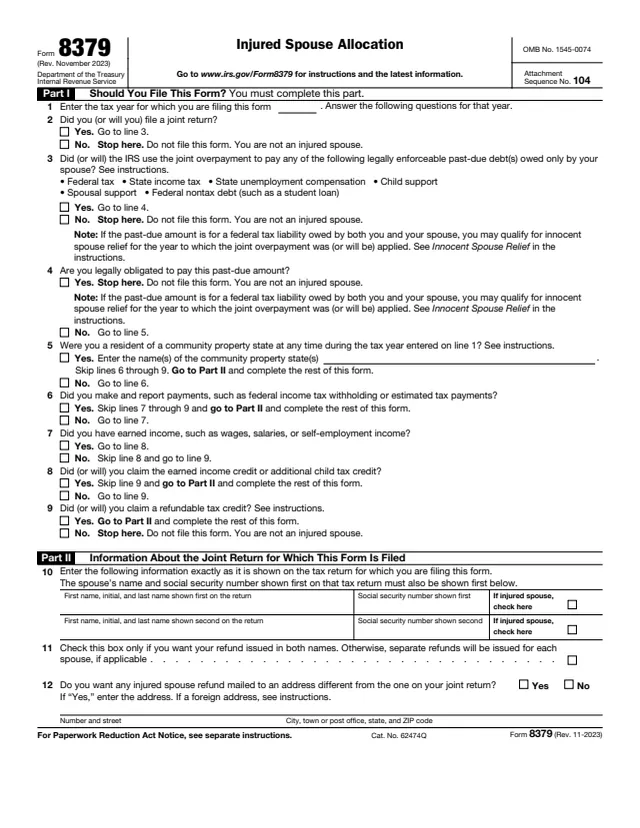
Form 8379, Injured Spouse Allocation, is filed by one spouse (the injured spouse) on a jointly filed tax return when the joint overpayment was, or is expected to be, applied (offset) to a past-due obligation of the other spouse. The instructions say that by filing it, the injured spouse may be able to get back their share of the joint refund.
The instructions list the debts involved: past-due federal tax, state income tax, state unemployment compensation debts, child support, and federal nontax debt such as a student loan. Part I is a series of Yes or No questions, and Part III splits the items on the joint return between the spouses as if each had filed a separate return. The IRS then figures any refund due to the injured spouse.
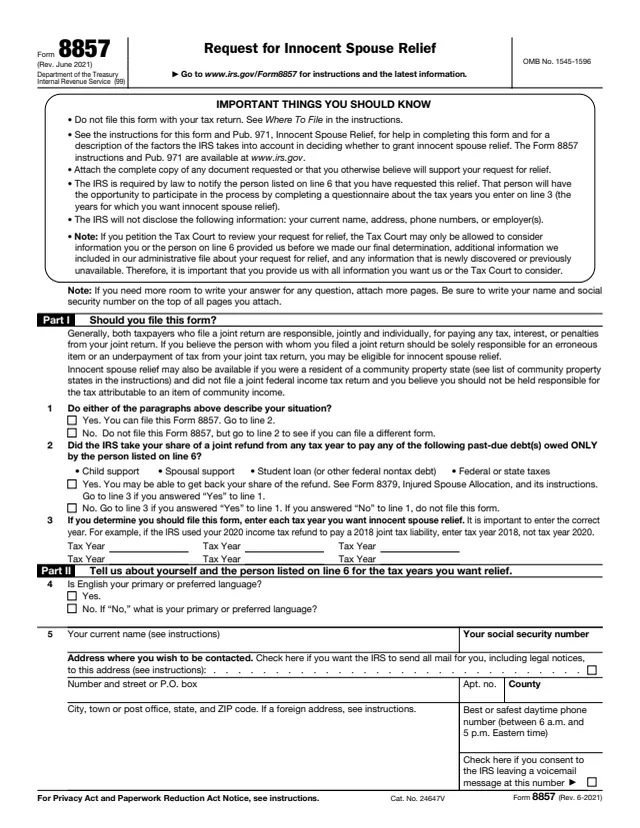
Form 8379 is not the form for innocent spouse relief, which uses Form 8857. You can fill out the PDF free in your browser on this page and download it without an account.
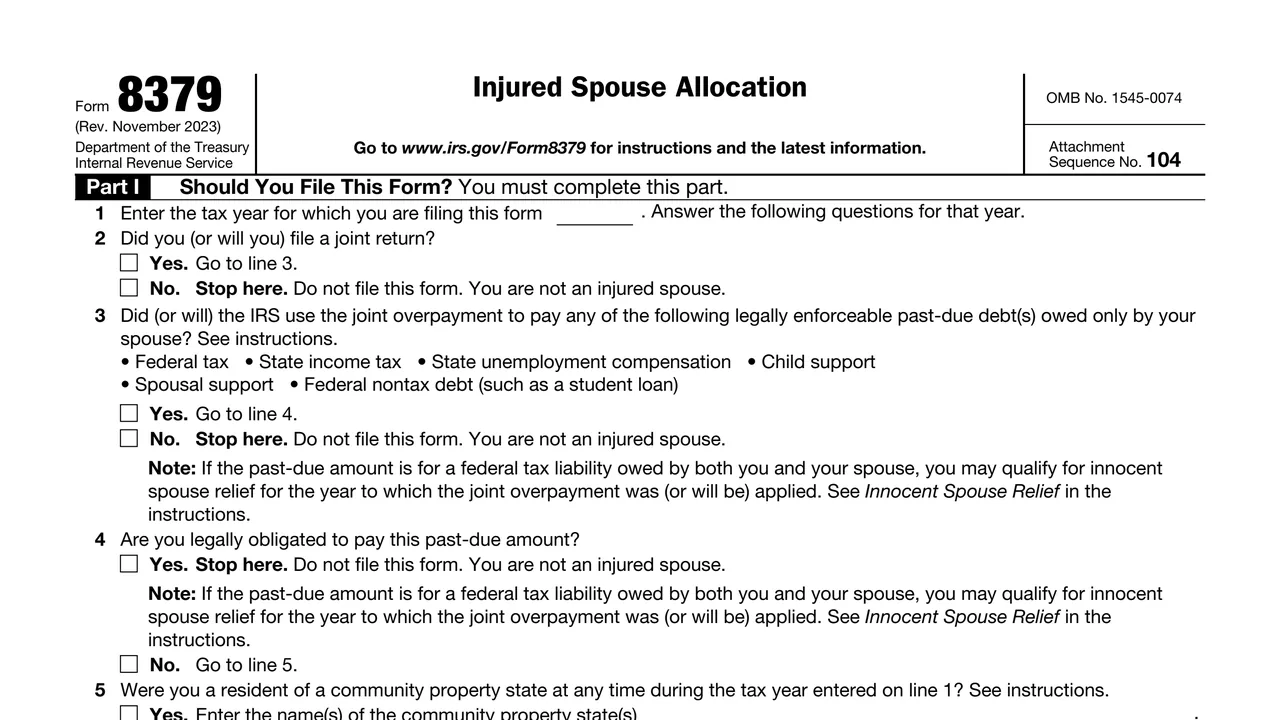
Lines 1 to 9: the tax year, then Yes or No questions about the joint return, the type of past-due debt, who owes it, community property states, payments, earned income and refundable credits.
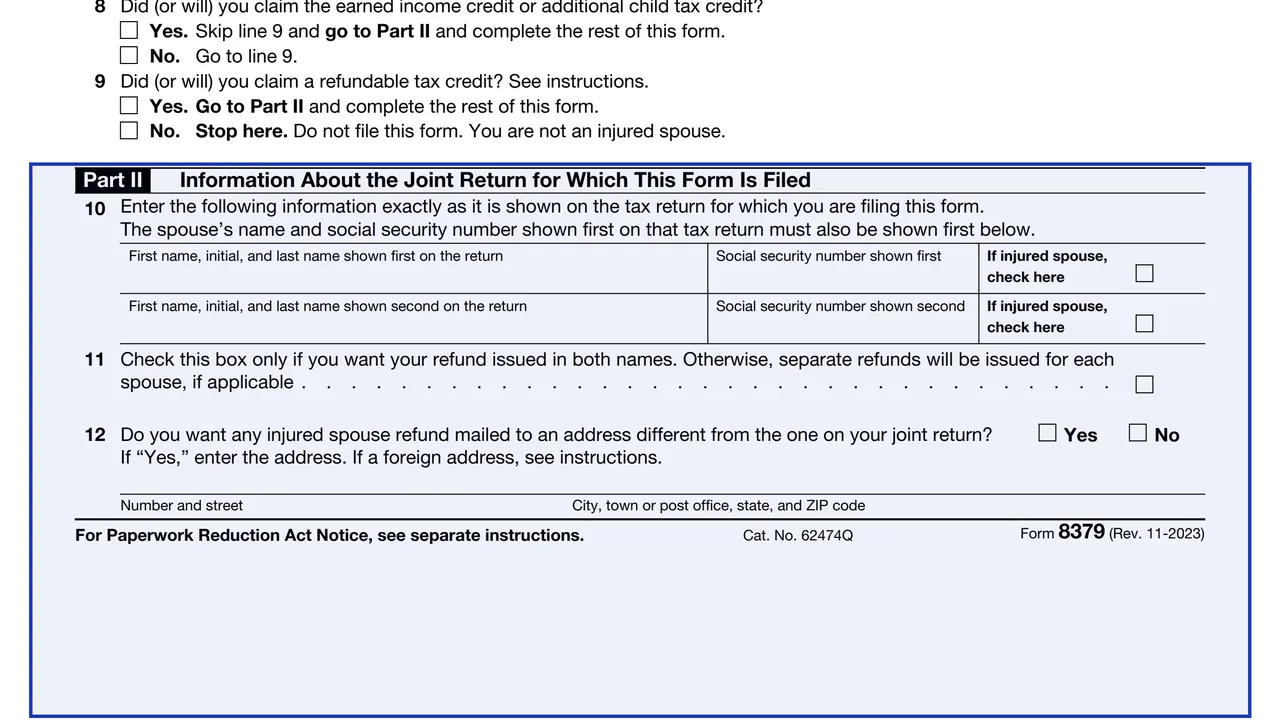
Names and Social Security numbers exactly as shown on the joint return, in the same order, with a box to mark which spouse is the injured spouse.
A box to have the refund issued in both names, and a Yes or No question on mailing the injured spouse refund to a different address.
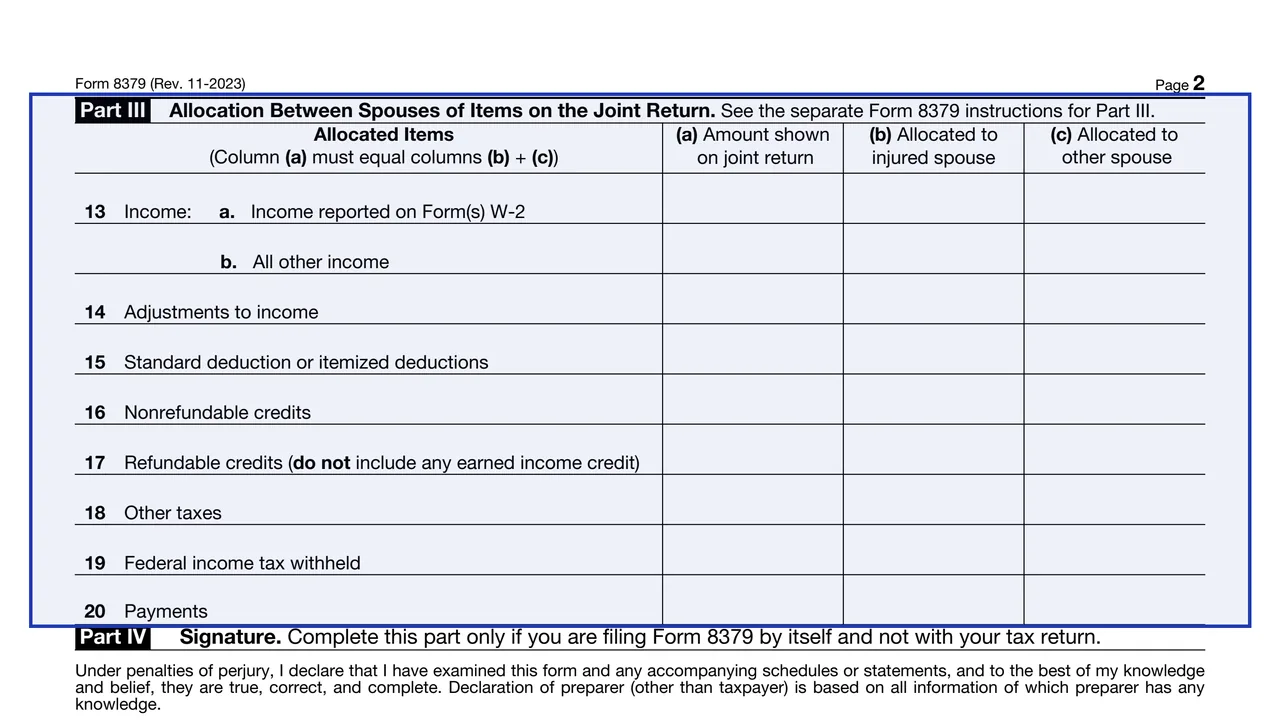
Lines 13 to 20 cover income, adjustments, deductions, credits, other taxes, withholding and payments. Column (a) is the joint return amount and must equal columns (b) plus (c).
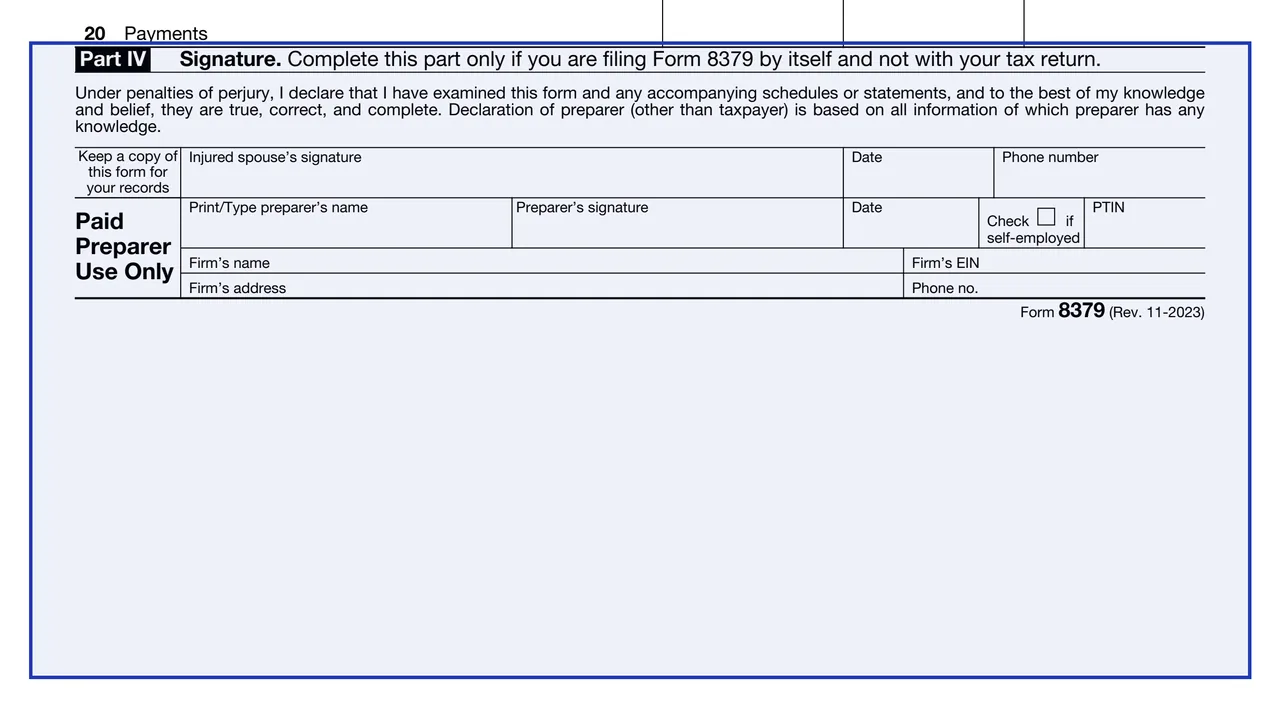
The injured spouse's signature, date and phone number, plus the paid preparer area. The form says to complete it only when filing Form 8379 by itself.
Enter the tax year on line 1 and answer lines 2 to 9 in order. Each answer on the form says whether to stop, go to the next line or skip to Part II.
Enter the names and Social Security numbers exactly as shown on the joint return. The spouse shown first on the return is also shown first here. Check the box next to the injured spouse.
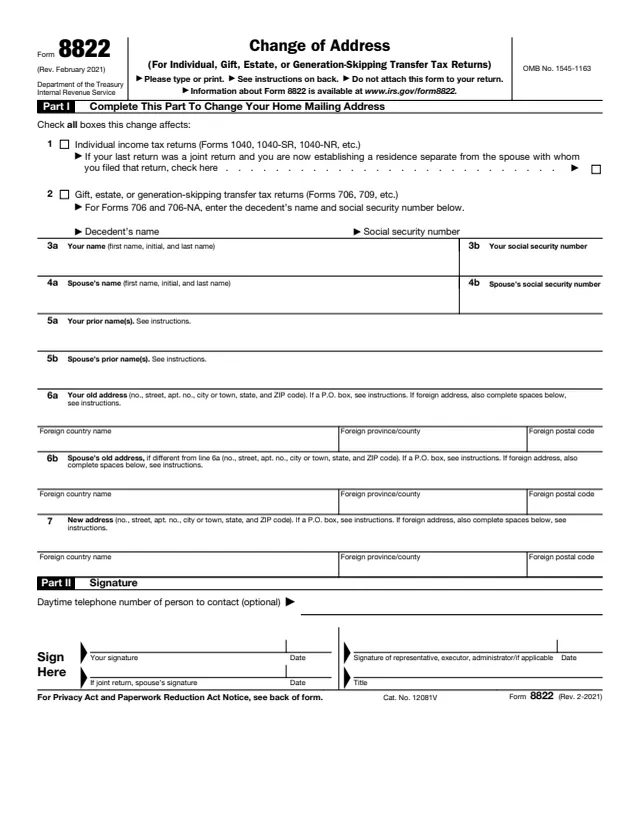
Check line 11 only for a refund in both names. On line 12, the instructions say a permanent address change also needs Form 8822, while a temporary change may delay the refund.
Enter each joint return amount in column (a), then split it in columns (b) and (c) as if each spouse had filed separately. The instructions say not to include the earned income credit, which the IRS allocates.
Enter each spouse's federal income tax withheld from Forms W-2, W-2G and 1099. Joint estimated payments can be split any way both spouses agree. Otherwise the instructions give a formula.
Sign and date Part IV only when filing Form 8379 by itself. The instructions say a daytime phone number may help speed processing.
You get the real form, filled in a browser tab, with nothing standing between you and the finished PDF.
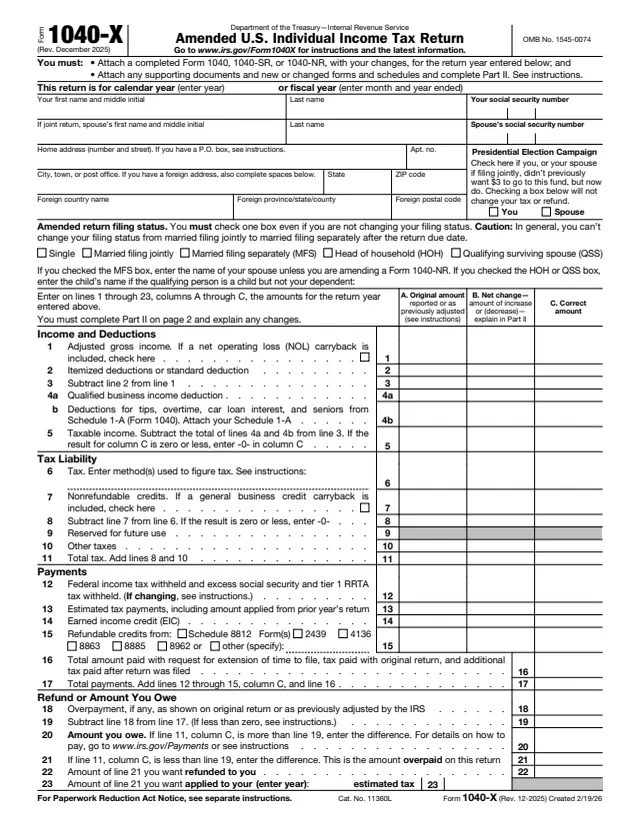
The instructions say Form 8379 can be filed with the joint return or an amended joint return (Form 1040-X), or afterwards by itself. With a joint return, write "Injured Spouse" in the upper left corner of page 1 of the return.
Attach copies of all Forms W-2 and W-2G for both spouses and any Forms 1099 showing federal income tax withholding. The instructions say not to include a copy of the joint return.
With a joint or amended return, to the IRS service center for the area where you live. Filed alone, the instructions give a chart that depends on whether the original return was filed on paper or electronically.
The instructions say to file within 3 years from the due date of the original return (including extensions) or within 2 years from the date the tax that was later offset was paid, whichever is later.
About 14 weeks with a paper joint return (11 weeks if filed electronically), or about 8 weeks when filed by itself after the joint return has been processed.
The instructions list leaving out Forms W-2, W-2G or 1099, attaching the joint return, not writing "Injured Spouse" on the return, and filing when no past-due obligation exists, which delays the refund.
The form is filed by one spouse on a joint return. The other spouse's debt is what caused the offset.
No tool matches that search.
One spouse on a jointly filed return, called the injured spouse, when the joint overpayment was or is expected to be applied to a past-due obligation of the other spouse.
No. The instructions say not to file Form 8379 when claiming innocent spouse relief, and to file Form 8857 instead.
The form lists federal tax, state income tax, state unemployment compensation, child support, spousal support and federal nontax debt such as a student loan, owed only by the other spouse.
For debts other than federal tax, the instructions give the Bureau of the Fiscal Service at 800-304-3107 (for TTY/TDD help, call 866-297-0517).
The instructions say about 14 weeks with a paper joint return, 11 weeks if filed electronically, and about 8 weeks when filed by itself after the joint return was processed.
Yes. The instructions say it can be filed by itself afterwards, with copies of all Forms W-2 and W-2G for both spouses and any Forms 1099 showing federal income tax withheld.
The instructions say that to keep an additional refund from a Form 1040-X from being offset, another Form 8379 is completed and attached to allocate it.