8839

Qualified Adoption Expenses

Agency
IRS
Revision
2025
Fillable fields
100
Pages
2
Official source
IRS form page
Checked
October 21, 2026
Fill 8839 online
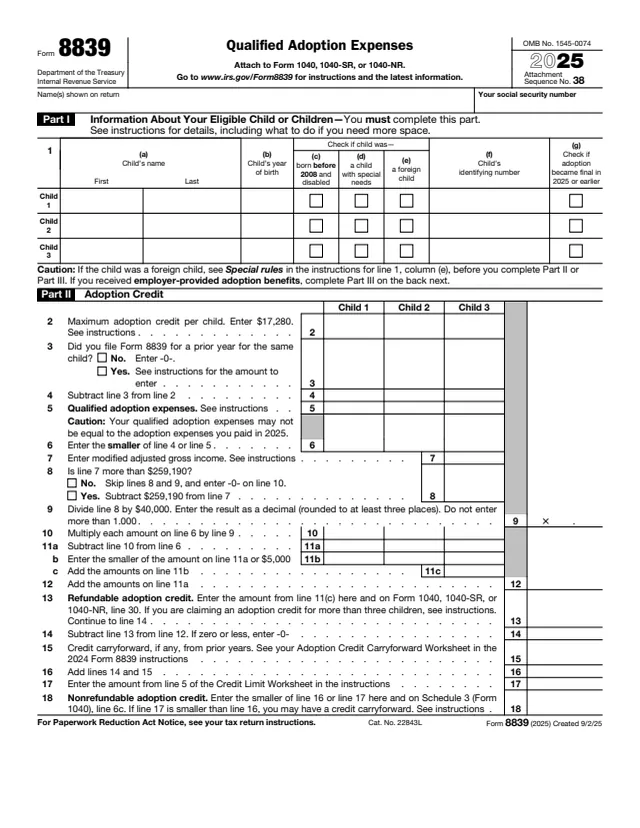
Page 1 of form 8839

Form 8839: Qualified Adoption Expenses

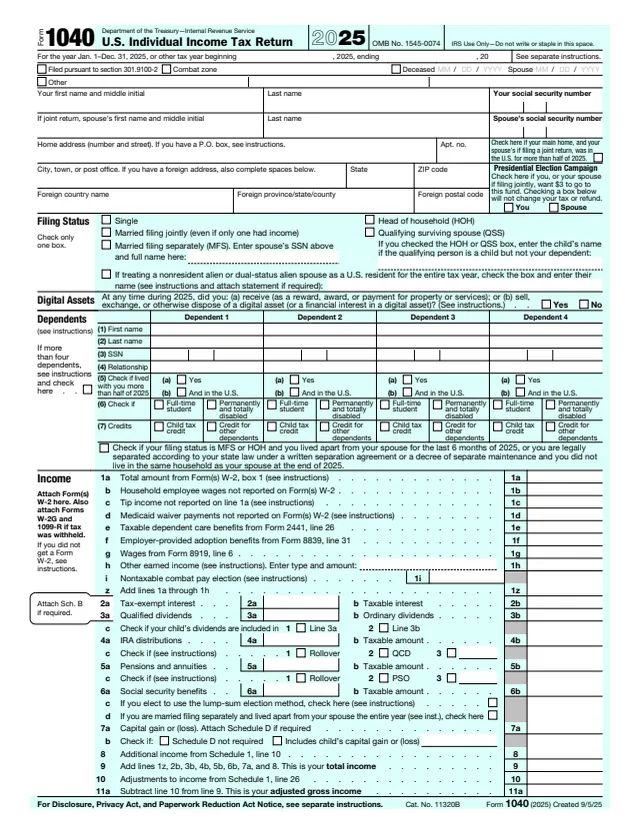
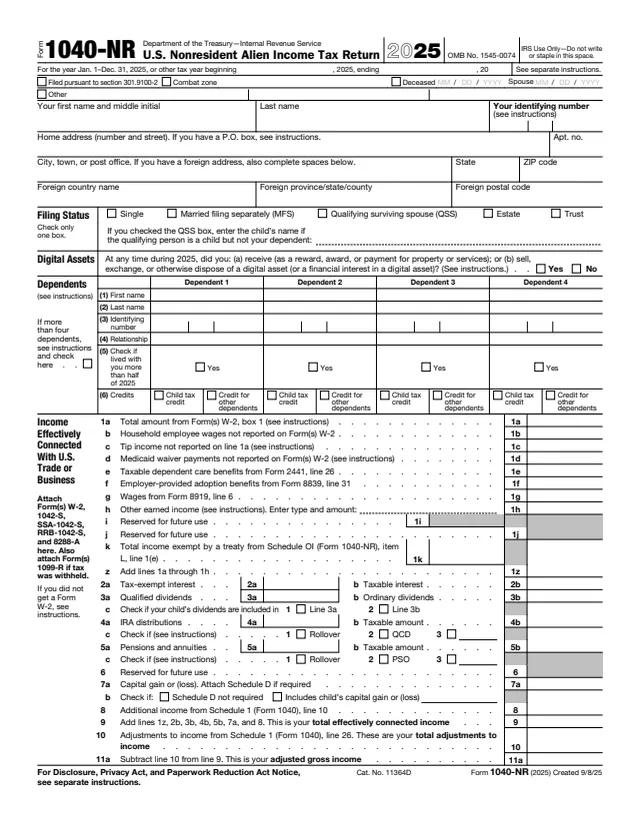
Form 8839 is used to figure the adoption credit and any employer-provided adoption benefits that can be excluded from income. The About page says both the exclusion and the credit can be claimed for expenses of adopting an eligible child, and the instructions add that the same expenses cannot be used for both. The 2025 form is attached to Form 1040, 1040-SR or 1040-NR.

The instructions say the maximum credit and the exclusion are both $17,280 per eligible child in 2025, and that up to $5,000 of the credit may be refundable, figured separately for each child. The amount begins to phase out when modified adjusted gross income is more than $259,190 and is completely phased out at $299,190 or more.

The form has three parts: information about each eligible child, the adoption credit, and employer-provided adoption benefits. This page covers the 2025 form. You can fill out Form 8839 free in your browser on this page and download it without an account.

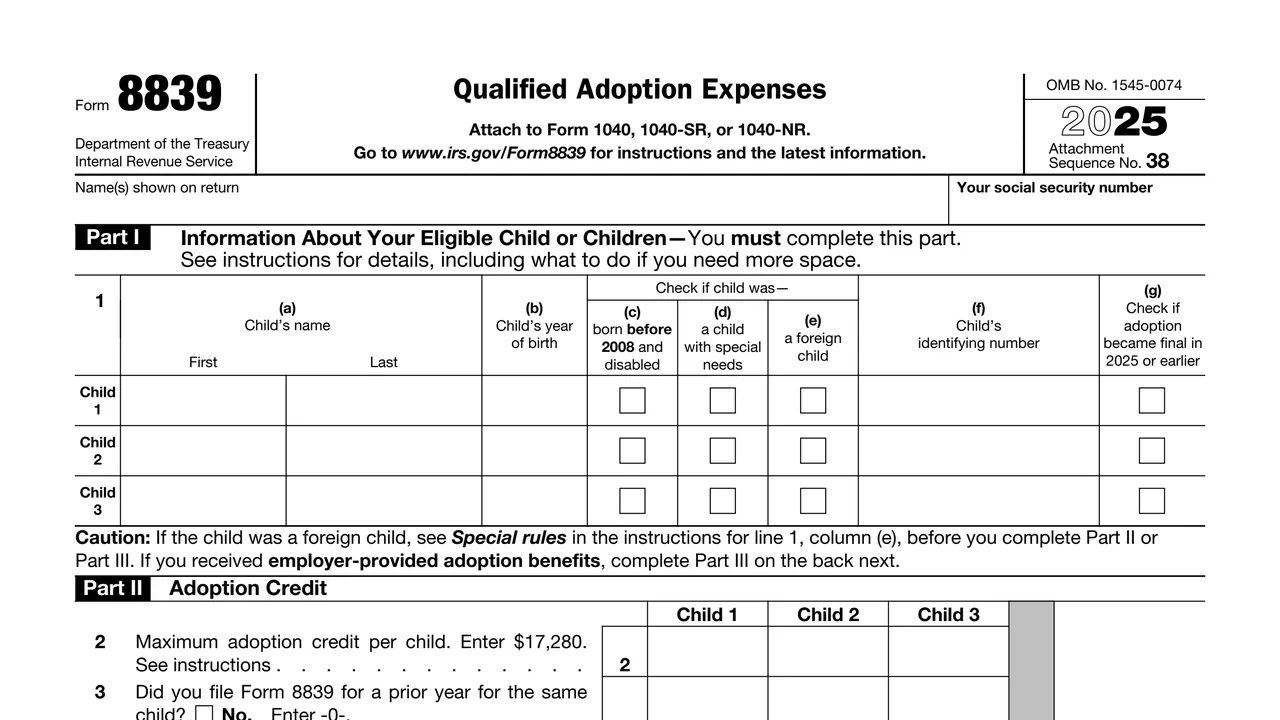
Top of page 1 of Form 8839: Qualified Adoption Expenses, as printed by IRS

What's on Form 8839

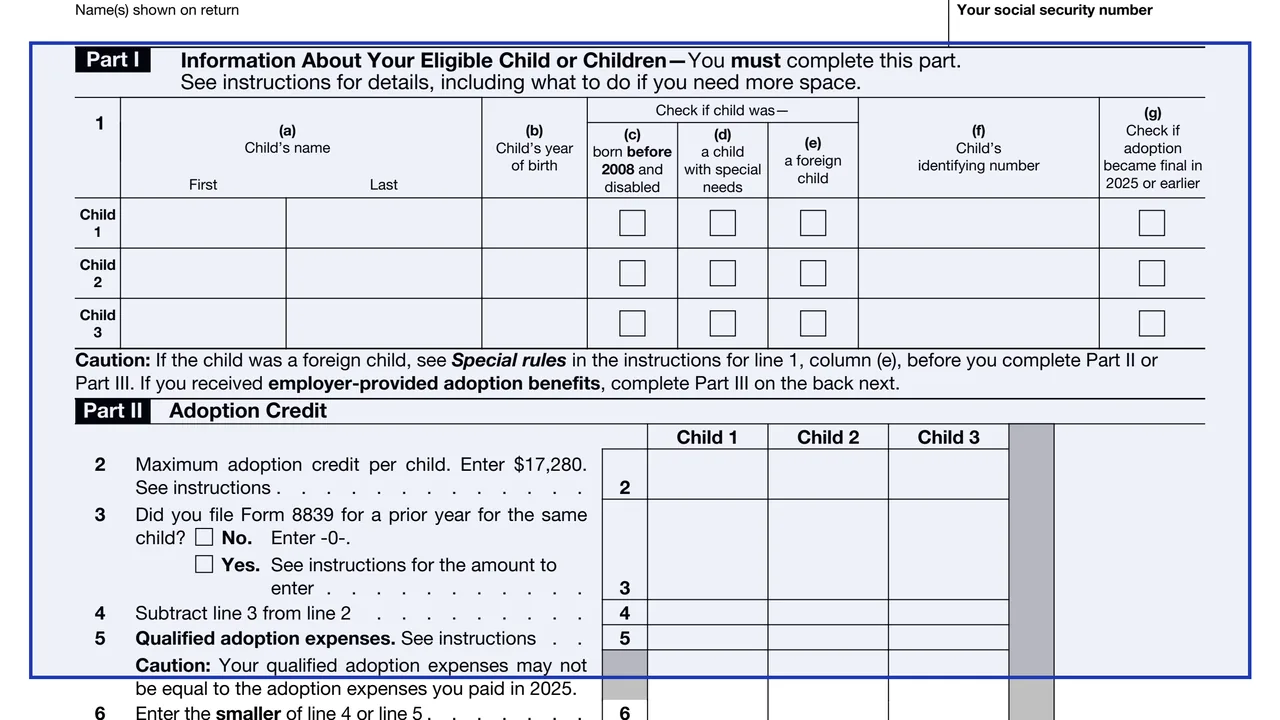
Part I: eligible child information

Line 1 has rows for three children: name, year of birth, boxes for a child born before 2008 and disabled, a child with special needs and a foreign child, the identifying number, and a box for an adoption that became final in 2025 or earlier.
Part II, lines 2 to 6

Per child: the maximum credit of $17,280, amounts from a prior year Form 8839 for the same child, and qualified adoption expenses. Line 6 is the smaller of line 4 or line 5.

Part II, lines 7 to 12

Modified adjusted gross income and the phaseout above $259,190, figured by dividing the excess by $40,000. Lines 11a to 11c figure the refundable part per child, up to $5,000 each.

Part II, lines 13 to 18

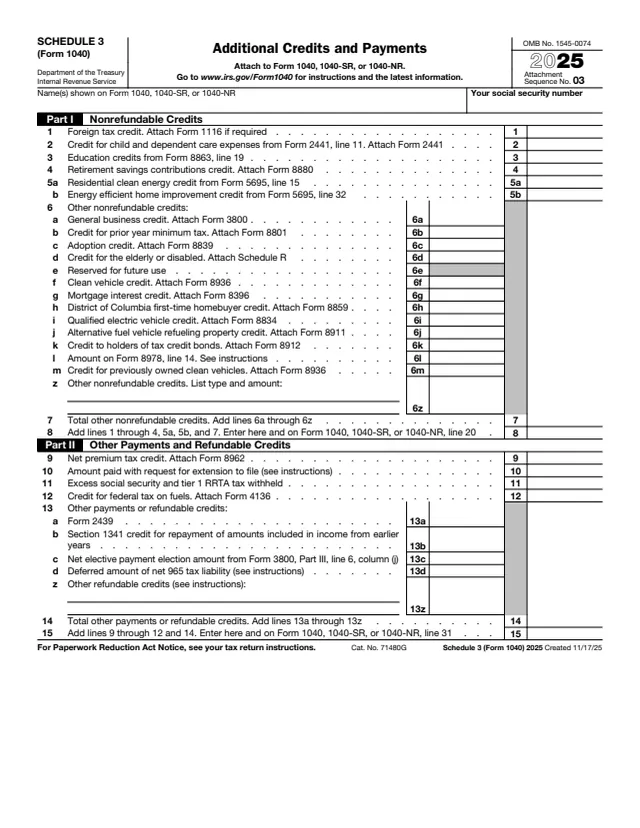
Line 13 is the refundable adoption credit, entered on line 30 of the return. Line 18 is the nonrefundable adoption credit, entered on Schedule 3 (Form 1040), line 6c.

Part III: employer-provided adoption benefits

Lines 19 to 30 figure excluded benefits per child with the same $17,280 maximum and income phaseout. Line 31 shows any taxable benefits, which go on line 1f of Form 1040, 1040-SR or 1040-NR.

How to fill out Form 8839

  1. 1

    Part III first, if it applies

    The instructions say expenses reimbursed by an employer under a written qualified adoption assistance program are not qualified adoption expenses, so Part III is completed before the credit in Part II.

  2. 2

    Line 1

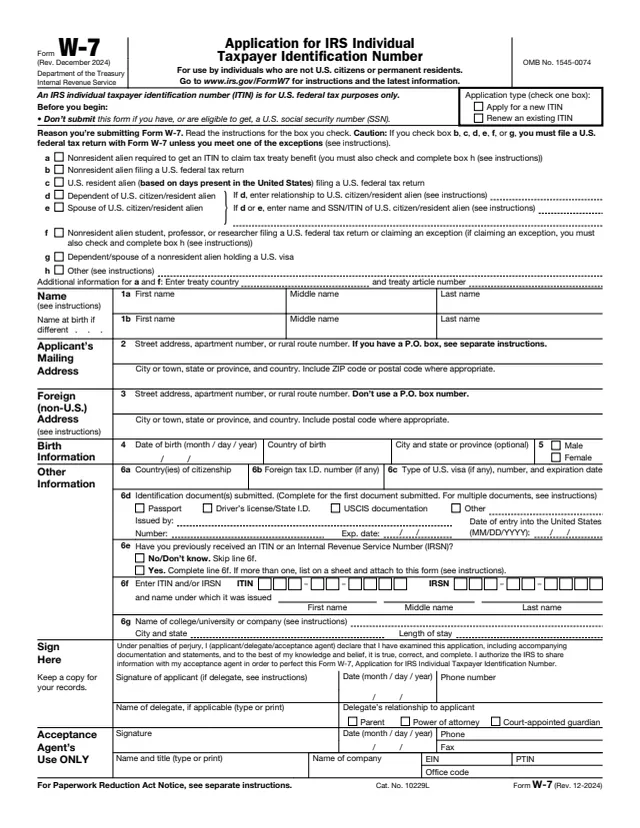
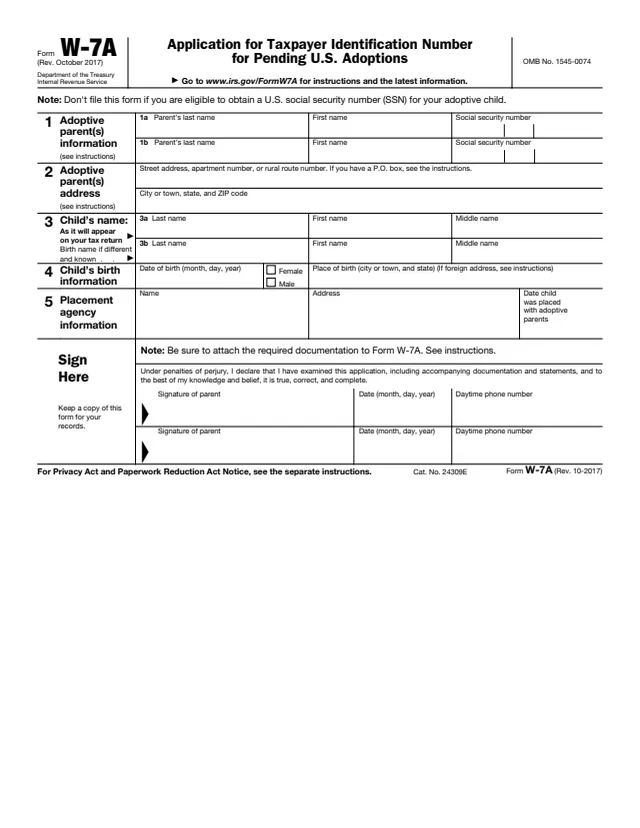
    Fill in the columns that apply to each child. Column (f) takes an SSN, ATIN or ITIN, and the instructions point to Form W-7A for an ATIN and Form W-7 for an ITIN. For more than three children, attach more Forms 8839.

  3. 3

    Lines 2 to 6

    Enter $17,280 on line 2, or an agreed share if another person (other than a joint-filing spouse) also paid expenses for the same child. Line 3 takes the total of lines 3 and 6 of the last Form 8839 filed for that child.

  4. 4

    Lines 7 to 13

    Line 7 is the amount from line 11b of Form 1040, 1040-SR or 1040-NR, increased by any Puerto Rico income exclusion and amounts from Form 2555 and Form 4563 the instructions list. Then figure the phaseout and the refundable part per child.

  5. 5

    Lines 14 to 18

    Enter any carryforward from prior years on line 15. Line 17 comes from the Credit Limit Worksheet in the instructions. If line 17 is smaller than line 16, the instructions give a carryforward worksheet to keep for 2026.

  6. 6

    Lines 19 to 31

    Enter $17,280 on line 19, prior year benefits for the same child on line 20, and 2025 benefits from box 12 code T of Form W-2 on line 22. Line 25 uses the MAGI worksheet in the instructions.

Why fill Form 8839 on indox

You get the real form, filled in a browser tab, with nothing standing between you and the finished PDF.

  • Fill the form right in your browser, no software to install
  • Free to fill and free to download, with no account
  • The official blank straight from the IRS, not a copy someone retyped
  • Works on a phone, tablet or computer

Where it goes, timing and records

Where it goes

The form says to attach it to Form 1040, 1040-SR or 1040-NR. It has attachment sequence number 38.

Amounts it feeds

Line 13 goes to line 30 of the return, line 18 goes to Schedule 3 (Form 1040), line 6c, and taxable benefits from line 31 go on line 1f.

Foreign adoptions

The instructions say the credit or exclusion for a foreign child is not available unless the adoption becomes final, and point to Rev. Proc. 2005-31 and Rev. Proc. 2010-31 for when a foreign adoption is treated as final.

Records

The instructions say to keep evidence of the state's or Indian tribal government's special needs determination, and point to Notice 2010-66 for examples of records that support the credit.

Carryforward

The instructions say an unused nonrefundable credit can be carried forward to the next 5 years or until used, whichever comes first, and cannot become a refundable credit in a later year.

Who uses Form 8839?

  • Adoptive parents claiming the credit

    Part II is for qualified adoption expenses paid for an eligible child. The instructions list adoption fees, attorney fees, court costs, travel expenses while away from home and re-adoption expenses for a foreign child.

  • Employees with adoption benefits

    Part III is for benefits paid under an employer's written qualified adoption assistance program. The form says these benefits should be shown in box 12 of Form W-2 with code T.

  • Parents of a child with special needs

    For a U.S. child with special needs, the instructions say a credit or exclusion may be available even with no qualified adoption expenses, when a state or Indian tribal government made the determination.

  • Married persons not filing jointly

    The instructions say a married taxpayer generally files a joint return to take the credit or exclusion, with an exception for spouses who lived apart during the last 6 months of 2025 and meet the other listed conditions.

  • Taxpayers with a carryforward

    A credit carried forward from prior years goes on line 15. The instructions say any carryforward from 2024 remains a nonrefundable credit.

The taxpayer who adopted or tried to adopt an eligible child completes the form and attaches it to their own Form 1040, 1040-SR or 1040-NR. The instructions describe the cases below.

Official sources and the blank

Do it all with indox

View all 94 tools

Questions about Form 8839

Can the adoption credit and the exclusion both be claimed?

The About page says both can be claimed for expenses of adopting an eligible child. The instructions say the credit and the exclusion cannot be claimed for the same expenses.

How much of the adoption credit is refundable?

The 2025 instructions say up to $5,000 of the credit may be refundable, figured separately for each eligible child. A carryforward from 2024 stays nonrefundable.

What is the 2025 maximum?

The instructions say $17,280 per eligible child for the credit and the same for the exclusion. It begins to phase out above $259,190 of modified adjusted gross income and is completely phased out at $299,190 or more.

What counts as qualified adoption expenses?

The instructions list adoption fees, attorney fees, court costs, travel expenses (including meals and lodging) while away from home, and re-adoption expenses for a foreign child. They exclude, among others, surrogate parenting costs and the adoption of a spouse's child.

What if an adoption was not successful?

For a U.S. child, the instructions say a credit may be allowable for an attempted or unsuccessful adoption, treated like expenses for an adoption not final by the end of the year. For a foreign child, the credit or exclusion is available only once the adoption becomes final.

What if the child has no SSN yet?

The instructions point to Form W-7A for an ATIN when a U.S. citizen or resident alien child cannot get an SSN in time, and to Form W-7 for an ITIN when the child is not. For an adoption that was unsuccessful or not yet final, entries that cannot be completed, such as column (f), are left blank.