Header
Name and the date the bonds were cashed.
8818
Optional Form To Record Redemption of Series EE and I U.S. Savings Bonds Issued After 1989
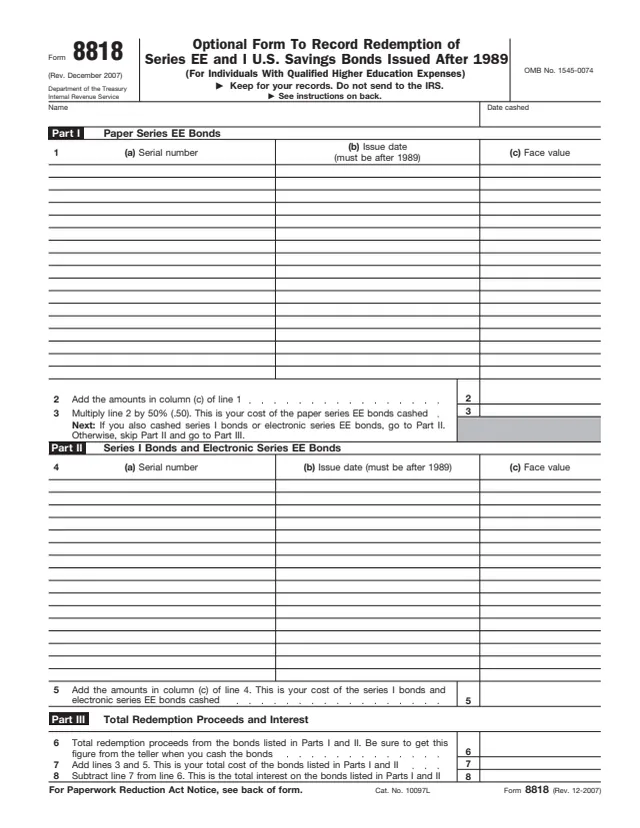
Form 8818, Optional Form To Record Redemption of Series EE and I U.S. Savings Bonds Issued After 1989, is a worksheet for individuals with qualified higher education expenses. The About page says it is used to keep a record of the post-1989 series EE and I bonds cashed, and that the information is needed to complete Form 8815, Exclusion of Interest From Series EE and I U.S. Savings Bonds Issued After 1989.
The form lists paper series EE bonds in Part I, series I bonds and electronic series EE bonds in Part II, and works out the total redemption proceeds, cost and interest in Part III. The form says "Keep for your records. Do not send to the IRS." Its Paperwork Reduction Act Notice says use of the form is optional, and the instructions are printed on page 2.
You can fill out Form 8818 free in your browser on this page and download it without an account.
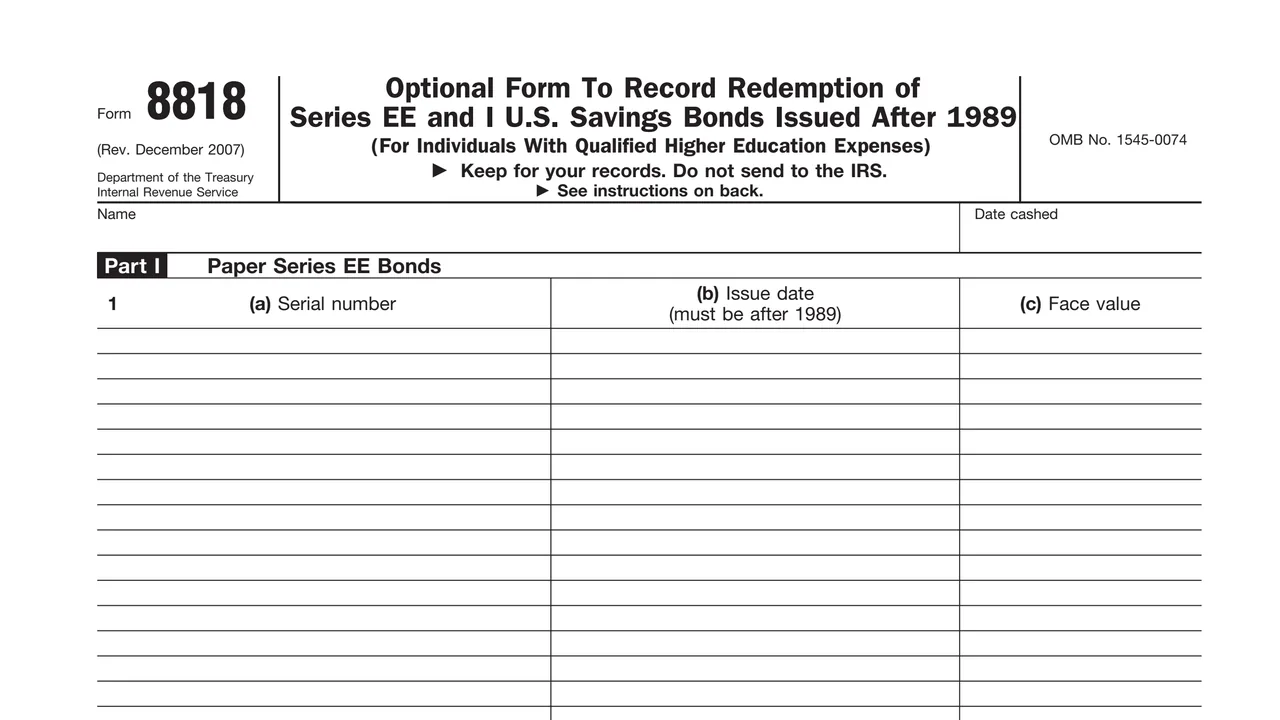
Name and the date the bonds were cashed.
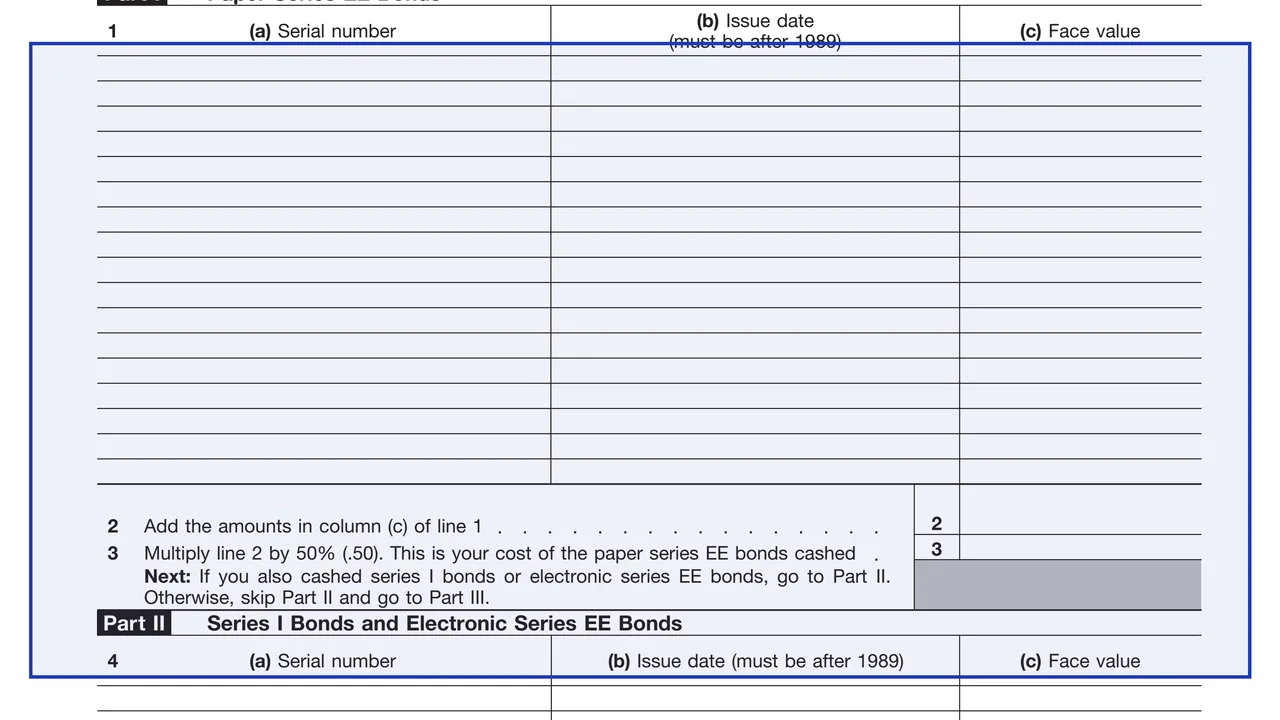
Line 1 lists each bond's serial number, issue date (must be after 1989) and face value. Line 2 adds the face values and line 3 takes 50% of that as the cost.
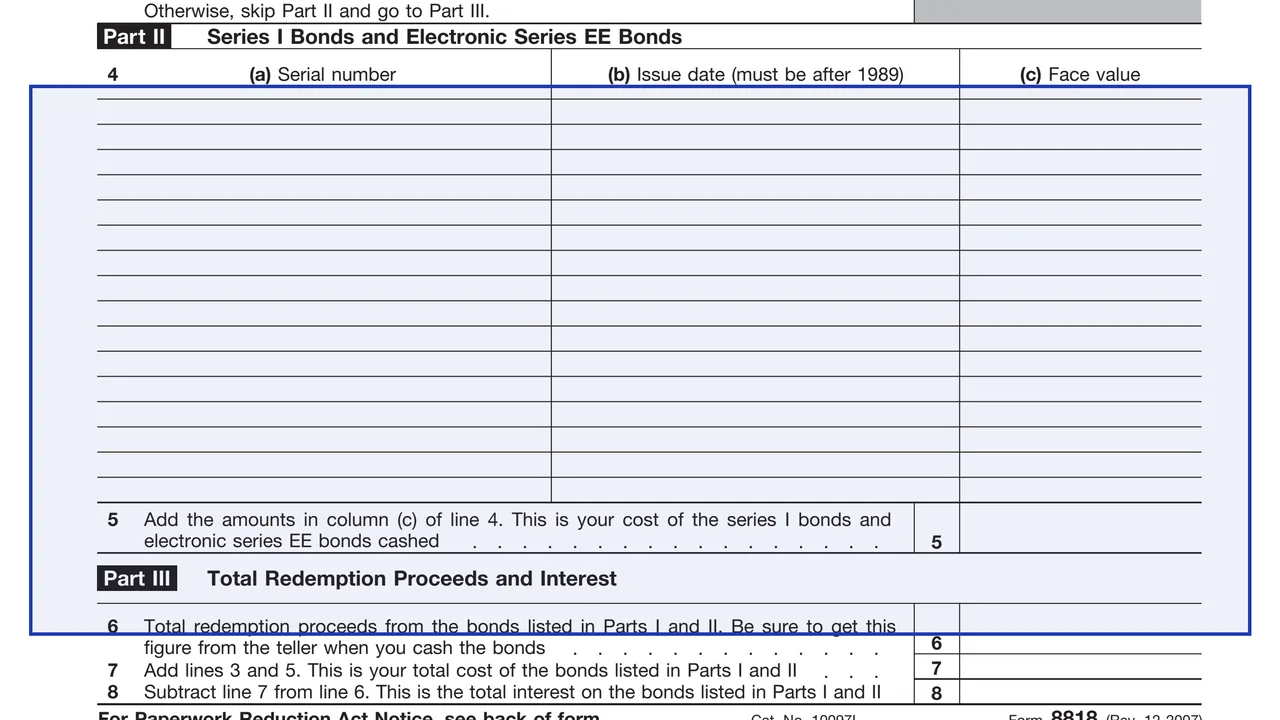
Line 4 lists each bond's serial number, issue date and face value, and line 5 adds the face values as the cost.
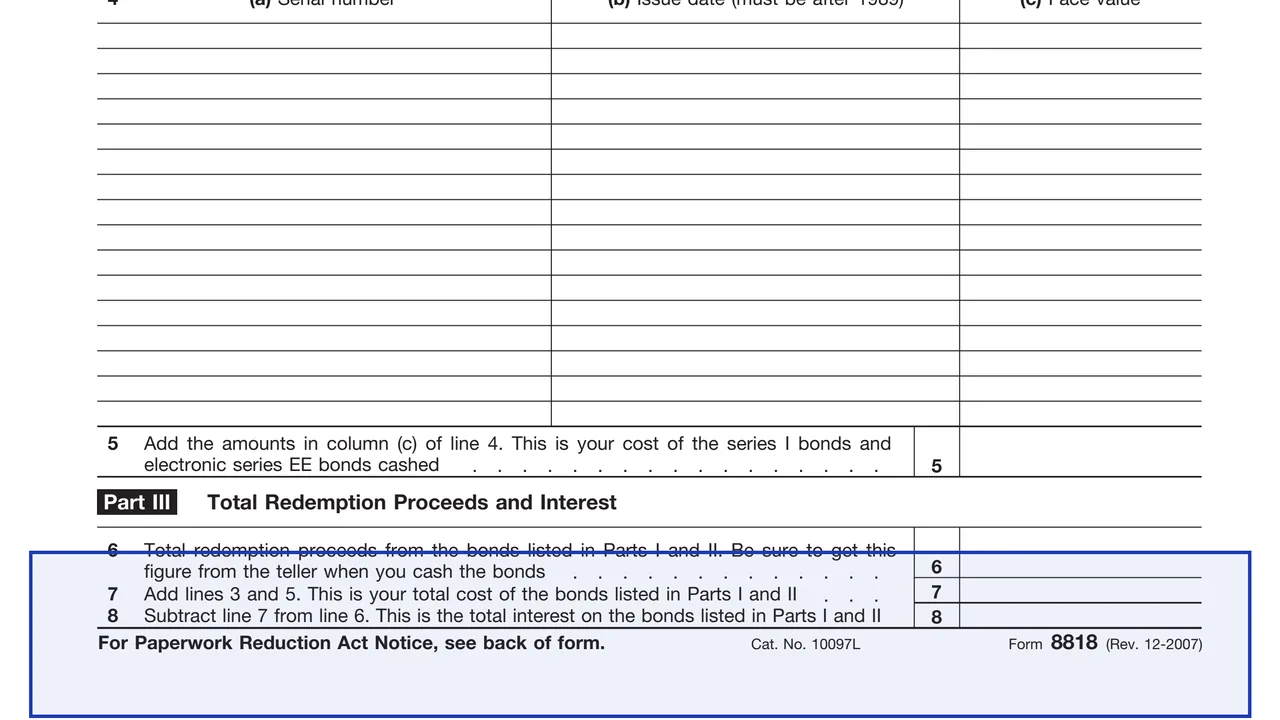
Line 6 total redemption proceeds, line 7 total cost of the bonds, and line 8 total interest.
Purpose of form, which bonds qualify for the exclusion, what counts as qualified higher education expenses, and line instructions.
The instructions say to separate series EE bonds issued after 1989 from those issued before 1990. Enter the name and the date cashed.
For each paper series EE bond issued after 1989, enter the serial number, issue date and face value. Add column (c) on line 2 and multiply by 50% (.50) on line 3.
List each series I bond and electronic series EE bond issued after 1989, including post-1989 EE bonds converted from paper to electronic. Add column (c) on line 5.
Enter the total redemption proceeds from the bonds in Parts I and II. The form says to get this figure from the teller when the bonds are cashed.
Add lines 3 and 5 for the total cost, then subtract line 7 from line 6 for the total interest. The form points to Form 8815 for whether this interest may be excluded.
The form says to use a separate Form 8818 each time series EE or series I bonds issued after 1989 are cashed.
You get the real form, filled in a browser tab, with nothing standing between you and the finished PDF.
The form says "Keep for your records. Do not send to the IRS."
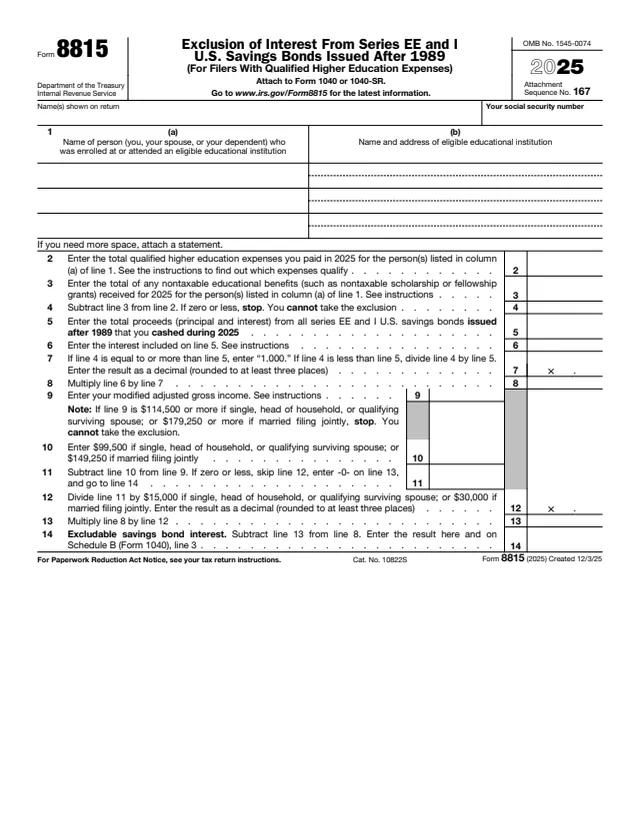
The information on Form 8818 is needed to complete Form 8815, which figures the interest that can be excluded from income on the income tax return.
The form says use of it is optional. Someone who does not use it but intends to exclude the interest should keep records with the same information, according to page 2.
The form notes that interest on U.S. savings bonds is exempt from state and local income taxes.
For limits on the amount that may be excluded, the form points to Pub. 550, Investment Income and Expenses, or Pub. 970, Tax Benefits for Education.
The form is for individuals and is kept with their own records. Nobody files it with the IRS.
No tool matches that search.
No. The form says to keep it for your records and not to send it to the IRS.
No. The form says its use is optional. Anyone who skips it but plans to exclude the interest should keep records with the information it asks for.
The form says they include tuition and fees, but not room and board, required for enrollment or attendance at a college, university or vocational school, plus contributions to a qualified tuition program or a Coverdell education savings account.
Line 3 says to multiply the face value total on line 2 by 50% (.50), and calls the result the cost of the paper series EE bonds cashed.
The form says to get this figure from the teller when you cash the bonds.
The form says a bond bought by a parent and issued in the name of a child under age 24 will not qualify for the exclusion by the parent or the child.