Header
The name of issuer line and a box to check if this endorsement supersedes a prior Roth IRA endorsement.
5305-RB
Roth Individual Retirement Annuity Endorsement
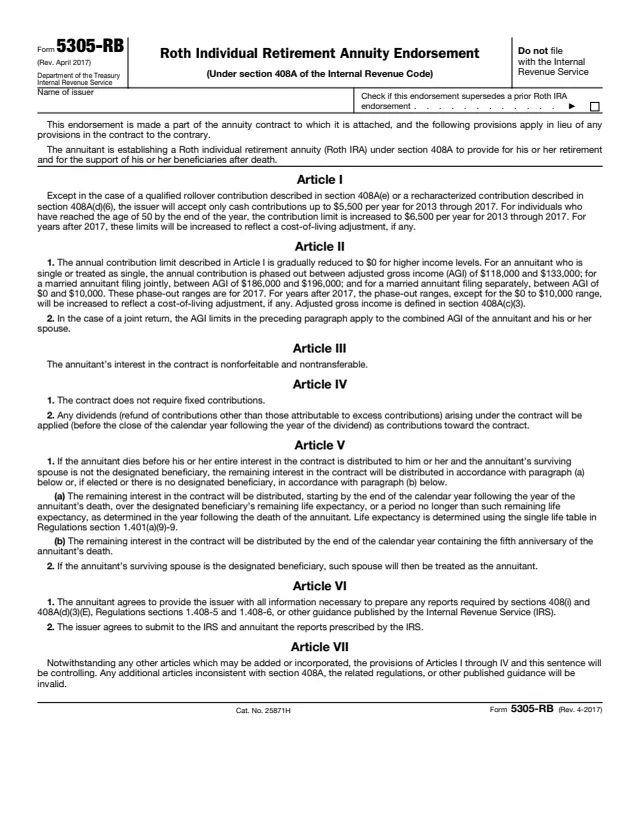
Form 5305-RB is a model annuity endorsement that, in the words of its instructions, meets the requirements of section 408A of the Internal Revenue Code. The form says the endorsement is made a part of the annuity contract to which it is attached, and its provisions apply in place of any provisions in the contract to the contrary. The issuer is the insurance company providing the annuity contract, and the annuitant is the person who establishes it.
The instructions say a Roth individual retirement annuity (Roth IRA) is established after the contract, which includes this endorsement, is fully executed by both the annuitant and the issuer. Only Articles I through VIII have been reviewed by the IRS. Article IX is open space for additional provisions the annuitant and the issuer agree to.
The form is not filed with the IRS. It says "Do not file Form 5305-RB with the IRS. Instead, keep it with your records." This is the April 2017 revision, so the dollar limits it prints are for 2013 through 2017. You can fill it out free in your browser on this page and download the result without an account.
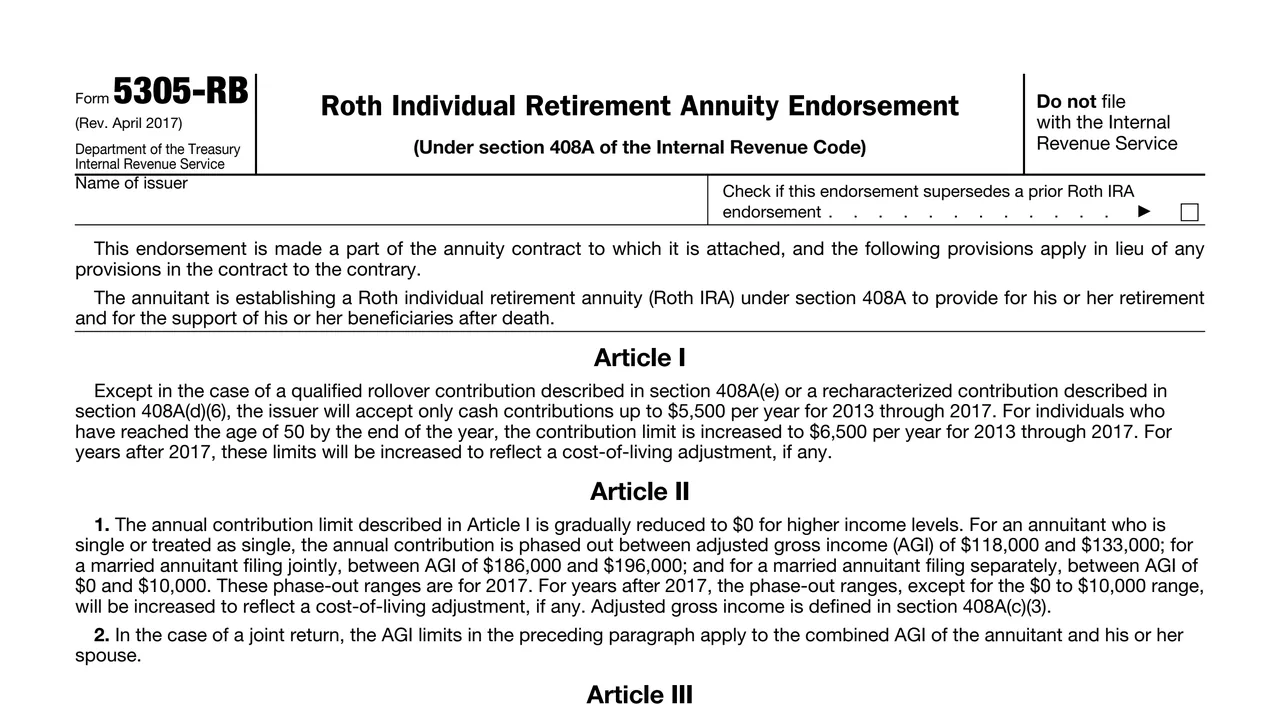
The name of issuer line and a box to check if this endorsement supersedes a prior Roth IRA endorsement.
Article I limits the issuer to cash contributions, apart from qualified rollover and recharacterized contributions. Article II phases the annual limit down to $0 at higher adjusted gross income (AGI).
Article III says the annuitant's interest is nonforfeitable and nontransferable. Article IV says the contract does not require fixed contributions and explains how dividends are applied.
Rules for distributing the remaining interest over the designated beneficiary's life expectancy or by the end of the year containing the fifth anniversary of the annuitant's death.
Article VI covers the information the annuitant provides and the reports the issuer submits. Article VII says which articles control. Article VIII covers amendments.
Open space on page 2 for any additional provisions. The form says to draw a line through it if no other provisions will be added.
Enter the name of the insurance company providing the annuity contract on the line at the top of page 1.
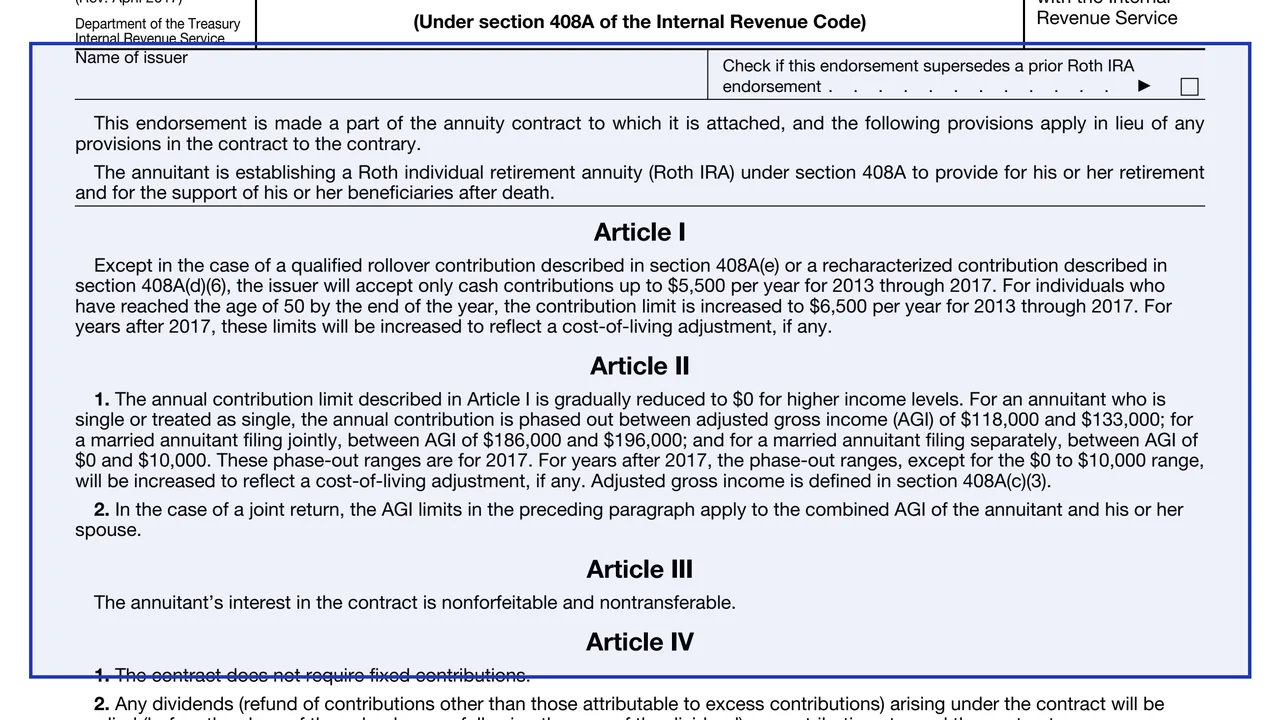
Check the box only if this endorsement supersedes a prior Roth IRA endorsement. Otherwise leave it empty.
The instructions say elections made under Article V should be reviewed periodically to make sure they match the annuitant's intent.
Add any agreed provisions, such as definitions, investment powers, voting rights, the issuer's fees or state law requirements, and attach pages if needed. If none, draw a line through the space.
The instructions say the Roth IRA is established once the contract, including this endorsement, is fully executed by both the annuitant and the issuer. Then keep it with your records.
You get the real form, filled in a browser tab, with nothing standing between you and the finished PDF.
Nowhere. The form says "Do not file Form 5305-RB with the IRS. Instead, keep it with your records." It stays attached to the annuity contract.
The instructions say that to make a regular contribution to a Roth IRA for a year, the IRA must be established no later than the due date (excluding extensions) of the individual's income tax return for the year.
Article I lists $5,500 per year for 2013 through 2017, or $6,500 for those who reached age 50 by the end of the year. The form says later years are adjusted for cost of living, if any.
The instructions say the annuitant may be subject to a 6% tax on excess contributions, for example when AGI exceeds the Article II limits for the tax year.
Provisions added in Article IX have to comply with state law and the Internal Revenue Code, and the form says they may not imply that the IRS reviewed or pre-approved them.
5305-R
9 fields, 2 pages
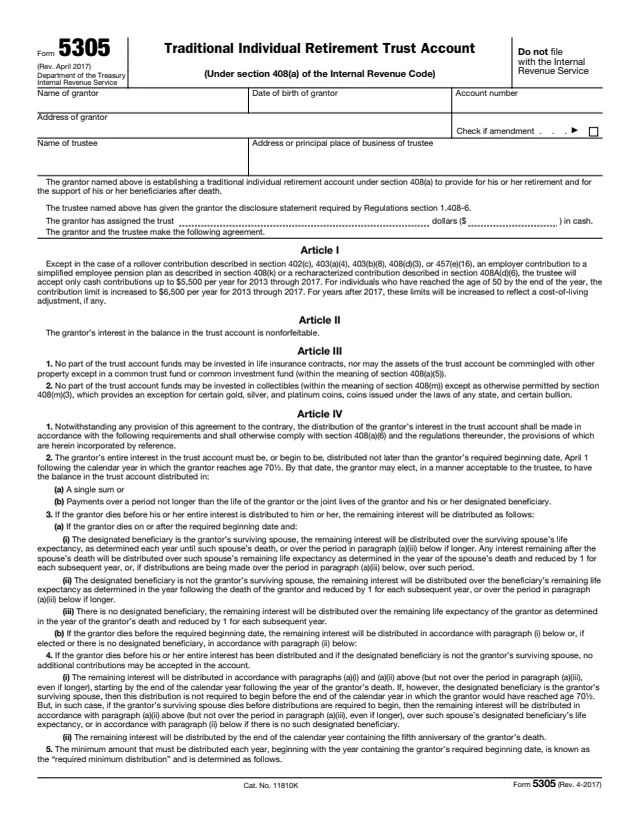
5305
10 fields, 2 pages
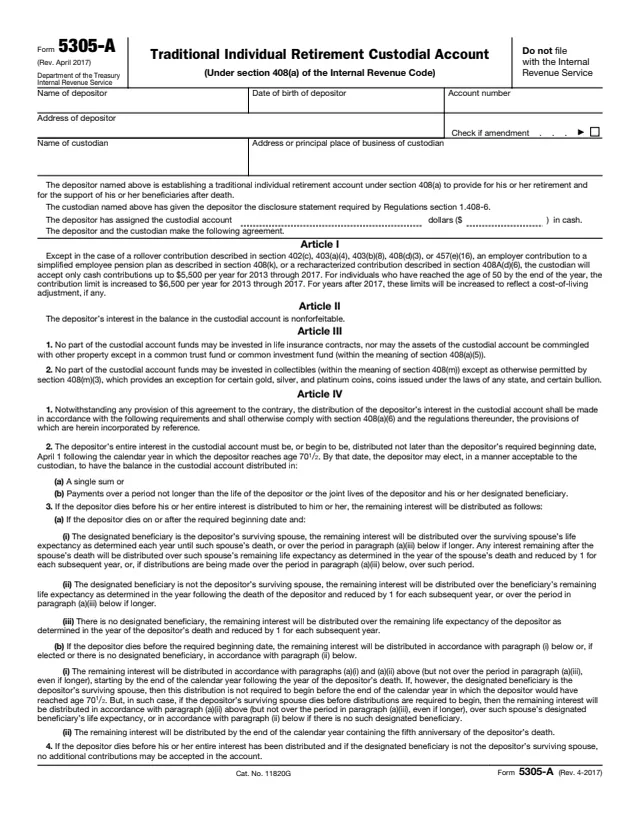
5305-A
10 fields, 2 pages
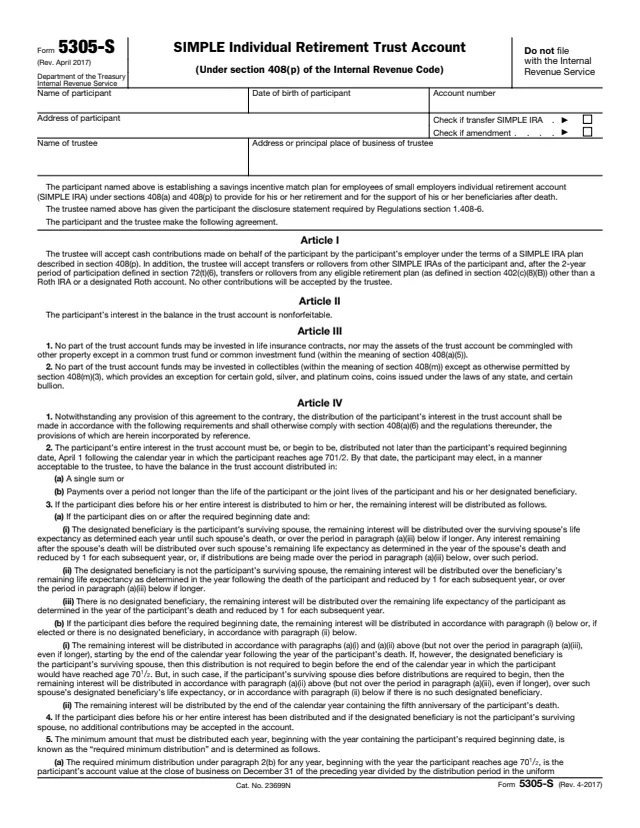
5305-S
9 fields, 2 pages
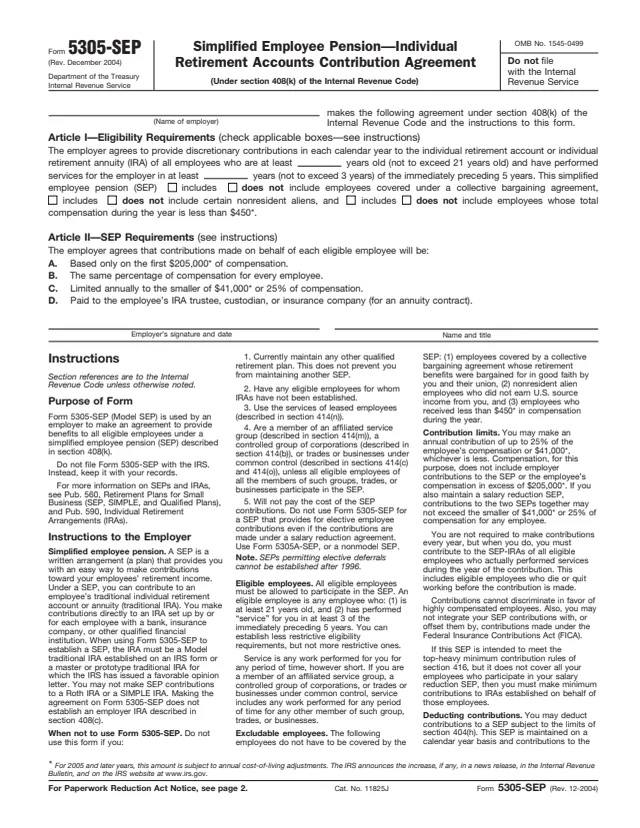
5305-SEP
7 fields, 2 pages
The form is an agreement between an insurance company and the person buying the annuity. Nobody sends it to the IRS.
No tool matches that search.
No. The form says "Do not file Form 5305-RB with the IRS. Instead, keep it with your records."
The issuer, which the instructions define as the insurance company providing the annuity contract, attaches it to the contract. The Roth IRA is established once both the annuitant and the issuer fully execute the contract.
The instructions say only Articles I through VIII have been reviewed by the IRS. Article IX holds any additional provisions.
The April 2017 revision lists $5,500 per year for 2013 through 2017, or $6,500 for those who reached age 50 by the end of the year, with cost-of-living adjustments, if any, for later years.
Article I says that apart from a qualified rollover contribution under section 408A(e) or a recharacterized contribution under section 408A(d)(6), the issuer accepts only cash contributions.
Article V says a surviving spouse who is the designated beneficiary is treated as the annuitant. Otherwise the interest is paid over the beneficiary's life expectancy or by the end of the year containing the fifth anniversary of the death.