Header
Name(s) shown on Form 1040 or 1040-SR and your social security number.
5074
Allocation of Individual Income Tax to Guam or the Commonwealth of the Northern Mariana Islands (CNMI)
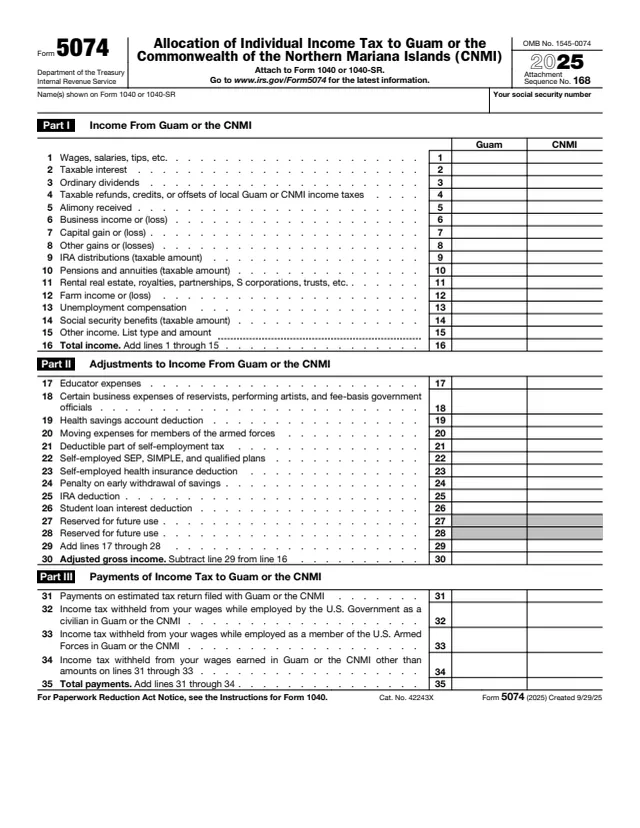
Form 5074 is the Allocation of Individual Income Tax to Guam or the Commonwealth of the Northern Mariana Islands (CNMI). The instructions say the United States and Guam or the CNMI use it to figure the individual income tax that is due to Guam or the CNMI.
The IRS About page says U.S. citizens and resident aliens with income from sources within Guam or the CNMI may need to file it with their United States income tax return. The form lists income from Guam or the CNMI, adjustments to that income and income tax paid to Guam or the CNMI. Part I splits the income into a Guam column and a CNMI column.
It is attached to Form 1040 or 1040-SR, and its instructions are printed on pages 3 and 4 of the PDF. This page covers the 2025 form. You can fill out Form 5074 free in your browser on this page and download the result without an account.
Name(s) shown on Form 1040 or 1040-SR and your social security number.
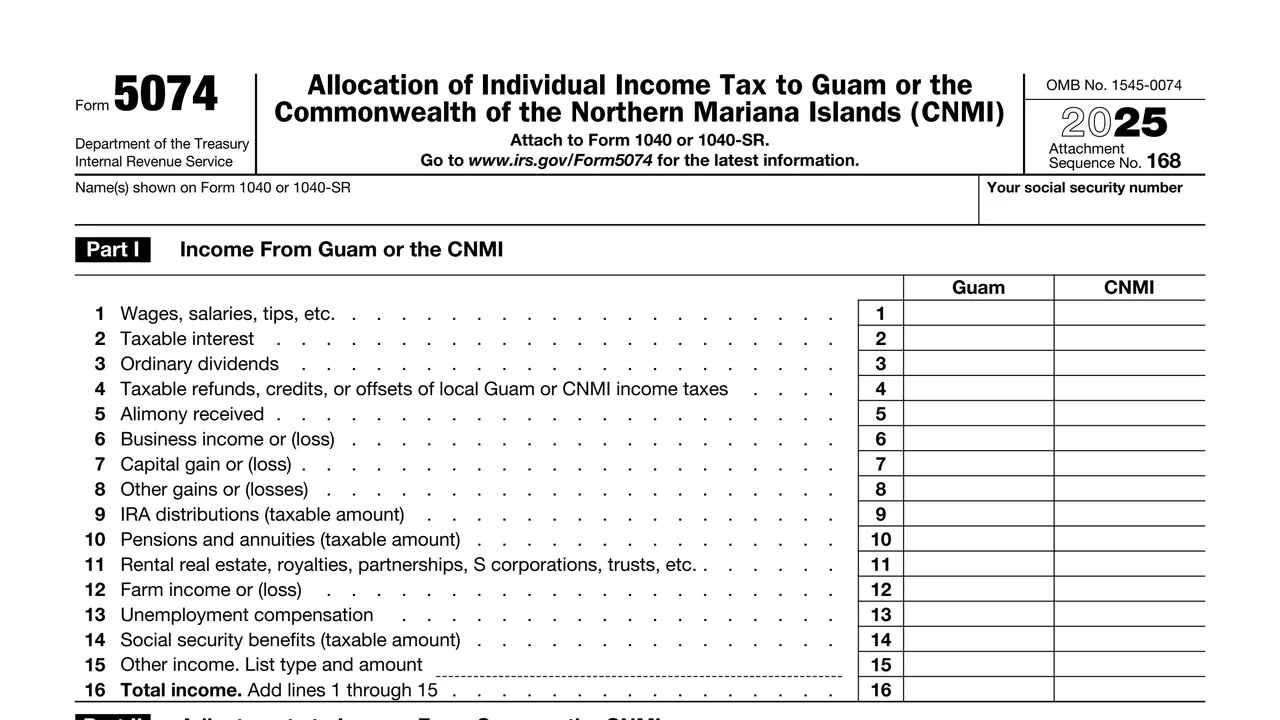
Lines 1 through 16 in a Guam column and a CNMI column: wages, interest, dividends, local tax refunds, alimony, business, capital and other gains, IRA, pension, rental, farm, unemployment, social security and other income.
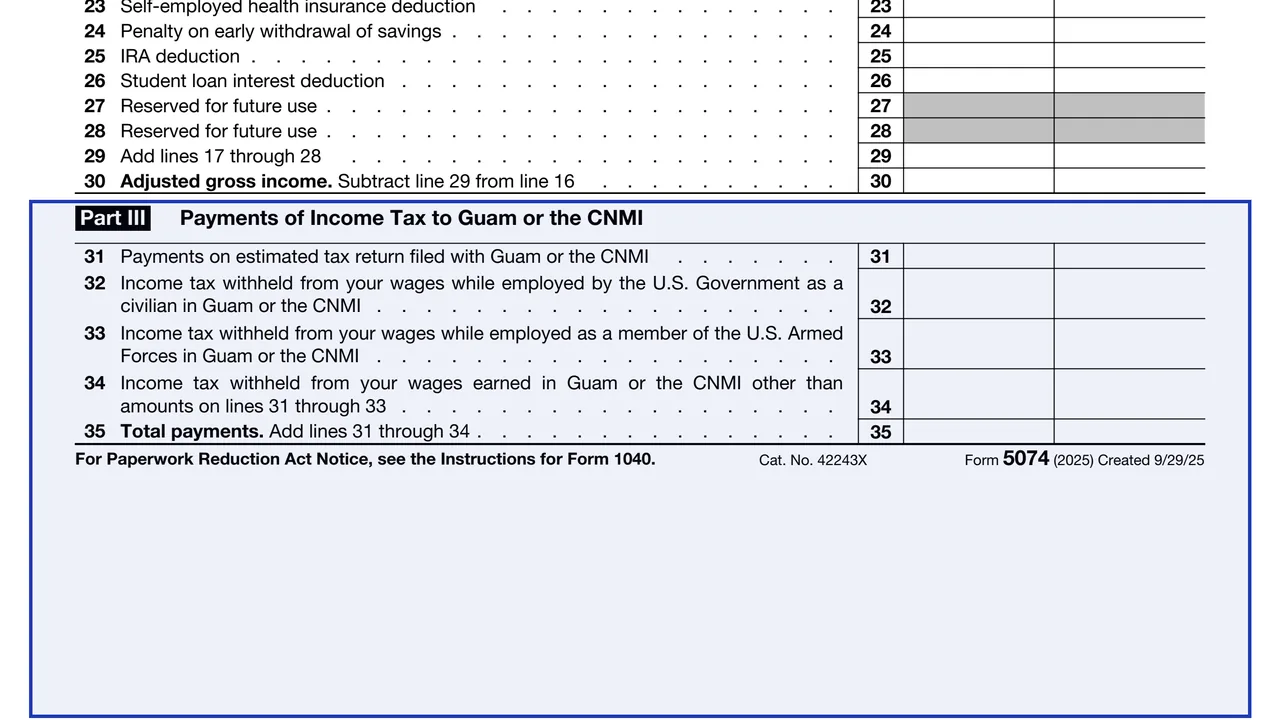
Lines 17 through 29 for adjustments such as educator expenses, the HSA deduction, self-employment items, the IRA deduction and student loan interest. Line 30 is adjusted gross income.
Lines 31 through 35 for estimated tax paid to Guam or the CNMI and income tax withheld from wages as a U.S. Government civilian, an Armed Forces member or another employee there.
Who files, where to file, amended returns, source of income rules, the de minimis exception and line notes for Part II.
Enter the name or names exactly as shown on Form 1040 or 1040-SR, and your social security number.
Enter only income from Guam or CNMI sources in the matching column. The instructions say wages are generally sourced where the work is done, interest where the payer is located, dividends where the paying corporation is organized and real property gains where the property is.
Line 15 lists the type and amount of other income. The instructions point to Schedule 1 (Form 1040), Part I, for Guam or CNMI income not on page 1 of the return. Add lines 1 through 15 on line 16.
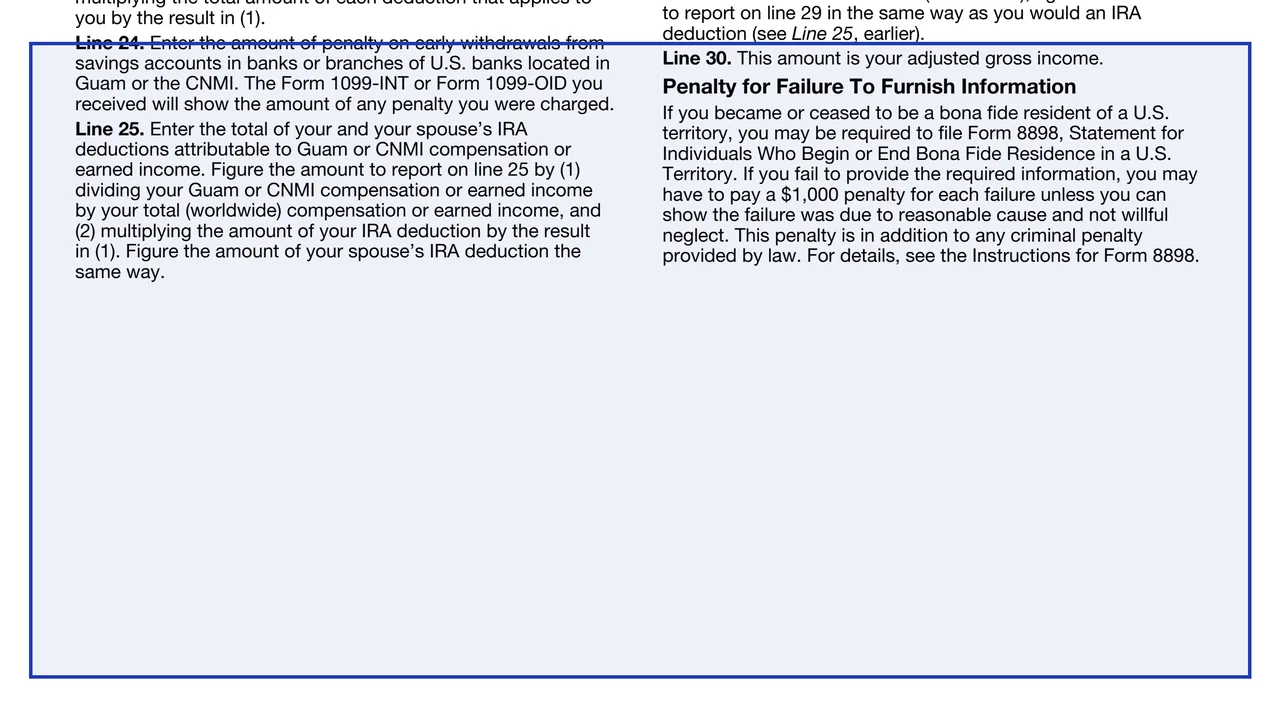
For lines 21 to 23 and line 25, the instructions say to divide your Guam or CNMI self-employment or earned income by your worldwide amount and multiply each deduction by the result. Name other deductions on the dotted line next to line 29.
Subtract line 29 from line 16. The instructions say this amount is your adjusted gross income.
Enter estimated tax paid with a Guam or CNMI return and income tax withheld from wages on lines 31 through 34, then add them on line 35. Attach the form to Form 1040 or 1040-SR.
You get the real form, filled in a browser tab, with nothing standing between you and the finished PDF.
The form says to attach it to Form 1040 or 1040-SR.
The instructions send you to www.irs.gov/Filing/Where-To-File-Your-Taxes-for-Form-5074 for the filing address.
The instructions say Form 1040-X can be e-filed using tax filing software, or a paper Form 1040-X can be sent to the address in the Instructions for Form 1040-X.
If you became or ceased to be a bona fide resident of a U.S. territory, the instructions say Form 8898 may be required, with a $1,000 penalty for each failure unless due to reasonable cause and not willful neglect.
The instructions point to Pub. 570, Tax Guide for Individuals With Income From U.S. Territories, for source rules and military details.
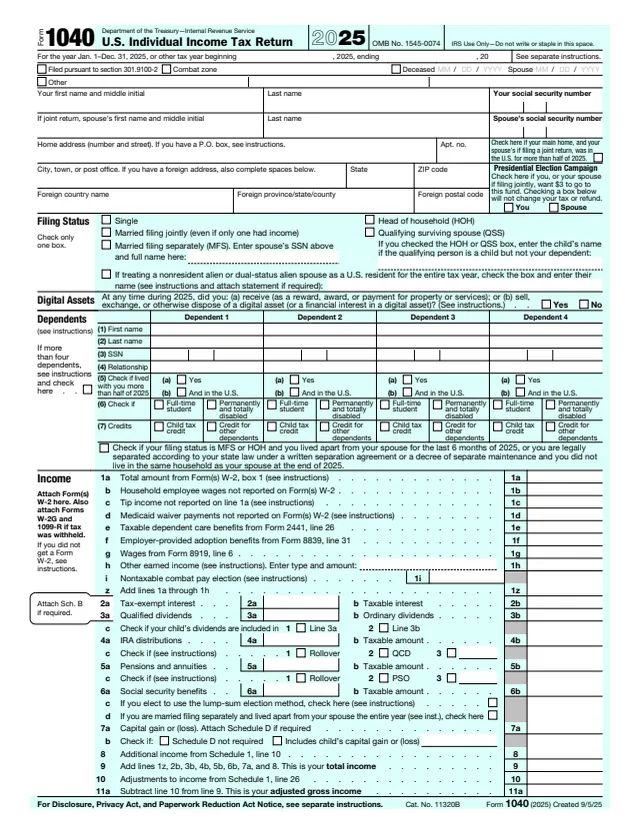
1040
199 fields, 2 pages
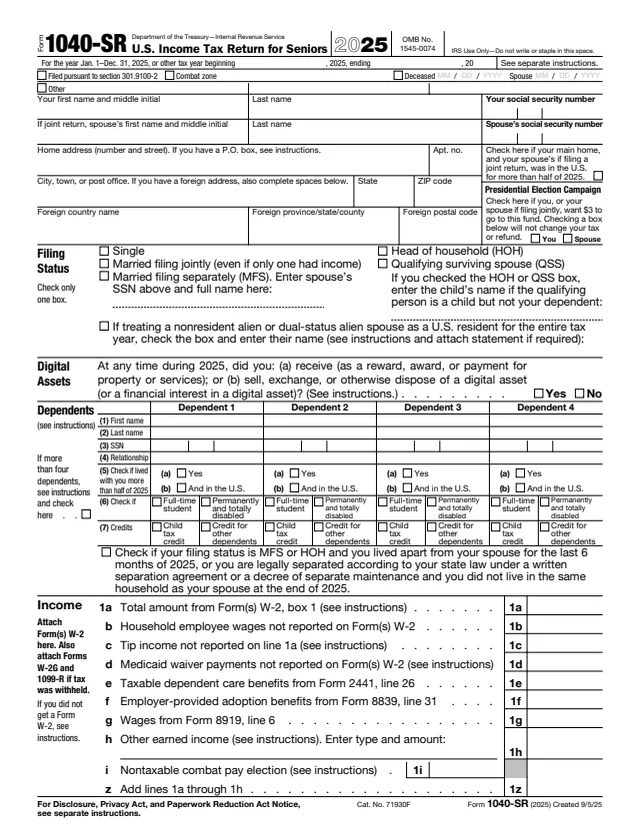
1040-SR
200 fields, 4 pages
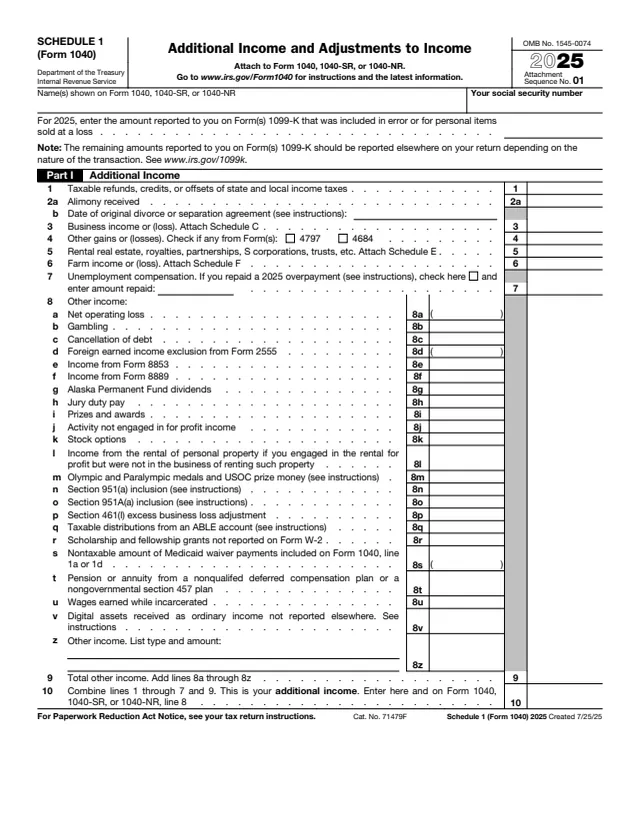
1040
73 fields, 2 pages
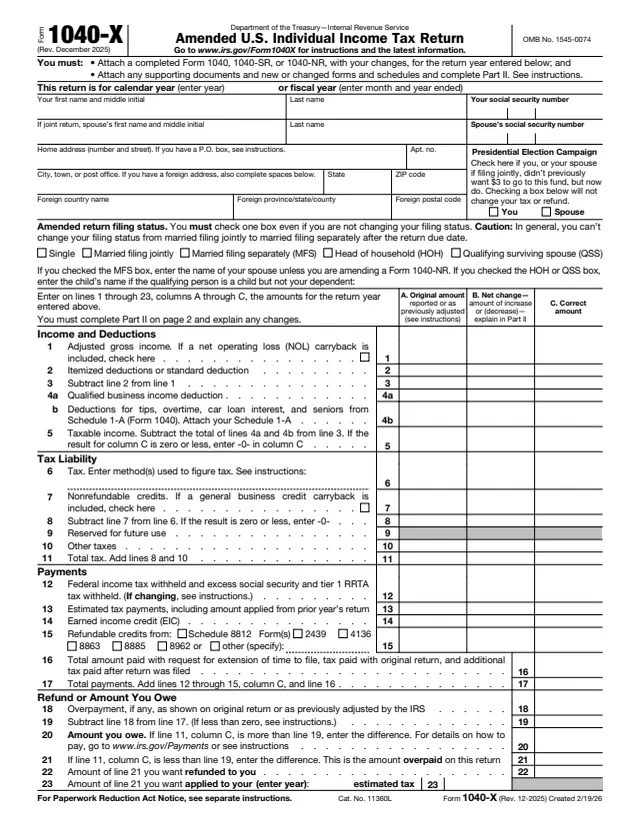
1040-X
166 fields, 2 pages
8898
99 fields, 2 pages
1099-INT
127 fields, 7 pages
An individual completes Form 5074 and attaches it to their own Form 1040 or 1040-SR. The instructions list who files it and special rules for joint filers, military families and short stays.
No tool matches that search.
The instructions say a U.S. citizen or resident alien, other than a bona fide resident of Guam or the CNMI, completes it when they file a U.S. return, report AGI of $50,000 or more, and have at least $5,000 of gross income from Guam or CNMI sources.
The instructions say the United States and Guam or the CNMI use it to figure the individual income tax that is due to Guam or the CNMI.
The instructions say Guam or CNMI income generally excludes pay for services performed there temporarily for 90 days or less and totaling $3,000 or less, for someone who meets the listed conditions.
The instructions say that, except as provided in regulations, income from sources within the United States or effectively connected with a U.S. trade or business is not income from Guam or the CNMI.
It is attached to Form 1040 or 1040-SR. For the filing address, the instructions point to www.irs.gov/Filing/Where-To-File-Your-Taxes-for-Form-5074.
The instructions say a bona fide resident of Guam or the CNMI stationed outside their territory has military pay sourced in that territory under the Servicemembers Civil Relief Act. A nonresident serving there does not have military pay sourced there.