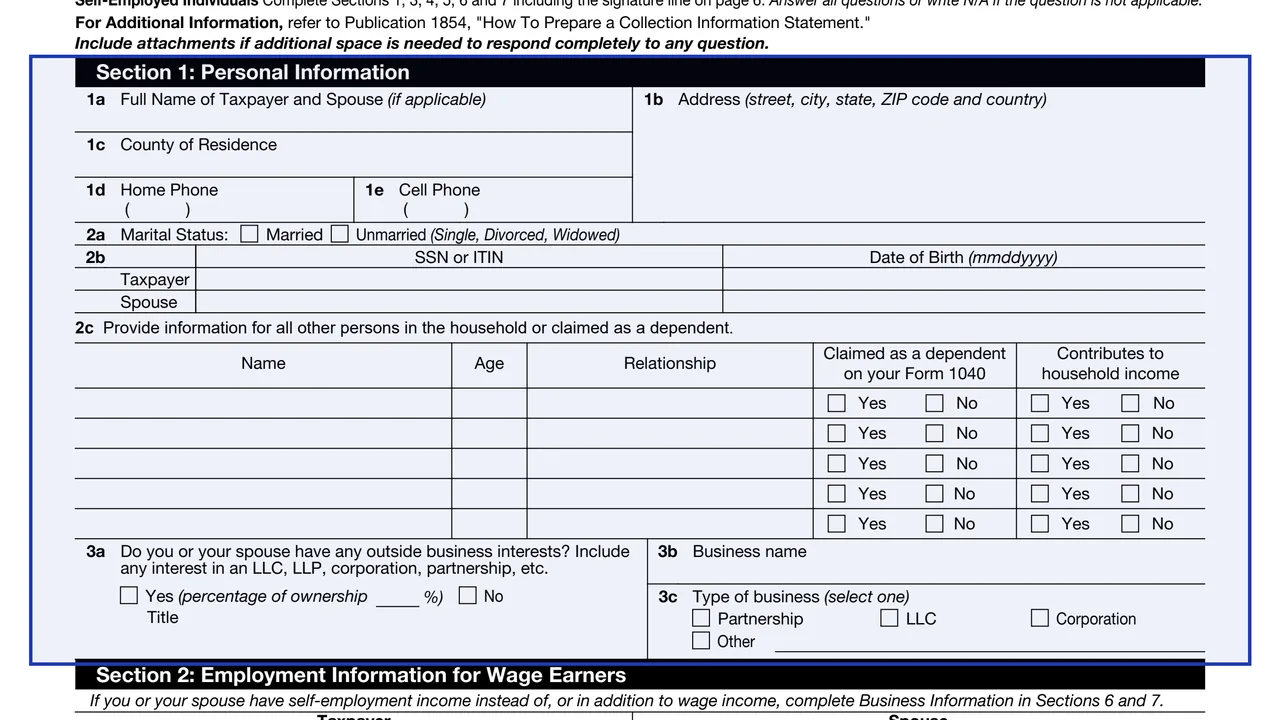
Section 1: personal information
Names, address, county, phone numbers, marital status, SSN or ITIN, dates of birth, other household members and dependents, and any outside business interests.
433-A
Collection Information Statement for Wage Earners and Self-Employed Individuals
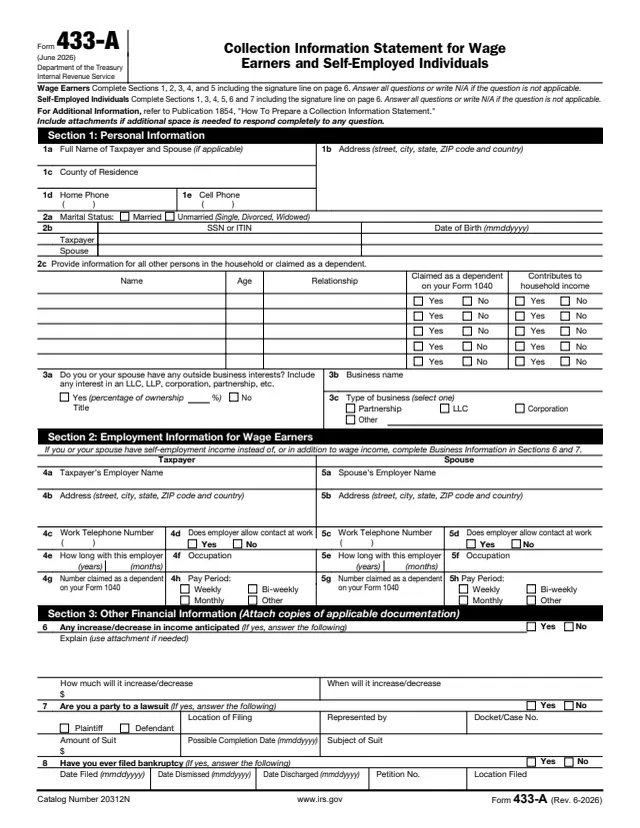
Form 433-A, Collection Information Statement for Wage Earners and Self-Employed Individuals, gives the IRS a picture of an individual's household, employment, assets, debts and monthly income and expenses. The form has no separate instructions. It points to Publication 1854, "How To Prepare a Collection Information Statement," for more information.
The form says wage earners complete Sections 1, 2, 3, 4 and 5 and self-employed individuals complete Sections 1, 3, 4, 5, 6 and 7, both including the signature line on page 6. Every question is answered, or marked N/A if it is not applicable. Business entities other than a sole proprietorship are directed to Form 433-B.
After the IRS reviews the completed form, it says you may be asked to verify the assets, encumbrances, income and expenses reported. This page covers the June 2026 revision (Rev. 6-2026). You can fill out Form 433-A free in your browser on this page and download the result without an account.
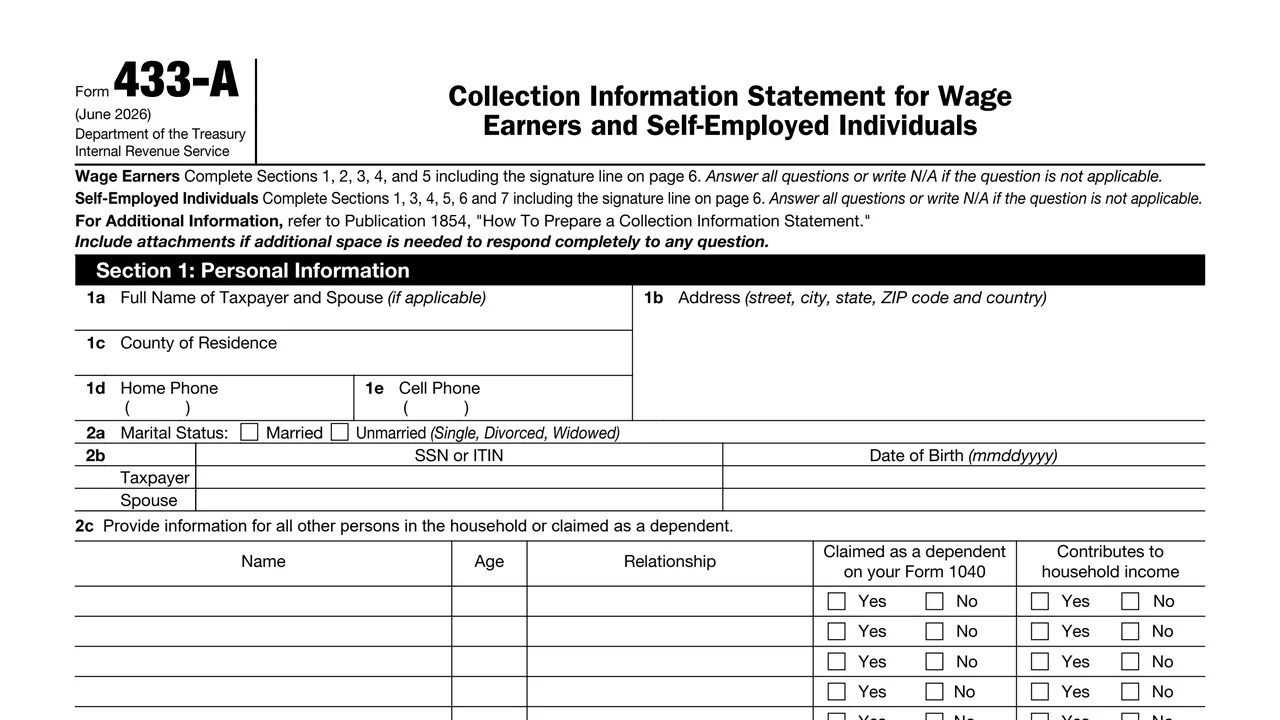
Names, address, county, phone numbers, marital status, SSN or ITIN, dates of birth, other household members and dependents, and any outside business interests.
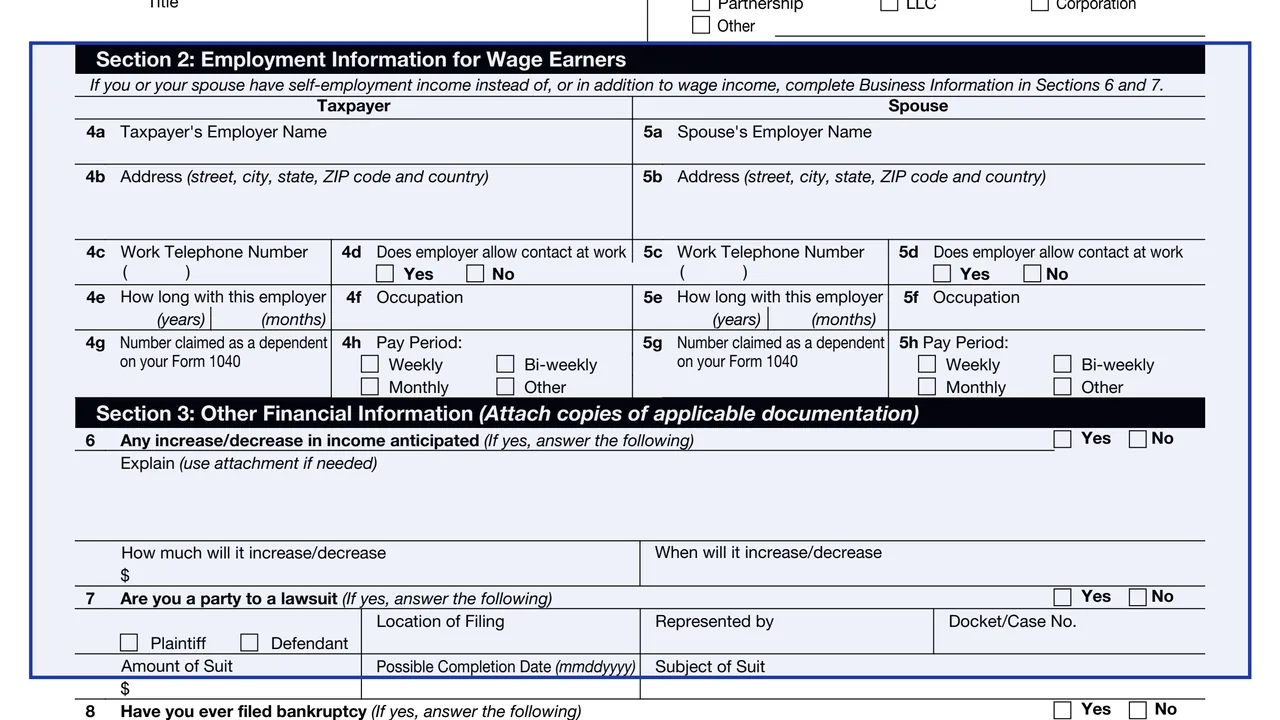
Employer name, address and phone for the taxpayer and spouse, whether the employer allows contact at work, time with the employer, occupation and pay period.
Expected income changes, lawsuits, bankruptcy, passport, time abroad, dual citizenship, incarceration, trusts, safe deposit boxes and transfers of assets worth more than $10,000 in the past 10 years.
Cash, bank accounts, investments, digital assets, available credit, life insurance, real property, vehicles and other personal assets, foreign and domestic.
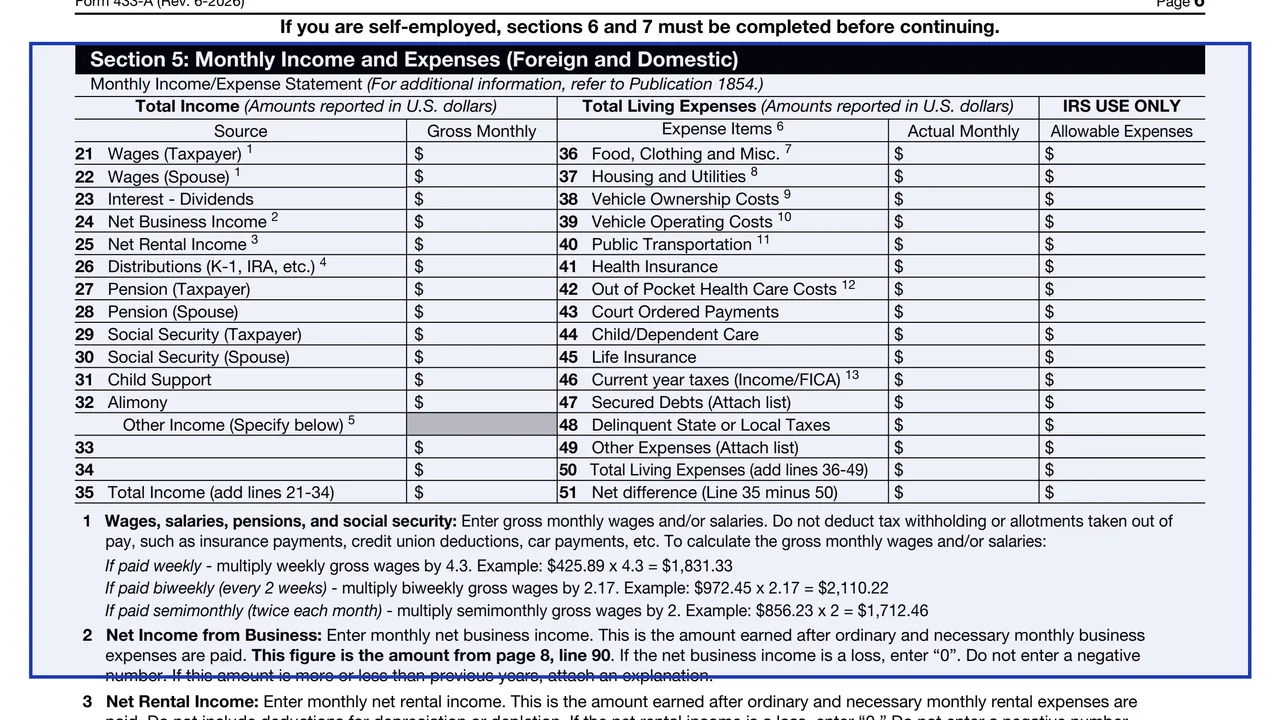
Lines 21 to 35 for income, lines 36 to 50 for living expenses and the net difference on line 51, followed by the certification and signatures.
Business details, payment processors, business bank accounts, receivables and business assets, then monthly business income and expenses ending with net business income on line 90.
Wage earners fill in Sections 1 to 5. Self-employed individuals fill in Sections 1, 3, 4, 5, 6 and 7, and the form says to finish Sections 6 and 7 before continuing to Section 5. Answer every question or write N/A.
Enter each account, investment, digital asset, property and vehicle with its value and any loan balance. Include assets in foreign countries or jurisdictions and add attachments if more space is needed.
Enter gross wages without deducting withholding or allotments. The form says to multiply weekly gross wages by 4.3, biweekly by 2.17 and semimonthly by 2.
Enter actual monthly amounts on lines 36 to 49 and attach lists for secured debts and other expenses. Leave the IRS USE ONLY column blank.
Use the prior 3, 6, 9 or 12 month period to find typical monthly business income and expenses. Enter line 90 on line 24 in Section 5, or "0" if it is a loss.
Sign and date on page 6 under penalties of perjury, with a spouse's signature on the line provided. The form says self-employed taxpayers return to page 6 to sign.
You get the real form, filled in a browser tab, with nothing standing between you and the finished PDF.
The form does not print a mailing address or a deadline. Publication 1854 is named for more on preparing a collection information statement.
Section 3 asks for copies of applicable documentation, and the form says to include attachments when more space is needed to respond completely to any question.
After review, the form says you may be asked for documents such as previously filed tax returns, pay statements, self-employment records, bank and investment statements, loan statements and bills for recurring expenses.
The form says the IRS generally does not allow private school tuition, college expenses, charitable contributions, voluntary retirement contributions or payments on unsecured debts, with exceptions in Publication 1854.
If net business income or net rental income is a loss, the form says to enter "0" and not a negative number.
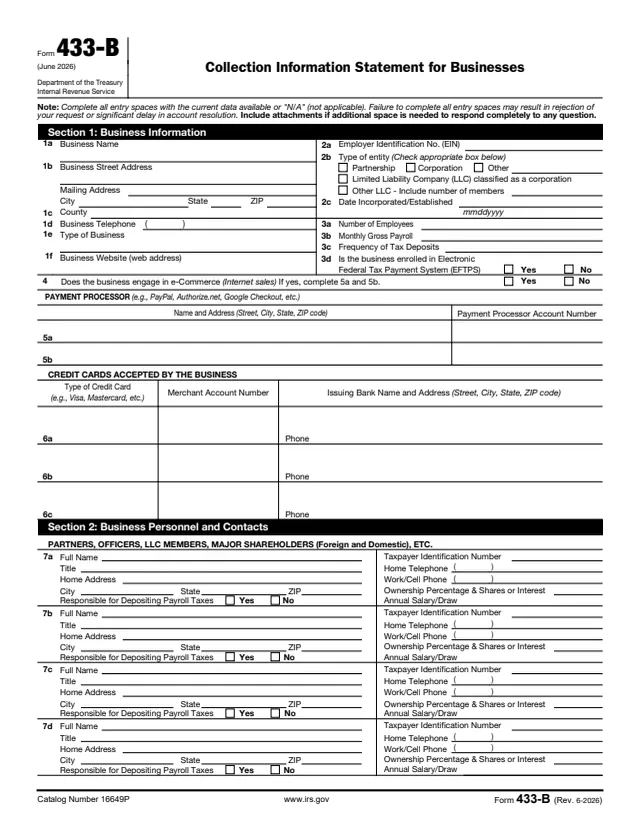
433-B
447 fields, 6 pages
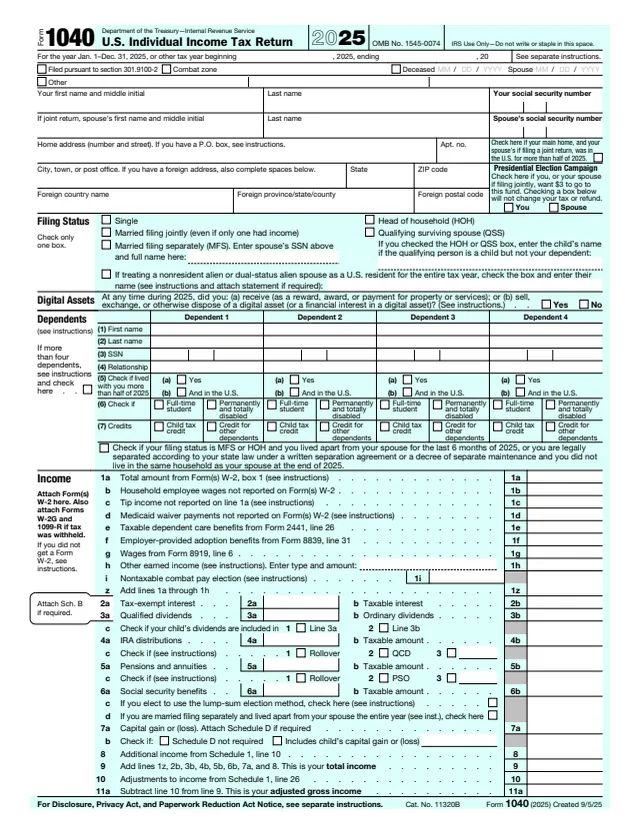
1040
199 fields, 2 pages
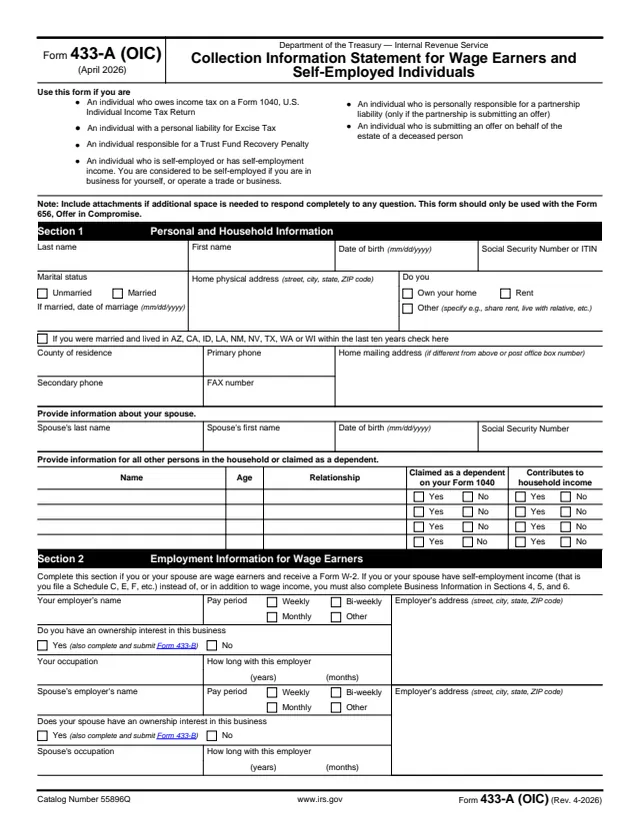
433-A
425 fields, 8 pages
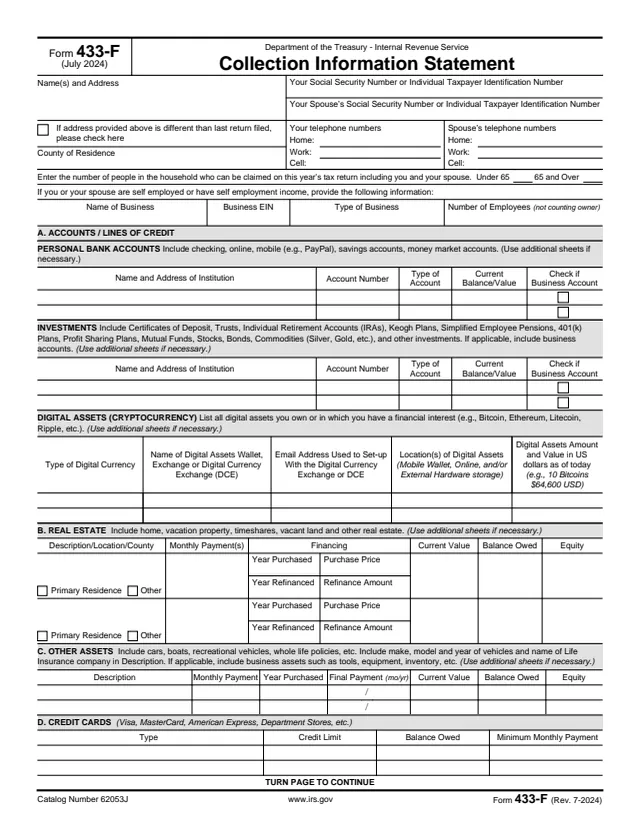
433F
214 fields, 4 pages
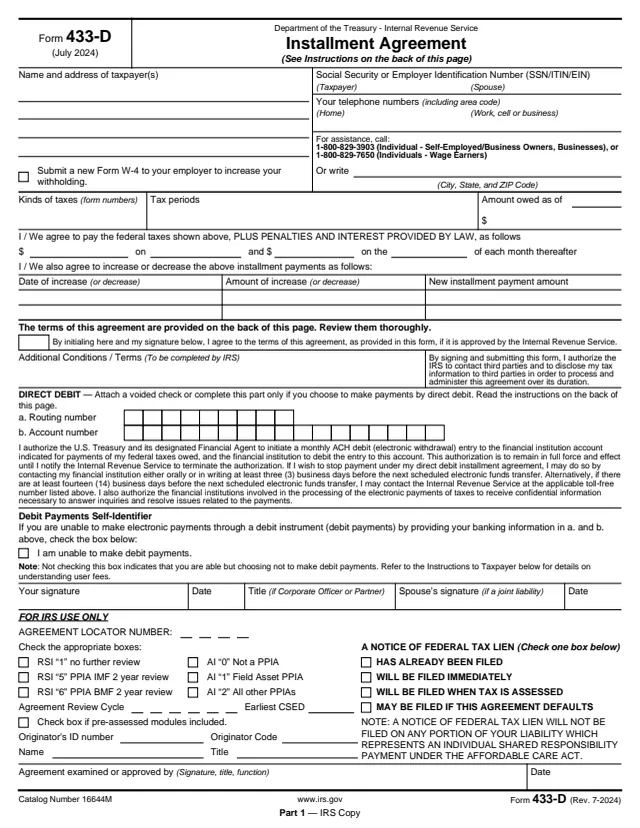
433-D
168 fields, 4 pages
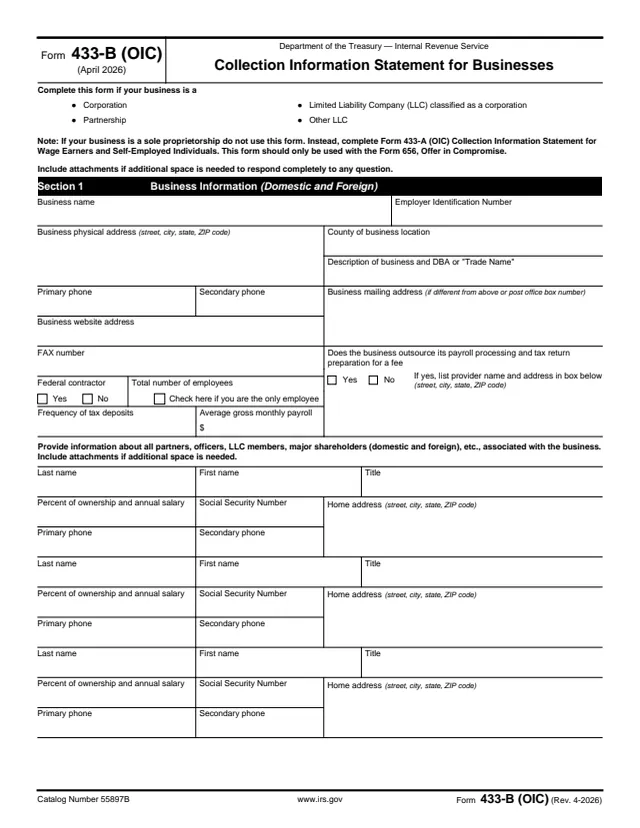
433-B
267 fields, 6 pages
The form is completed by an individual taxpayer, and by a spouse where it applies, for the IRS.
No tool matches that search.
The form says wage earners complete Sections 1, 2, 3, 4 and 5, and self-employed individuals complete Sections 1, 3, 4, 5, 6 and 7, both including the signature line on page 6.
The form says all business entities other than a sole proprietorship, including limited liability companies, partnerships or corporations, complete Form 433-B.
The form says to multiply weekly gross wages by 4.3, biweekly gross wages by 2.17 and semimonthly gross wages by 2.
Yes. Section 4 says to include assets located in foreign countries or jurisdictions and to add attachments if more space is needed.
The form says that after the IRS reviews it, you may be asked to provide verification for the assets, encumbrances, income and expenses reported.
The form refers to Publication 1854, "How To Prepare a Collection Information Statement."