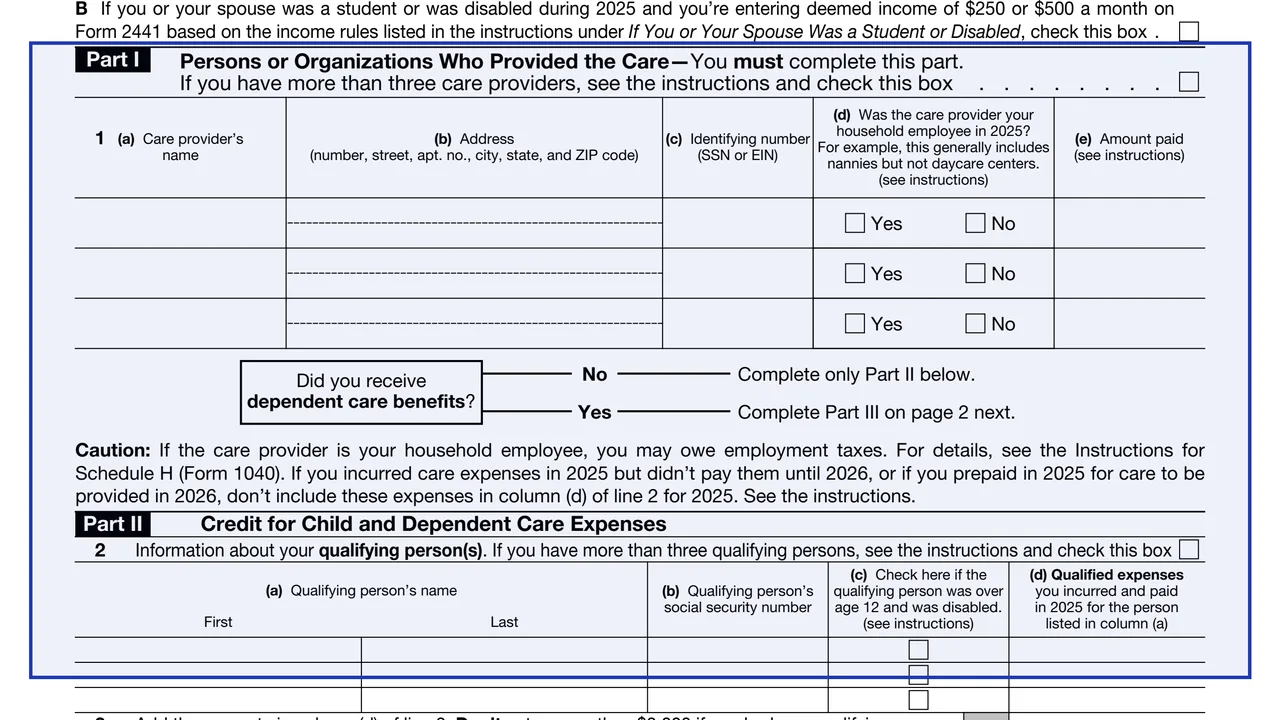
Lines A and B: checkboxes
Line A is for a married filing separately return that meets the requirements in the instructions. Line B is checked when entering deemed income of $250 or $500 a month for a student or disabled spouse.
2441
Child and Dependent Care Expenses
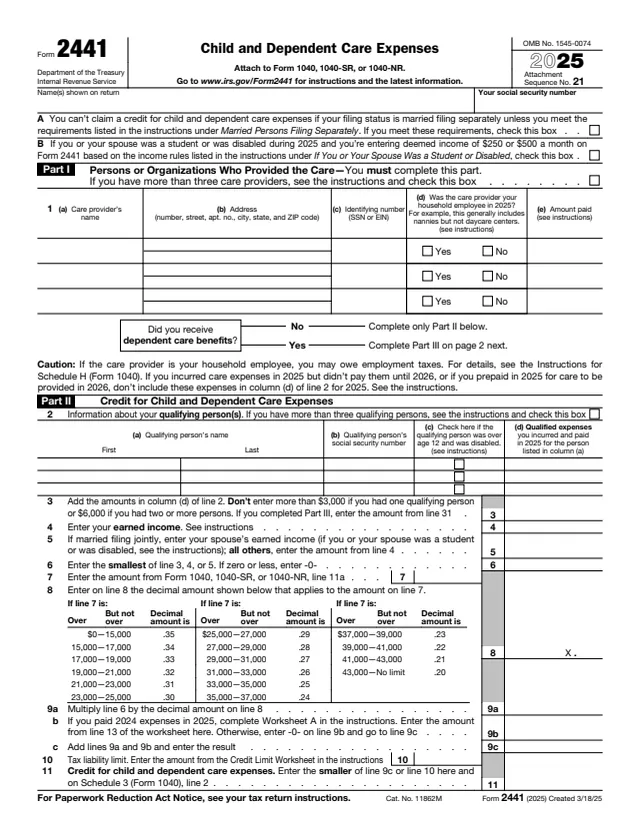
Form 2441 is the IRS form for the credit for child and dependent care expenses. The IRS page says that if you paid someone to care for your child or other qualifying person so you (and your spouse if filing jointly) could work or look for work, you may be able to take the credit. The form is attached to Form 1040, 1040-SR or 1040-NR.
The same form handles dependent care benefits, such as amounts an employer paid for care or pre-tax contributions to a dependent care flexible spending account. The instructions say anyone who received dependent care benefits for 2025 uses Form 2441 to figure how much, if any, can be excluded from income, and that Part III comes before the credit in Part II.
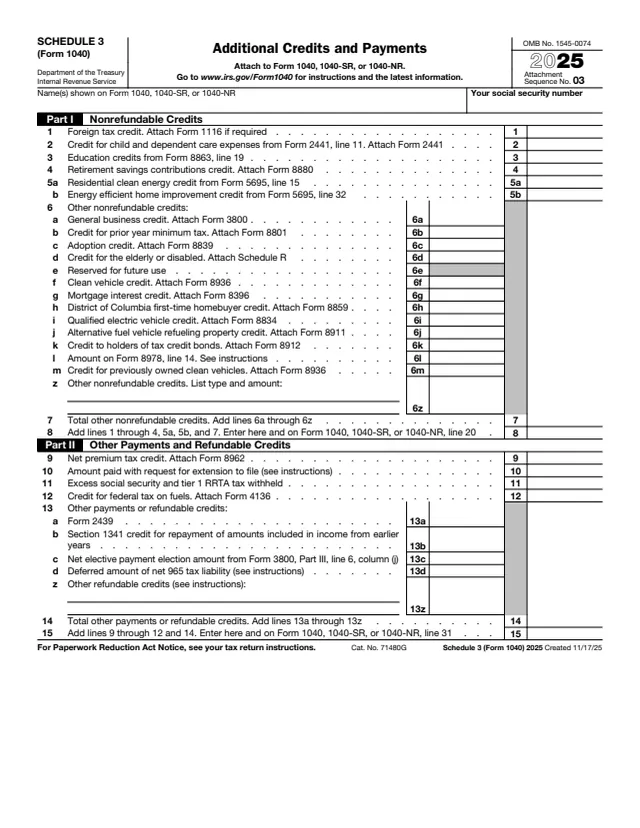
For 2025, line 3 caps the expenses used for the credit at $3,000 for one qualifying person or $6,000 for two or more. The credit is a decimal from .35 down to .20 of those expenses, based on the amount from line 11a of your return, and line 11 carries to Schedule 3 (Form 1040), line 2.
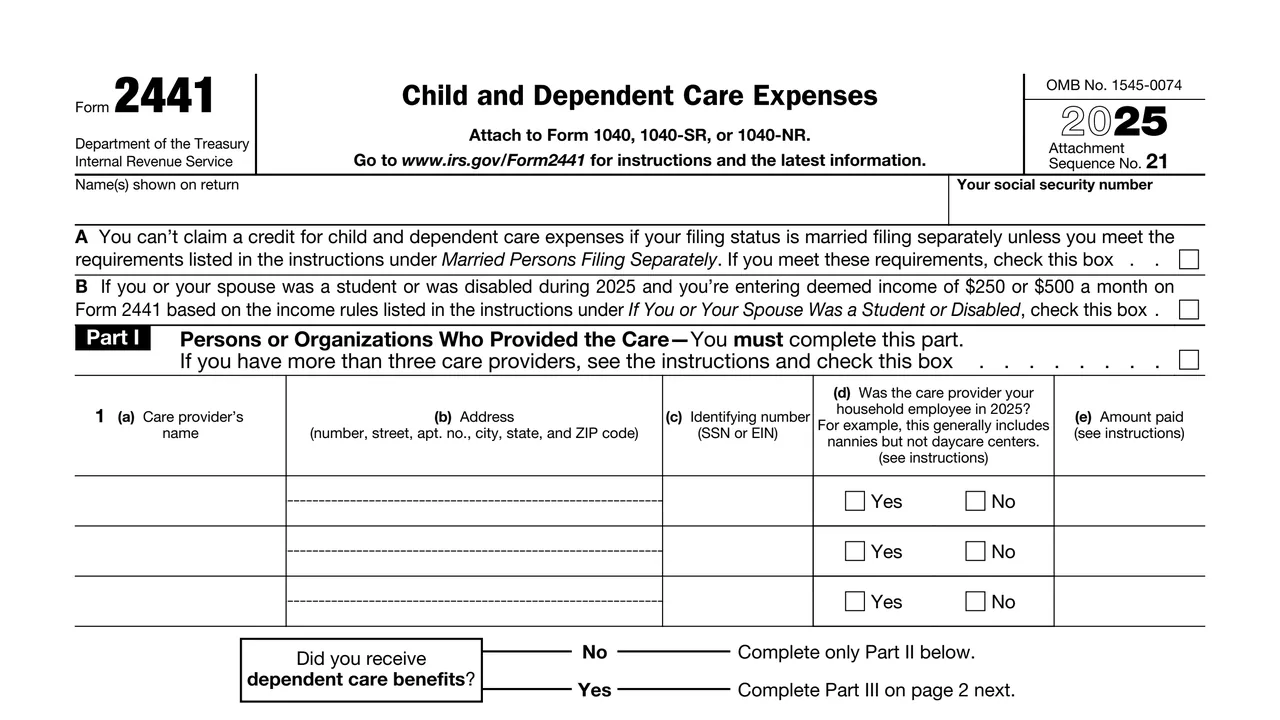
Line A is for a married filing separately return that meets the requirements in the instructions. Line B is checked when entering deemed income of $250 or $500 a month for a student or disabled spouse.
Each provider's name, address, SSN or EIN, whether they were your household employee, and the amount paid. The form marks this part as required on every Form 2441.
Each qualifying person's name and social security number, a box for a person over age 12 who was disabled, and the qualified expenses incurred and paid in 2025 for that person.
Expenses capped at $3,000 or $6,000 are compared with earned income, multiplied by the decimal on line 8 and limited by the Credit Limit Worksheet. Line 11 goes on Schedule 3 (Form 1040), line 2.
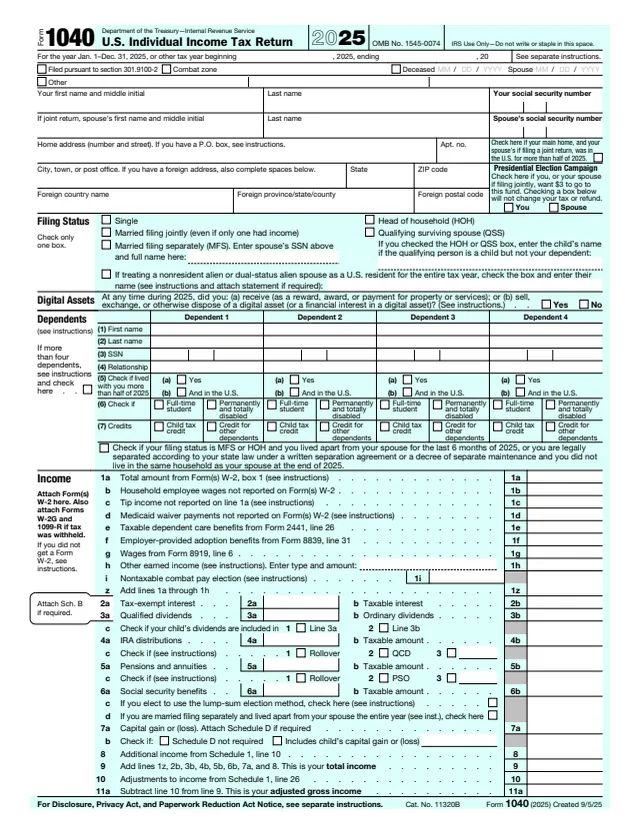
Benefits received, grace period carryovers and forfeited amounts, then the deductible, excluded and taxable benefits. Taxable benefits on line 26 go on Form 1040, 1040-SR or 1040-NR, line 1e.
Used when reporting benefits and also claiming the credit. Benefits from line 28 reduce the $3,000 or $6,000 limit, and line 31 carries to line 3 on page 1.
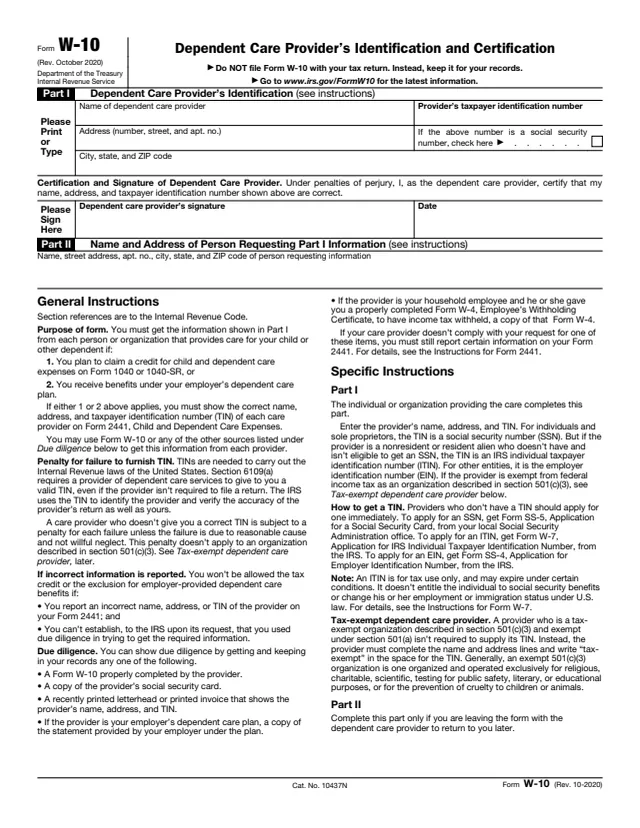
The instructions say Form W-10 or another listed source can be used to get each care provider's name, address and identifying number. Missing details can lead to the credit being disallowed unless you show due diligence.
Line A is only for married filing separately returns that meet the listed requirements. Line B is only for deemed income for a student or disabled spouse.
List each care provider, mark Yes or No for household employee and enter the total paid in 2025. With more than three providers, the instructions say to check the box and attach a statement.
If you received dependent care benefits, for example in box 10 of Form W-2, the instructions say to complete Part III before figuring the credit in Part II.
Enter each name and SSN as shown on the social security card, and the qualified expenses incurred and paid in 2025. Expenses for 2024 care paid in 2025 go through Worksheet A to line 9b instead.
Work through lines 3 to 10, using the Credit Limit Worksheet for line 10. Line 11 goes on Schedule 3 (Form 1040), line 2. You can fill this form free on this page.
You get the real form, filled in a browser tab, with nothing standing between you and the finished PDF.
Form 2441 is attached to Form 1040, 1040-SR or 1040-NR and is due with it.
Attach it to your return, along with any statement listing extra care providers or qualifying persons. The instructions say to put your name and SSN on each statement.
The IRS form is free.
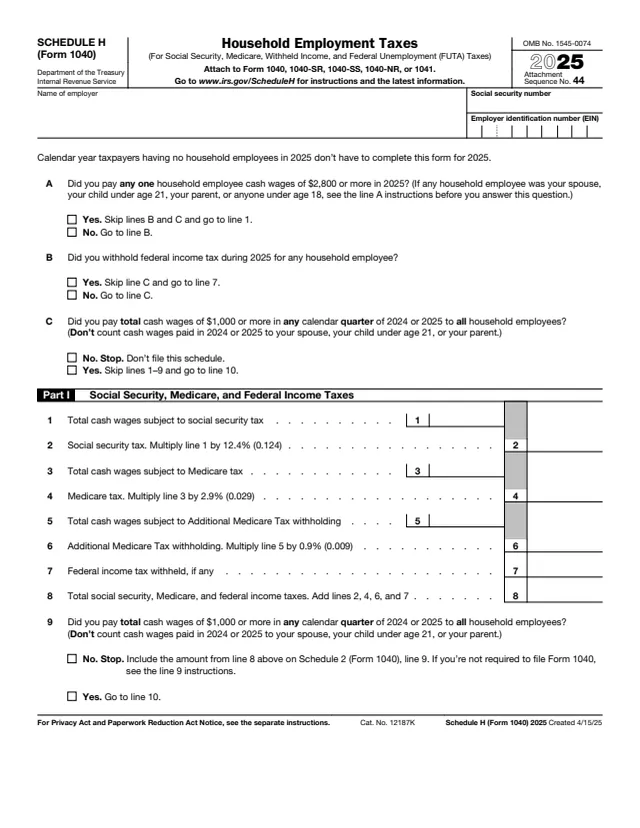
The form cautions that if the care provider is your household employee, you may owe employment taxes, and points to the Instructions for Schedule H (Form 1040).
The instructions say child support payments, overnight camp, summer school, tutoring programs and schooling for a child in kindergarten or above aren't qualified expenses.
The instructions say getting and keeping the provider's completed Form W-10 is one way to show due diligence.
W-10
6 fields, 1 page
1040
37 fields, 1 page
1040
72 fields, 2 pages
W-2
568 fields, 11 pages
1040
199 fields, 2 pages
1040
27 fields, 2 pages
No tool matches that search.
For 2025, line 3 says not to enter more than $3,000 for one qualifying person or $6,000 for two or more. The instructions say the $6,000 limit applies even if all the expenses were for one of the two persons.
The instructions list a qualifying child under age 13 whom you can claim as a dependent, a disabled spouse who couldn't care for themselves and lived with you more than half the year, and certain other disabled persons who lived with you more than half the year.
Generally no. The instructions say married persons generally file a joint return to claim it, but a separate filer who lived apart from their spouse for the last 6 months of 2025 and meets the other listed tests can check the box on line A.
The instructions say the cost of a day camp can be included, even one that specializes in an activity such as computers or soccer. Overnight camp, summer school and tutoring programs are not included.
The instructions say no credit is allowed for amounts paid to your spouse, the parent of your qualifying child, or a person you can claim as a dependent. Your own child can be the provider only if age 19 or older by the end of 2025 and not your dependent.
Complete Part III. For 2025, the instructions say up to $5,000, or $2,500 if married filing separately, can be excluded through a dependent care assistance program. Any taxable part goes on line 1e of your return.