Header and return type
Name, EIN and address, with boxes for Address Change, VIN Correction, Amended Return and Final Return.
2290
Heavy Highway Vehicle Use Tax Return
Form 2290, Heavy Highway Vehicle Use Tax Return, is used to figure and pay the tax on highway motor vehicles used during the period with a taxable gross weight of 55,000 pounds or more. The IRS also lists it for claiming suspension of the tax on vehicles expected to be used 5,000 miles or less (7,500 miles or less for agricultural vehicles), claiming a credit for vehicles that were destroyed, stolen, sold or used under those limits, and reporting used vehicles.
This page covers the July 2026 revision, for the period July 1, 2026, through June 30, 2027. The PDF cover sheet says not to use this revision for a tax period that began on or before June 30, 2026.
The return comes with Schedule 1 (Form 2290), which lists each vehicle by VIN and category. One copy is stamped and returned for use as proof of payment when registering vehicles with a state. You can fill out Form 2290 free in your browser on this page and download the result without an account.
Name, EIN and address, with boxes for Address Change, VIN Correction, Amended Return and Final Return.
Lines 1 to 6: month of first use, tax from page 2, additional tax from a weight increase, total tax, credits and balance due, with boxes for EFTPS or card payment.
Lines 7 to 9: suspended vehicles for this period, vehicles suspended in the prior period, and suspended vehicles sold or transferred.
Categories A through V by taxable gross weight, from 55,000 pounds to over 75,000 pounds, with annual tax, partial-period tax, number of vehicles and amount. Category W is for suspended vehicles.
Part I summarizes the vehicles and Part II lists each VIN and category. It comes in two copies, followed by a Consent to Disclosure of Tax Information.
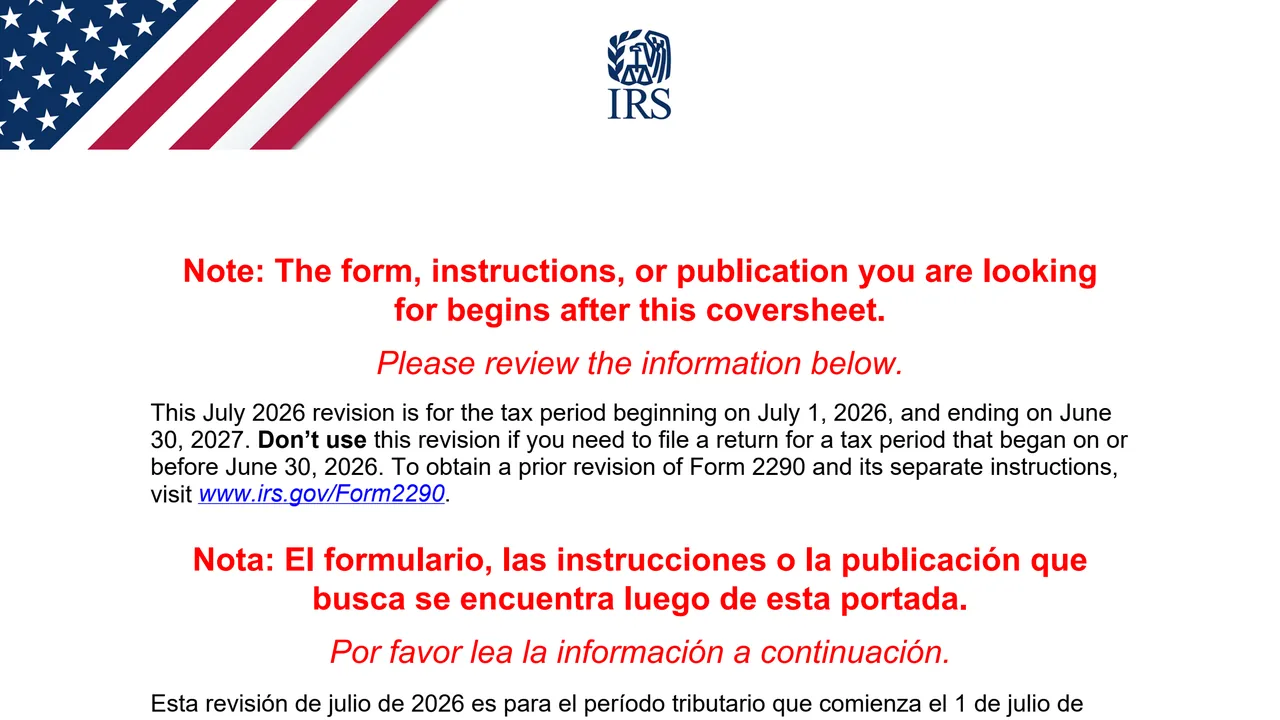
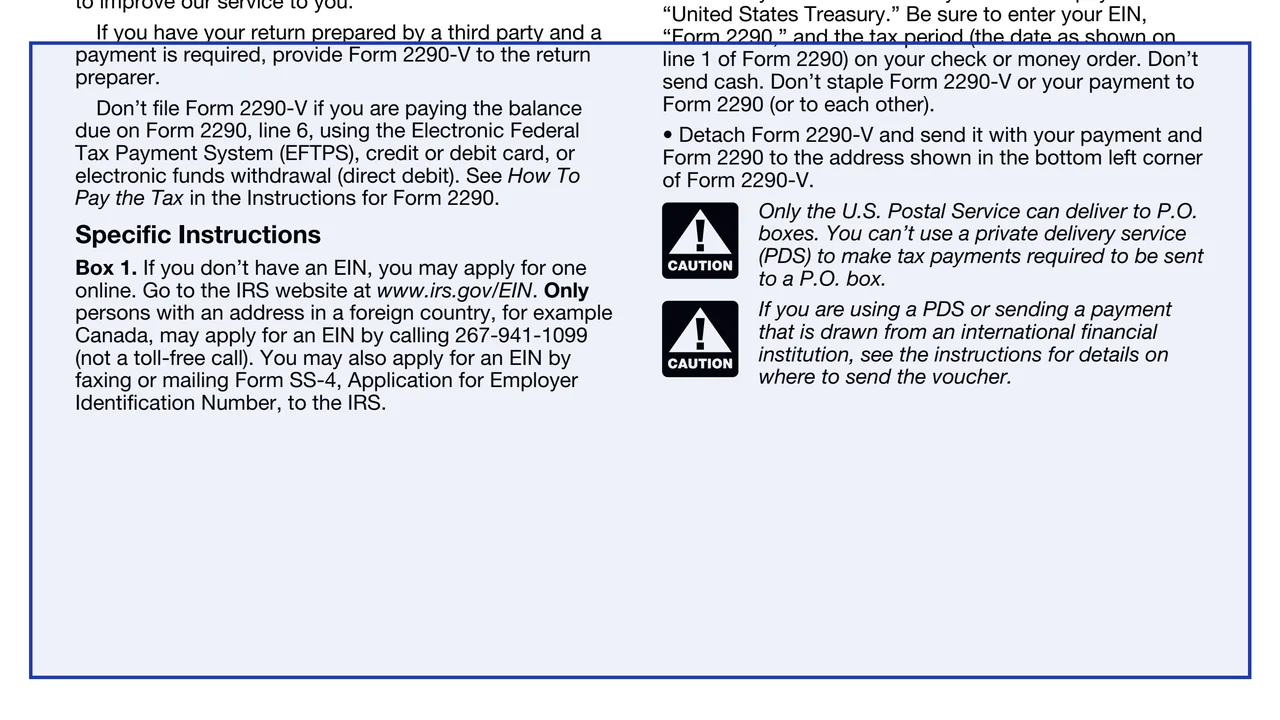
Used with a payment by check or money order. Boxes 1 to 4 hold the EIN, amount paid, date from line 1, and name and address.
The instructions list the EIN, the VIN of each vehicle and the taxable gross weight of each vehicle. They say a Social Security number can't be used in place of an EIN.
Enter the month of first use as year and month. The form says to enter 202607 if the vehicles were used on public highways during July 2026.
Find each vehicle's category. Use column (1) for vehicles used in July and column (2) with the instructions' tables for vehicles first used later. Multiply by the number of vehicles and total column (4) on line 2.
Line 3 is additional tax from a weight increase. Line 5 credits need supporting documentation and can't exceed line 4, the instructions say. Line 6 is the balance due.
Check line 7 for vehicles expected to stay under the mileage use limit, line 8a to confirm last period's suspended vehicles, and line 9 for suspended vehicles sold or transferred.
List every VIN with its category on both copies of Schedule 1 and enter the same month of first use. Sign the return. The consent to disclosure is signed if you agree to it.
You get the real form, filled in a browser tab, with nothing standing between you and the finished PDF.
The instructions say Form 2290 is filed by the last day of the month following the month of first use. For first use in July 2026, the chart shows August 31, 2026.
The instructions say electronic filing is required for each return reporting and paying tax on 25 or more vehicles. Suspended category W vehicles don't count toward that number.
With full payment: Internal Revenue Service, P.O. Box 932500, Louisville, KY 40293-2500. Without payment, or paid through EFTPS or card: Department of the Treasury, Internal Revenue Service, Ogden, UT 84201-0031.
The instructions list direct debit when e-filing, EFTPS, credit or debit card, and check or money order with Form 2290-V, payable to "United States Treasury."
The stamped copy of Schedule 1 is used when registering vehicles with a state. The instructions say U.S. Customs and Border Protection also requires it for Canadian or Mexican vehicles entering the United States.
866-699-4096 (toll free) from the United States, or 859-320-3581 (not toll free) from Canada or Mexico, Monday to Friday, 8:00 a.m. to 6:00 p.m., Eastern time.
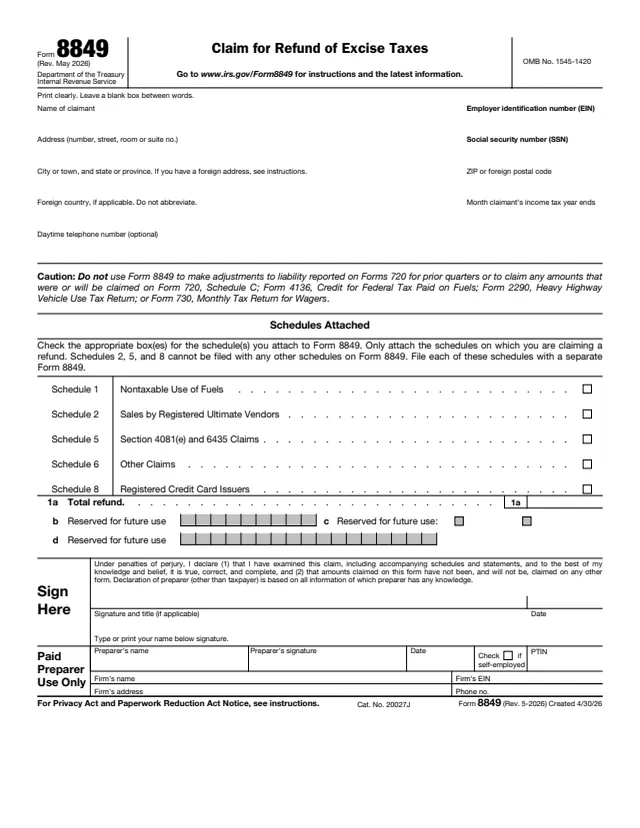
8849
27 fields, 4 pages
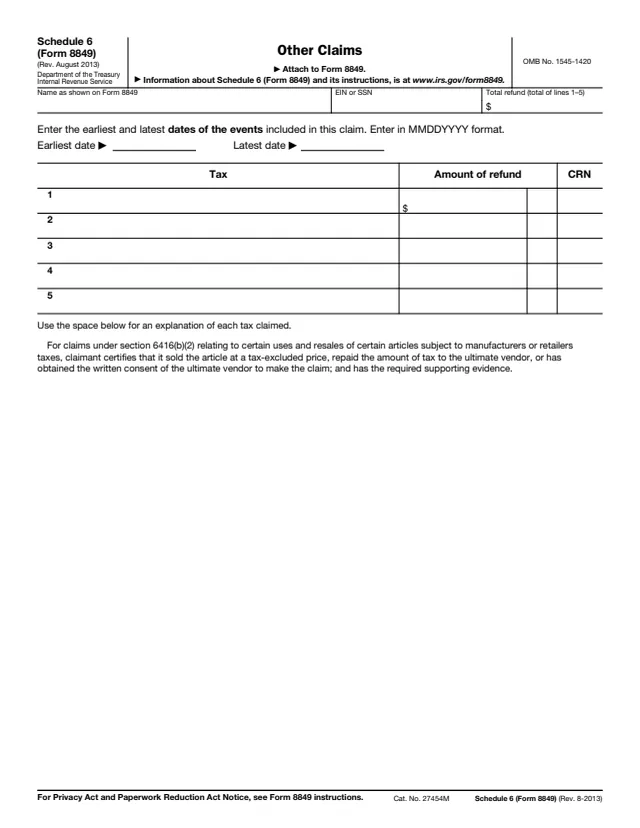
8849 Sch. 6
26 fields, 1 page
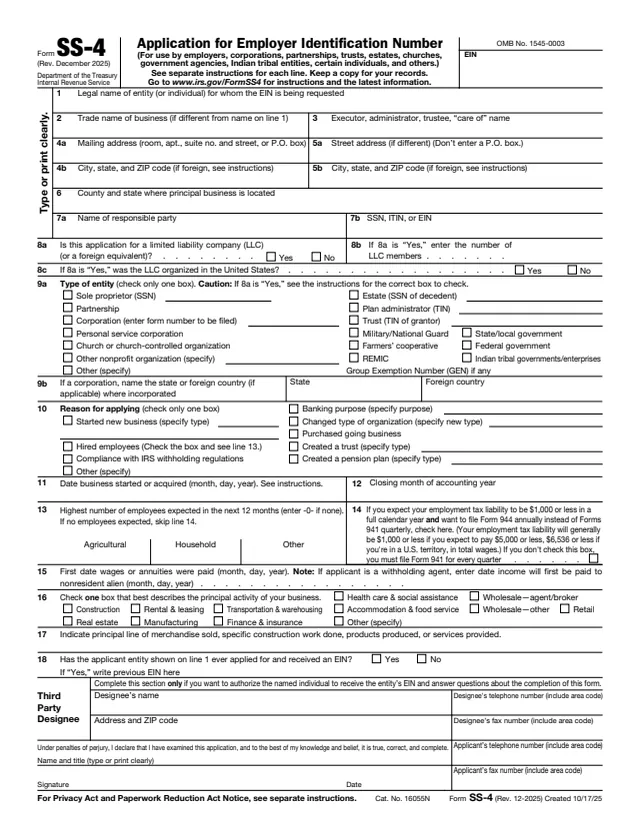
SS-4
89 fields, 2 pages
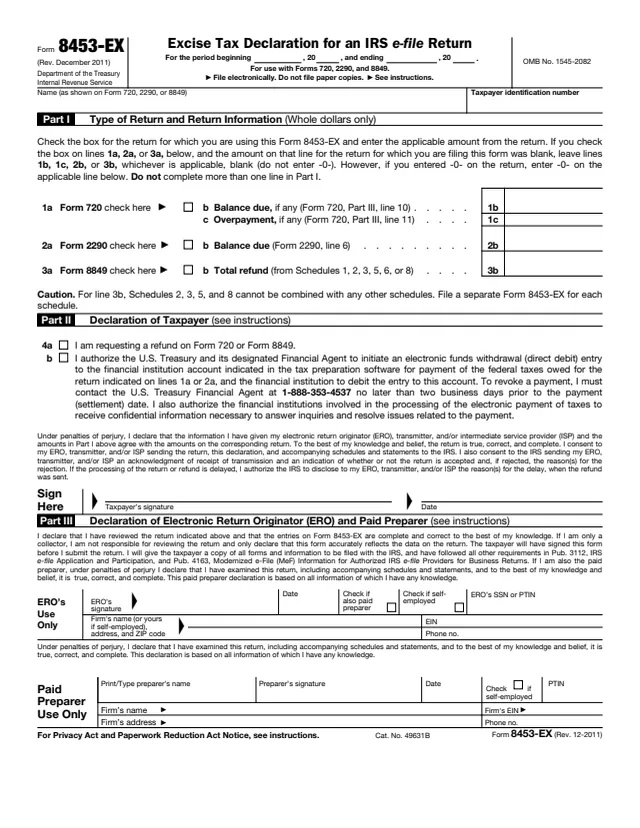
8453-EX
29 fields, 2 pages
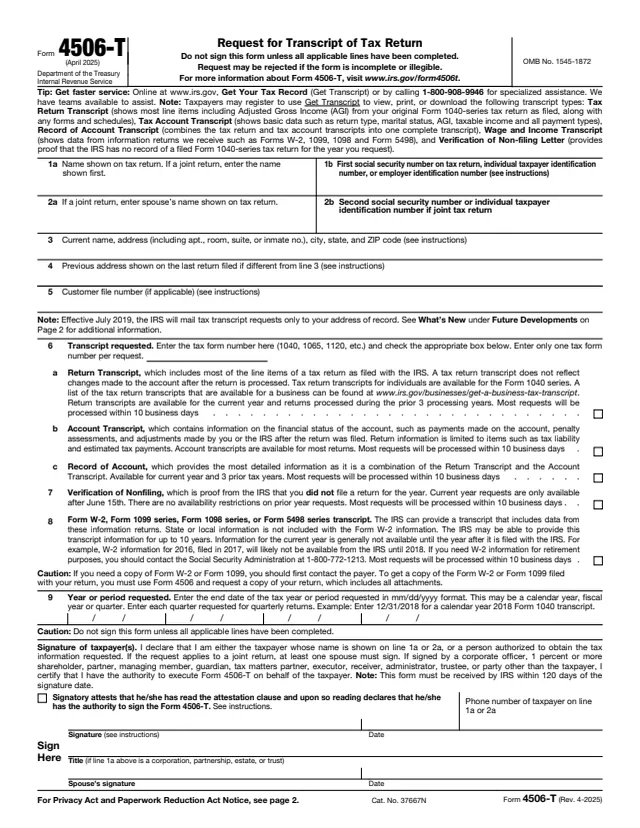
4506-T
29 fields, 2 pages
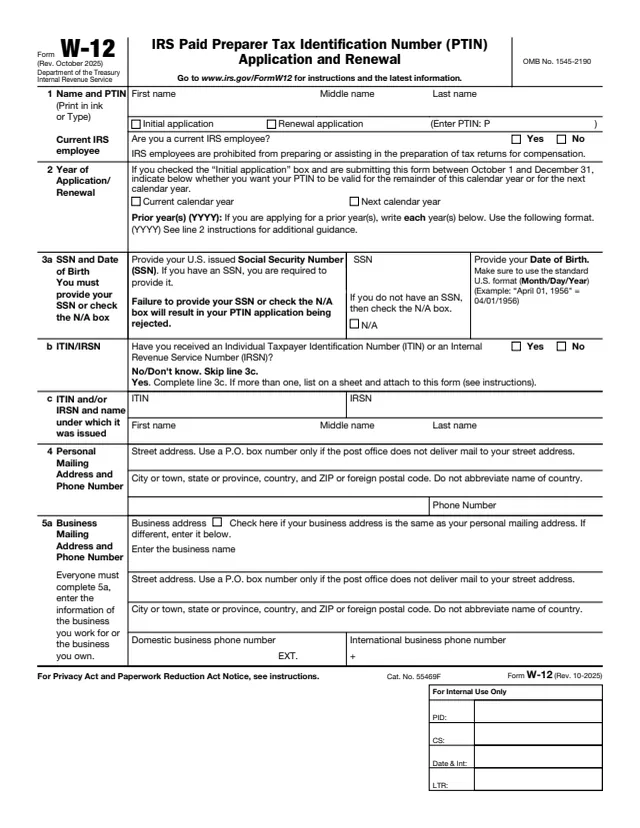
W-12
85 fields, 3 pages
The instructions say Form 2290 and Schedule 1 are filed when a taxable highway motor vehicle is registered, or required to be registered, in your name at the time of its first use in the period and has a taxable gross weight of 55,000 pounds or more.
No tool matches that search.
The instructions say highway motor vehicles with a taxable gross weight of 55,000 pounds or more are taxable. They give trucks, truck tractors and buses as examples.
The instructions define it as use on public highways of 5,000 miles or less, or 7,500 miles or less for agricultural vehicles, during the period. It applies to the total mileage, regardless of the number of owners.
No. The instructions say an EIN is needed to file Form 2290 and a Social Security number can't be used.
The instructions say a separate Form 2290 is filed for each month in which vehicles are first used, and the tax for vehicles first used after July comes from the partial-period tables.
For a vehicle destroyed, stolen or sold before June 1, the instructions say a credit can be claimed on the next Form 2290, or a refund on Form 8849.
The instructions say that once an e-filed return is accepted by the IRS, the stamped Schedule 1 can be available within minutes. For a paper return, the form says one copy of Schedule 1 will be stamped and returned to you.