Header
Name of taxpayer, tax identification number (last 4 digits) and year/period ended.
14900
Worksheet for Qualified Loan Limit and Deductible Home Mortgage Interest for Tax Years Beginning after 2017
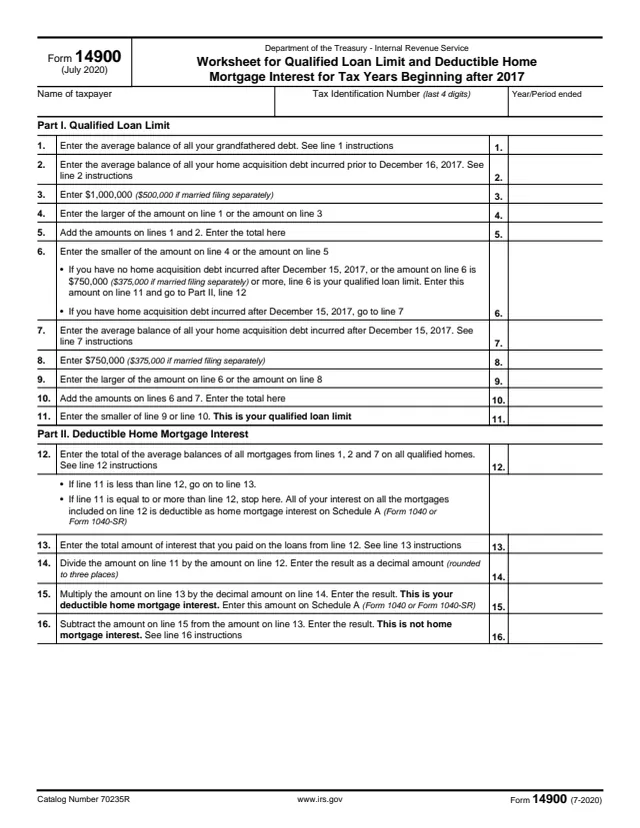
Form 14900, Worksheet for Qualified Loan Limit and Deductible Home Mortgage Interest for Tax Years Beginning after 2017, is a two-page IRS worksheet. Page 1 has the 16 worksheet lines and page 2 has the instructions for lines 1, 2, 7, 12, 13 and 16.
Part I figures a qualified loan limit from the average balances of mortgages on qualified homes, grouped by when the debt was taken out: grandfathered debt, home acquisition debt incurred before December 16, 2017, and home acquisition debt incurred after December 15, 2017. Part II compares that limit with the total average mortgage balance to figure how much of the interest paid is deductible as home mortgage interest on Schedule A (Form 1040 or Form 1040-SR).
The worksheet is written to the taxpayer and asks for the taxpayer's name, the last 4 digits of the tax identification number and the year or period ended. You can fill it out free in your browser on this page and download the result without an account.
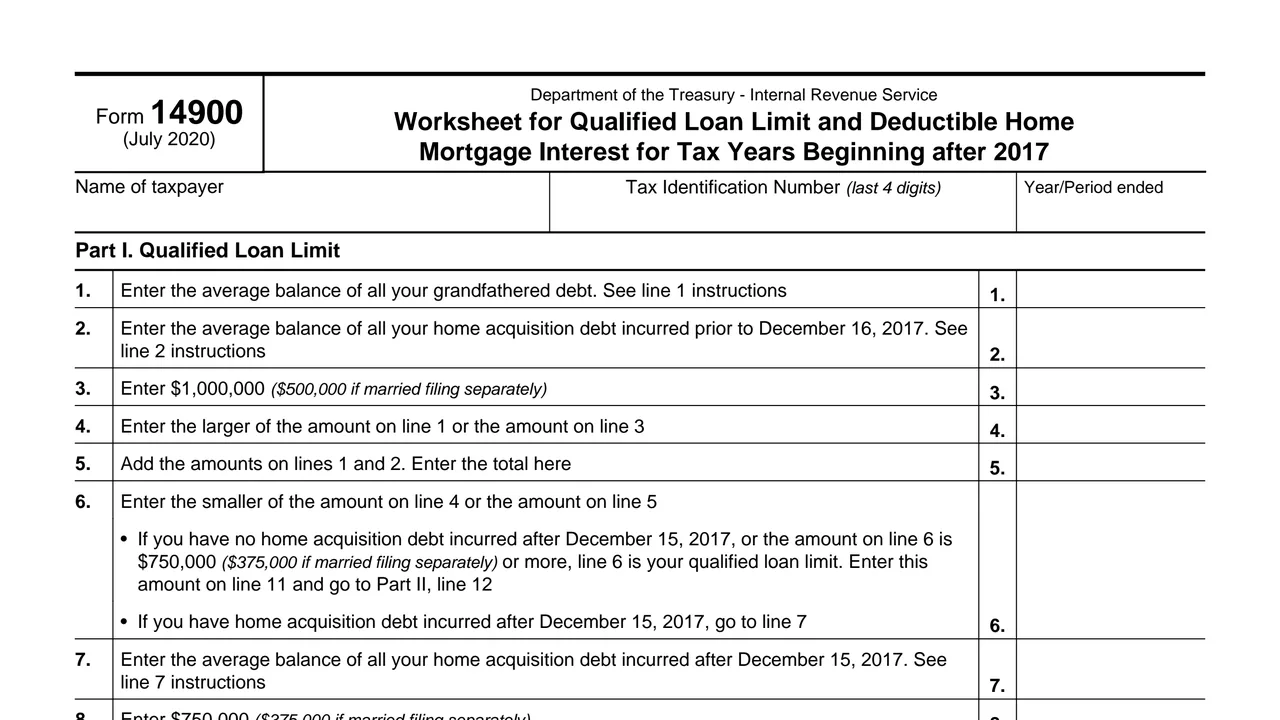
Name of taxpayer, tax identification number (last 4 digits) and year/period ended.
Average balances of grandfathered debt and of home acquisition debt incurred before December 16, 2017, compared with $1,000,000 ($500,000 if married filing separately).
Average balance of home acquisition debt incurred after December 15, 2017, compared with $750,000 ($375,000 if married filing separately). Line 11 is the qualified loan limit.
The total of the average balances of all mortgages from lines 1, 2 and 7, and the total interest paid on those loans.
A decimal ratio of line 11 to line 12, the deductible home mortgage interest on line 15, and the interest that is not home mortgage interest on line 16.
Instructions for lines 1, 2, 7, 12, 13 and 16, explaining how each average balance and the interest amount are figured.
Enter the taxpayer's name, the last 4 digits of the tax identification number and the year or period ended.
Figure the average balance for the current year of each mortgage in the group and add them. The line 2 instructions also cover a written binding contract entered into before December 15, 2017 for a main home purchased before April 1, 2018.
Enter $1,000,000 ($500,000 if married filing separately) and follow the larger and smaller comparisons. The worksheet says that with no debt incurred after December 15, 2017, or a line 6 amount of $750,000 ($375,000 if married filing separately) or more, line 6 is the qualified loan limit and goes on line 11.
Enter the average balance of debt incurred after December 15, 2017 and $750,000 ($375,000 if married filing separately), then work the comparisons to reach the qualified loan limit on line 11.
Enter the total average balances from lines 1, 2 and 7. If line 11 is equal to or more than line 12, the worksheet says to stop, because all the interest is deductible. Otherwise enter the interest paid, which the instructions say a Form 1098 from the lender shows, without points or mortgage insurance premiums.
Divide line 11 by line 12 and round to three decimal places. Multiply line 13 by that decimal for line 15, then subtract line 15 from line 13 for line 16.
You get the real form, filled in a browser tab, with nothing standing between you and the finished PDF.
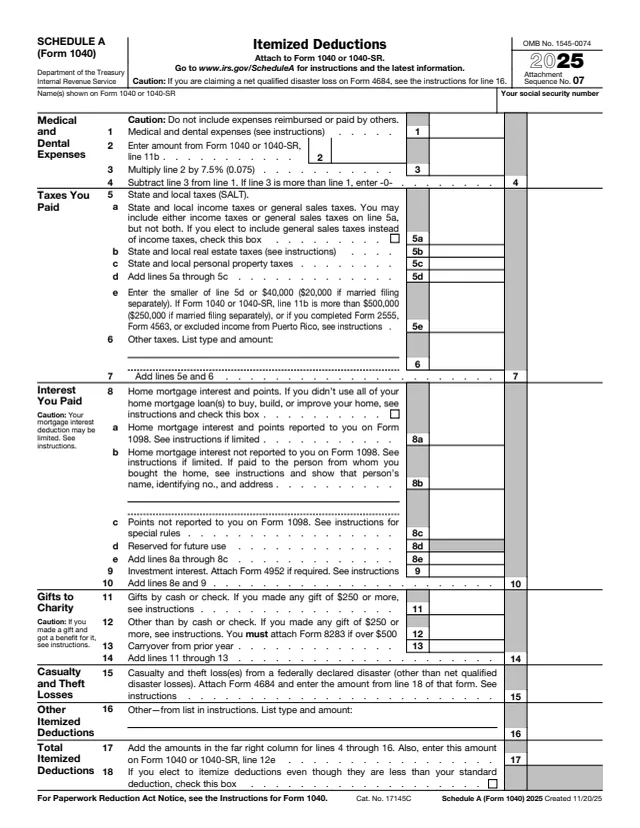
The worksheet says line 15 is the deductible home mortgage interest and to enter it on Schedule A (Form 1040 or Form 1040-SR).
If line 11 is equal to or more than line 12, the worksheet says all of the interest on the mortgages on line 12 is deductible as home mortgage interest on Schedule A.
The instructions say the line 16 amount cannot be deducted as home mortgage interest. If no mortgage proceeds were used for business, investment or other deductible activities, they say all of it is personal interest, which isn't deductible.
The worksheet prints no mailing address or due date. For the Paperwork Reduction Act Notice, it points to the Instructions for Forms 1040 and 1040-SR.
The worksheet speaks to the taxpayer ("all your grandfathered debt") and sends its result to Schedule A (Form 1040 or Form 1040-SR). It prints no filing address and no deadline.
No tool matches that search.
It figures the qualified loan limit in Part I and the deductible home mortgage interest in Part II, for tax years beginning after 2017.
The line 1 instructions describe it as each mortgage on qualified homes that the taxpayer had on October 13, 1987.
Line 3 uses $1,000,000 ($500,000 if married filing separately) and line 8 uses $750,000 ($375,000 if married filing separately).
No. The line 13 instructions say not to include points or mortgage insurance premiums on that line.
The worksheet says to enter the line 15 amount on Schedule A (Form 1040 or Form 1040-SR).
The instructions say it cannot be deducted as home mortgage interest, and that it is personal interest if no mortgage proceeds were used for business, investment or other deductible activities.