Section A: situation
Required for everyone. Four boxes for filing for yourself, answering an IRS notice, filing for a dependent who does not file, or filing for another person.
14039
Identity Theft Affidavit (Spanish Version)
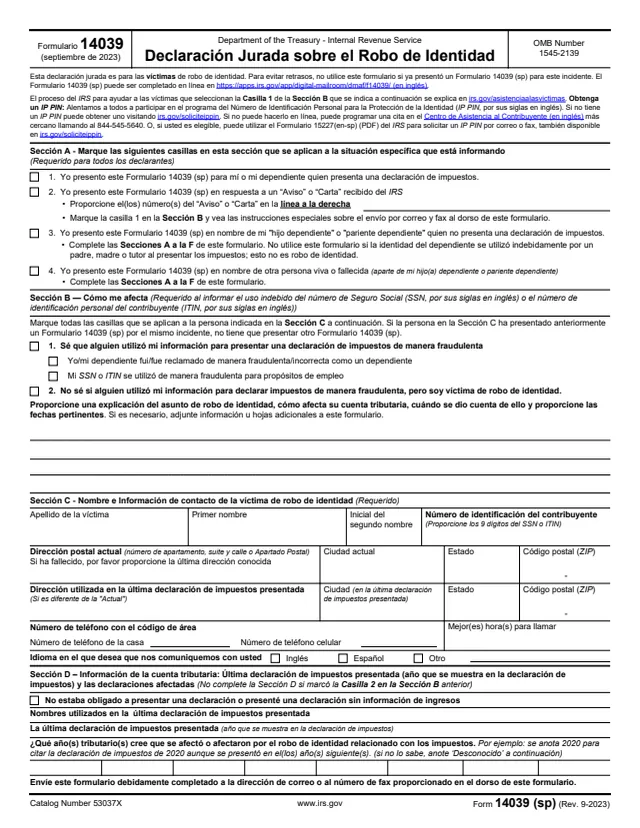
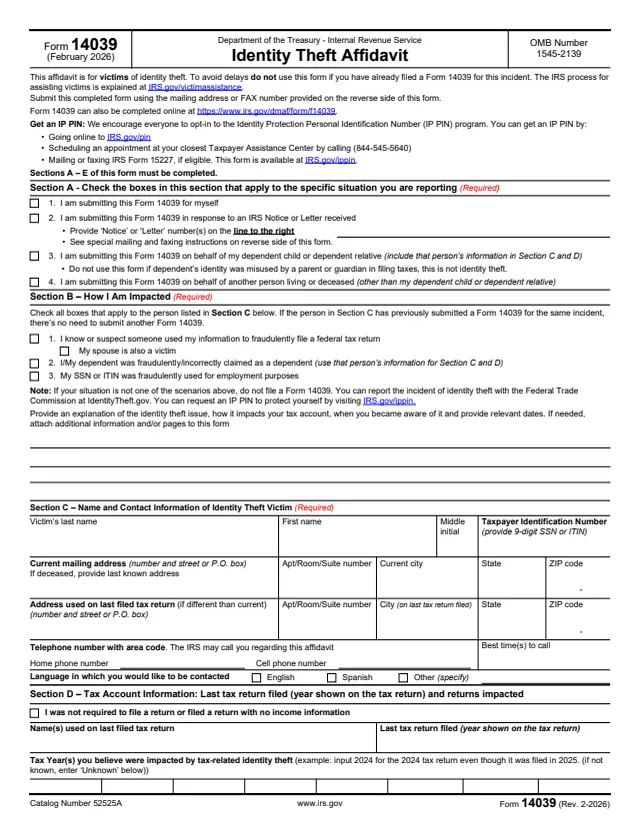
Form 14039 (sp) is the Spanish version of Form 14039, Identity Theft Affidavit. The PDF is titled "Declaración Jurada sobre el Robo de Identidad" and is dated "septiembre de 2023" (Rev. 9-2023). Its six sections and the filing instructions on page 2 are all in Spanish. The IRS lists the English Form 14039 with a later revision date, Rev. 2-2026.
The form says it is for victims of identity theft. To avoid delays, it says not to use it if a Form 14039 (sp) was already filed for the same incident. It also says the affidavit can be completed online at apps.irs.gov/app/digital-mailroom/dmaf/f14039/, which it marks as being in English, and it encourages everyone to get an Identity Protection PIN (IP PIN) at irs.gov/soliciteippin.
The English edition, Form 14039, has its own page. You can fill out this Spanish PDF free in your browser on this page and download it without an account.
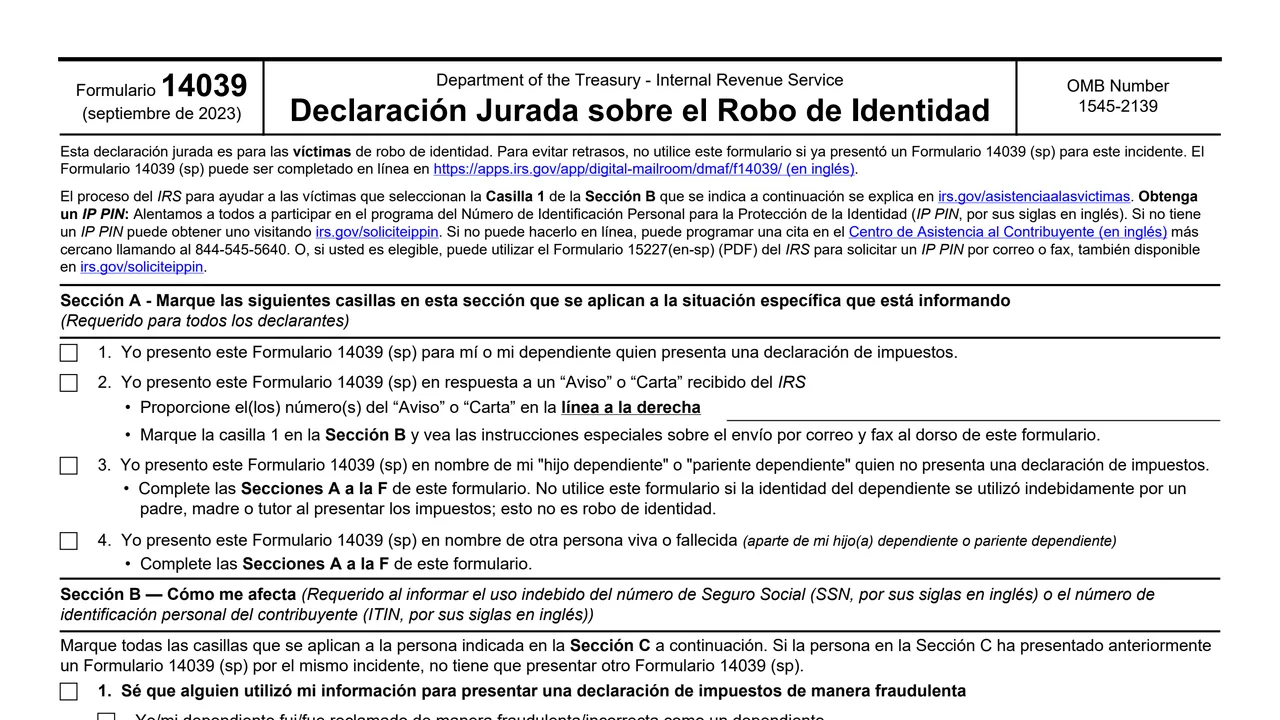
Required for everyone. Four boxes for filing for yourself, answering an IRS notice, filing for a dependent who does not file, or filing for another person.
Required when reporting misuse of an SSN or ITIN. Box 1 covers a fraudulent return, a fraudulent dependent claim or use of the number for work. Box 2 is for victims who do not know of tax misuse, with space to explain.
Required. Name, the 9-digit SSN or ITIN, current address (last known if deceased), the address on the last return if different, phone numbers, best times to call and preferred language.
The last return filed, the names used on it and the tax years believed affected, with a box for people not required to file. It is skipped if box 2 in Section B is checked.
Required. A statement under penalties of perjury, signed and dated by the taxpayer, representative, custodian, parent or guardian.
Required when filing for someone else. One of five reason boxes, the documents to attach, a CAF number if any, and the representative's name, address and phone.
Check the boxes that apply. If you are replying to an IRS notice or letter, enter its number on the line to the right of box 2.
Check every box that applies to the person in Section C. Explain the identity theft, how it affects the tax account, when it was discovered and the relevant dates. Attach extra sheets if needed.
Enter the victim's name and full 9-digit SSN or ITIN, current address, the address on the last return if different, phone numbers and the preferred language.
Enter the last return filed, the names on it and the affected years, for example 2020 for the 2020 return even if filed later. If the years are not known, the form says to enter "Desconocido" (unknown).
Sign and date Section E. A representative checks only one box in Section F, attaches the documents that box lists, such as a court certificate or death certificate, and adds their contact details.
You get the real form, filled in a browser tab, with nothing standing between you and the finished PDF.
The form says to choose one way to send it: online (the preferred method), by mail or by fax, not all of them. It also asks for clear, readable photocopies of any extra information.
The preferred method is apps.irs.gov/app/digital-mailroom/dmaf/f14039/, which the form marks as being in English.
Always include a cover sheet marked "Confidencial". If you are replying to an IRS notice that shows a fax number, fax it there. Everyone else faxes toll free to 855-807-5720.
A reply to a notice goes, with a copy of the notice if possible, to the address on the notice. Other mail goes to Department of the Treasury, Internal Revenue Service, Fresno, CA 93888-0025.
If box 1 or 2 in Section B is checked and the return cannot be e-filed because a number was misused, the form says to attach it to the back of the paper return and send both where you normally file.
The form says not to use its mailing address or fax number to file an original tax return. Send the return to the IRS office where you normally file.
14039
72 fields, 2 pages
14039-B
48 fields, 2 pages
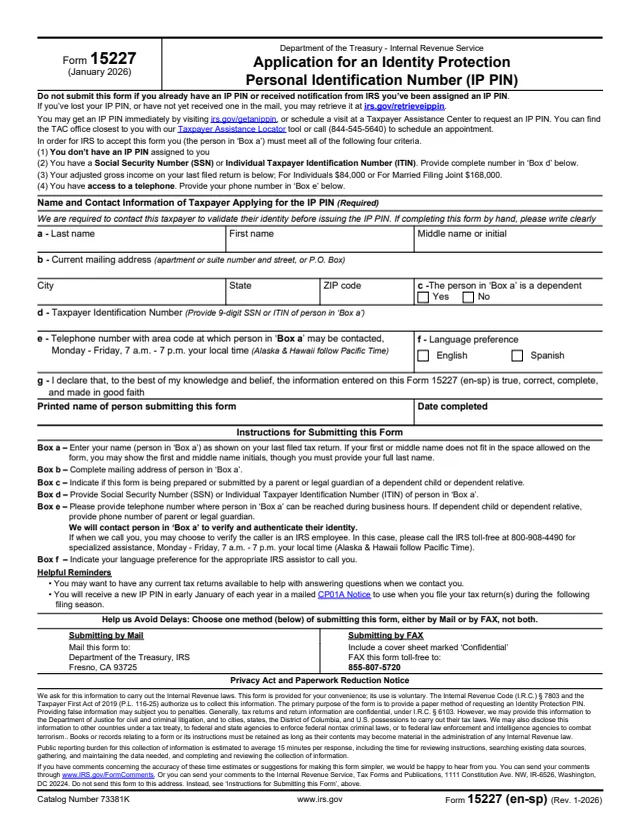
15227
42 fields, 2 pages
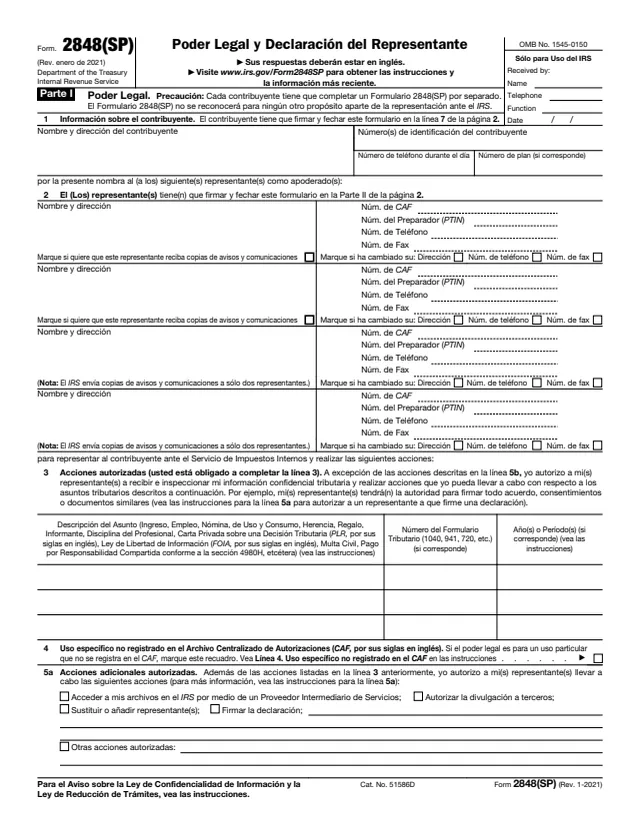
2848
78 fields, 2 pages
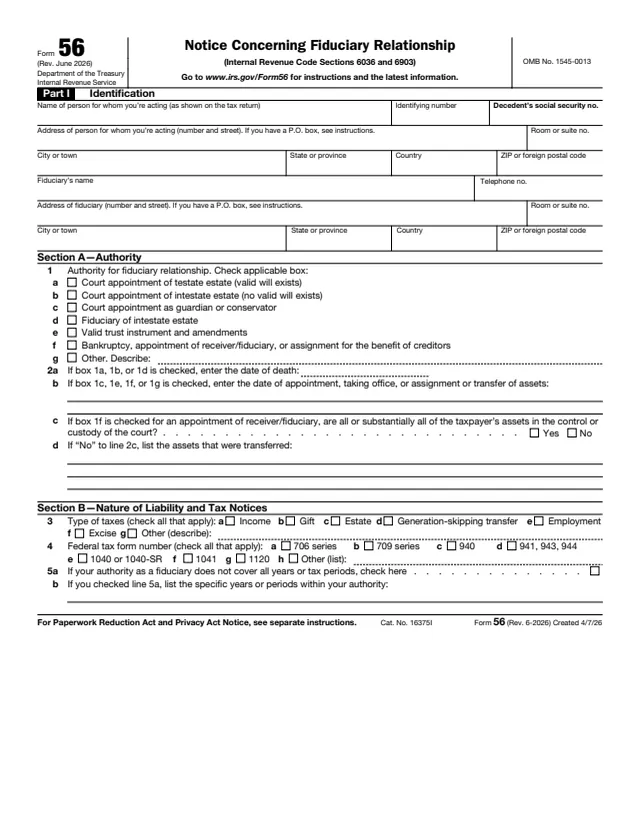
56
72 fields, 2 pages
The identity theft victim completes and signs it, or a parent, guardian, custodian or representative does so for them. It goes to the IRS online, by fax or by mail.
No tool matches that search.
Spanish. The form and its filing instructions are in Spanish, while the online version it links to is marked as being in English. The English edition is Form 14039.
No. The form says not to use it if a Form 14039 (sp) was already filed for this incident, to avoid delays.
The form lists 855-807-5720 as a toll-free fax for people not replying to an IRS notice. A reply to a notice goes to the fax number on that notice.
Yes. Box 3 in Section A and box 5 in Section F are for a dependent child or relative. The form says misuse of the dependent's identity by a parent or guardian on a tax return is not identity theft.
Section F says no attachments are needed, including a death certificate. A court-appointed representative attaches the court certificate, and when no representative was appointed, the filer attaches a death certificate or a formal notice of the death from a government office.
The form points to irs.gov/soliciteippin. If you cannot get one online, it lists 844-545-5640 to book a Taxpayer Assistance Center appointment, or Form 15227 (en-sp) for eligible taxpayers by mail or fax.