Items 1 and 2: basis and equivalent hearing
Boxes for a lien notice and a levy notice, and a box asking for an equivalent hearing if the CDP request is not timely.
12153
Request for a Collection Due Process or Equivalent Hearing (Spanish Version)
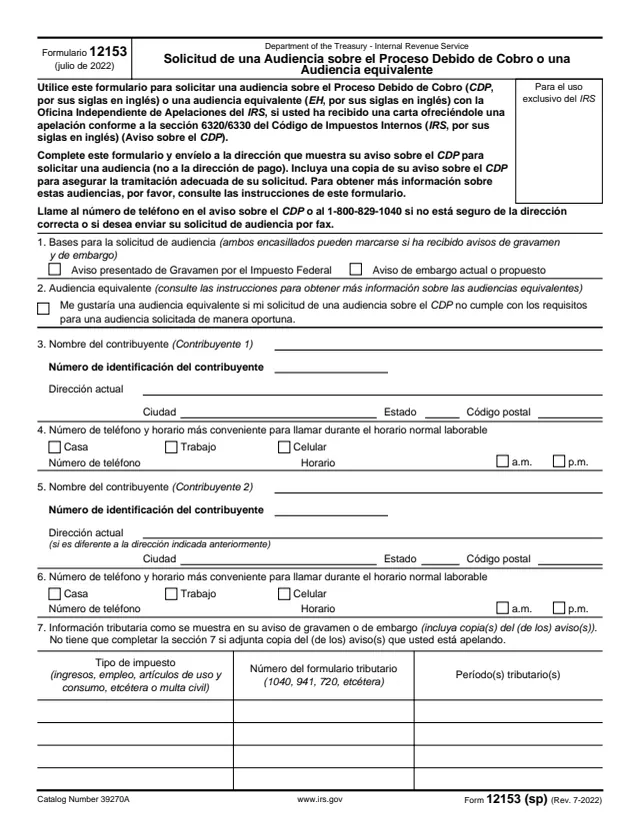
Form 12153 (sp) is the Spanish version of Form 12153, Request for a Collection Due Process or Equivalent Hearing. The PDF is titled "Solicitud de una Audiencia sobre el Proceso Debido de Cobro o una Audiencia equivalente" and is dated "julio de 2022" (Rev. 7-2022), the same revision date as the English edition. It has two pages of form items and two pages of information about the hearings, all in Spanish.
The form says it is used to request a Collection Due Process (CDP) hearing or an equivalent hearing (EH) with the IRS Independent Office of Appeals after receiving a letter that offers an appeal under section 6320 or 6330 of the Internal Revenue Code, called the CDP notice. It asks you to send it to the address on the CDP notice, not the payment address, with a copy of the notice.
The English edition, Form 12153, has its own page. You can fill out this Spanish PDF free in your browser on this page and download it without an account.
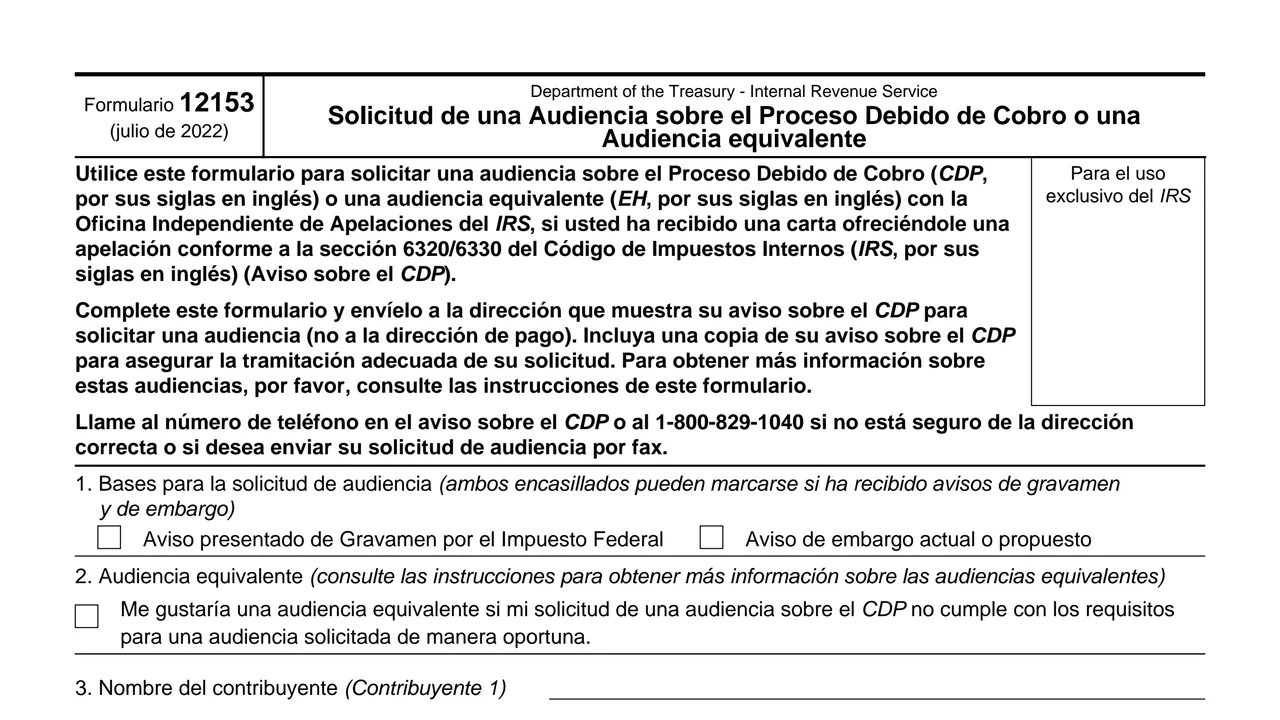
Boxes for a lien notice and a levy notice, and a box asking for an equivalent hearing if the CDP request is not timely.
Name, taxpayer identification number, current address, and home, work or cell phone with the best time to call, for Taxpayer 1 and Taxpayer 2.
Type of tax (income, employment, excise or civil penalty), the tax form number, such as 1040, 941 or 720, and the tax periods. It can be skipped if copies of the notices are attached.
Boxes for not being liable, innocent spouse relief, taxes discharged in bankruptcy, payments not applied, lien withdrawal, economic hardship or a collection alternative, plus space for other issues.
Boxes for an installment agreement, an offer in compromise, currently unable to pay, or other, with notes on when Form 433-A (sp) or 433-B (sp) is not needed.
A statement that the hearing suspends the collection statute period, then signatures and dates for both taxpayers or the representative, and an IRS use only area.
Check the notice or notices you received. Check item 2 if you want an equivalent hearing in case the CDP request does not meet the timeliness requirement.
Enter each taxpayer's name, number, address and daytime phone. Fill in item 7 from the lien or levy notice, or attach a copy of each notice you are appealing.
Check the reasons that fit or explain the dispute in your own words, adding pages if needed. The form says the request will not be processed without a reason.
To propose an alternative, check it and include Form 433-A (sp) for individuals or 433-B (sp) for businesses. The form says this is not required but helps resolve the case faster.
Sign and date. A company officer adds a title after the signature. A representative signs with Form 2848 (sp) attached unless it is already on file.
You get the real form, filled in a browser tab, with nothing standing between you and the finished PDF.
Send it to the address on your CDP notice, not the payment address, with a copy of the notice. Call the number on the notice or 1-800-829-1040 if unsure of the address or to fax the request.
Page 3 says a timely request stops levy action in most cases and suspends the IRS's 10-year collection period until the Appeals determination is final. The determination can be appealed in court.
The form says it is the same as a CDP hearing except it does not stop levy, does not suspend the 10-year period, and its decision cannot be challenged in court.
The form says to keep a copy of the request and proof of the date it was sent. A levy hearing request does not stop the IRS from filing a Notice of Federal Tax Lien.
Low Income Taxpayer Clinics can represent low-income people and help people who speak English as a second language, free or for a nominal fee. Publication 4134 (sp) lists them; call 800-829-3676 for a copy.
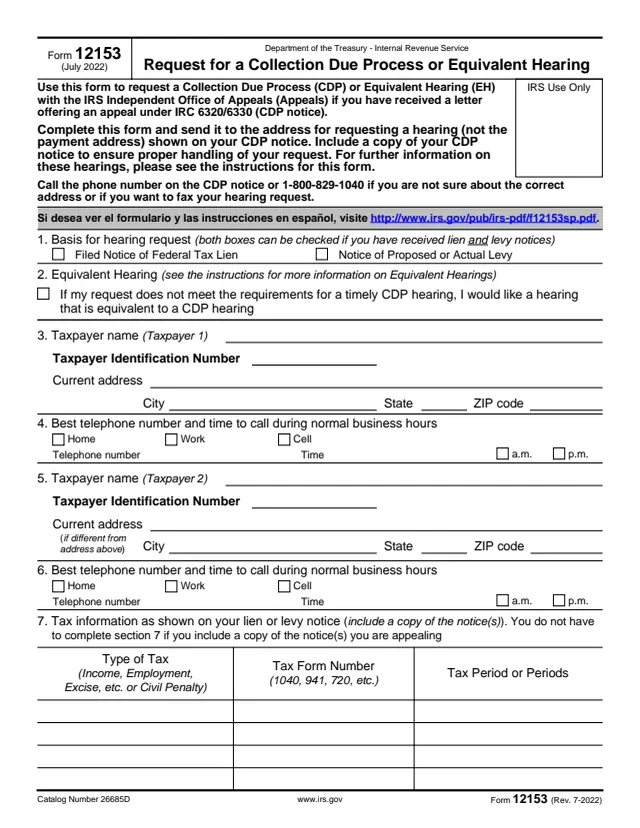
12153
79 fields, 4 pages
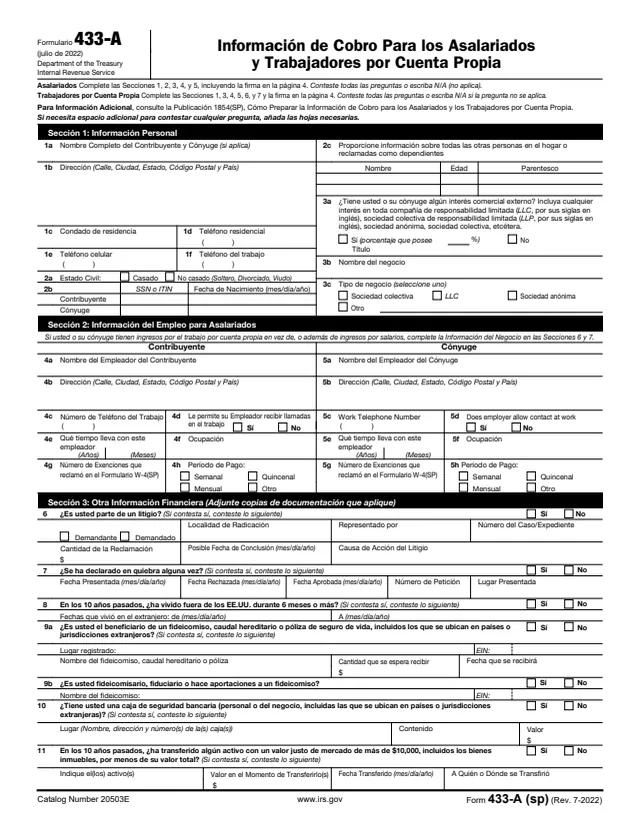
433-A
391 fields, 6 pages
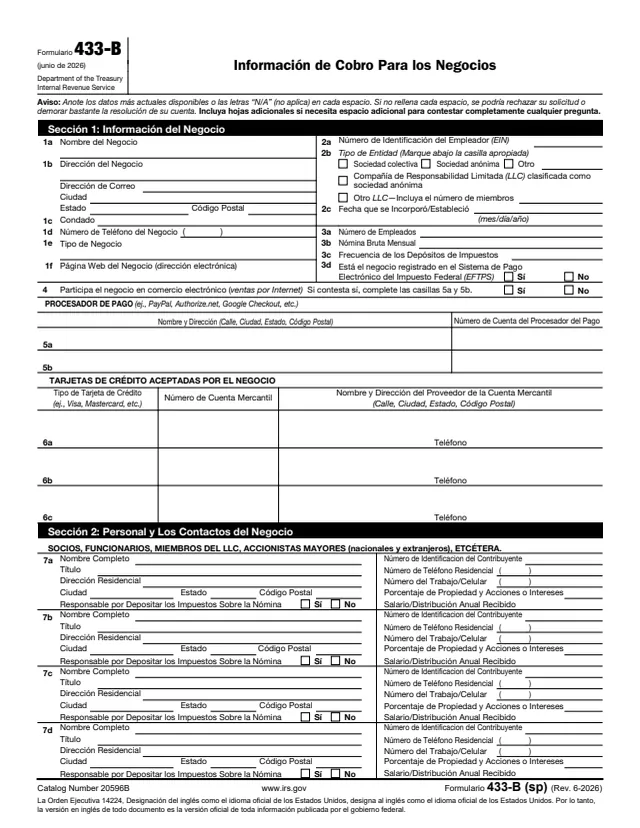
433-B
453 fields, 6 pages
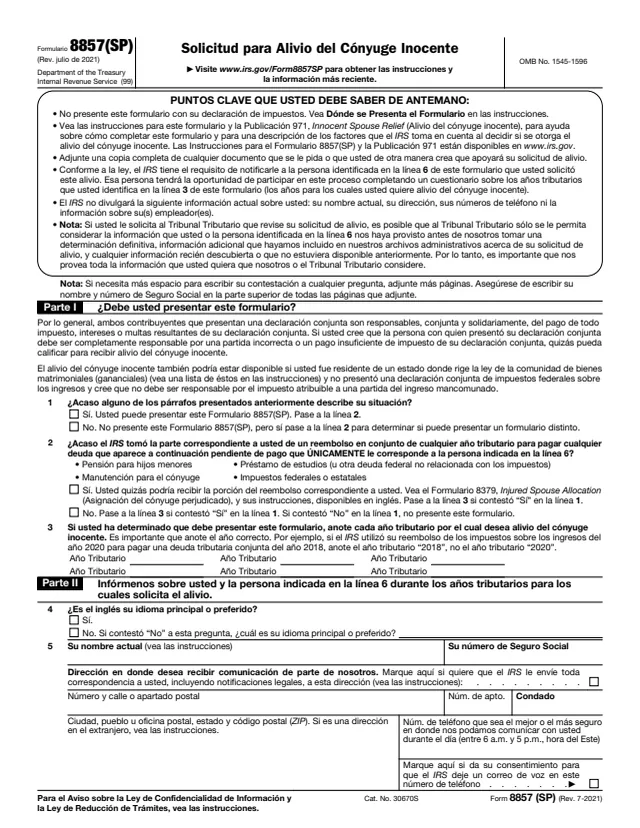
8857
207 fields, 6 pages
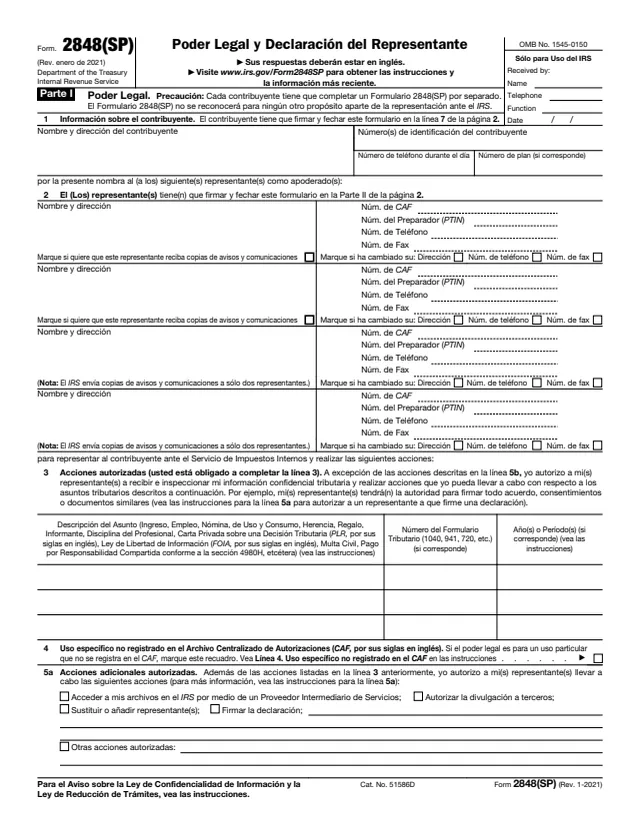
2848
78 fields, 2 pages
The taxpayer named on the CDP notice, or their representative, completes and signs it and sends it to the IRS address on the notice. The IRS Independent Office of Appeals holds the hearing.
No tool matches that search.
Spanish. The form items and the information pages are in Spanish. The English edition is Form 12153, with the same July 2022 revision date.
To the address on your CDP notice, not the payment address. The form says to include a copy of the notice.
The form says to check item 2 to receive an equivalent hearing. It does not stop levy or suspend the 10-year collection period, and its decision cannot be taken to court.
Only to discuss a collection alternative. Item 9 names Form 433-A (sp) or 433-B (sp) and says they are not required with the request, but early submission helps.
Check that reason in item 8. Page 3 says Form 8857 (sp), Request for Innocent Spouse Relief, is completed for the request to be considered.
Page 4 says that if collection is suspended because you cannot pay, applicable interest and penalties keep accruing on the unpaid balance.