Name of the requester
"Nombre del solicitante", as shown on the tax return.
1040 Sch. LEP
Request for Change in Language Preference (Spanish Version)
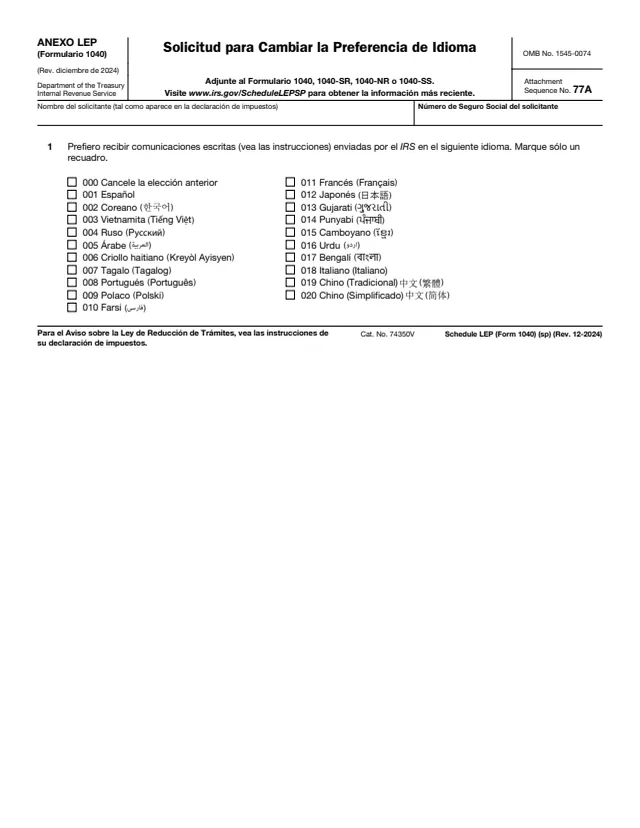
Schedule LEP (Form 1040) (sp) is the Spanish version of Schedule LEP, Request for Change in Language Preference. Its Spanish title is "Anexo LEP (Formulario 1040), Solicitud para Cambiar la Preferencia de Idioma". The schedule and its page of instructions are in Spanish, and each language on line 1 is named in Spanish with its own script, for example "Coreano (한국어)". The IRS office names in the header and the footer are in English.
The schedule tells the IRS which language the filer prefers for written communications, such as letters, notices, forms, instructions and publications, or that the filer wants to go back to English. The instructions say it is not mandatory and that taxpayers with limited English proficiency can file it with their return.
It is attached to Form 1040, 1040-SR, 1040-NR or 1040-SS, and points to www.irs.gov/ScheduleLEPSP for the latest information. You can fill out the PDF free in your browser on this page and download it without an account.
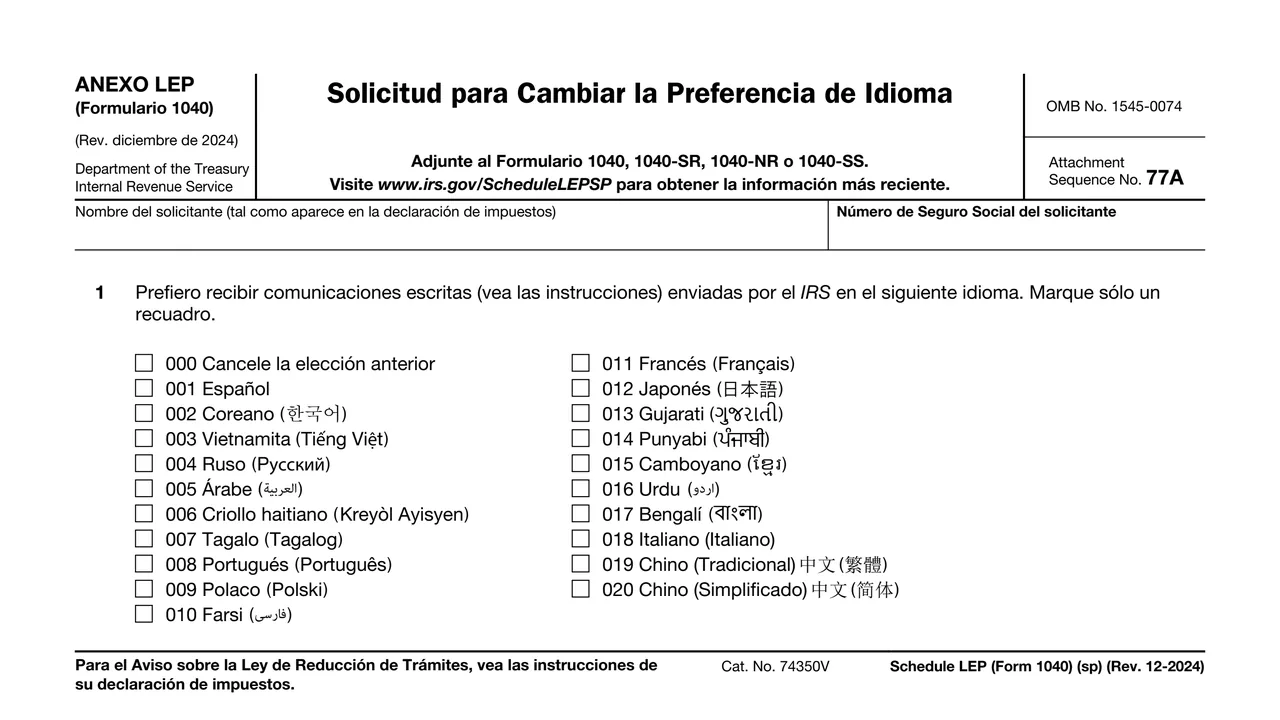
"Nombre del solicitante", as shown on the tax return.
The Social Security number of the person making the request.
Spanish, Korean, Vietnamese, Russian, Arabic, Haitian Creole, Tagalog, Portuguese, Polish and Farsi, each also shown in its own script.
French, Japanese, Gujarati, Punjabi, Cambodian, Urdu, Bengali, Italian, and Chinese (Traditional) and (Simplified).
"Cancele la elección anterior", to cancel a previous choice.
Purpose, who can file, how to file, and notes on the name, joint returns, the SSN and line 1, with tips on www.irs.gov/MyLanguage and the VITA and TCE programs.
The labels are in Spanish. The items below give their English meaning.
Enter the name exactly as it appears on the tax return.
Enter the SSN shown on the return. On a joint return, enter only the SSN of the spouse making the request. An ITIN goes here if the filer has one.
Check only one box. The selection applies to all future written communications, including correspondence about other tax years, until it is changed or cancelled.
If both spouses prefer a language other than English, complete one schedule for each spouse.
Attach it to the income tax return. If the schedule is e-filed with the return, the instructions say not to file the paper form.
You get the real form, filled in a browser tab, with nothing standing between you and the finished PDF.
The instructions say the preference can be stated only by filing Schedule LEP with the income tax return.
If it is filed electronically with the return, the paper schedule is not filed. The instructions point to www.irs.gov/efile and say to click Español.
With the current year return or any later one, but not with a return for a year before 2020.
The instructions say communications may not arrive in the chosen language right away. The IRS plan was scheduled to begin providing translations in 2023, and communications continue in English until they are translated.
The instructions point to www.irs.gov/MyLanguage for basic filing information in other languages and to www.irs.gov/es/VITA for the VITA and TCE programs.
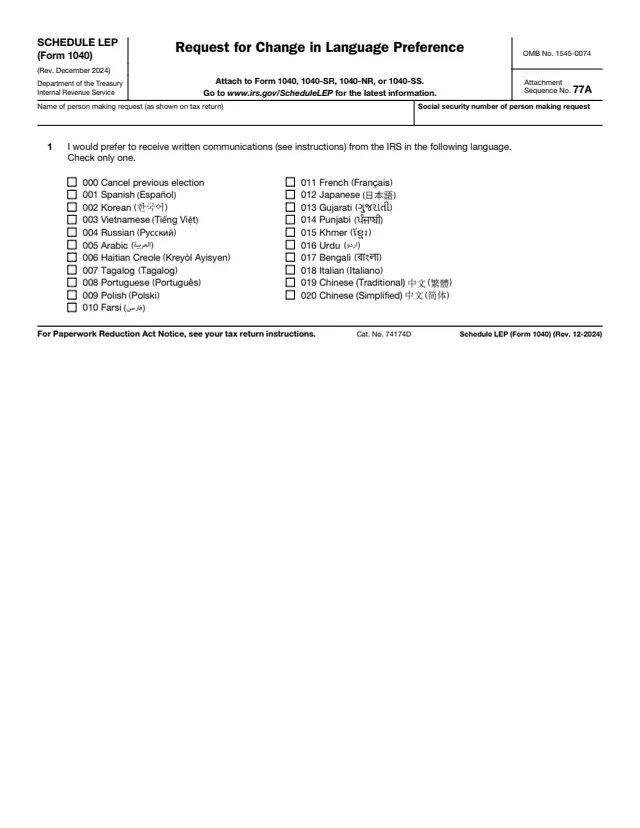
1040 Sch. LEP
23 fields, 2 pages
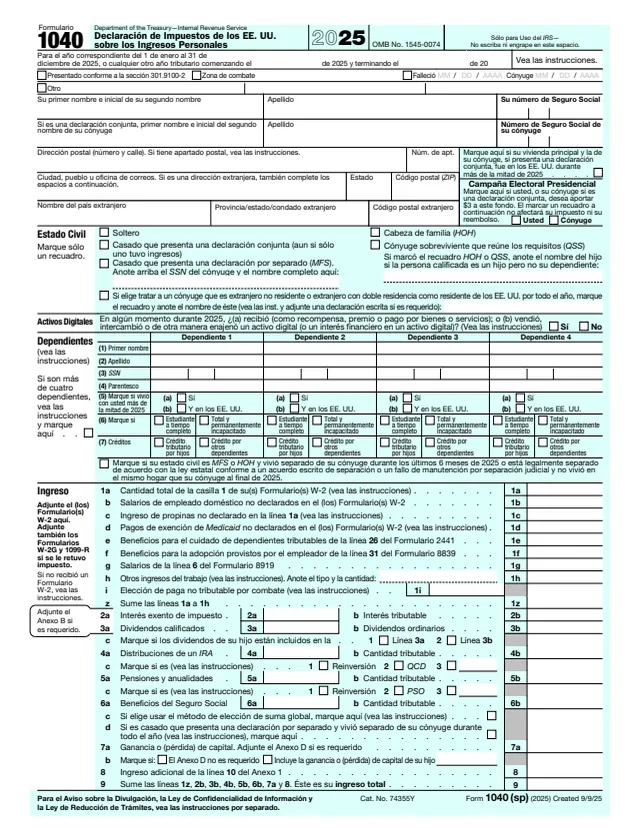
1040
199 fields, 2 pages
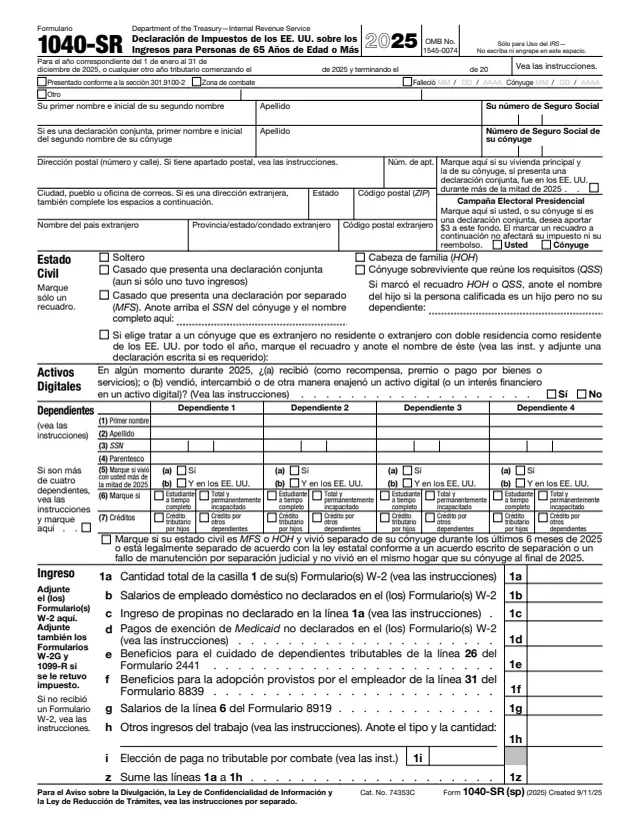
1040-SR
200 fields, 4 pages
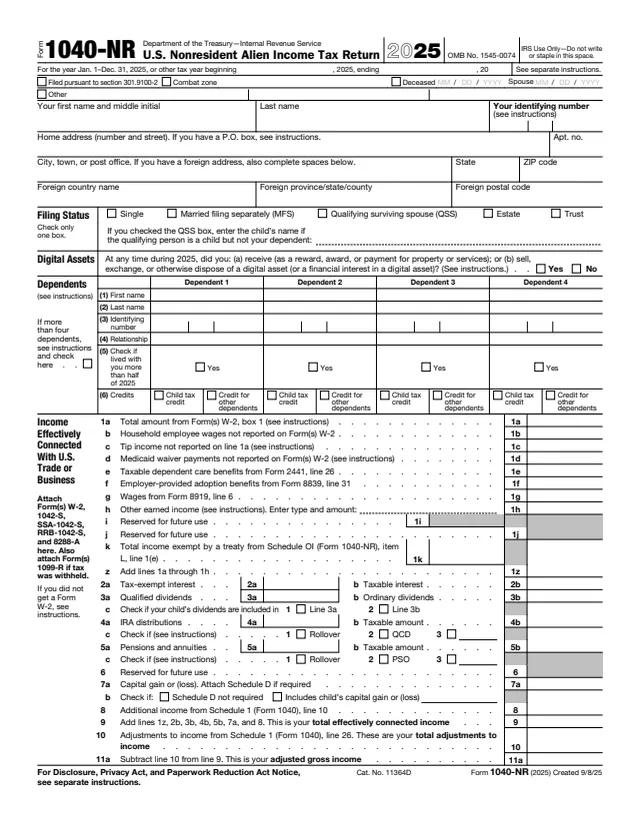
1040-NR
171 fields, 2 pages
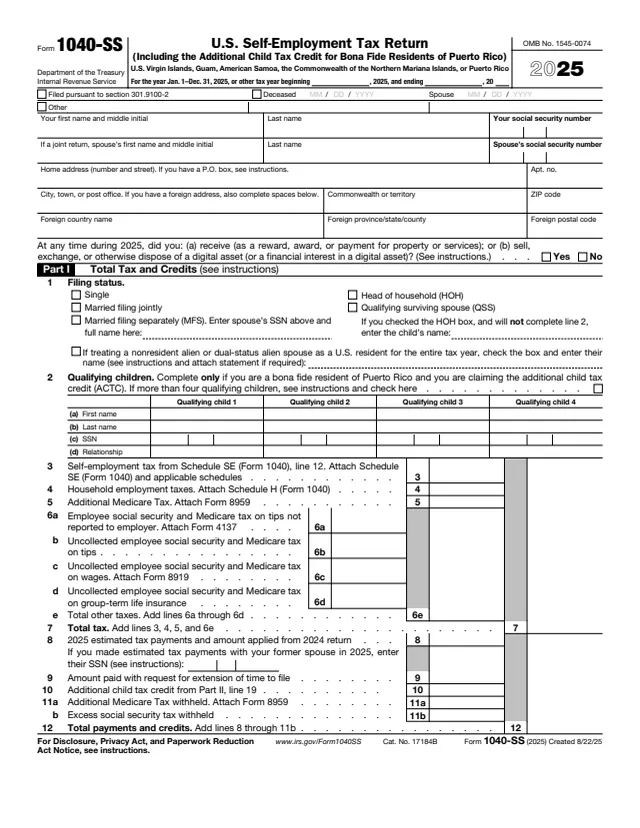
1040-SS
132 fields, 3 pages
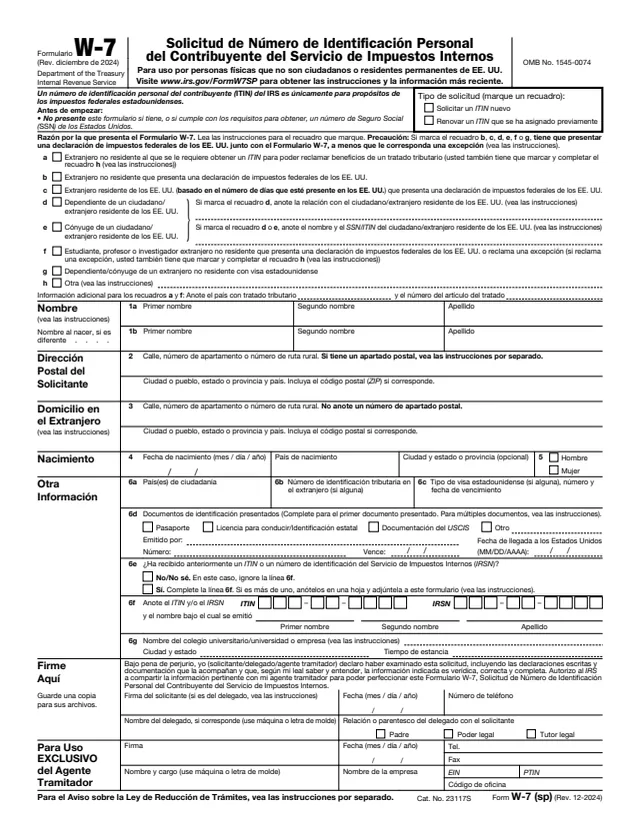
W-7
68 fields, 1 page
The instructions say the taxpayer files it with their own income tax return, and it goes to the IRS with that return. Its use is not mandatory.
No tool matches that search.
The schedule and its instructions are in Spanish. The language names on line 1 are in Spanish with each language's own script. The English edition is Schedule LEP (Form 1040).
By checking one box on line 1. Code 001 is Spanish ("Español"), and the line lists 20 languages plus code 000 to cancel a previous choice.
No. The instructions say its use is not mandatory.
The instructions say the preference can be stated only by filing Schedule LEP with the income tax return.
No. Each spouse who prefers an alternative language files a separate Schedule LEP, even if both prefer the same language.
The instructions say not necessarily right away. Notices and letters continue in English until they are translated into the preferred language.