Instructions page
Who can use the form, when to use it as a backup, the states that require registration first, what each section of the Voter Information page needs, the agency disclosure statement and the Privacy Act advisory.
SF186
Federal Write-In Absentee Ballot (FWAB)
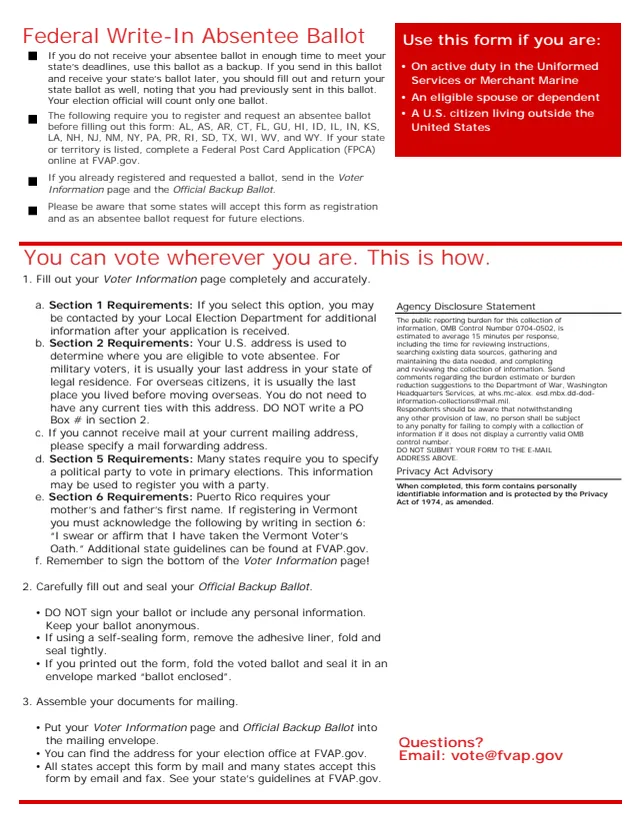
Standard Form 186 (SF 186), the Federal Write-In Absentee Ballot (FWAB), is a backup absentee ballot. The form says to use it if you do not receive your absentee ballot in enough time to meet your state's deadlines. It carries OMB No. 0704-0502, Rev. 08/2026, and GSA hosts a copy in its forms library. GSA's page lists the Uniformed and Overseas Citizens Absentee Voting Act, 52 U.S.C. § 20303, as its authority.
The form lists who it is for: people on active duty in the Uniformed Services or Merchant Marine, eligible spouses or dependents, and U.S. citizens living outside the United States. It has an instructions page, a Voter Information page with seven sections, an Official Backup Ballot, a privacy sleeve and a mailing envelope.
The form says that if you send in this ballot and later receive your state's ballot, you should fill out and return the state ballot as well, noting that you had previously sent in this ballot, and your election official will count only one ballot. You can fill it out free in your browser on this page and download the result without an account.
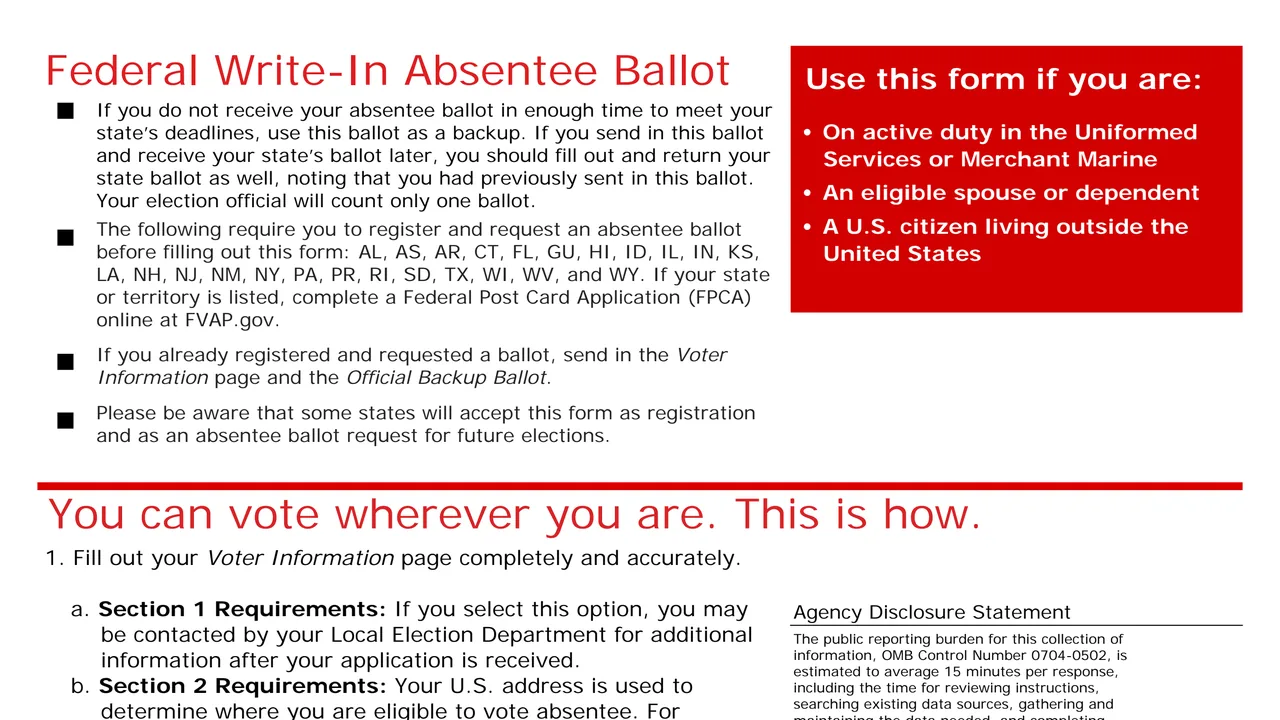
Who can use the form, when to use it as a backup, the states that require registration first, what each section of the Voter Information page needs, the agency disclosure statement and the Privacy Act advisory.
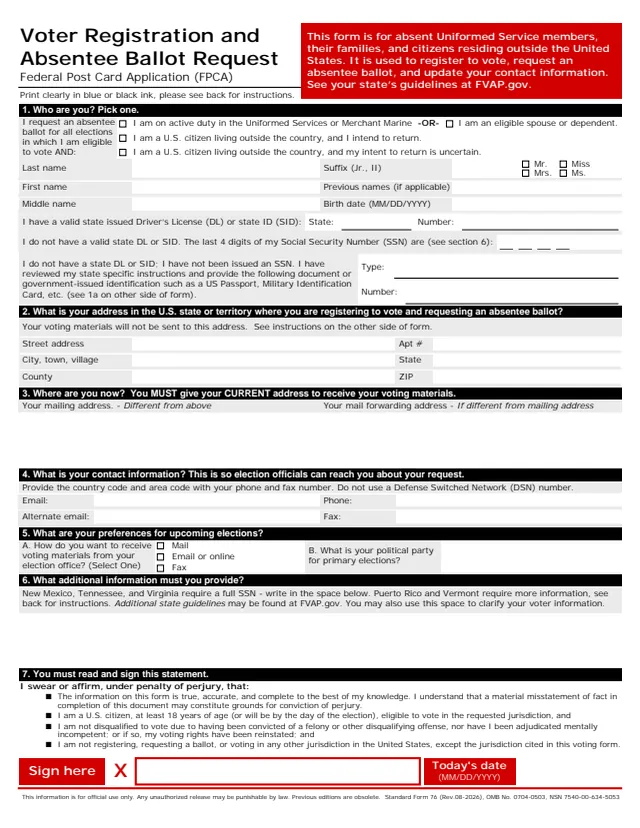
Voter category, name, previous names, birth date, a state driver's license or ID, the last 4 digits of the SSN or another document, and the U.S. voting residence address.
Current mailing and forwarding addresses, email, phone and fax with country and area code, whether to register and request ballots for future elections, how to receive materials, and party for primaries.
Additional information some states need, such as a full SSN or witness signatures, then a sworn statement under penalty of perjury with a signature and today's date.
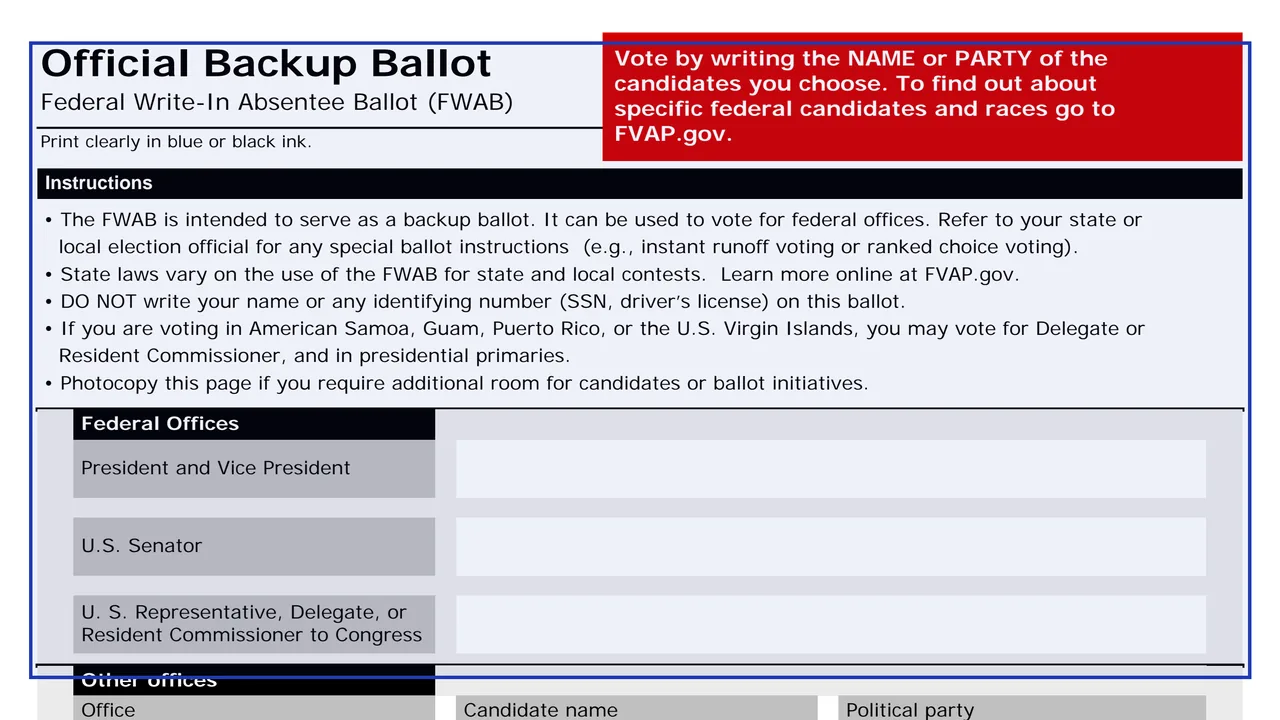
Write-in spaces for President and Vice President, U.S. Senator, and U.S. Representative, Delegate, or Resident Commissioner, plus other offices with candidate and party, and ballot initiatives.
An Official Ballot page marked Private for folding around the ballot, and a mailing envelope with From and To lines and a line for the election month and year.
The form has six pages.
If your state or territory is on the list on the first page, the form says to complete a Federal Post Card Application (FPCA) online at FVAP.gov. If you already registered and requested a ballot, send the Voter Information page and the Official Backup Ballot.
Print clearly in blue or black ink. The instructions say not to write a PO Box in section 2, to give your current address in section 3, and not to use a Defense Switched Network (DSN) number in section 4.
The form says Puerto Rico requires your mother's and father's first name, and Vermont voters write: I swear or affirm that I have taken the Vermont Voter's Oath.
Read the statement in section 7, then sign and date at the bottom. The instructions remind you to sign the bottom of the Voter Information page.
Write the name or party of the candidates you choose. The form says not to sign the ballot or write your name or any identifying number on it, and to photocopy the page if you need more room.
Fold and seal the ballot, put it and the Voter Information page in the mailing envelope, and send it to your election office. The form says the address can be found at FVAP.gov.
You get the real form, filled in a browser tab, with nothing standing between you and the finished PDF.
To your election office. The form says the address can be found at FVAP.gov, and the burden statement says not to submit the form to its e-mail address.
The form says all states accept this form by mail and many states accept it by email and fax, and to see your state's guidelines at FVAP.gov.
The envelope says no postage is necessary in the U.S. mail (DMM 703.8.0), and that international airmail postage is required if not mailed using the U.S. Postal Service, APO/FPO/DPO system, or diplomatic pouch.
The form says to fill out and return your state ballot as well, noting that you had previously sent in this ballot. Your election official will count only one ballot.
The burden is estimated to average 15 minutes per response (OMB Control Number 0704-0502). The form says that when completed it contains personally identifiable information protected by the Privacy Act of 1974, as amended.
The red box on the first page and Section 1 of the Voter Information page list who the form is for.
No tool matches that search.
The form names no issuing agency in its header. It carries OMB No. 0704-0502, its burden statement sends comments to the Department of War, Washington Headquarters Services, and it lists [email protected] for questions. GSA hosts a copy in its forms library.
The form says to use it as a backup if you do not receive your absentee ballot in enough time to meet your state's deadlines.
The form says to fill out and return your state ballot as well, noting that you had previously sent in this ballot. Your election official will count only one ballot.
No. The ballot instructions say not to write your name or any identifying number (SSN, driver's license) on the ballot, and not to sign it.
The form says it can be used to vote for federal offices, and that state laws vary on its use for state and local contests. Voters in American Samoa, Guam, Puerto Rico or the U.S. Virgin Islands may vote for Delegate or Resident Commissioner and in presidential primaries.
The form says some states will accept it as registration and as an absentee ballot request for future elections. Section 5 asks whether you want to register and request a ballot for all elections you are eligible to vote in.
The form says all states accept it by mail and many accept it by email and fax. The envelope says no postage is necessary in the U.S. mail, and the election office address can be found at FVAP.gov.