Header: service, premises and contract
Type of utility service, contract number, premises to be served, Government-owned or Leased boxes, lease number and lessor.
GSA1533
Utilities Contract
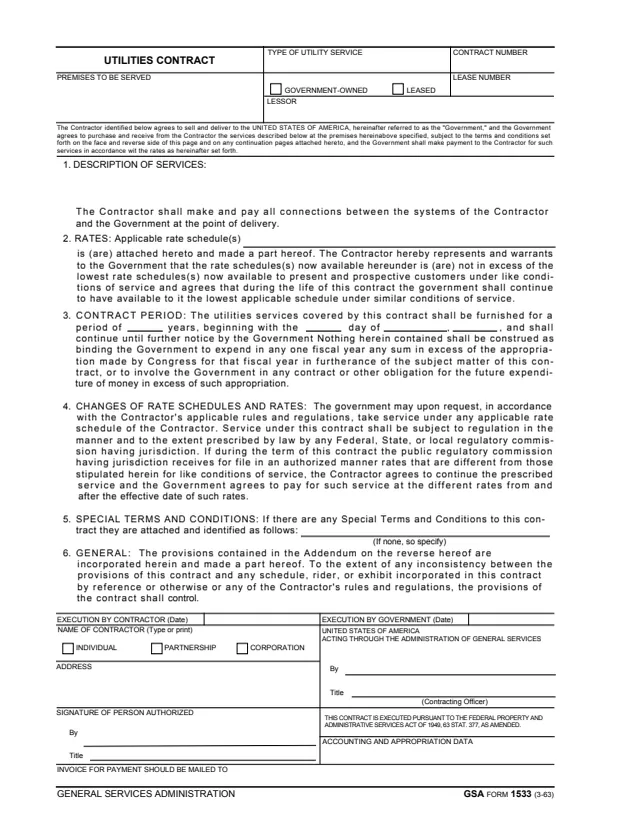
GSA Form 1533, Utilities Contract, is a two-page General Services Administration (GSA) form, printed as GSA FORM 1533 (3-63). GSA hosts it in its forms library, and GSA's page lists no authority or regulation for it. The form says the contract is executed pursuant to the Federal Property and Administrative Services Act of 1949, 63 Stat. 377, as amended.
Under it, the Contractor agrees to sell and deliver utility services to the United States of America at the premises named at the top, and the Government agrees to purchase them and pay at the rates in the attached rate schedules. The front page has six numbered paragraphs: description of services, rates, contract period, changes of rate schedules and rates, special terms and conditions, and general. The reverse is an Addendum of seven clauses.
The contract is executed by the Contractor and by the United States of America acting through the Administration of General Services, with a Contracting Officer's signature. You can fill it out free in your browser on this page and download the result without an account.
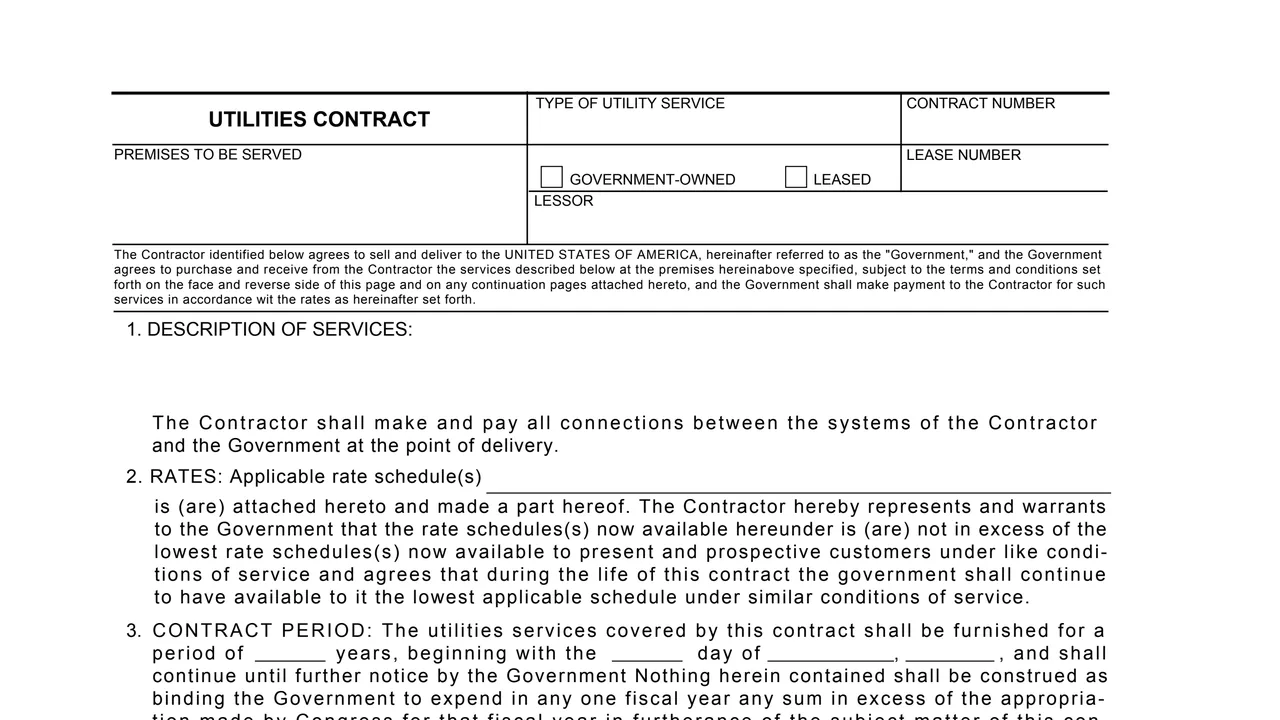
Type of utility service, contract number, premises to be served, Government-owned or Leased boxes, lease number and lessor.
A description of services, then the applicable rate schedules, which the Contractor warrants are not in excess of the lowest rate schedules available to customers under like conditions of service.
Blanks for a period in years and a starting day, month and year. Service continues until further notice by the Government.
Service under any applicable rate schedule and regulation by any Federal, State or local regulatory commission having jurisdiction, any special terms and conditions attached, and the Addendum made part of the contract.
Execution by Contractor and Execution by Government, each dated, plus accounting and appropriation data and where invoices for payment are mailed.
Seven clauses on the reverse: officials not to benefit, covenant against contingent fees, nondiscrimination in employment, convict labor, patents, Work Hours Act of 1962 overtime compensation, and payment for services rendered.
Enter the type of utility service, contract number and premises to be served, check Government-owned or Leased, and fill in the lease number and lessor blocks.
Paragraph 1 has space for the description of services. The form says the Contractor shall make and pay all connections between the systems of the Contractor and the Government at the point of delivery.
Paragraph 2 has a line for the applicable rate schedule or schedules, which the form says are attached and made a part of the contract.
Paragraph 3 has blanks for a period in years and a starting day, month and year.
Paragraph 5 has a line for any special terms and conditions attached to the contract. The form says if none, so specify.
The Contractor and the Contracting Officer each complete and date their execution block. The bottom blocks take the accounting and appropriation data and where invoices for payment are mailed.
You get the real form, filled in a browser tab, with nothing standing between you and the finished PDF.
The form says the contract is executed pursuant to the Federal Property and Administrative Services Act of 1949, 63 Stat. 377, as amended.
If the regulatory commission having jurisdiction receives rates different from those in the contract for like conditions of service, the form says the Contractor continues the service and the Government pays the different rates from their effective date.
Paragraph 3 says nothing in the contract binds the Government to expend in any one fiscal year any sum in excess of the appropriation made by Congress for that fiscal year.
The Addendum says all bills for services are paid without penalty or interest, and the Government is entitled to any discounts customarily applicable to payment of bills by any customer of the Contractor.
The Work Hours Act of 1962 clause computes liquidated damages in the sum of $10 for each calendar day a laborer or mechanic worked in excess of eight hours, or forty hours in a workweek, without the required overtime wages.
The form prints no Privacy Act statement, OMB number, time estimate or filing address.
The form is a contract between the Contractor that supplies the service and the Government, with an execution block for each.
No tool matches that search.
The footer reads GENERAL SERVICES ADMINISTRATION and GSA FORM 1533 (3-63). GSA hosts it in its forms library. The form says the contract is executed pursuant to the Federal Property and Administrative Services Act of 1949, 63 Stat. 377, as amended.
The Contractor identified on the form, and the United States of America acting through the Administration of General Services, which signs through a Contracting Officer.
The premises named in the Premises to Be Served block, marked Government-owned or Leased, with blocks for a lease number and lessor.
Paragraph 3 has blanks for a period in years and a start date, and says service shall continue until further notice by the Government.
Paragraph 4 says service is subject to regulation by any Federal, State or local regulatory commission having jurisdiction, and that the Government pays different rates the commission receives for like conditions of service from their effective date.
Seven clauses: officials not to benefit, covenant against contingent fees, nondiscrimination in employment, convict labor, patents, Work Hours Act of 1962 overtime compensation, and payment for services rendered. Paragraph 6 makes the Addendum part of the contract.