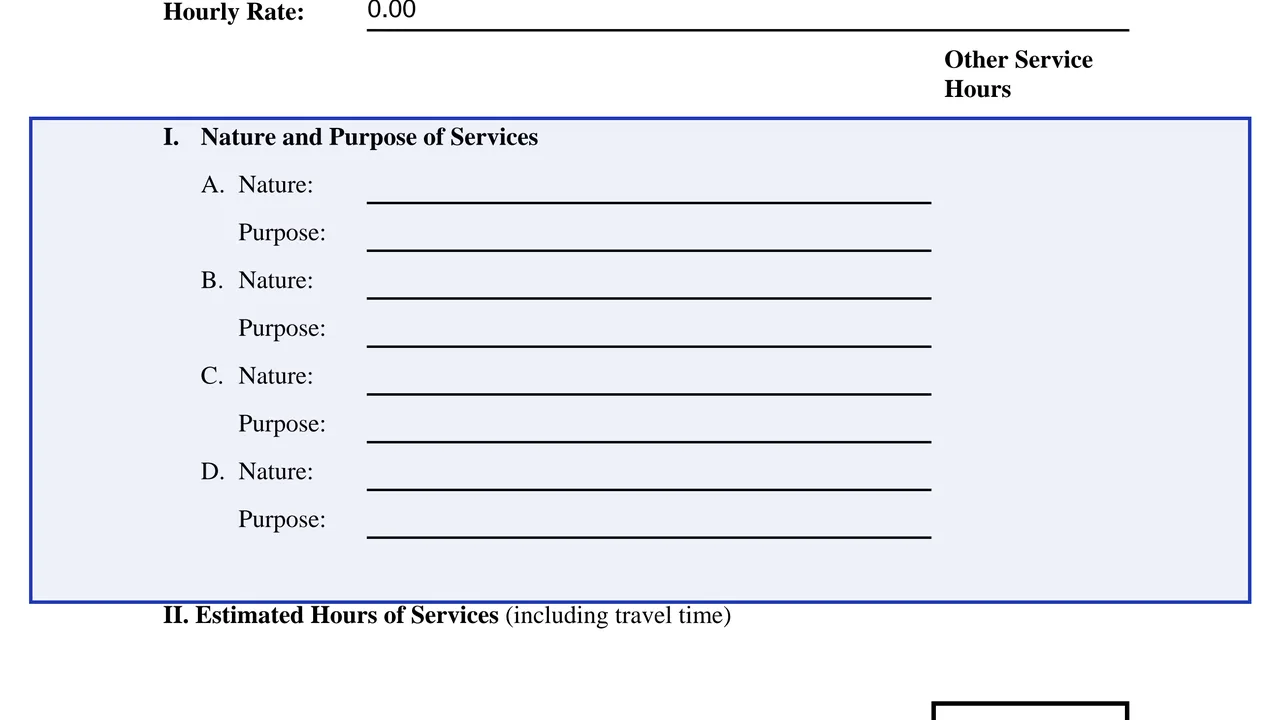
Case and provider details
Date, case name, case number, type of service, name of provider and hourly rate.
CJA 28H
Other Services Summary Budget Worksheet for Non-capital Representations with the Potential for Extraordinary Cost
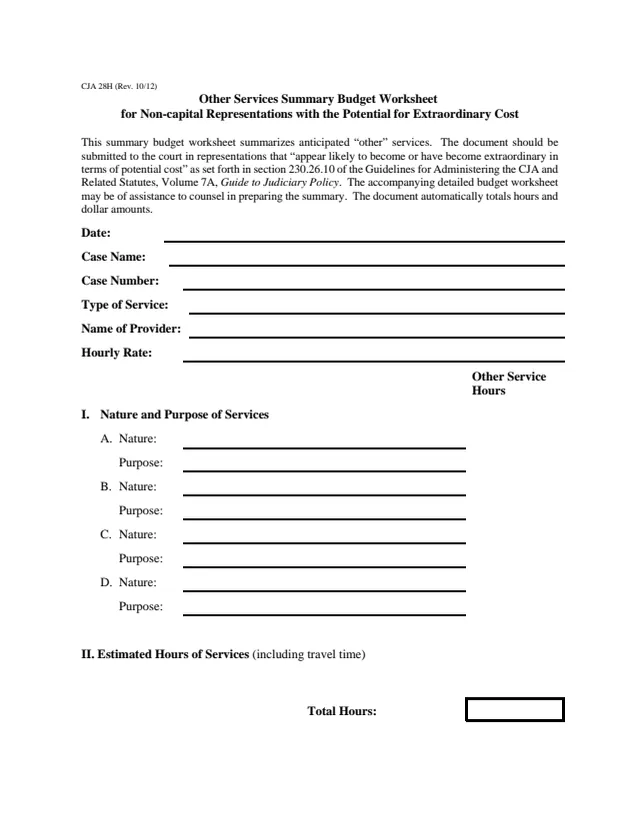
CJA 28H, Other Services Summary Budget Worksheet for Non-capital Representations with the Potential for Extraordinary Cost, is a Criminal Justice Act (CJA) case budgeting form from the U.S. Courts. The U.S. Courts list it under Budgeting Worksheets. The PDF is dated Rev. 10/12, and the page lists it as effective on October 1, 2012.
The form says it summarizes anticipated "other" services and should be submitted to the court in representations that "appear likely to become or have become extraordinary in terms of potential cost" as set forth in section 230.26.10 of the Guidelines for Administering the CJA and Related Statutes, Volume 7A, Guide to Judiciary Policy. It has two pages: the nature and purpose of the services, total hours, travel and other costs, and an approved case budget. The explanatory memorandum the U.S. Courts page links as the form instructions says the AO developed CJA Forms 28A to 28H, with a detailed and a summary worksheet for each of four types of services: attorney, investigator, expert and "other".
This page explains the form in plain words and is not legal advice. It can be filled out free in the browser on this page and downloaded without an account.
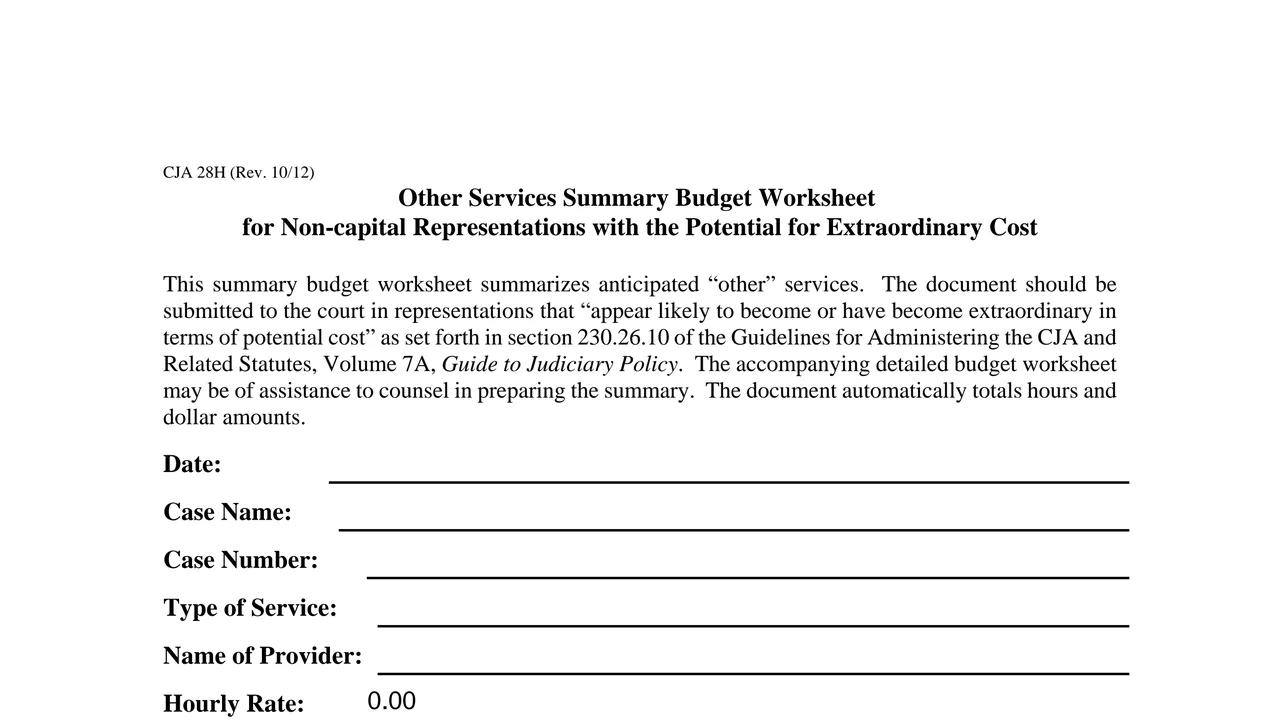
Date, case name, case number, type of service, name of provider and hourly rate.
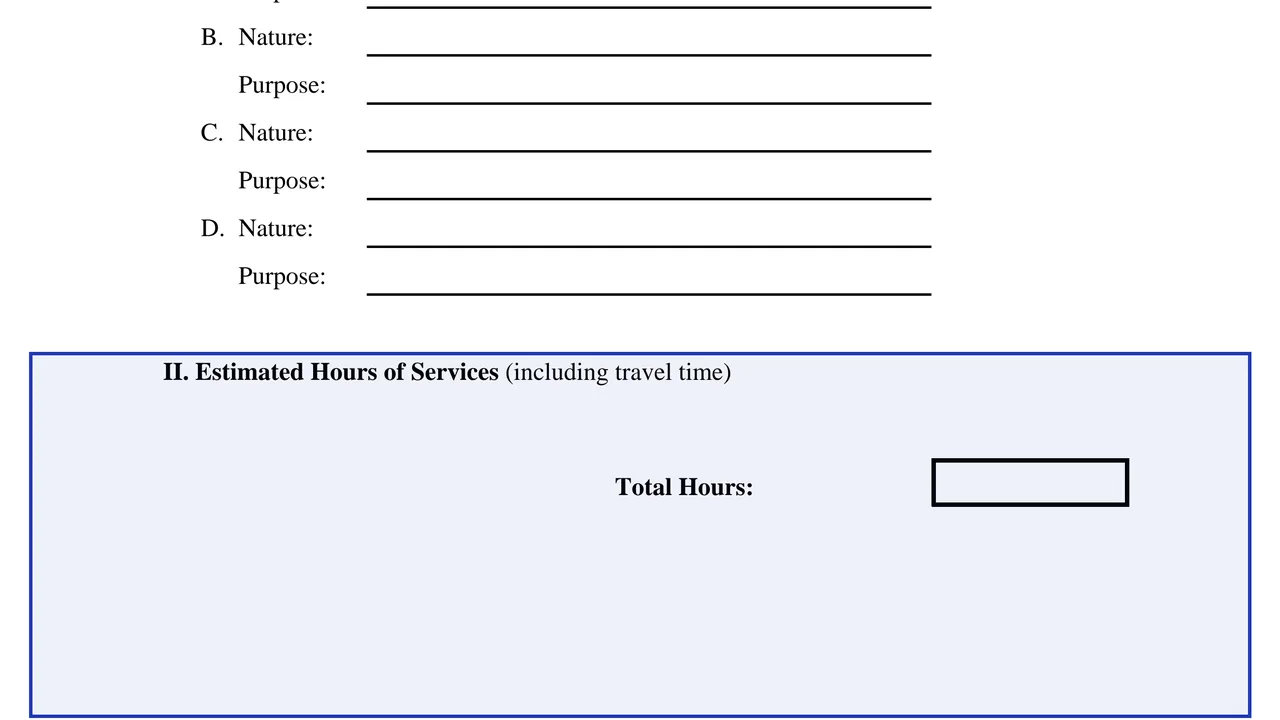
Up to four services, each with its nature and its purpose.
One total of estimated hours of services, including travel time.
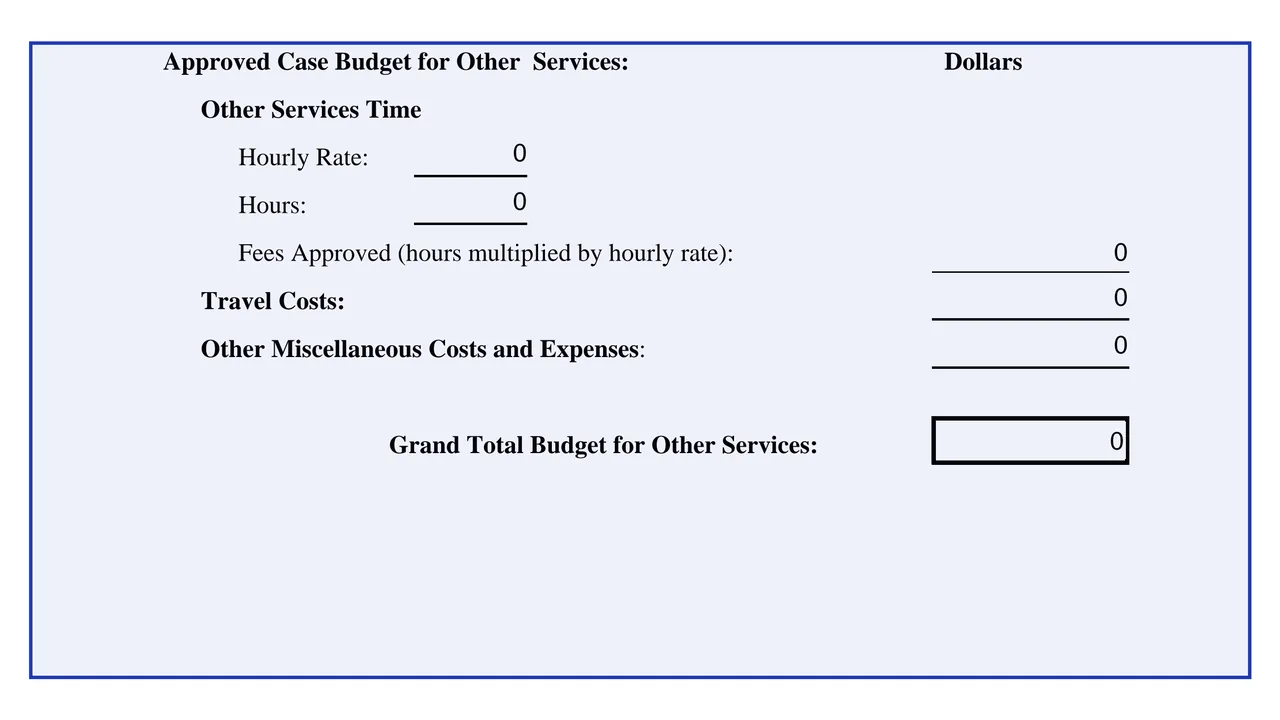
Travel expenses and other miscellaneous costs and expenses, each entered as one amount.
Other services time (hourly rate and hours), fees approved (hours multiplied by hourly rate), travel costs, other costs and the grand total budget for other services.
The form says the accompanying detailed budget worksheet may be of assistance to counsel in preparing the summary. For this service type it is CJA 28G in the U.S. Courts list.
Enter the date, case name, case number, type of service, name of provider and hourly rate.
Section I asks for the nature and the purpose of each service, with room for four. Section II takes the total estimated hours, including travel time.
Enter travel expenses in section III and other miscellaneous costs and expenses in section IV.
The last page multiplies hours by the hourly rate and adds travel and other costs into the grand total budget for other services.
The PDF has Print, Save As and Reset buttons at the end. The form has no signature line.
You get the real form, filled in a browser tab, with nothing standing between you and the finished PDF.
The form says it should be submitted to the court. The memorandum says that in some cases the court may review summary worksheets for some services and detailed worksheets for others.
The memorandum recommends that the presiding judicial officer send a case budget to the chief judge of the court of appeals (or his or her delegate) for approval.
The memorandum says the Judicial Conference adopted a CJA guideline in September 2003 encouraging courts to use case budgeting where the defense of an individual CJA defendant is anticipated to cost in excess of $30,000 or involve more than 300 hours of attorney time.
CJA 28H does not print a filing fee, an hourly rate or a mileage rate. The rates, hours and costs are entered on the worksheet, which totals them.
The memorandum says case budgets should not be viewed as etched in stone and may be modified as the case progresses. It says judges reviewing a budget may contact the ODS Legal and Policy Branch Duty Attorney, and that the Ninth Circuit Excel worksheets can be obtained from the ODS Legal and Policy Duty Attorney at 202-502-3030.
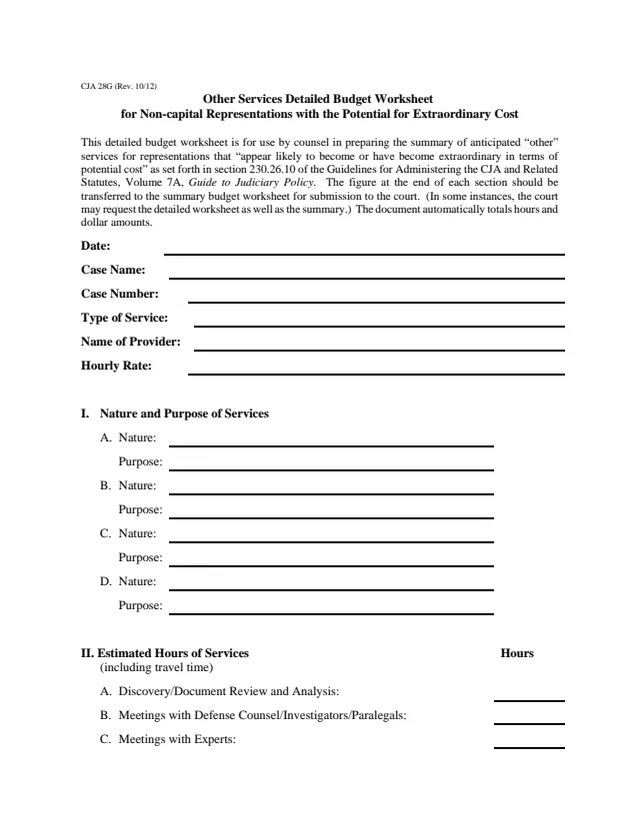
CJA 28G
51 fields, 4 pages
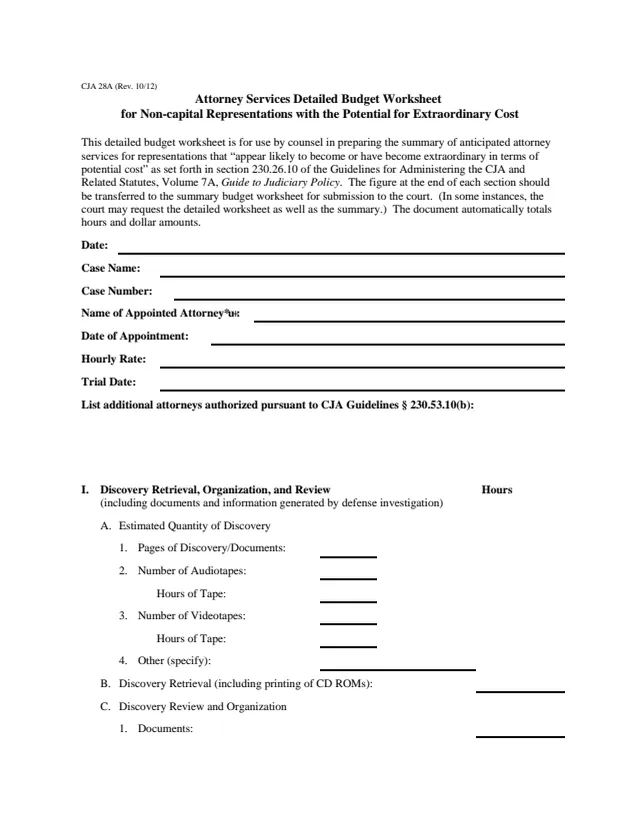
CJA 28A
142 fields, 9 pages
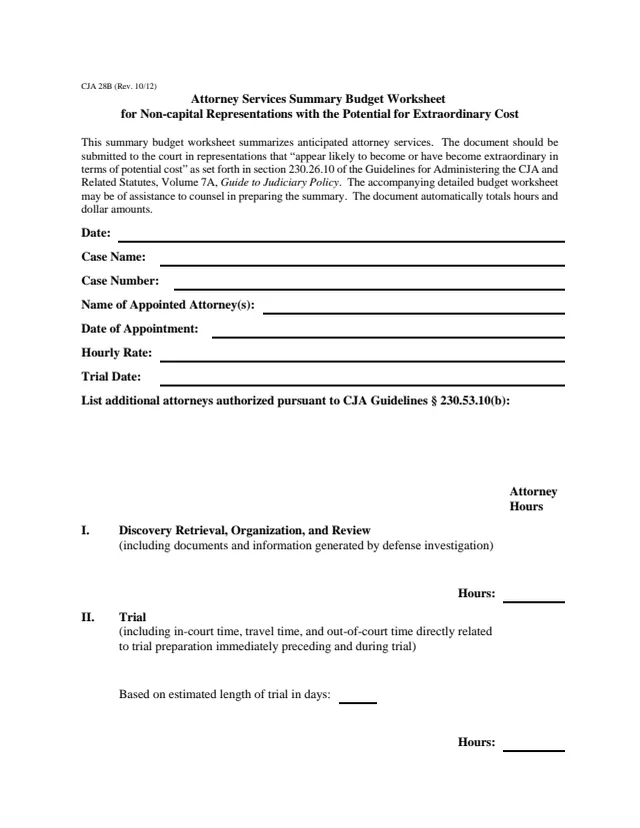
CJA 28B
29 fields, 4 pages
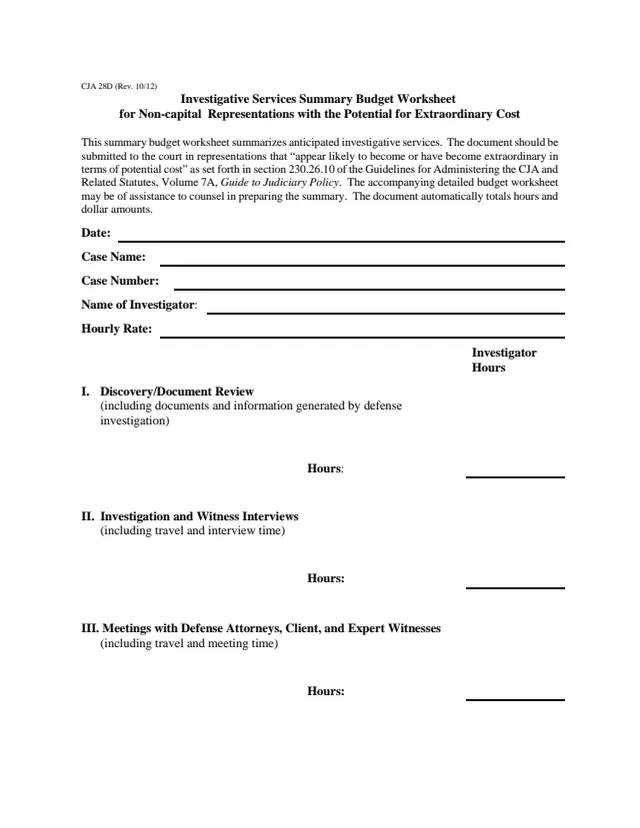
CJA 28D
22 fields, 3 pages
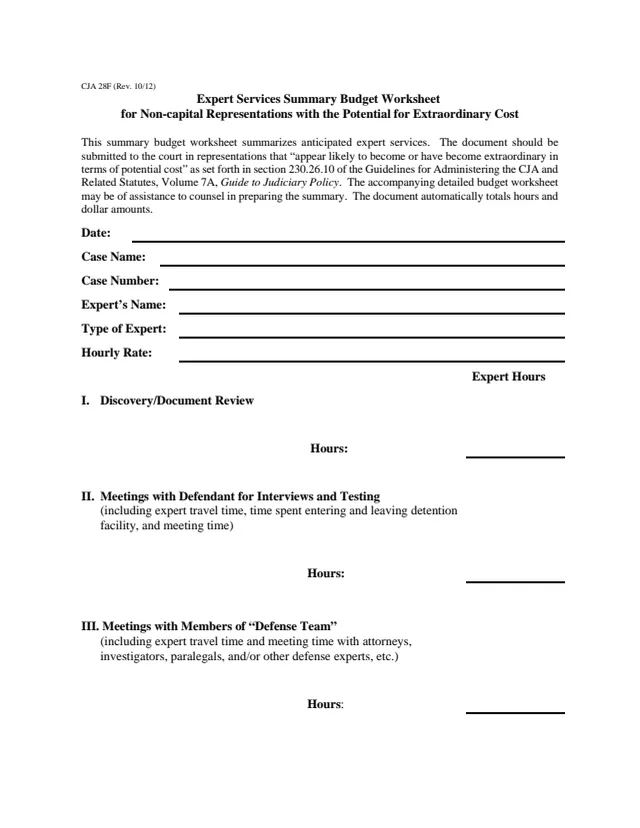
CJA 28F
26 fields, 3 pages
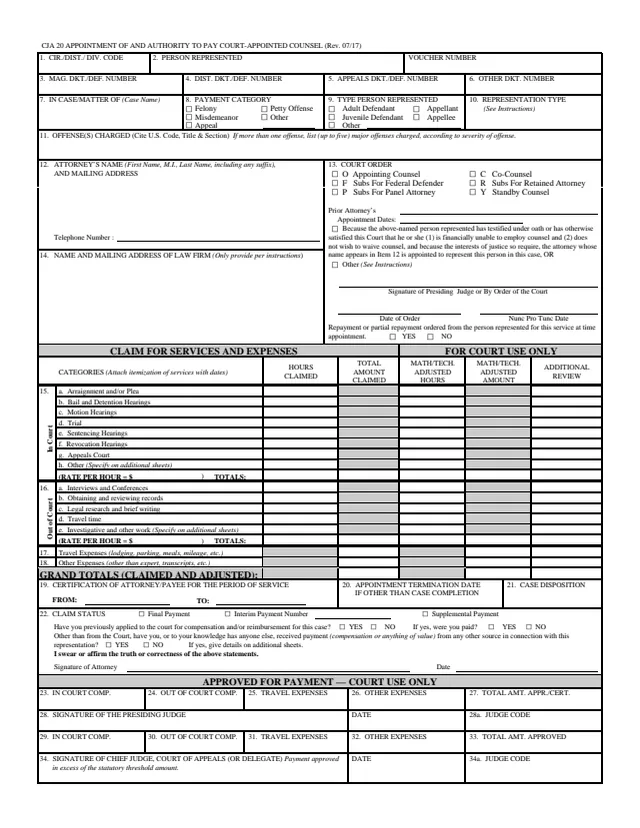
CJA 20
149 fields, 1 page
CJA 28H is prepared by CJA appointed counsel for the court, not filed by the public. The form and its memorandum name these roles.
No tool matches that search.
The explanatory memorandum says both the detailed and the summary worksheets for each service provider would be completed by appointed counsel in preparing the case budget. It is not a form the public files, and it has no signature line.
The form says the accompanying detailed budget worksheet may be of assistance to counsel in preparing the summary. The memorandum says the court may choose to review the summary worksheets for some services and the detailed worksheets for experts and other service providers.
The memorandum says the CJA guideline encourages case budgeting where the defense of an individual CJA defendant is anticipated to cost in excess of $30,000 or involve more than 300 hours of attorney time, and that counsel may initiate a case budget or the court may request one on its own initiative. This page cannot say whether a case meets that threshold.
The memorandum says case budgets should not be viewed as etched in stone and may be modified as the case progresses. If a foundation of the budget dramatically shifts, it says the court should have counsel modify the case budget and seek approval for any additional funds and resources.
Yes. The form says it automatically totals hours and dollar amounts, and the last page multiplies hours by the hourly rate to show the fees approved.