Case details
The date, case name and number, the name of the investigator and the hourly rate.
CJA 28C
Investigative Services Detailed Budget Worksheet for Non-capital Representations with the Potential for Extraordinary Cost
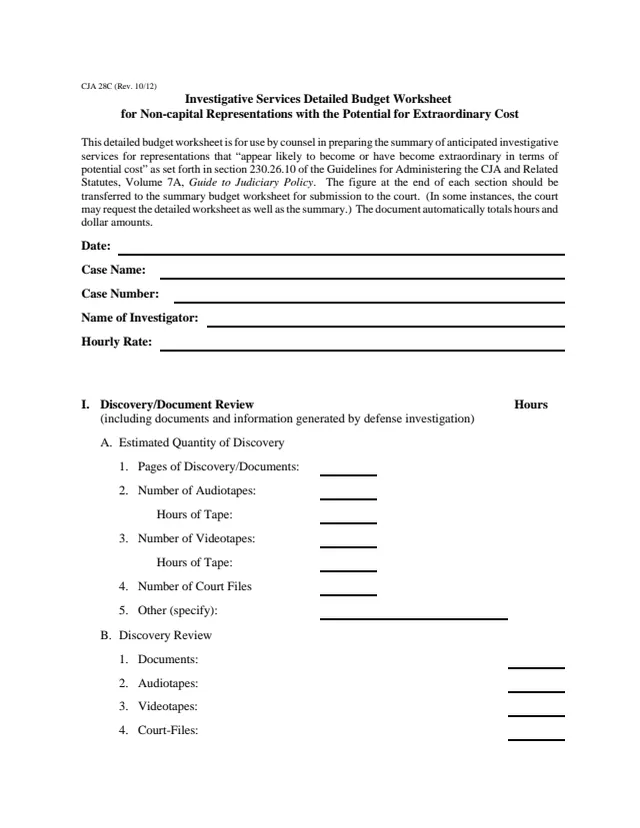
CJA 28C, Investigative Services Detailed Budget Worksheet for Non-capital Representations with the Potential for Extraordinary Cost, is a Criminal Justice Act (CJA) case-budgeting worksheet from the U.S. Courts, listed under Budgeting Worksheets. The PDF is dated Rev. 10/12, and the page lists it as effective on October 1, 2012.
The form says it is for use by counsel in preparing the summary of anticipated investigative services for representations that "appear likely to become or have become extraordinary in terms of potential cost" under section 230.26.10 of the Guidelines for Administering the CJA and Related Statutes, Volume 7A, Guide to Judiciary Policy. Its 8 pages estimate an investigator's hours for document review, investigation and interviews, meetings and court time, then travel and other costs. The figure at the end of each section goes onto the summary budget worksheet for submission to the court, and the document totals hours and dollar amounts automatically.
This page explains the form in plain words and is not legal advice. You can fill it out free in your browser on this page and download the result without an account.
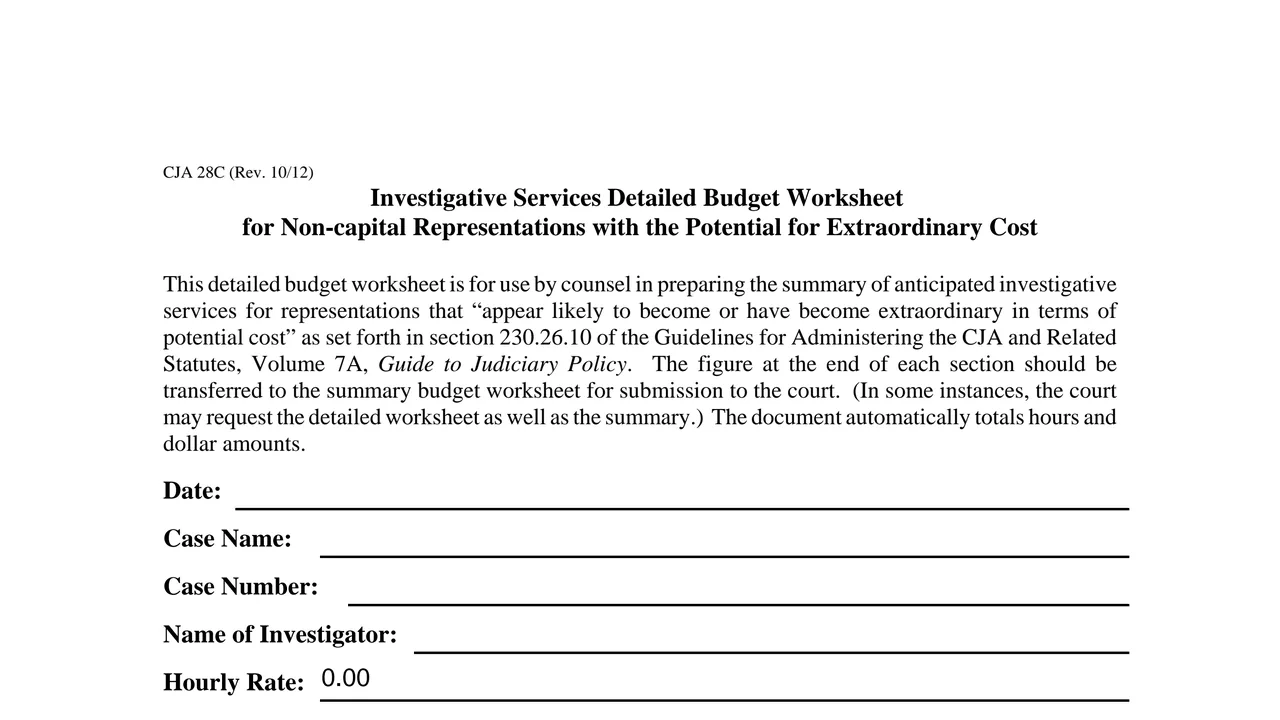
The date, case name and number, the name of the investigator and the hourly rate.
Estimated pages of discovery, audiotapes and videotapes with hours of tape, court files and other items, then the hours to review each kind.
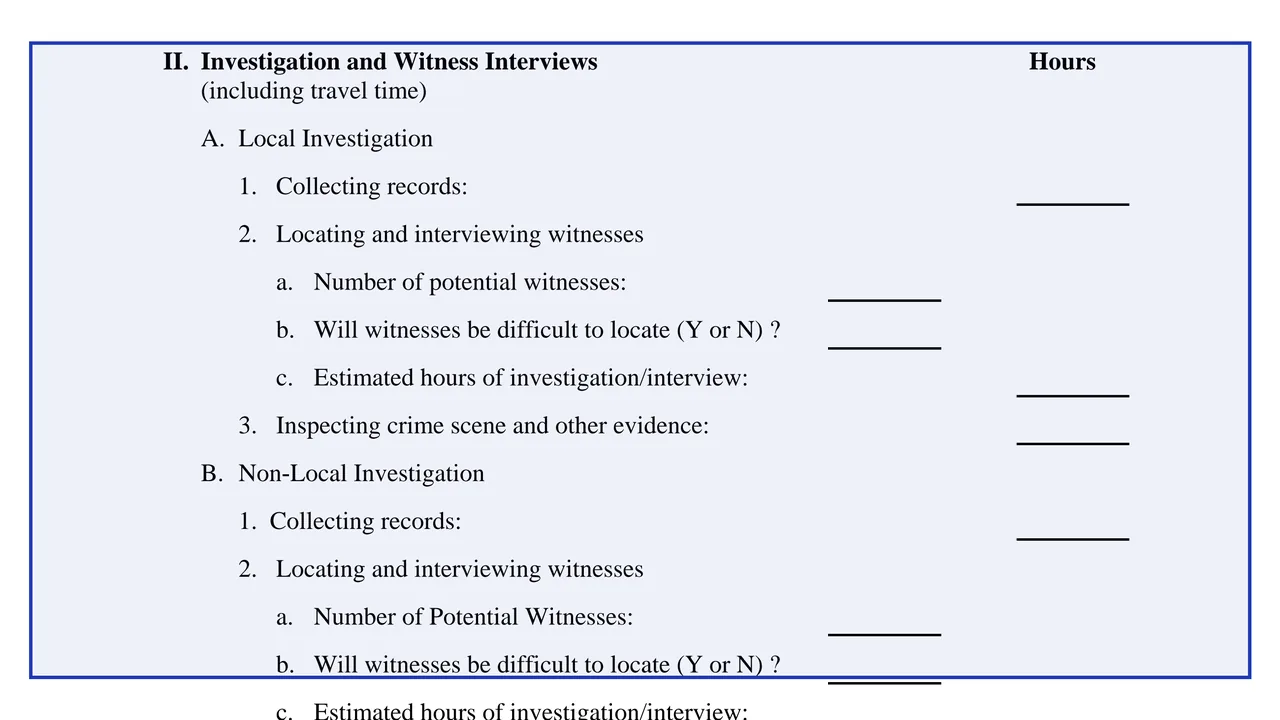
Local and non-local hours for collecting records, locating and interviewing witnesses, whether witnesses will be difficult to locate, and inspecting the crime scene and other evidence, including travel time.
Meeting and travel time with the client, attorneys and expert witnesses, including whether the defendant is in a remote jail facility and distances in miles, then meetings with prosecutors, case agents and others.
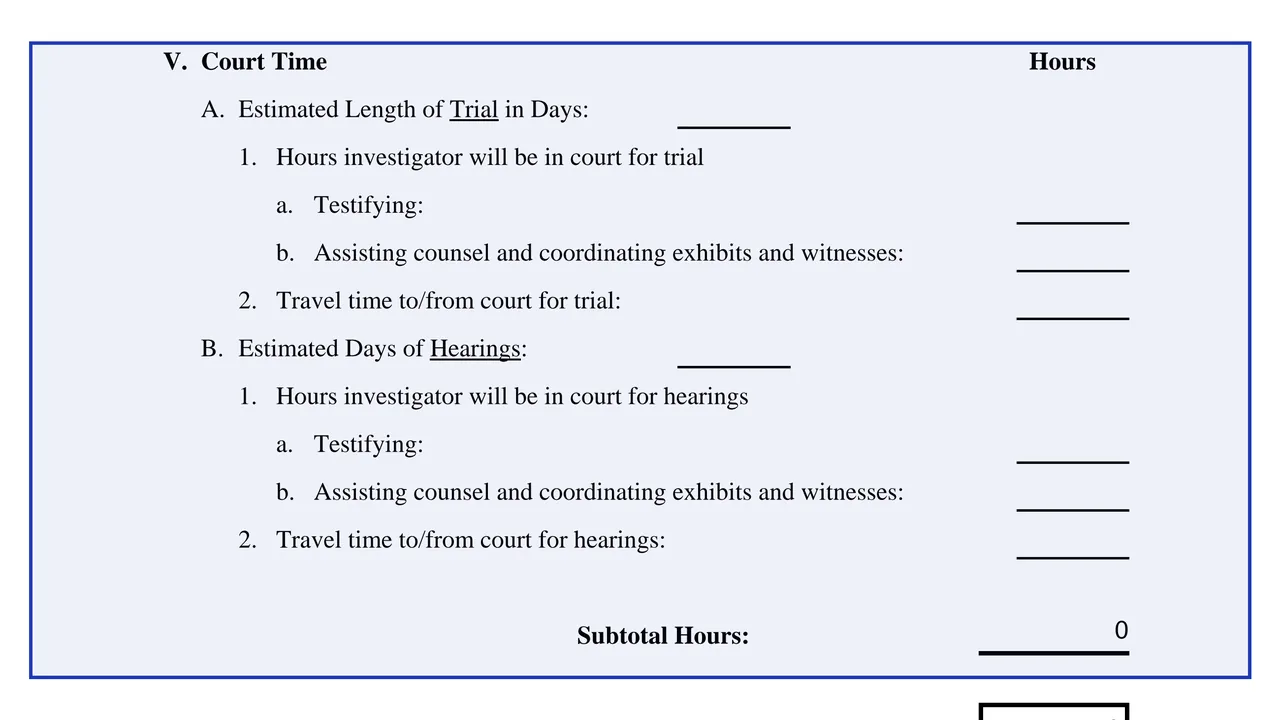
Estimated trial days and days of hearings, with the investigator's hours testifying or assisting counsel and coordinating exhibits and witnesses, plus travel time, ending in Grand Total Hours.
Local and long-distance travel costs, miscellaneous costs such as criminal records checks, records retrieval and copying, and an Approved Case Budget for Investigative Services ending in the Grand Total Budget for Investigator.
Fill in the date, case name and number, the investigator's name and the hourly rate.
Section I asks for the quantity of discovery, including court files, then the hours to review documents, tapes, court files and other material.
Sections II to IV ask for hours to collect records, locate and interview witnesses and inspect evidence, and for meetings with the client, attorneys, experts, prosecutors and case agents, with travel time.
Section V asks for the estimated trial days and days of hearings, the hours the investigator will be in court testifying or assisting counsel, and travel time to and from court.
Section VI uses a POV mileage rate for local trips and government travel rates and per diems for air, train, rental vehicle or overnight travel. The form notes not to double count meetings that include both defense counsel and the defendant.
The form says the figure at the end of each section should be transferred to the summary budget worksheet for submission to the court. The document totals hours and dollar amounts automatically.
You get the real form, filled in a browser tab, with nothing standing between you and the finished PDF.
The section figures go onto the summary budget worksheet for submission to the court. The form says that in some instances the court may request the detailed worksheet as well as the summary.
The explanatory memorandum recommends that the presiding judicial officer send a case budget to the chief judge of the court of appeals, or his or her delegate, for approval.
The form does not print a filing fee. Its dollar fields are budget estimates for investigator fees, travel and other costs.
The form says that if extensive out-of-district investigator travel is anticipated, the court may wish to require a more detailed travel budget, and should determine whether it will issue "blanket" travel authorization or approve investigator travel "seriatim."
The memorandum says case budgets should not be viewed as etched in stone. If a foundation of the budget shifts dramatically, it says the court should have counsel modify the budget and seek approval for any additional funds and resources.
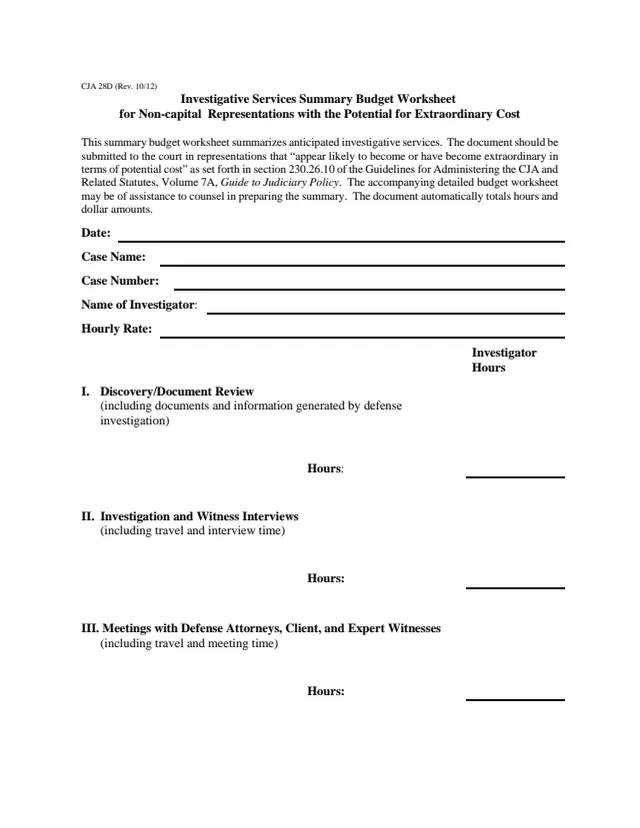
CJA 28D
22 fields, 3 pages
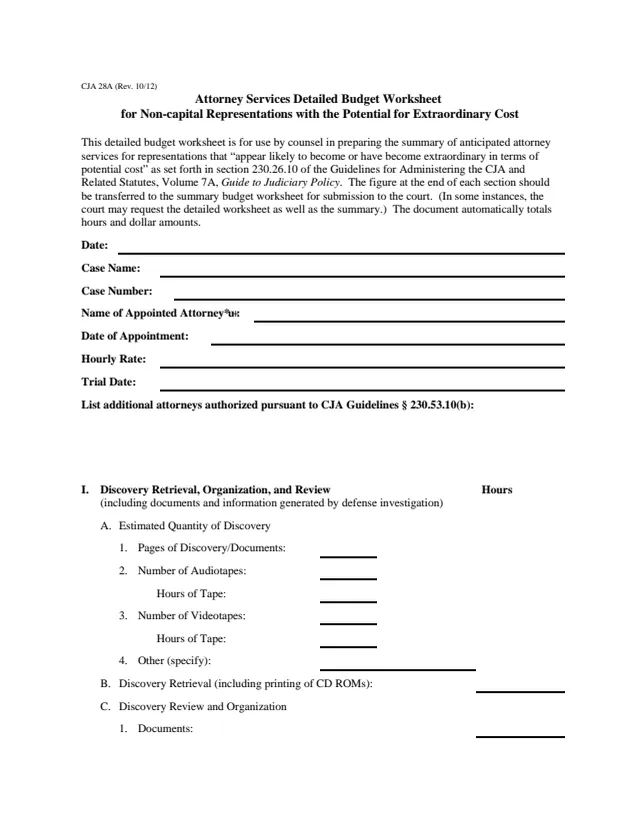
CJA 28A
142 fields, 9 pages
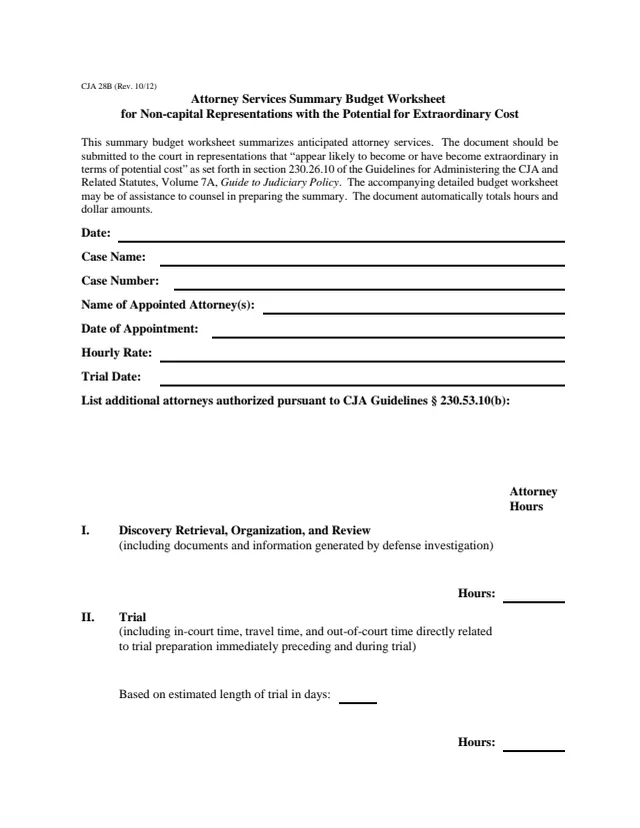
CJA 28B
29 fields, 4 pages
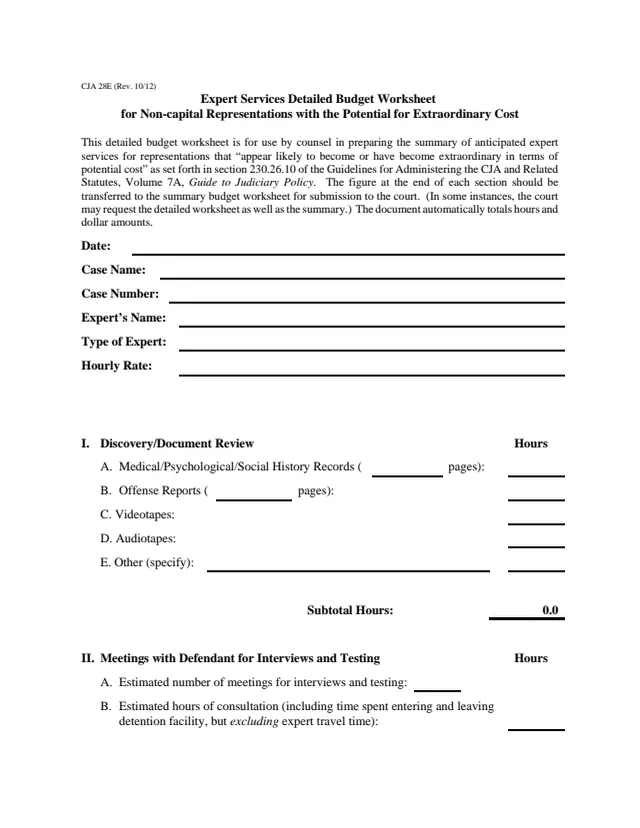
CJA 28E
149 fields, 8 pages
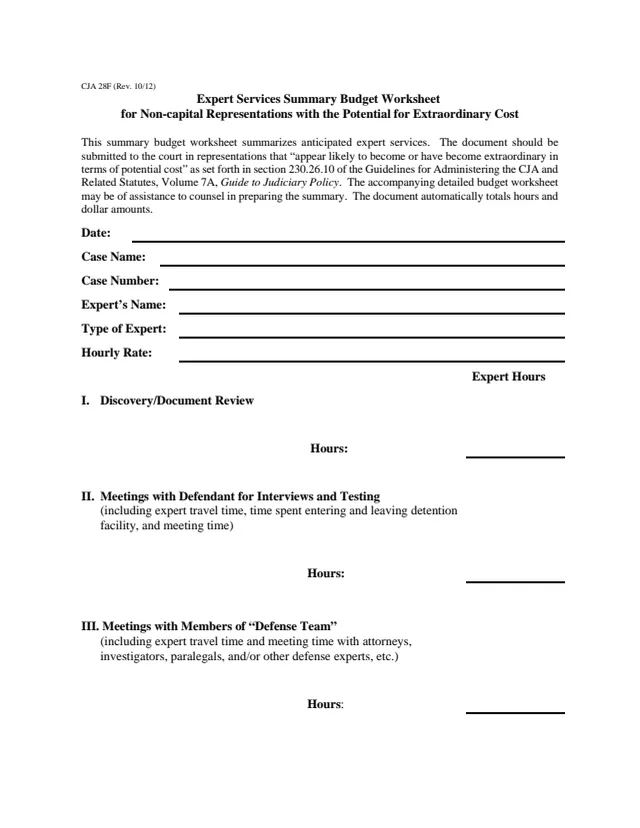
CJA 28F
26 fields, 3 pages
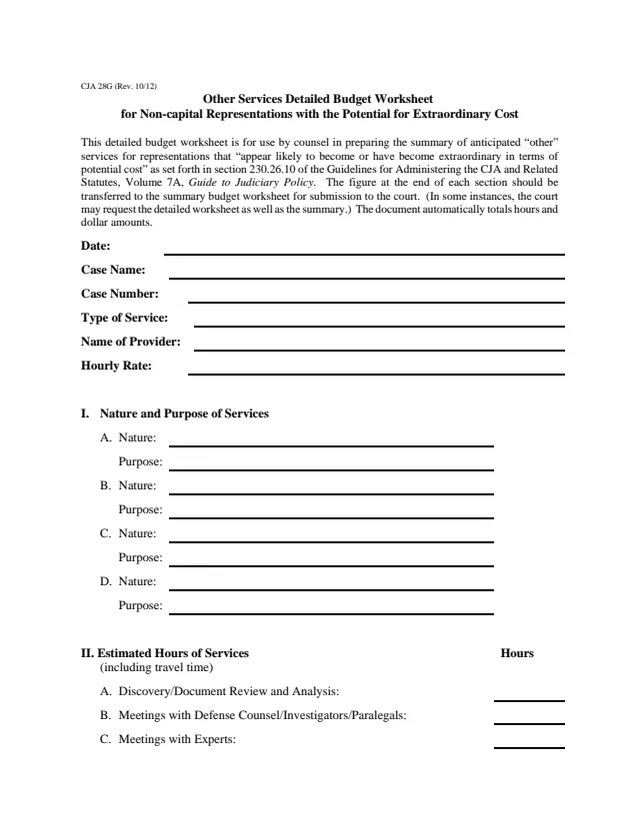
CJA 28G
51 fields, 4 pages
The worksheet is prepared by appointed counsel and covers an investigator's work. It and its explanatory memorandum name these roles.
No tool matches that search.
Appointed counsel. The form says it is for use by counsel in preparing the summary of anticipated investigative services, and it names the investigator whose time it estimates.
The form says the figure at the end of each section should be transferred to the summary budget worksheet for submission to the court. The U.S. Courts list the investigative services summary worksheet as CJA 28D.
The explanatory memorandum says that in some instances the work of several providers of the same type of service could be combined on one form.
The explanatory memorandum says a Judicial Conference guideline encourages case budgeting for any representation in which the defense of an individual CJA defendant is anticipated to cost in excess of $30,000 or involve more than 300 hours of attorney time. It says the court or counsel determines whether a case has that potential.
Local trips use a POV mileage rate. Trips that need air or train transportation, a rental vehicle or an overnight stay use government travel rates and per diems for the estimate.
Yes. The form says the document automatically totals hours and dollar amounts.
The U.S. Courts page links Form Instructions: the Explanatory Memorandum for Case Budgeting in Non-capital Panel Attorney Representations with the Potential for Extraordinary Cost.