The memorandum rule
Section 230.30(b) is quoted: counsel will submit with the voucher a detailed memorandum supporting the claim that the case was extended or complex and that the excess payment is necessary to provide fair compensation.
CJA 27A
Guidance to Attorneys in Drafting the Memorandum for a Claim in Excess of the Case Compensation Maximum (Court of Appeals)
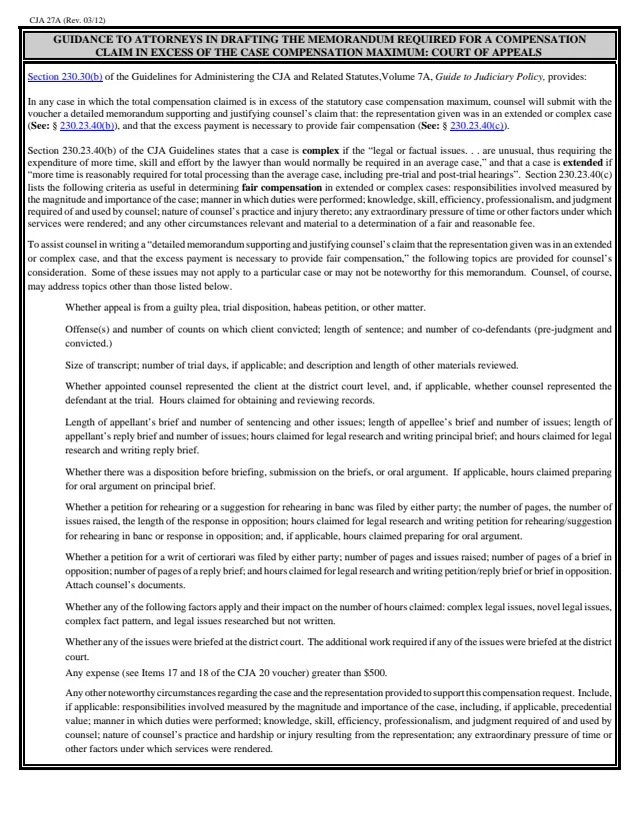
CJA 27A, Guidance to Attorneys in Drafting the Memorandum for a Claim in Excess of the Case Compensation Maximum (Court of Appeals), is a one-page CJA guidance sheet from the U.S. Courts, listed under Attorney Excess Compensation Claims. The PDF is dated Rev. 03/12, and the page lists it as effective on March 1, 2012.
It has no blanks to fill in. It quotes section 230.30(b) of the Guidelines for Administering the CJA and Related Statutes, Volume 7A, Guide to Judiciary Policy, which says that in any case in which the total compensation claimed is in excess of the statutory case compensation maximum, counsel will submit with the voucher a detailed memorandum. It then quotes how the Guidelines describe complex and extended cases, lists criteria for fair compensation, and offers topics for counsel's consideration.
This page explains the guidance in plain words and is not legal advice. You can open it free in your browser on this page and download it without an account.
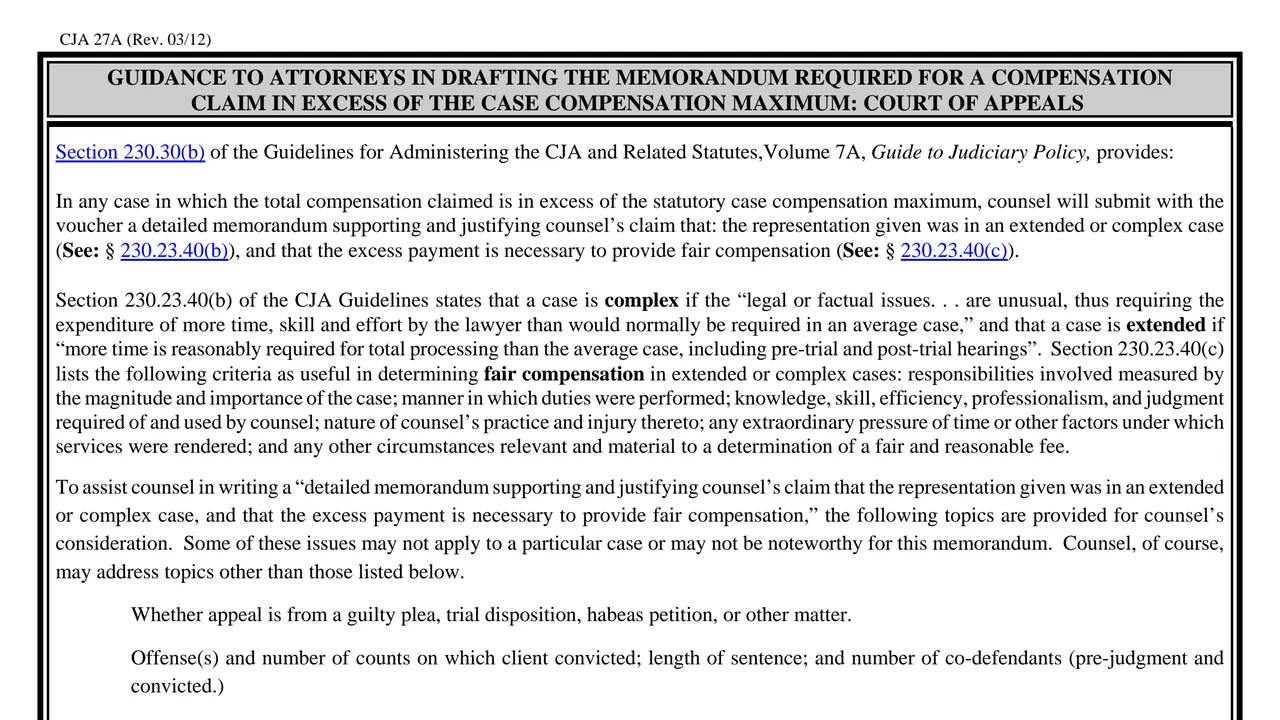
Section 230.30(b) is quoted: counsel will submit with the voucher a detailed memorandum supporting the claim that the case was extended or complex and that the excess payment is necessary to provide fair compensation.
Section 230.23.40(b) is quoted: a case is complex if its legal or factual issues are unusual and need more time, skill and effort than an average case, and extended if more time is reasonably required for total processing than the average case.
Section 230.23.40(c) lists the magnitude and importance of the case, how duties were performed, the knowledge, skill, efficiency, professionalism and judgment required, the nature of counsel's practice and injury to it, extraordinary time pressure, and other relevant circumstances.
The type of appeal, offenses and counts of conviction, the sentence, co-defendants, transcript size, trial days, other materials reviewed, district court representation and hours for obtaining and reviewing records.
Brief lengths and issues, research and writing hours, disposition before briefing, submission on the briefs or oral argument, rehearing or in banc petitions, and certiorari petitions, with counsel's documents attached.
Complex or novel legal issues, a complex fact pattern, issues researched but not written, issues briefed at the district court, any expense greater than $500 from items 17 and 18 of the CJA 20 voucher, and other noteworthy circumstances.
The sheet opens with sections 230.30(b), 230.23.40(b) and 230.23.40(c), which describe the memorandum, the complex and extended standards and the fair compensation criteria.
The guidance says some topics may not apply to a particular case or may not be noteworthy for the memorandum, and that counsel may address topics other than those listed.
Most topics ask for counts: pages, issues, trial days and co-defendants, and the hours claimed for records, research and writing, and oral argument preparation.
For a petition for a writ of certiorari, the guidance says to attach counsel's documents.
The guidance lists any expense greater than $500 as a topic, pointing to items 17 and 18 of the CJA 20 voucher.
The quoted section 230.30(b) says counsel will submit the detailed memorandum with the voucher.
You get the real form, filled in a browser tab, with nothing standing between you and the finished PDF.
The quoted guideline says counsel will submit the memorandum with the voucher. CJA 27A prints no address or court office.
The guidance does not print a filing fee. Its only dollar figure is the $500 expense topic.
The guidance does not print a deadline.
The U.S. Courts page offers CJA 27A as a one-page PDF with a Print button.
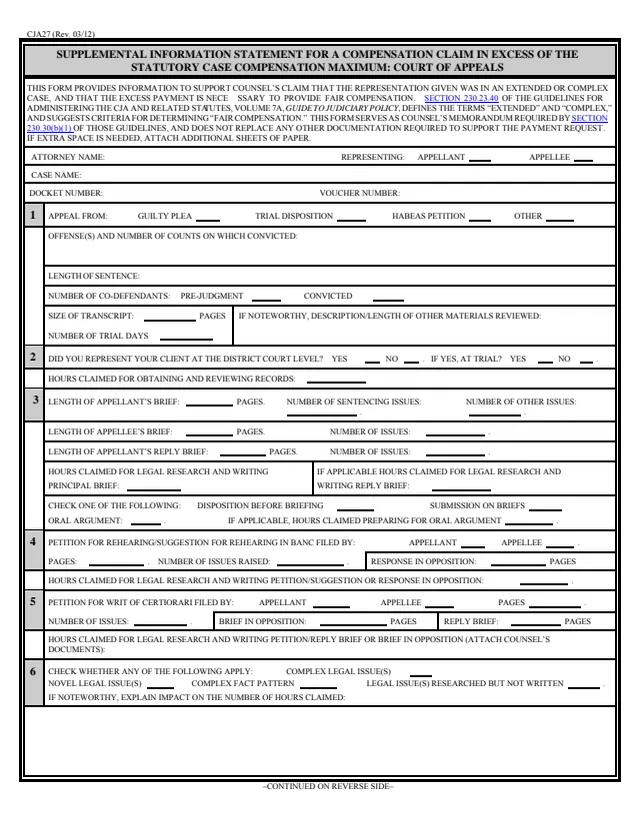
CJA 27
53 fields, 2 pages
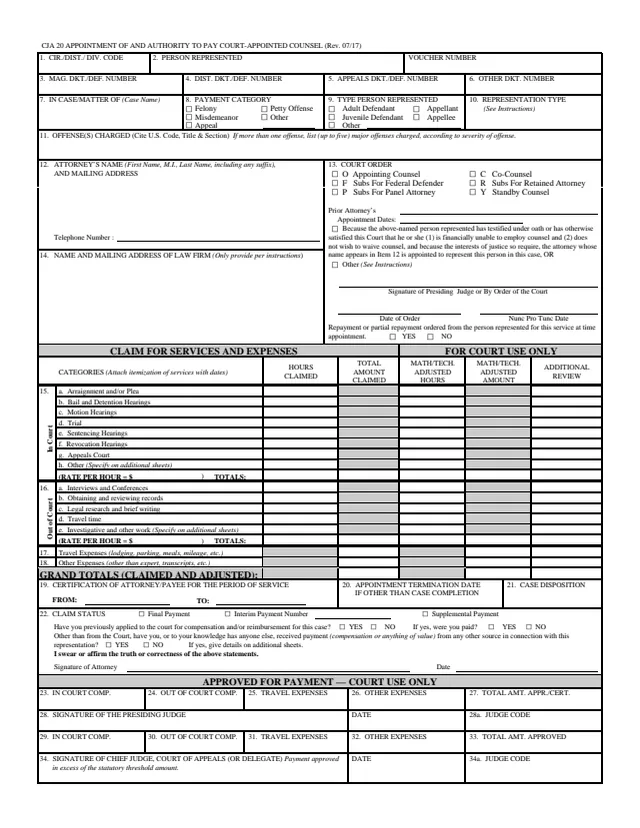
CJA 20
149 fields, 1 page
CJA 26A
1 field, 1 page
CJA 26
37 fields, 2 pages
The guidance is written for counsel. It names these roles and situations.
No tool matches that search.
No. It is a one-page guidance sheet with no blanks or signature line. It lists topics for counsel's consideration when drafting the memorandum.
CJA 27A quotes section 230.30(b) of the Guidelines: in any case in which the total compensation claimed is in excess of the statutory case compensation maximum, counsel will submit with the voucher a detailed memorandum.
CJA 27A quotes section 230.23.40(b): a case is complex if its legal or factual issues are unusual and require more time, skill and effort than an average case, and extended if more time is reasonably required for total processing than the average case, including pre-trial and post-trial hearings.
The guidance says some topics may not apply to a particular case or may not be noteworthy for the memorandum, and that counsel may address topics other than those listed.
The U.S. Courts list CJA 27 in the same Attorney Excess Compensation Claims category. The CJA 27 PDF says it serves as counsel's memorandum required by section 230.30(b)(1) of the Guidelines.
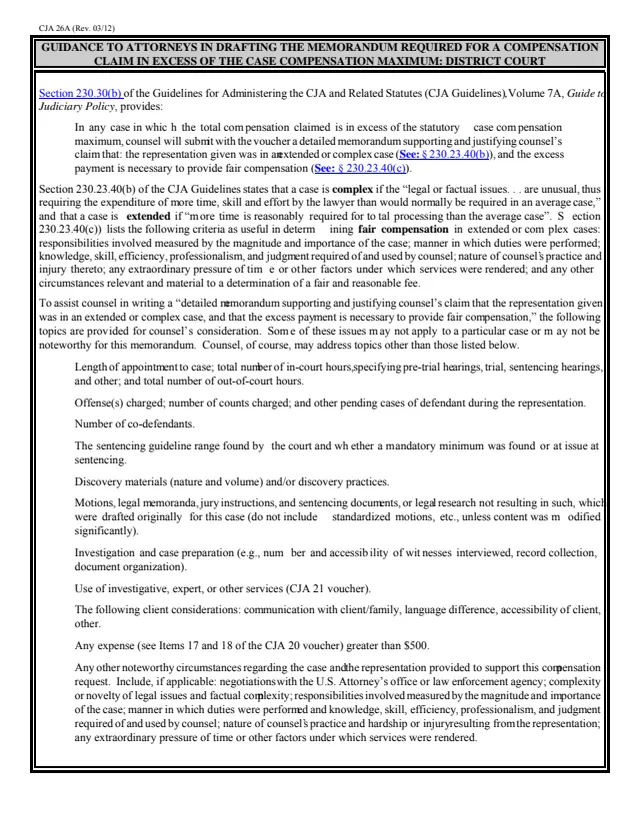
The U.S. Courts forms list includes CJA 26A, guidance to attorneys drafting the memorandum for a claim in excess of the case compensation maximum in the district court.
No. This page explains the guidance sheet in plain words.