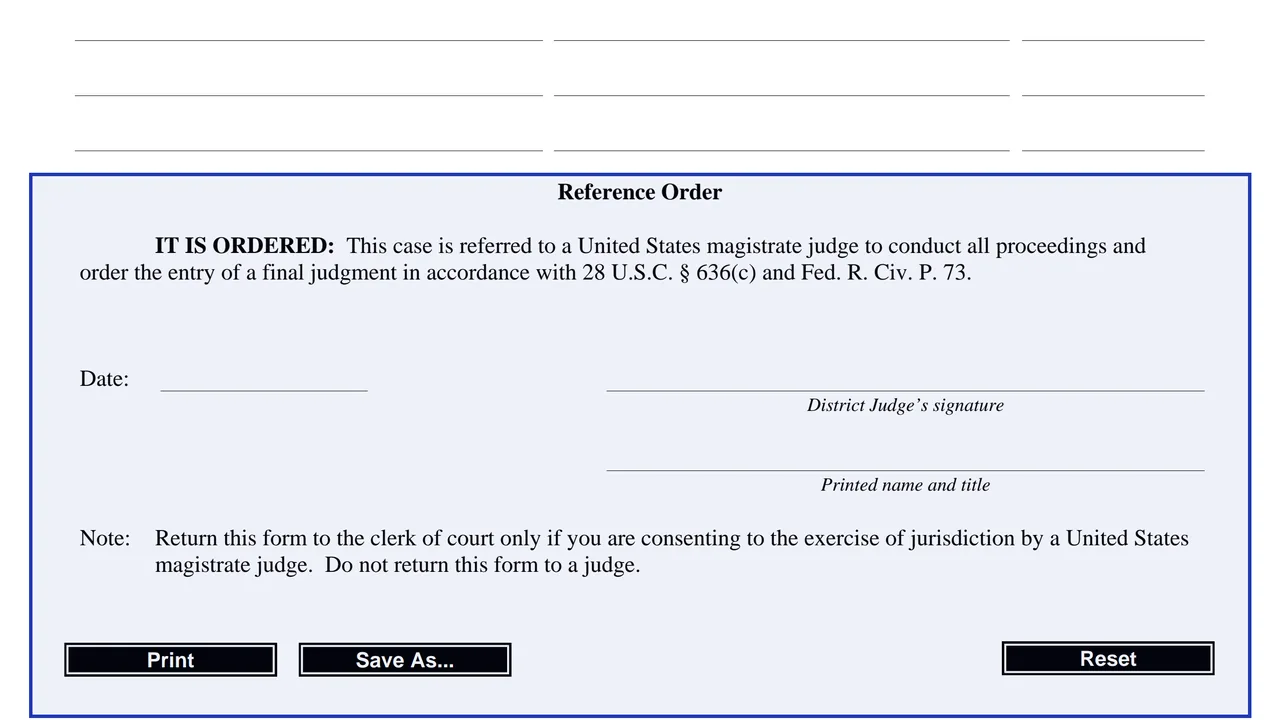
Caption
The district, the plaintiff, the defendant and the civil action number.
AO 85
Notice, Consent, and Reference of a Civil Action to a Magistrate Judge
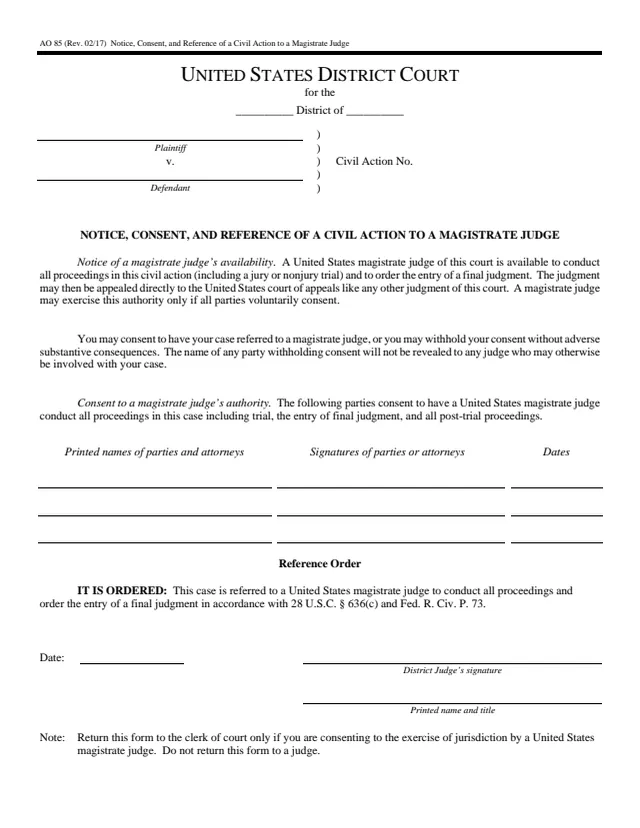
AO 85, Notice, Consent, and Reference of a Civil Action to a Magistrate Judge, is a one-page United States District Court form for a civil action. The U.S. Courts list it under Civil Forms. The current version is Rev. 02/17, and the U.S. Courts page lists it as effective on February 1, 2017.
The form has three parts. A notice says a United States magistrate judge of the court is available to conduct all proceedings in the civil action, including a jury or nonjury trial, and to order the entry of a final judgment. A consent block holds the printed names, signatures and dates of the parties or attorneys who consent. A reference order, signed by the district judge, refers the case under 28 U.S.C. § 636(c) and Fed. R. Civ. P. 73. The form says a magistrate judge may exercise this authority only if all parties voluntarily consent.
This page explains the form in plain words and is not legal advice. You can fill it out free in your browser on this page and download the result without an account.
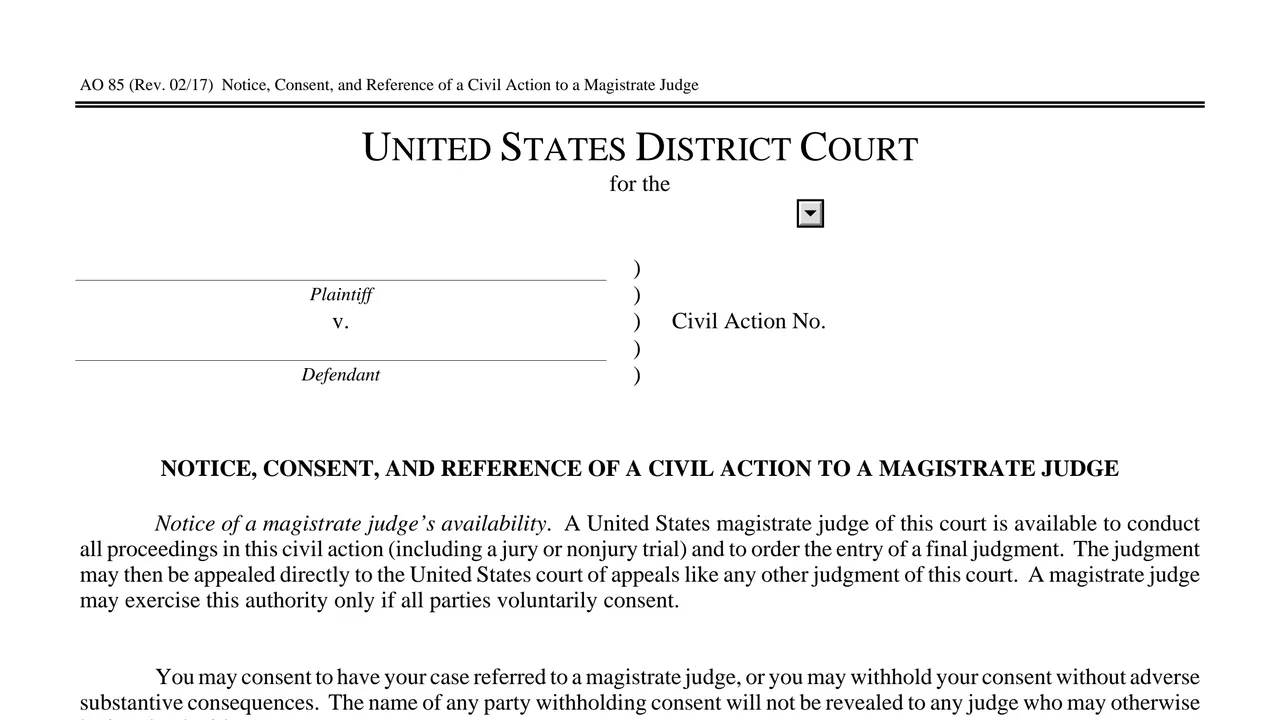
The district, the plaintiff, the defendant and the civil action number.
A magistrate judge is available to conduct all proceedings, including a jury or nonjury trial, and to order the entry of a final judgment, which the form says may then be appealed directly to the United States court of appeals like any other judgment of the court.
The form says consent may be withheld without adverse substantive consequences, and the name of any party withholding consent will not be revealed to any judge who may otherwise be involved with the case.
The parties listed consent to have a magistrate judge conduct all proceedings, including trial, the entry of final judgment and all post-trial proceedings, with printed names, signatures and dates.
IT IS ORDERED that the case is referred to a magistrate judge in accordance with 28 U.S.C. § 636(c) and Fed. R. Civ. P. 73, with the date and the district judge's signature, printed name and title.
Enter the district, the plaintiff, the defendant and the civil action number.
The notice paragraphs describe what a magistrate judge may do with consent and what happens to the name of a party who withholds it.
Each consenting party or attorney prints a name, signs and dates the consent block.
The note says to return the form to the clerk of court only if consenting, and not to return it to a judge.
The Reference Order is dated and signed by the district judge, with a printed name and title.
You get the real form, filled in a browser tab, with nothing standing between you and the finished PDF.
The note says: "Return this form to the clerk of court only if you are consenting to the exercise of jurisdiction by a United States magistrate judge. Do not return this form to a judge."
The form says a magistrate judge may exercise this authority only if all parties voluntarily consent.
The form says the judgment may be appealed directly to the United States court of appeals like any other judgment of the court.
The form does not print a fee.
The U.S. Courts page offers AO 85 as a PDF.
AO 85A
22 fields, 1 page
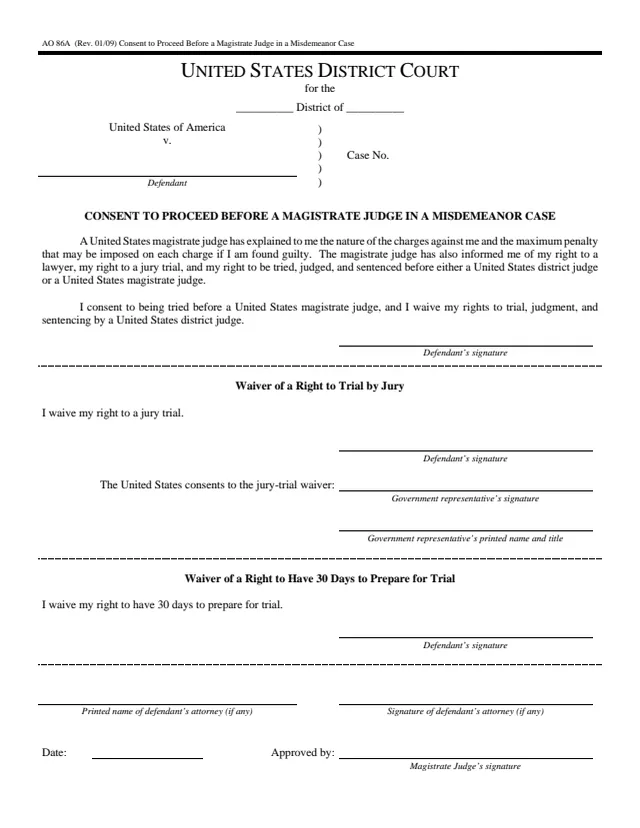
AO 86A
15 fields, 1 page
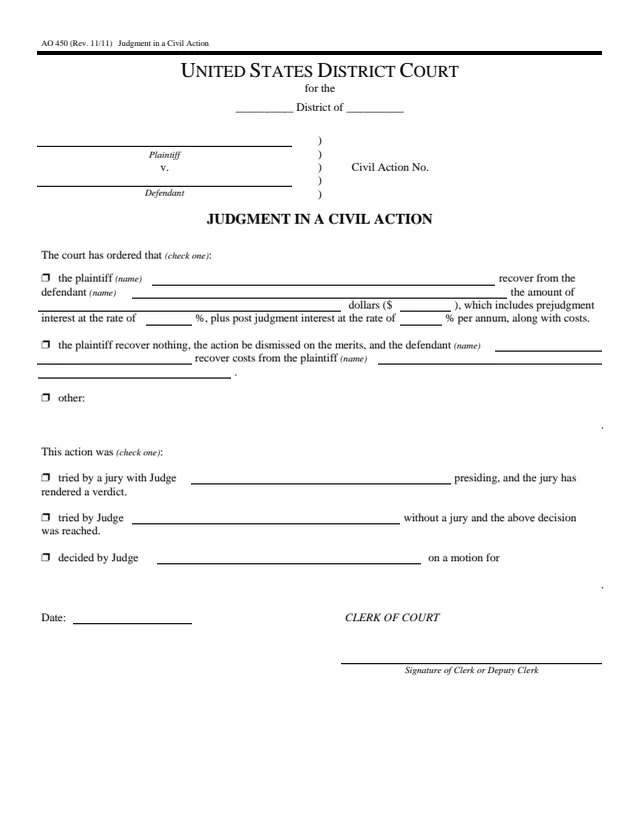
AO 450
26 fields, 1 page
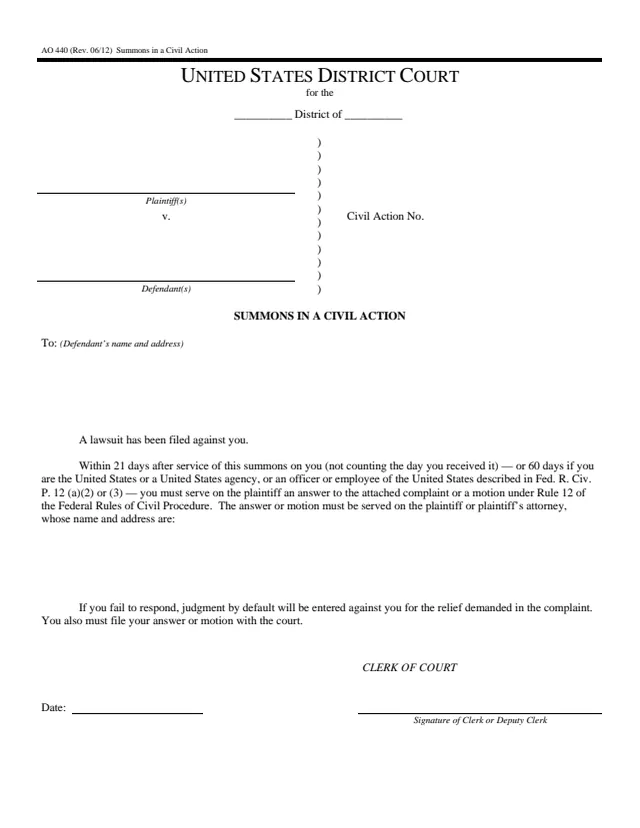
AO 440
34 fields, 2 pages
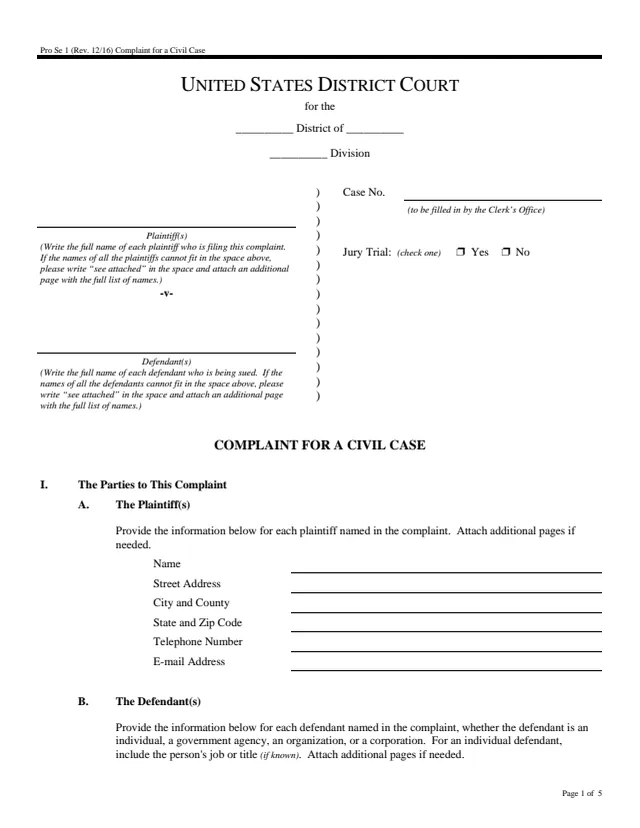
Pro Se 1
76 fields, 5 pages
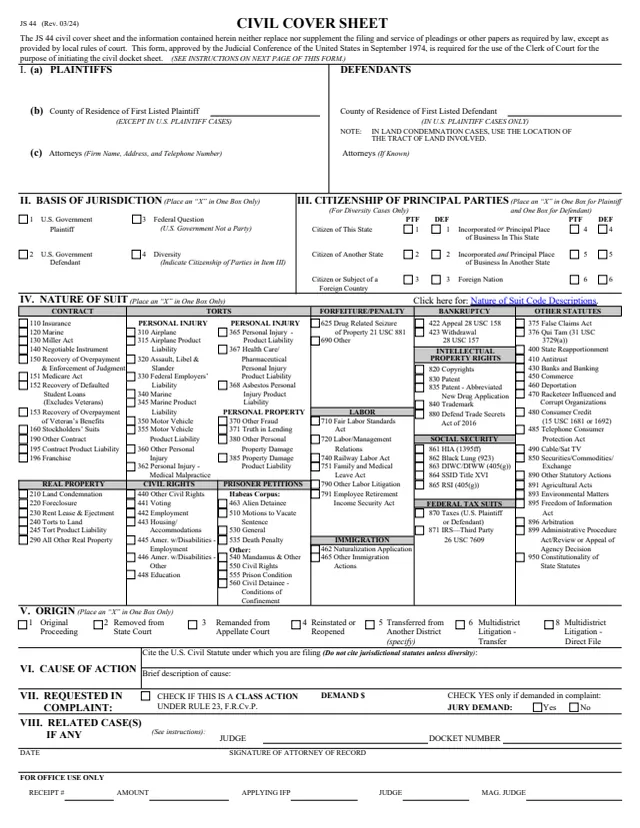
JS 44
35 fields, 2 pages
The form names who signs the consent, who signs the order and where the form goes.
No tool matches that search.
It gives notice that a United States magistrate judge is available, records the consent of the parties to have a magistrate judge conduct all proceedings and order the entry of a final judgment, and holds the district judge's reference order.
The form says a magistrate judge may exercise this authority only if all parties voluntarily consent.
The form says the name of any party withholding consent will not be revealed to any judge who may otherwise be involved with the case.
To the clerk of court, and only if the party is consenting. The form says not to return it to a judge.
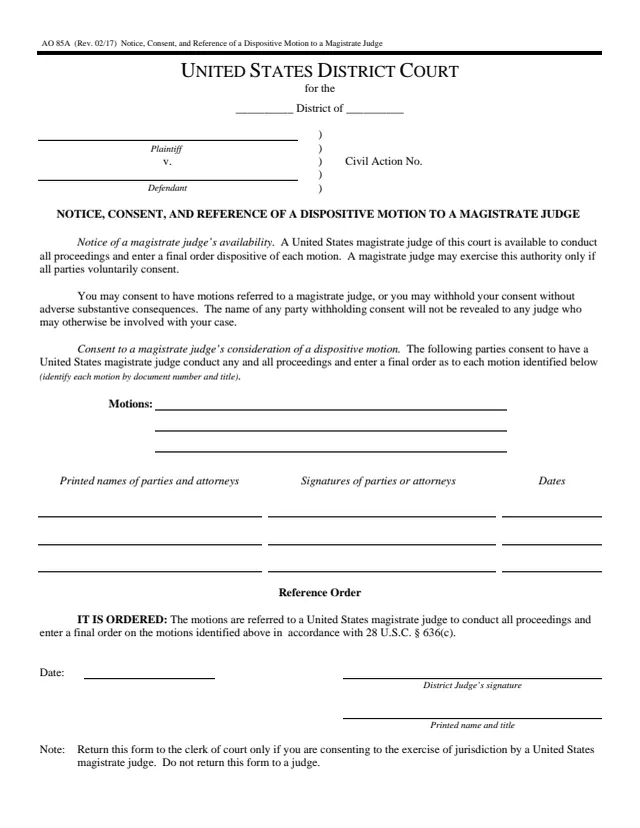
AO 85 covers all proceedings in a civil action, including trial and final judgment. AO 85A covers dispositive motions identified by document number and title.
No. This page explains what the printed form says in plain words and does not say whether anyone should consent.