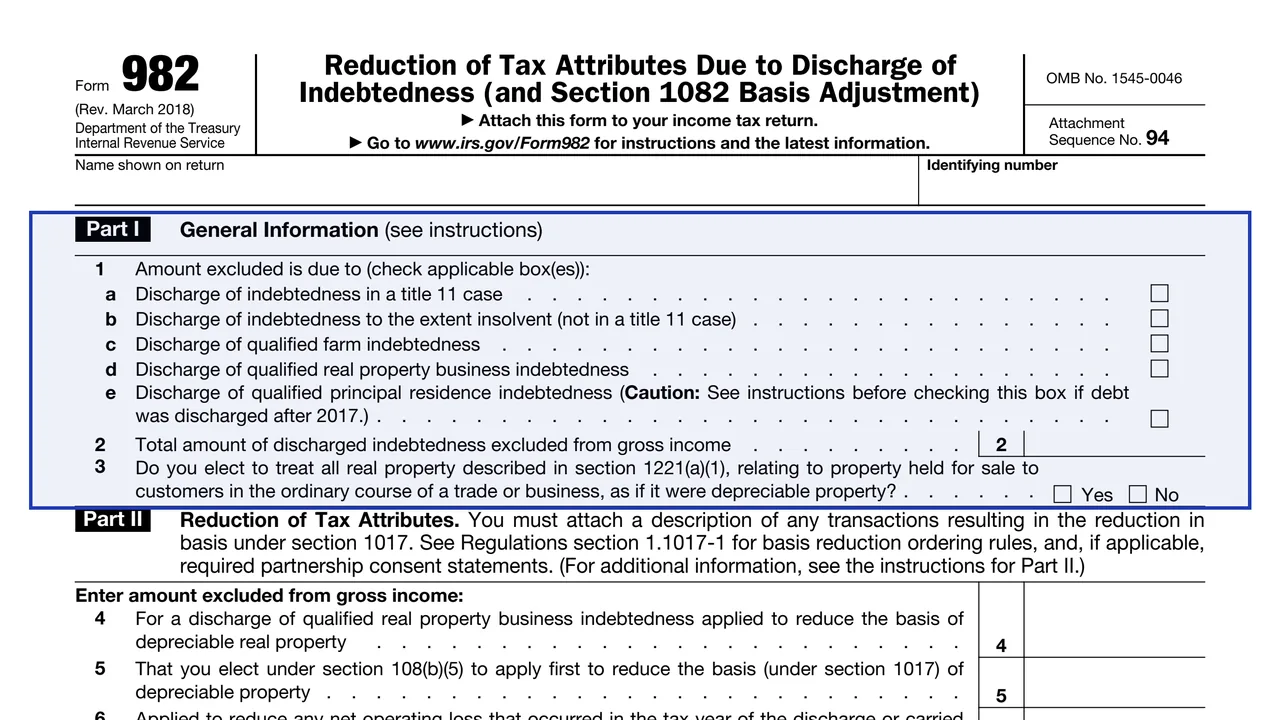
Part I, line 1: reason for the exclusion
Boxes for a title 11 case, insolvency, qualified farm indebtedness, qualified real property business indebtedness and qualified principal residence indebtedness.
982
Reduction of Tax Attributes Due to Discharge of Indebtedness (and Section 1082 Basis Adjustment)
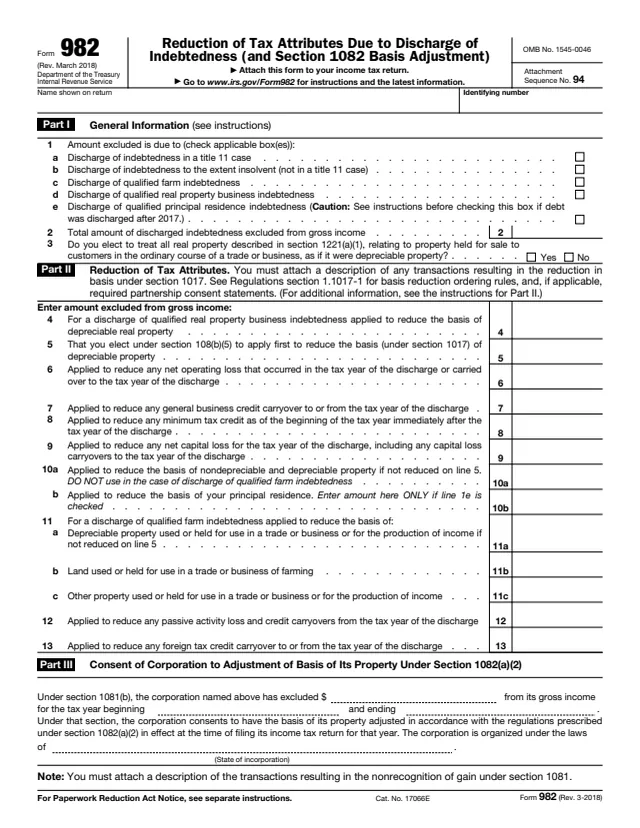
Form 982, Reduction of Tax Attributes Due to Discharge of Indebtedness (and Section 1082 Basis Adjustment), is used to determine, under certain circumstances described in section 108, the amount of discharged indebtedness that can be excluded from gross income.
The instructions say the amount by which a taxpayer benefits from the discharge of indebtedness is generally included in gross income, but under certain circumstances in section 108 it can be excluded. Form 982 reports the exclusion and the reduction of certain tax attributes, either dollar for dollar or 33 1/3 cents per dollar. The instructions add that certain individuals, such as those with a discharged car loan, credit card debt or mortgage on a principal residence, may need to complete only a few lines.
The form says "Attach this form to your income tax return." You can fill out Form 982 free in your browser on this page and download it without an account.
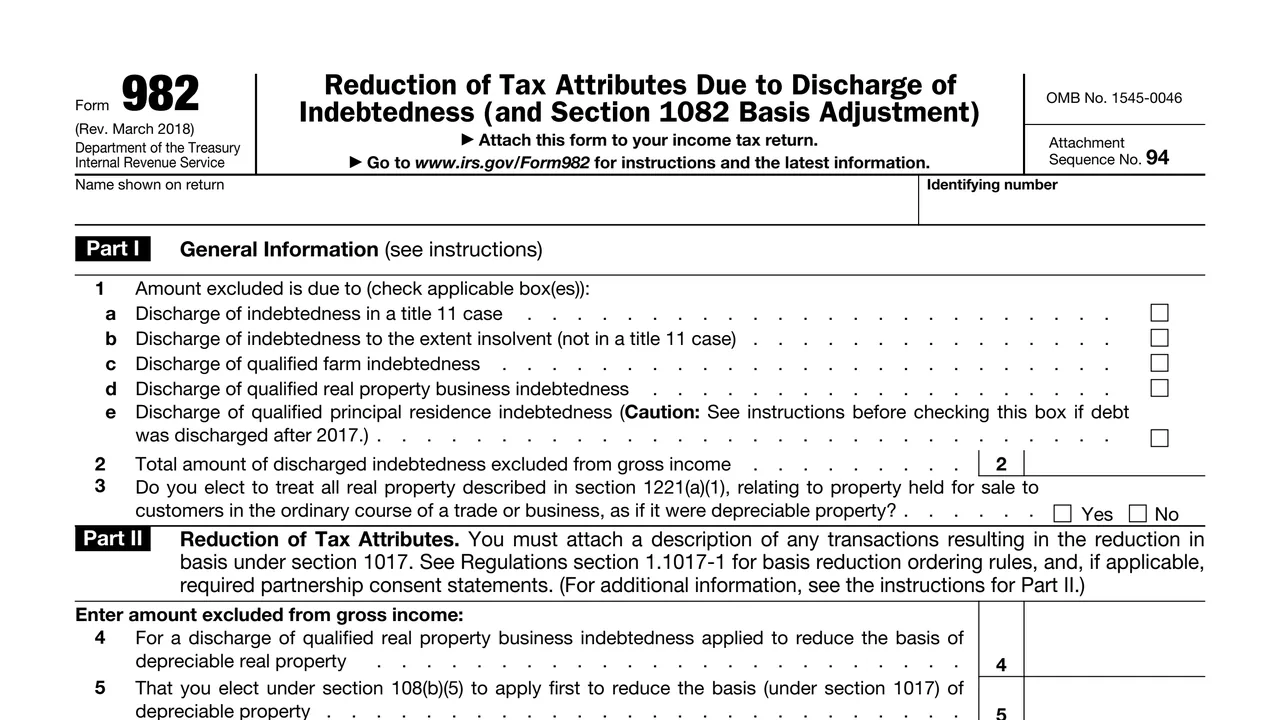
Boxes for a title 11 case, insolvency, qualified farm indebtedness, qualified real property business indebtedness and qualified principal residence indebtedness.
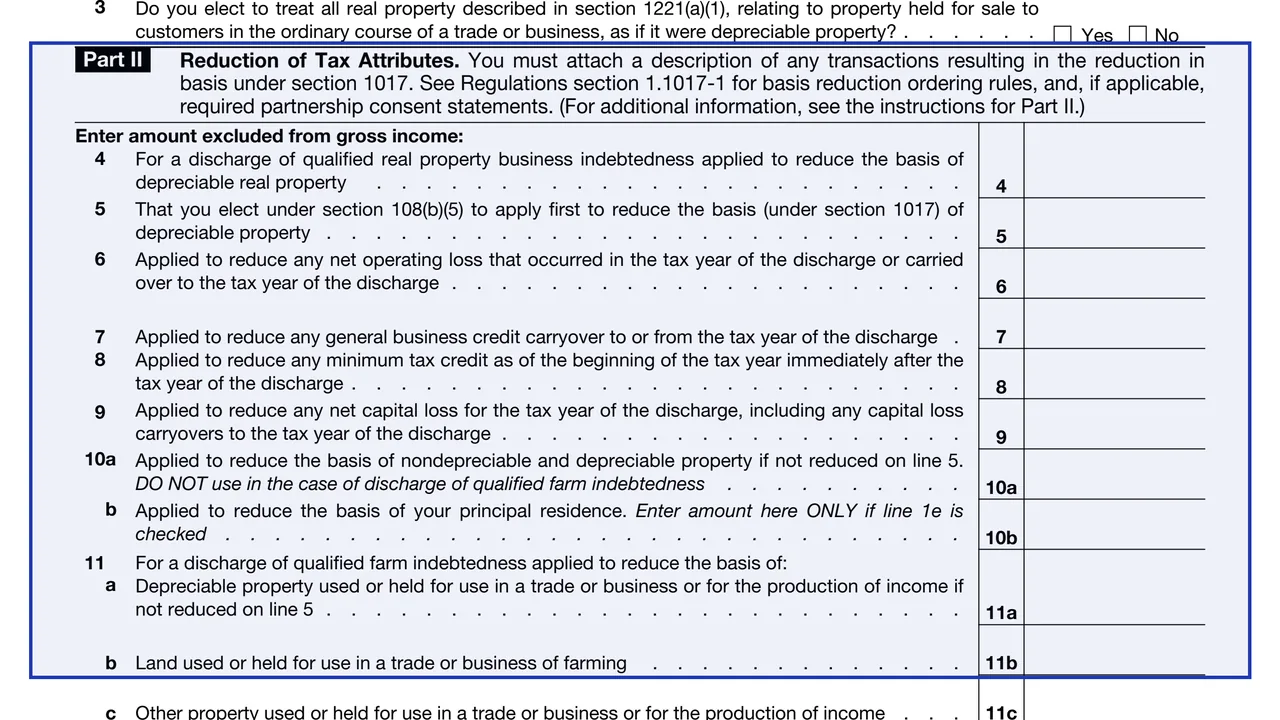
Line 2 is the total amount of discharged indebtedness excluded from gross income. Line 3 is a Yes or No election to treat section 1221(a)(1) real property as depreciable property.
Amounts applied to reduce depreciable real property basis, depreciable property basis by election, net operating loss, general business credit, minimum tax credit and net capital loss.
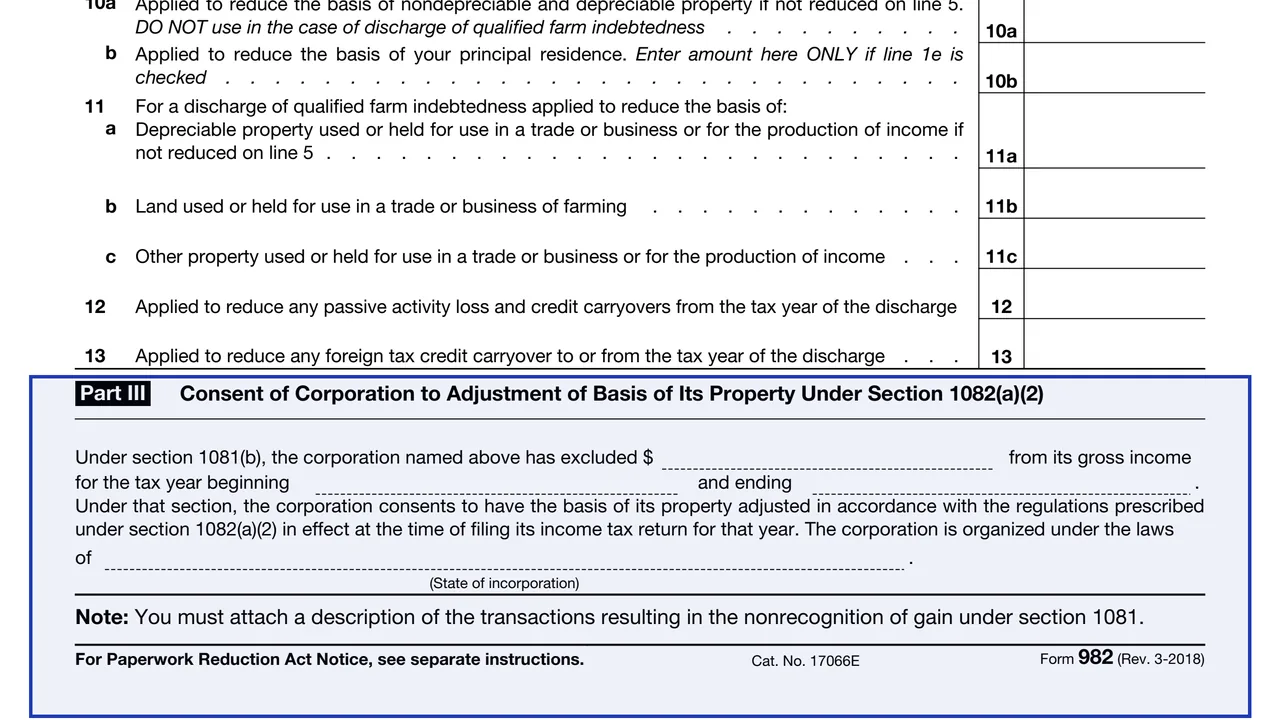
Line 10a reduces the basis of nondepreciable and depreciable property if not reduced on line 5. Line 10b reduces the basis of a principal residence, only if line 1e is checked.
Basis reductions for qualified farm indebtedness, then passive activity loss and credit carryovers and the foreign tax credit carryover.
The corporation states the amount excluded under section 1081(b), the tax year, and its state of incorporation, and consents to the basis adjustment.
Check the box or boxes for the reason the amount is excluded. The instructions say a discharge in a title 11 case uses box 1a, not box 1e, and an insolvent taxpayer not in a title 11 case can elect box 1b instead of box 1e.
Enter the total amount excluded from gross income under section 108. If any box on lines 1b through 1e is checked, the instructions say not to enter more than the limit explained for those lines.
For a nonbusiness debt such as a car loan or credit card debt, with no Part II attributes other than basis in nondepreciable property, the instructions say to check 1a or 1b, complete line 2 and enter on line 10a the smallest of the three amounts they list.
For qualified principal residence indebtedness, check box 1e and include the excluded amount on line 2. If the residence is still owned after the discharge, line 10b is the smaller of the line 2 amount for that debt or the basis of the main home.
Report attribute reductions in the order the instructions list, unless box 1d is checked or line 5 is used to reduce depreciable property basis first. Part II also calls for a description of transactions that reduce basis under section 1017.
A corporation using section 1081(b) enters the amount excluded, the tax year and its state of incorporation, and attaches a description of the transactions resulting in the nonrecognition of gain under section 1081.
You get the real form, filled in a browser tab, with nothing standing between you and the finished PDF.
The form says "Attach this form to your income tax return." The instructions say to file it with the federal income tax return for the year the discharge is excluded under section 108(a).
The instructions say the section 108(b)(5) election and the line 1d election are made on a timely filed return (including extensions) and can be revoked only with the consent of the IRS.
If the return was timely filed without either election, the instructions say it can still be made on an amended return within 6 months of the due date (excluding extensions), marked "Filed pursuant to section 301.9100-2".
The instructions say the maximum amount that can be treated as qualified principal residence indebtedness is $750,000 ($375,000 if married filing separately).
Checking box 1e for a discharge in a title 11 case, entering more on line 2 than the line 1b to 1e limits allow, and using line 10b when box 1e is not checked.
The instructions say to file Form 982 with the federal income tax return for a year a discharge of indebtedness is excluded from income under section 108(a). It goes to the IRS with that return.
No tool matches that search.
The About Form 982 page says it is used to determine, under certain circumstances described in section 108, the amount of discharged indebtedness that can be excluded from gross income.
No. The form says to attach it to the income tax return, and the instructions say to file it with the federal income tax return for the year the discharge is excluded.
No. The instructions say box 1e is not checked if the discharge occurs in a title 11 case. Box 1a is checked instead.
No. The instructions say certain individuals may need to complete only a few lines, for example for a discharged personal loan or a loan to buy a principal residence, and they give a chart of which lines to complete.
The instructions say the reduction is either dollar for dollar or 33 1/3 cents per dollar, depending on the attribute, in the order they list unless box 1d is checked or the line 5 election is made.
It is the consent of a corporation that excluded an amount from gross income under section 1081(b) to have the basis of its property adjusted under the regulations prescribed under section 1082(a)(2).