Names and SSNs
Your first name, initial, last name and SSN, then the same for your spouse or partner.
8958
Allocation of Tax Amounts Between Certain Individuals in Community Property States
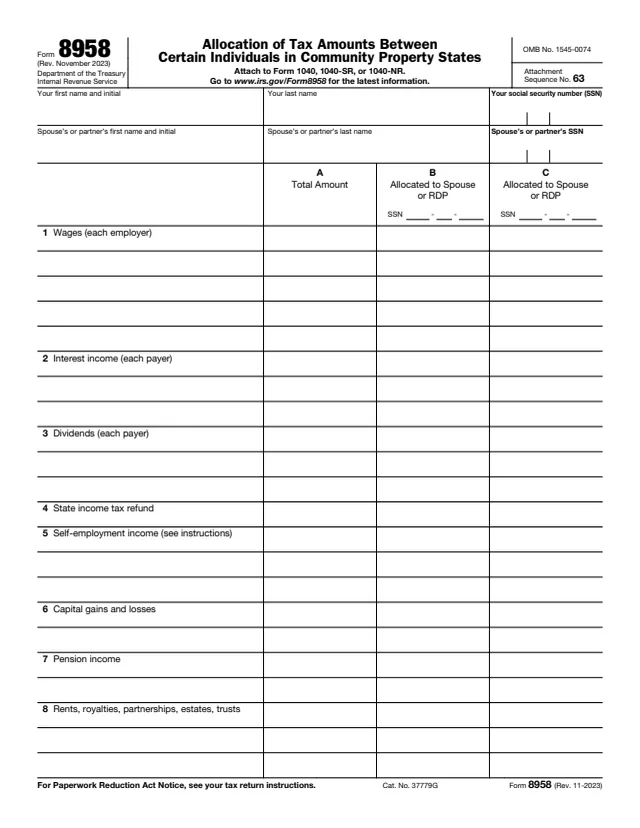
Form 8958 allocates tax amounts between spouses or registered domestic partners (RDPs) with community property rights who file separate federal income tax returns. The form says it is intended for individuals who are subject to community property laws and who file separate federal income tax returns.
The form lists wages, interest, dividends, a state income tax refund, self-employment income, capital gains and losses, pension income, and rents, royalties, partnerships, estates and trusts. It also covers self-employment tax, taxes withheld and other items such as social security benefits. Column A holds the total amount of each item, and columns B and C show the part allocated to each spouse or RDP.
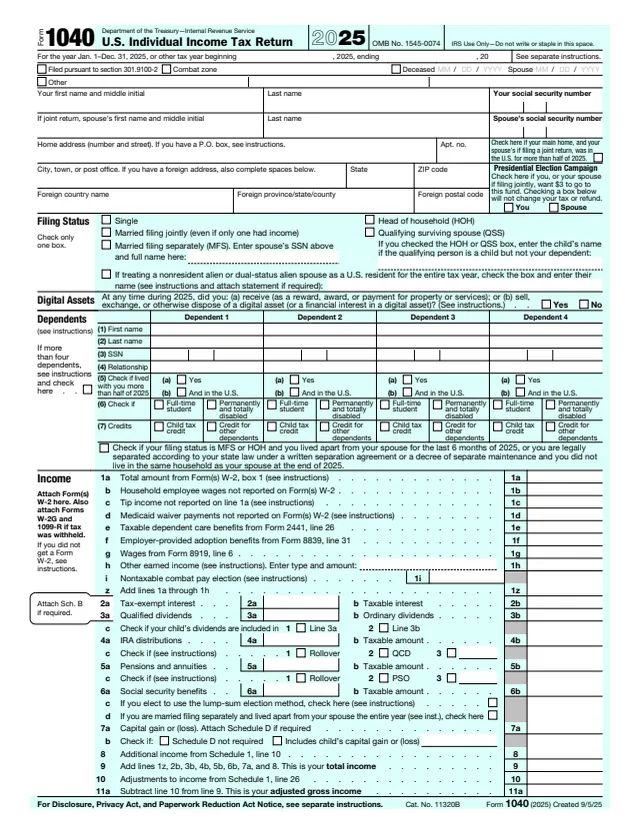
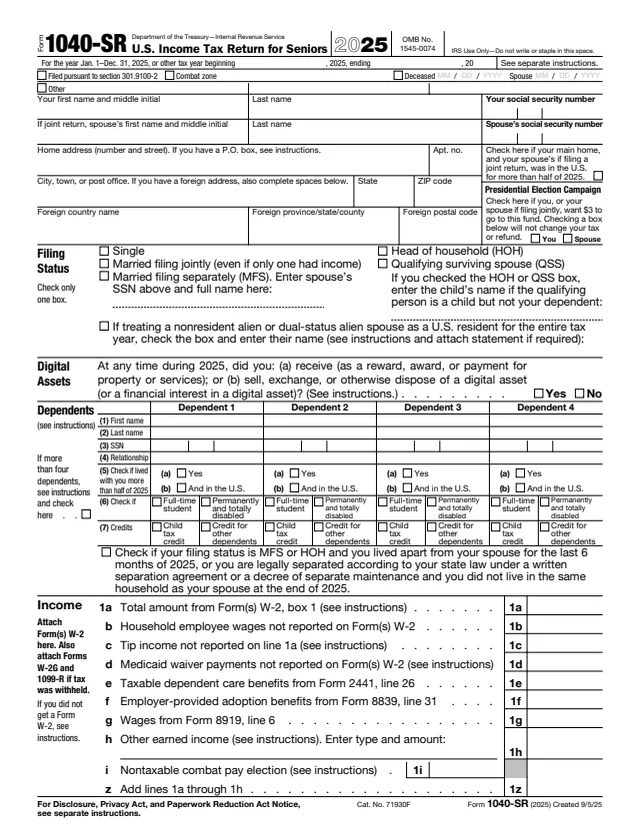
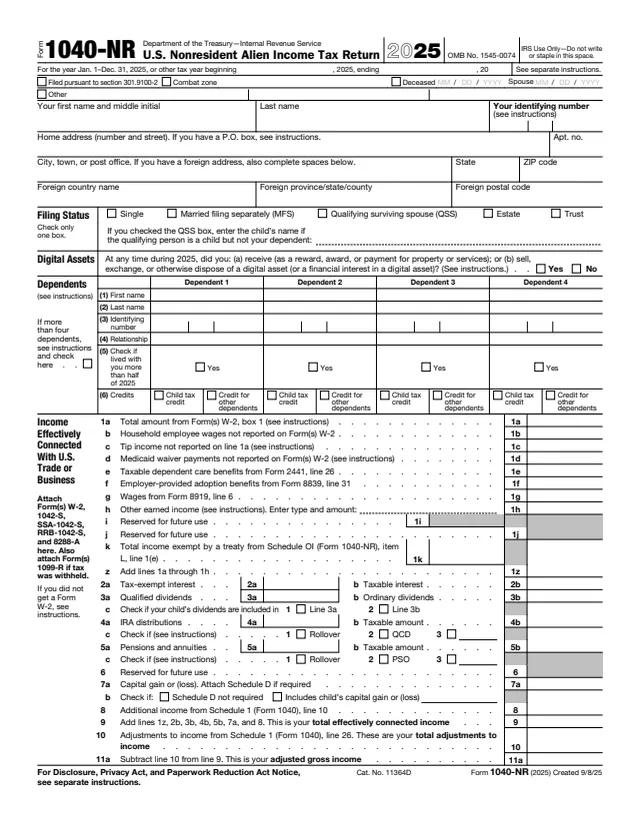
The form header says to attach it to Form 1040, 1040-SR or 1040-NR. Its instructions point to Pub. 555, Community Property, for more information. You can fill out Form 8958 free in your browser on this page and download the result without an account.
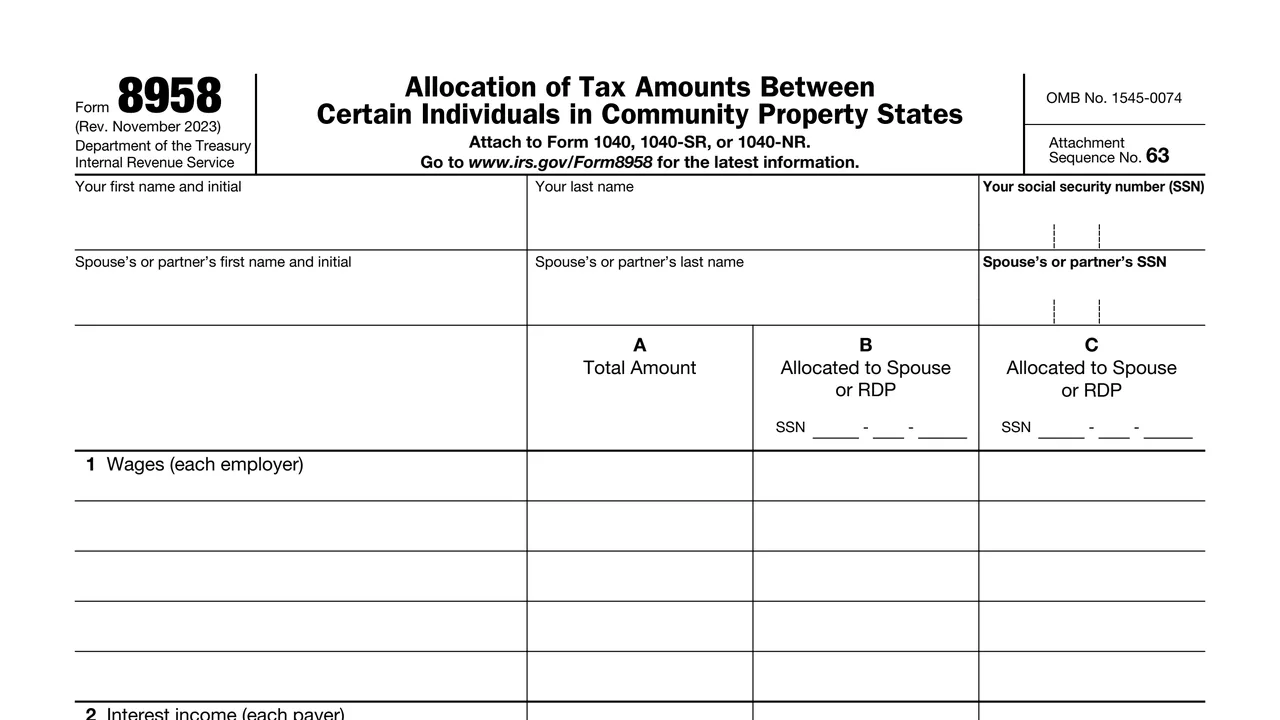
Your first name, initial, last name and SSN, then the same for your spouse or partner.
Column A is the total amount. Columns B and C are the amounts allocated to each spouse or RDP, each with an SSN at the top.
Wages from each employer, interest and dividends from each payer, and any state income tax refund.
Self-employment income, capital gains and losses, pension income, and rents, royalties, partnerships, estates and trusts.
The deductible part of self-employment tax, self-employment tax, and taxes withheld.
Other items such as social security benefits, unemployment compensation, deductions and credits.
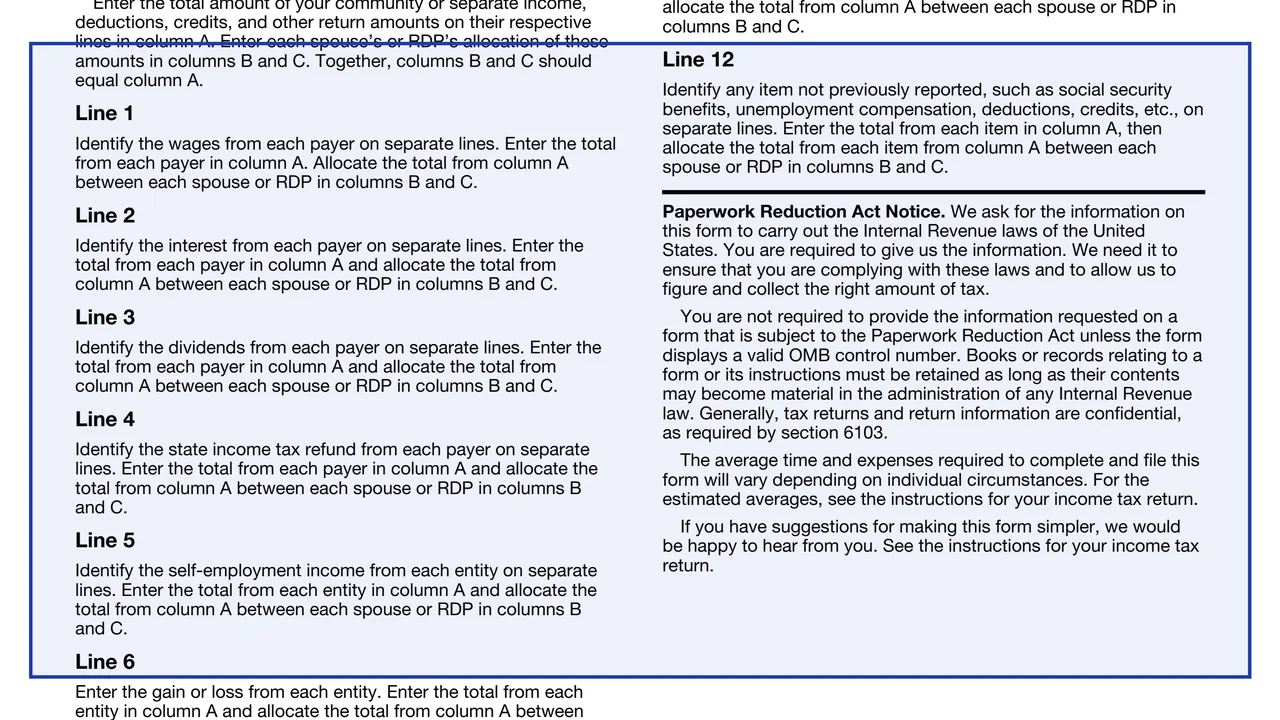
The instructions say you and your spouse or RDP identify community and separate income, deductions, credits and other return amounts according to the laws of your state.
Enter both names and SSNs at the top, and the SSN of each spouse or RDP above columns B and C.
Identify the wages, interest, dividends or state income tax refund from each payer on separate lines. Enter each total in column A and allocate it between columns B and C.
Identify self-employment income, gains or losses, pension income, rent, royalty, partnership, estate or trust items, and self-employment tax amounts from each entity or payer on separate lines, then allocate each total.
Identify the taxes withheld from each payer or entity, and any item not reported earlier, such as social security benefits, on separate lines. Enter the totals and allocate them.
The instructions say columns B and C together should equal column A. If you need more room, attach a statement listing the source of the item and the total plus the allocated amounts.
You get the real form, filled in a browser tab, with nothing standing between you and the finished PDF.
The form header says to attach it to Form 1040, 1040-SR or 1040-NR. It carries Attachment Sequence No. 63.
The instructions say to put your name and SSN on any added statements and attach them at the end of your return.
The instructions say that generally the laws of the state in which you are domiciled govern whether you have community income or separate income for federal tax purposes.
The instructions say wages and sole proprietorship self-employment income are community income that is evenly split, and each spouse reporting half the community wages is entitled to credit for half the income tax withheld on those wages.
The instructions say IRA distributions are deemed separate property and the IRA deduction cannot be split between spouses or RDPs.
The form says it is intended for individuals who are subject to community property laws and who file separate federal income tax returns. It goes with the individual's own return.
No tool matches that search.
The form says it is intended for individuals who are subject to community property laws and who file separate federal income tax returns. That covers spouses and registered domestic partners with community property rights.
No. The form header says to attach it to Form 1040, 1040-SR or 1040-NR.
Column A holds the total of each item. Columns B and C hold the amounts allocated to each spouse or RDP. The instructions say columns B and C together should equal column A.
The instructions say that when each spouse reports half the community wages on a separate return, each is entitled to credit for half the income tax withheld on those wages. The same applies to each RDP.
The instructions say to attach a statement listing the source of the item and the total plus the allocated amounts, with your name and SSN, at the end of your return.
The form points to Pub. 555, Community Property, and says to check with the laws of your state for information about your situation.