Owner and custodian details
The account owner's name, date of birth and address, the custodian's name and principal place of business, the eligibility statement and the dollar amount in cash assigned to the custodial account.
5305-C
Health Savings Custodial Account
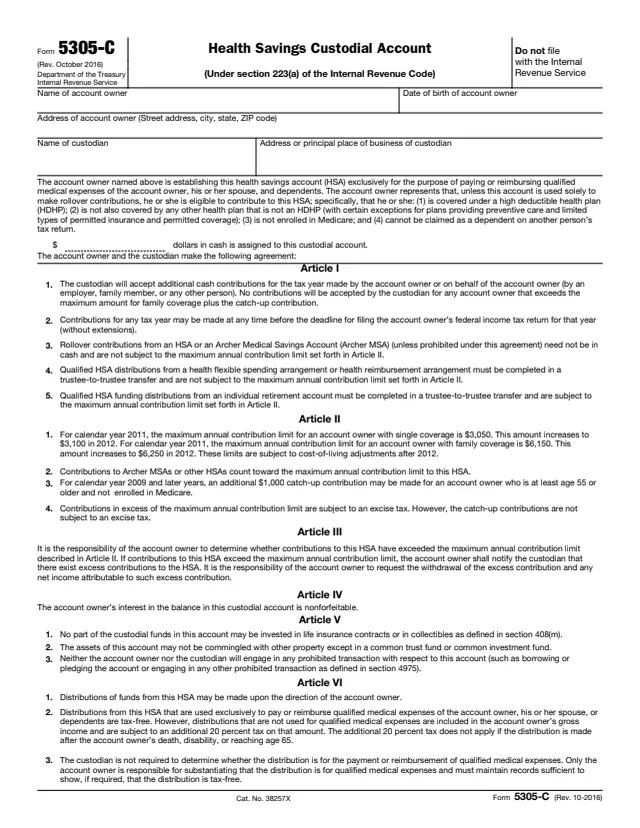
Form 5305-C is a model custodial account agreement that has been approved by the IRS, the instructions say. It sets up a health savings account (HSA) under section 223(a) of the Internal Revenue Code. The form states that the account owner is establishing the HSA exclusively for the purpose of paying or reimbursing qualified medical expenses of the account owner, his or her spouse, and dependents.
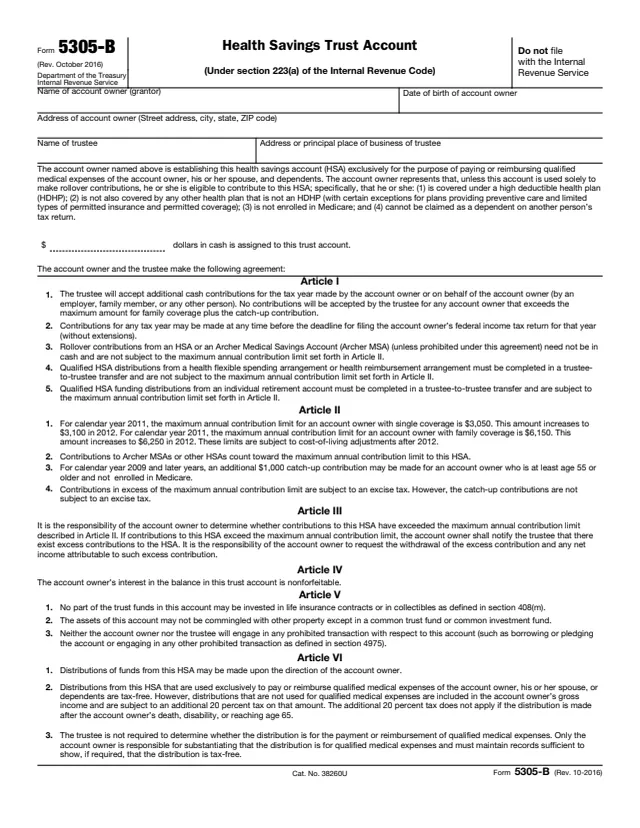
The agreement is between the account owner and a custodian. The instructions say an HSA is established after the form is fully executed by both the account owner and the custodian, and that the form can be completed at any time during the tax year. Form 5305-B is the trust account version of the same agreement, signed with a trustee.
The instructions say "Do not file Form 5305-C with the IRS. Instead, keep it with your records." You can fill out Form 5305-C free in your browser on this page and download the result without an account.
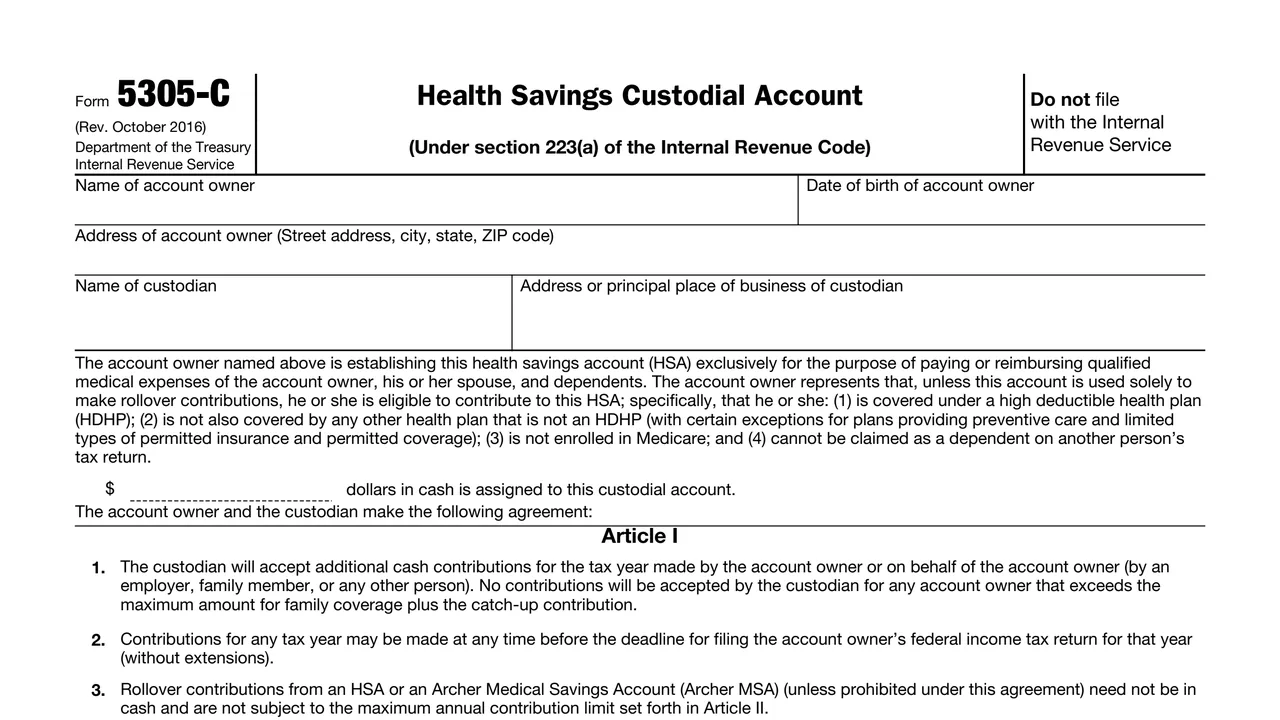
The account owner's name, date of birth and address, the custodian's name and principal place of business, the eligibility statement and the dollar amount in cash assigned to the custodial account.
Who may contribute, the deadline for each tax year, rollovers and trustee-to-trustee transfers, the annual limits and catch-up contribution, and the owner's responsibility for excess contributions.
The owner's interest is nonforfeitable. No custodial funds may be invested in life insurance contracts or collectibles, assets may not be commingled except in a common fund, and prohibited transactions are barred.
Distributions are made at the owner's direction. The article says which distributions are tax-free and that only the account owner is responsible for substantiating qualified medical expenses.
What happens to the HSA when the owner dies, the custodian's duty to prepare reports and returns, which articles control, and how the agreement is amended.
Space for additional provisions, then signature and date lines for the account owner and the custodian and an optional witness signature.
Enter the account owner's name, date of birth and street address, city, state and ZIP code. The instructions say the owner's social security number serves as the identification number of the HSA.
Enter the name of the custodian and the address or principal place of business of the custodian.
Enter the dollar amount in cash being assigned to the custodial account on the line below the eligibility statement.
Add any provisions agreed by the account owner and custodian, attaching pages if necessary. If none are added, the form says to draw a line through the space. Added provisions have to comply with Article IX.
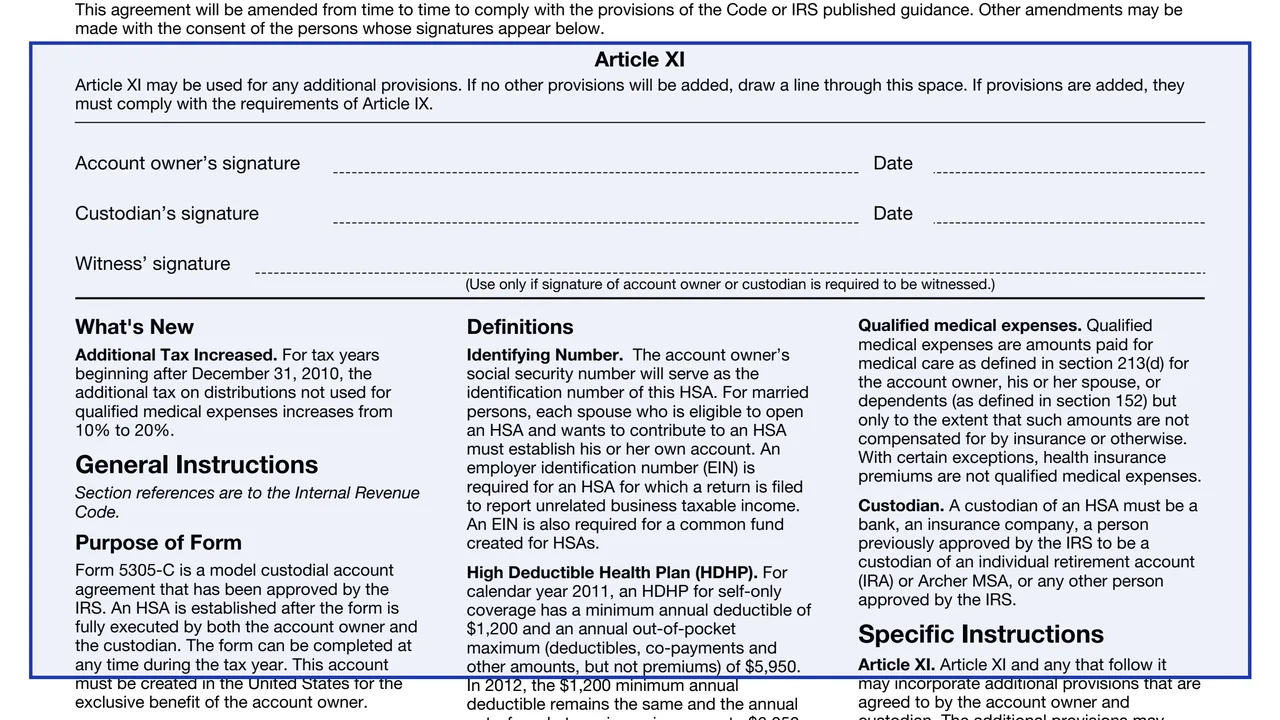
The account owner and the custodian sign and date. The witness line is used only if a signature is required to be witnessed.
You get the real form, filled in a browser tab, with nothing standing between you and the finished PDF.
The instructions say not to file Form 5305-C with the IRS and to keep it with your records instead.
The instructions say an HSA is established after the form is fully executed by both the account owner and the custodian. The form can be completed at any time during the tax year.
Article I says contributions for any tax year may be made at any time before the deadline for filing the account owner's federal income tax return for that year (without extensions).
Article II prints limits for 2011 and 2012, such as $3,050 for single coverage and $6,150 for family coverage in 2011, and says they are subject to cost-of-living adjustments after 2012.
The form says distributions not used for qualified medical expenses are included in gross income and subject to an additional 20 percent tax, which does not apply after death, disability or reaching age 65.
The instructions say an EIN is required for an HSA for which a return is filed to report unrelated business taxable income, and for a common fund created for HSAs.
5305-B
6 fields, 2 pages
5305-A
10 fields, 2 pages
5305
10 fields, 2 pages
5305-EA
15 fields, 2 pages
5305-E
15 fields, 2 pages
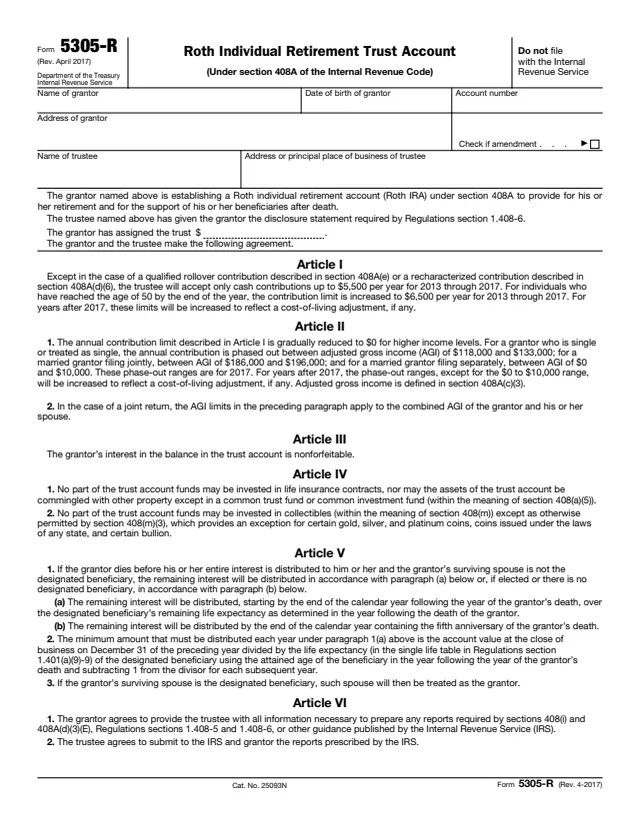
5305-R
9 fields, 2 pages
The form is an agreement signed by the account owner and the custodian. It is not filed with the IRS.
No tool matches that search.
No. The instructions say not to file Form 5305-C with the IRS and to keep it with your records.
Form 5305-C is a model custodial account agreement signed with a custodian. Form 5305-B is the model trust account agreement, signed with a trustee. Their articles otherwise follow the same text.
The instructions list a bank, an insurance company, a person previously approved by the IRS to be a custodian of an individual retirement account (IRA) or Archer MSA, or any other person approved by the IRS.
The instructions say after the form is fully executed by both the account owner and the custodian. The form can be completed at any time during the tax year.
The form prints limits for calendar years 2011 and 2012 and says they are subject to cost-of-living adjustments after 2012. The instructions point to Pub. 969 and other IRS published guidance for more on HSAs.
The instructions say that for married persons, each spouse who is eligible to open an HSA and wants to contribute to an HSA must establish his or her own account.