Page 1 flowchart
Do You Have To File Form 2210? walks through lines 1 to 9 and Part II to show whether to file the form, file only page 1, or not file.
2210
Underpayment of Estimated Tax by Individuals, Estates, and Trusts
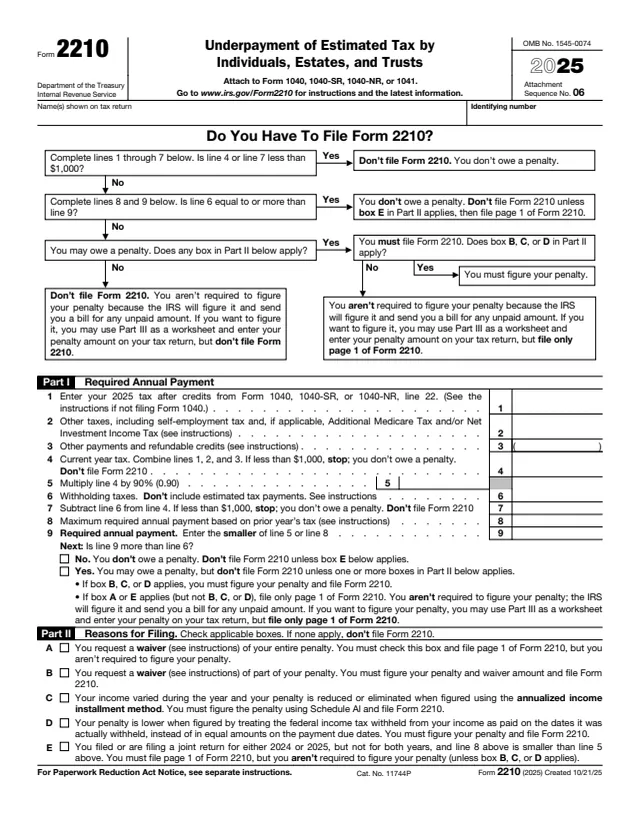
Form 2210 is the 2025 IRS form individuals, estates and trusts use to see if they owe a penalty for underpaying estimated tax and, if they do, to figure the amount. It attaches to Form 1040, 1040-SR, 1040-NR or 1041.
The instructions say the IRS will generally figure the penalty and send a bill, and in that case Form 2210 is not filed. The flowchart at the top of page 1 shows when it is filed: for example, to request a waiver, to use the annualized income installment method, or to treat withholding as paid on the dates it was actually withheld. Some of those cases need page 1 only.
Part I figures the required annual payment, Part II lists the reasons for filing, Part III figures the underpayment and the penalty, and Schedule AI is the annualized income installment method. You can fill out the PDF free in your browser on this page and download it without an account.
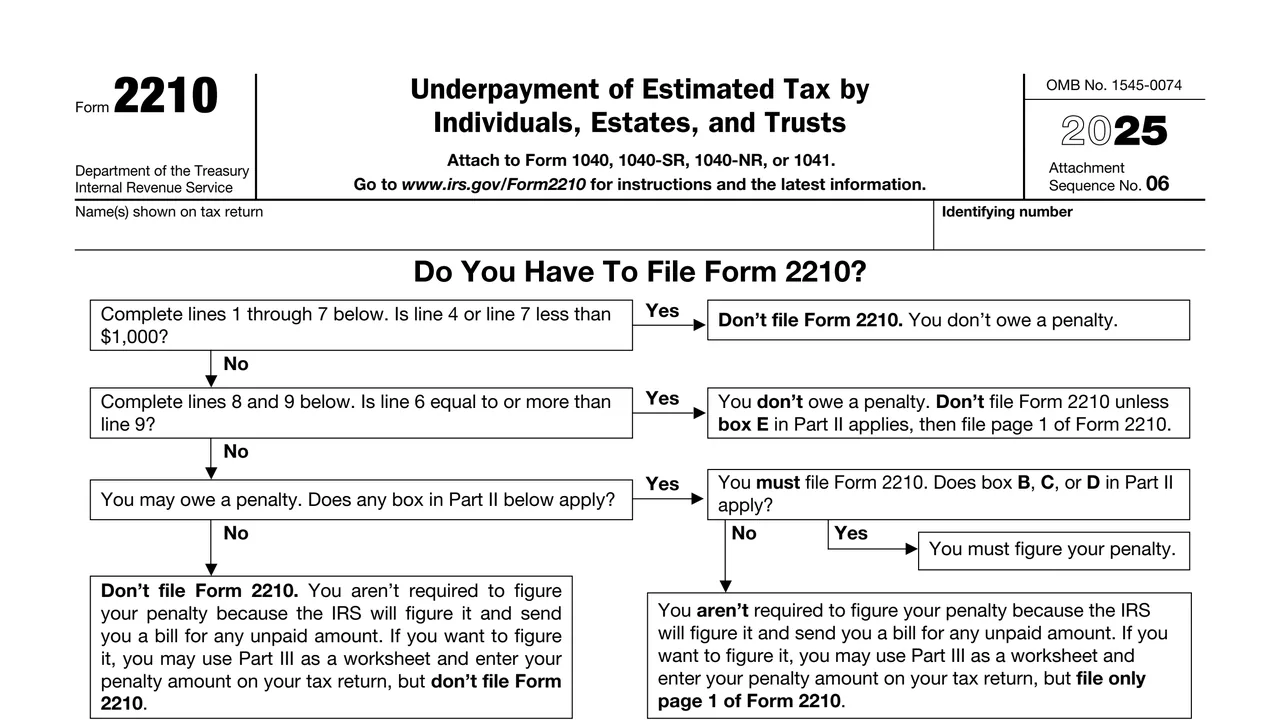
Do You Have To File Form 2210? walks through lines 1 to 9 and Part II to show whether to file the form, file only page 1, or not file.
Lines 1 to 9: current year tax, 90% of it, withholding, the maximum based on the prior year's tax, and the required annual payment, the smaller of lines 5 and 8.
Boxes A to E: full waiver, partial waiver, annualized income, withholding treated as paid when withheld, and a joint return for one of the two years.
Lines 10 to 18 in four columns for the due dates 4/15/25, 6/15/25, 9/15/25 and 1/15/26: required installments, payments, underpayment and overpayment.
Line 19 holds the total penalty from the penalty worksheet in the instructions, also entered on Form 1040, 1040-SR or 1040-NR, line 38, or Form 1041, line 27.
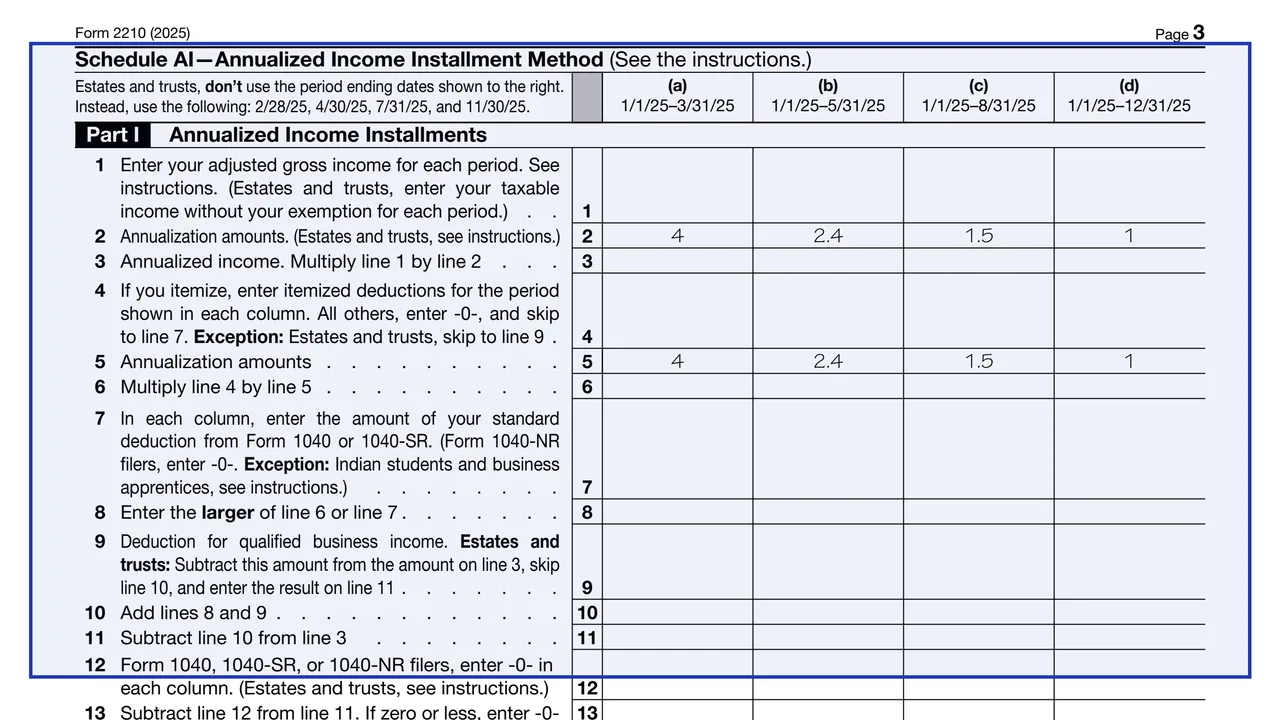
Page 3 annualizes income and deductions for four periods to figure the required installments, with a Part II for annualized self-employment tax.
Enter 2025 tax after credits, other taxes such as self-employment tax, and refundable credits. The form says that if line 4 is less than $1,000, stop; you don't owe a penalty.
Multiply line 4 by 90%, enter withholding without estimated tax payments on line 6, and subtract. The form says a line 7 below $1,000 also means no penalty.
Line 8 is based on the 2024 tax. The instructions say to use 110% of it if 2024 AGI was more than $150,000 ($75,000 if married filing separately for 2025). Line 9 is the smaller of line 5 or line 8.
Check each box that applies. If none apply, the form says not to file Form 2210.
Enter 25% of line 9 in each column, or the Schedule AI amounts if box C applies. Enter payments and withholding by due date on line 11, then finish lines 12 through 18 one column at a time.
Figure the penalty with the worksheet in the instructions, which applies the rate for each rate period to the days each underpayment stayed unpaid, and enter the total.
You get the real form, filled in a browser tab, with nothing standing between you and the finished PDF.
The form says to attach it to Form 1040, 1040-SR, 1040-NR or 1041.
Without box B, C or D, the instructions say the IRS will figure any penalty and send a bill. If the 2025 return is filed by April 15, 2026, no interest is charged on a penalty paid by the date on the bill.
With box A or E (but not B, C or D), the form says to file only page 1. Part III can still be used as a worksheet.
Attach Form 2210 and a statement explaining the reasons and the time period. For retirement or disability, the instructions ask for documents showing the retirement date and age, or the date of disability.
The four 2025 installment due dates printed on the form are 4/15/25, 6/15/25, 9/15/25 and 1/15/26.
The instructions say no penalty or form applies if 2025 total tax minus withholding is less than $1,000, or if there was no 2024 tax liability for a full 12-month year as a U.S. citizen or resident alien.
2210-F
21 fields, 1 page
1040
199 fields, 2 pages
1040-NR
171 fields, 2 pages
1041
173 fields, 3 pages
8960
38 fields, 1 page
8962
141 fields, 2 pages
The form is for individuals, estates and trusts. Its flowchart and the boxes in Part II decide whether it is filed.
No tool matches that search.
No. The instructions say the IRS will generally figure the penalty, and in that case the form should not be filed. The flowchart on page 1 shows when it is filed.
Line 9: the smaller of 90% of the 2025 tax on line 5 or the maximum based on the 2024 tax on line 8.
The instructions say all or part may be waived if, in 2024 or 2025, the filer retired after reaching age 62 or became disabled with reasonable cause, or for a casualty, disaster or other unusual circumstance.
Schedule AI, the annualized income installment method, may lower or eliminate one or more required installments. The instructions say using it for one due date means using it for all.
Yes. The instructions say the penalty is figured separately for each installment due date and may be owed for an earlier due date even when a refund is due.
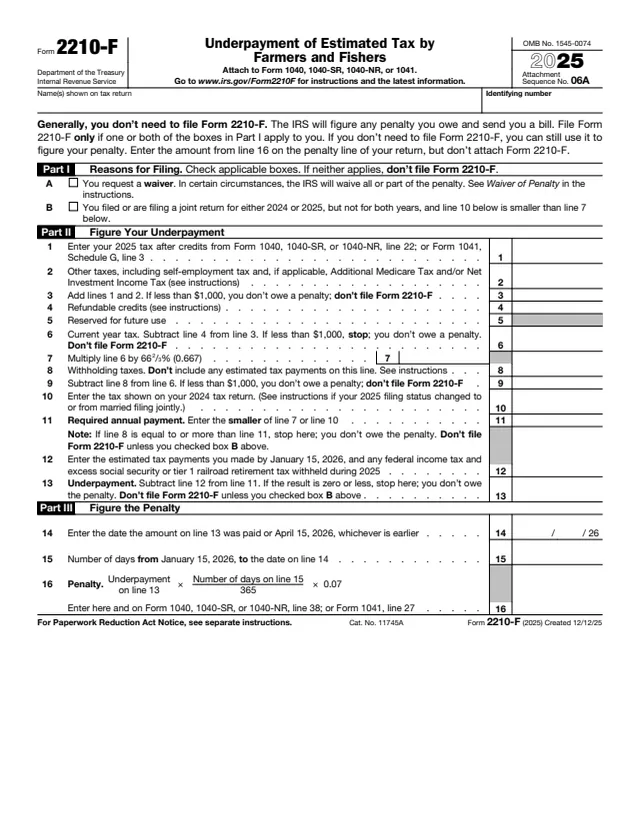
Yes. The instructions use a different percentage for them and point those who meet the two-thirds farming or fishing test but did not file and pay by March 2, 2026, to Form 2210-F.