Payer and recipient blocks
Names, separate address boxes, telephone number, both TINs, an account number, the FATCA filing requirement box and the 2nd TIN not. box.
1099-MISC
Miscellaneous Information
Form 1099-MISC, Miscellaneous Information, is an information return. A payer files it with the IRS and furnishes a copy to the person it paid. The instructions say to file it "for each person in the course of your business" to whom certain payments were made during the year, such as rents, royalties, prizes and awards, other income payments, medical and health care payments, crop insurance proceeds, fishing boat proceeds and gross proceeds paid to an attorney.
The December 2026 revision is a continuous-use form. The instructions say to use it to file 2026 information with the IRS in early 2027 and for later years until a superseding revision is issued. This revision adds boxes 13a for cash tips, 13b for Treasury Tipped Occupation Codes and 14 for overtime compensation, and splits the payer and recipient addresses into separate entry boxes.
Copies 1, B and 2 can be filled out free in your browser on this page and downloaded without an account. The PDF says Copy A printed from it is for information only and is not scannable.
Names, separate address boxes, telephone number, both TINs, an account number, the FATCA filing requirement box and the 2nd TIN not. box.
Rents, royalties, other income and federal income tax withheld.
Fishing boat proceeds, medical and health care payments, a checkbox for direct sales totaling $5,000 or more of consumer products for resale, and substitute payments in lieu of dividends or interest.
Crop insurance proceeds, gross proceeds paid to an attorney, fish purchased for resale and section 409A deferrals.
Cash tips, the Treasury Tipped Occupation Code (TTOC), overtime compensation and nonqualified deferred compensation. Boxes 13a and 14 show amounts already included in box 3.
State tax withheld, the state and payer's state number, and state income, for up to two states.
Enter both names, addresses and TINs. The instructions say to enter the recipient's TIN with hyphens, XXX-XX-XXXX for an SSN, ITIN or ATIN and XX-XXXXXXX for an EIN. The recipient's TIN may be truncated on payee statements but not on the copy filed with the IRS.
Enter the 4-digit calendar year. The instructions say an account number is required when the payer files more than one Form 1099-MISC for a recipient with multiple accounts, or checks the FATCA box.
Report each payment in its own box. The instructions say the IRS uses this information to determine whether the recipient has properly reported the payment.
Box 13a holds the total cash tips included in box 3. Box 14 holds qualified overtime included in box 3; the instructions say only the "half" portion of "time-and-a-half" is reported there.
Boxes 16 to 18 are for the payer's convenience and need not be completed for the IRS. Keep each state's information separated by the dash line.
You get the real form, filled in a browser tab, with nothing standing between you and the finished PDF.
The instructions say to furnish payee statements by January 31 and file with the IRS by February 28, or March 31 if filing electronically. A due date on a Saturday, Sunday or legal holiday moves to the next business day.
The PDF says a payer with 10 or more information returns in the aggregate may be required to e-file, and points to the free Information Return Intake System (IRIS).
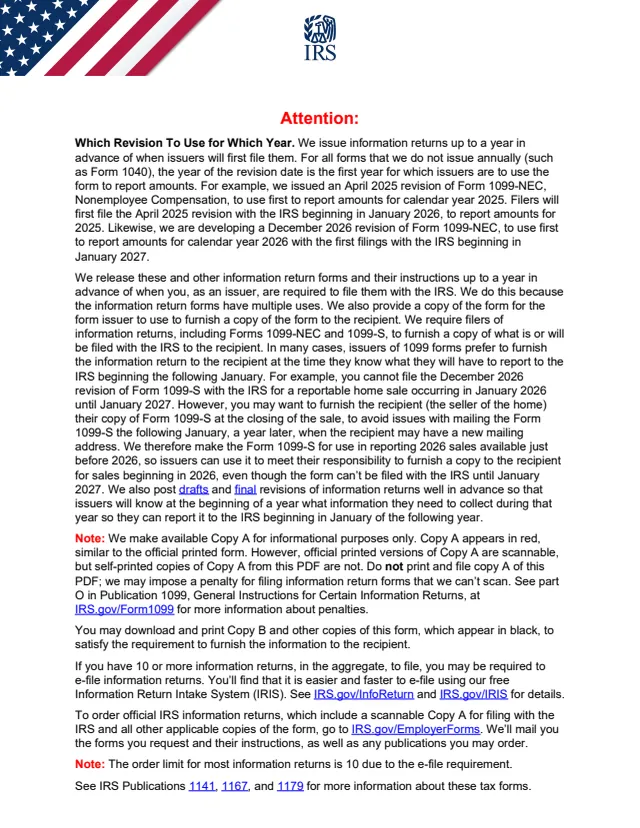
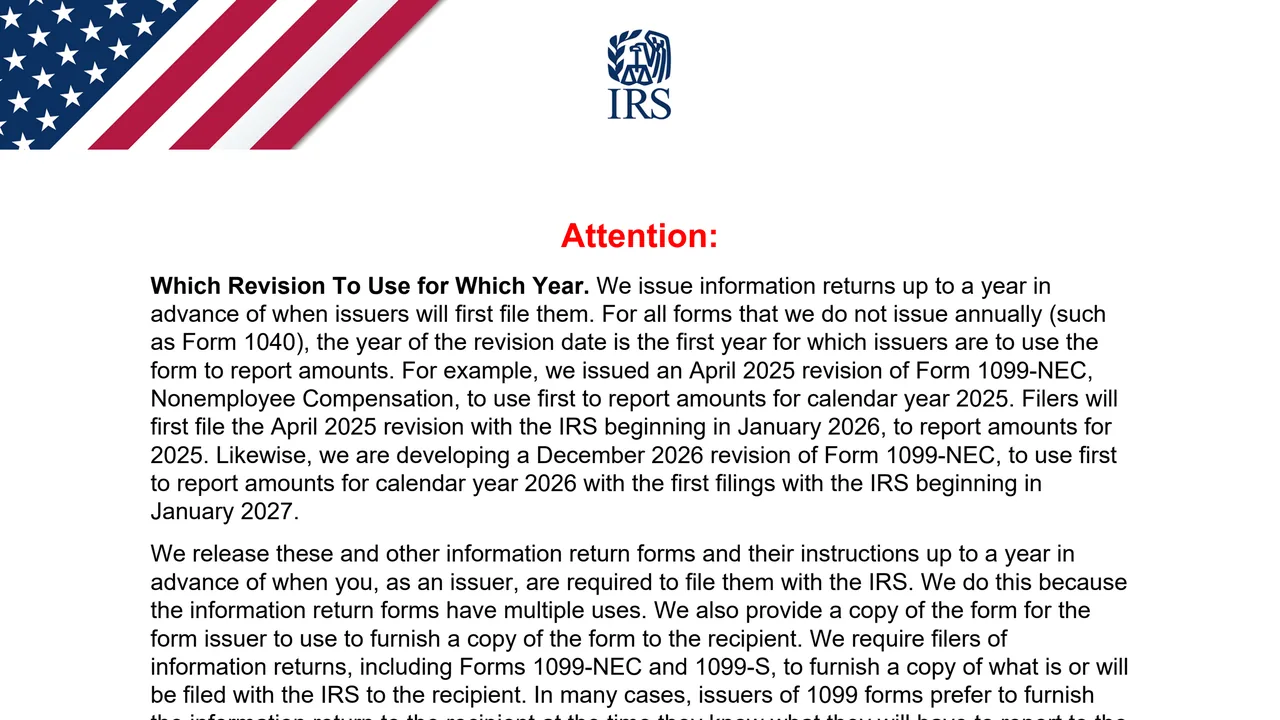
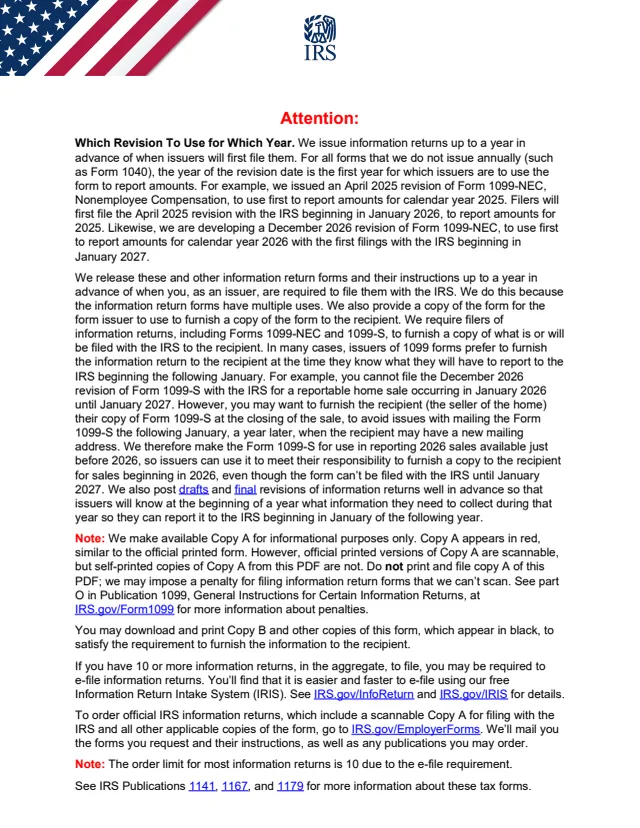
The PDF says Copy A is shown in red for information only and self-printed copies are not scannable: "Do not print and file copy A of this PDF." Official scannable forms can be ordered at IRS.gov/EmployerForms.
Copy B and the other black copies may be downloaded and printed to furnish the information to the recipient. The instructions say Copies 1, B and 2 are fillable online.
To correct a paper form already sent to the IRS, the instructions point to part H of Pub. 1099 and say not to check the VOID box on the correction.
1099-NEC
140 fields, 6 pages
W-9
23 fields, 6 pages
1099-K
207 fields, 6 pages
1099-C
33 fields, 4 pages
W-2
568 fields, 11 pages
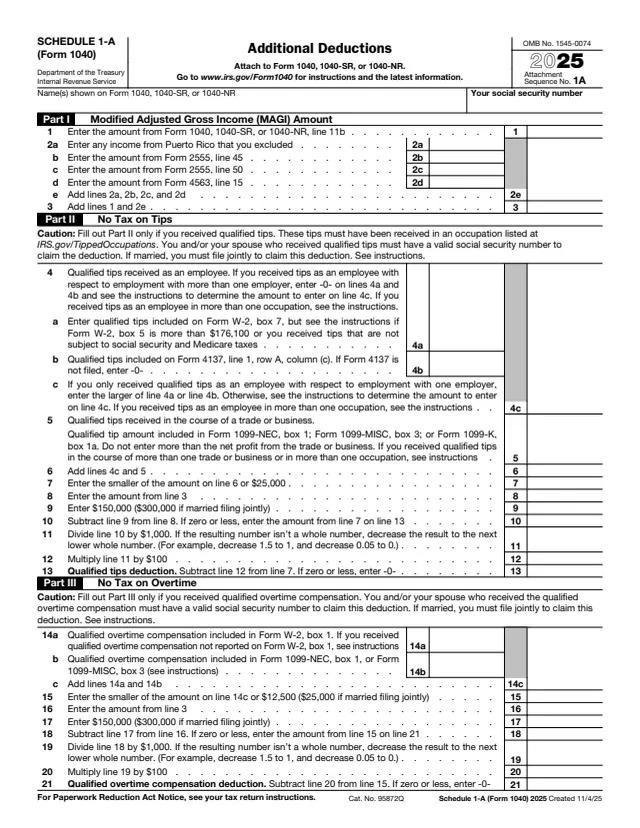
1040
54 fields, 2 pages
The payer completes the form, files Copy A with the IRS and gives Copy B to the recipient. The instructions say to report only payments made in the course of a trade or business; personal payments are not reportable.
No tool matches that search.
Nonemployee compensation, including attorneys' fees of $2,000 or more, goes in box 1a of Form 1099-NEC. Gross proceeds paid to an attorney, such as a settlement, go in box 10 of Form 1099-MISC.
The instructions list new boxes 13a and 13b for cash tips and tipped occupation codes, box 14 for overtime compensation, separate address boxes, and a $2,000 reporting threshold for certain payments for tax years beginning after 2025.
The instructions say January 31 for the recipient's statement, and February 28 on paper or March 31 electronically for the IRS.
The PDF says no. Copy A printed from it is not scannable and the IRS may impose a penalty for filing forms it cannot scan. Copy B and the other black copies can be printed.
Generally not. The instructions list exceptions that are reported, including medical and health care payments, fish purchased for resale, substitute payments and gross proceeds paid to an attorney.
The recipient instructions say to contact the payer. If the form cannot be corrected, attach an explanation to the tax return and report the information correctly.