Header
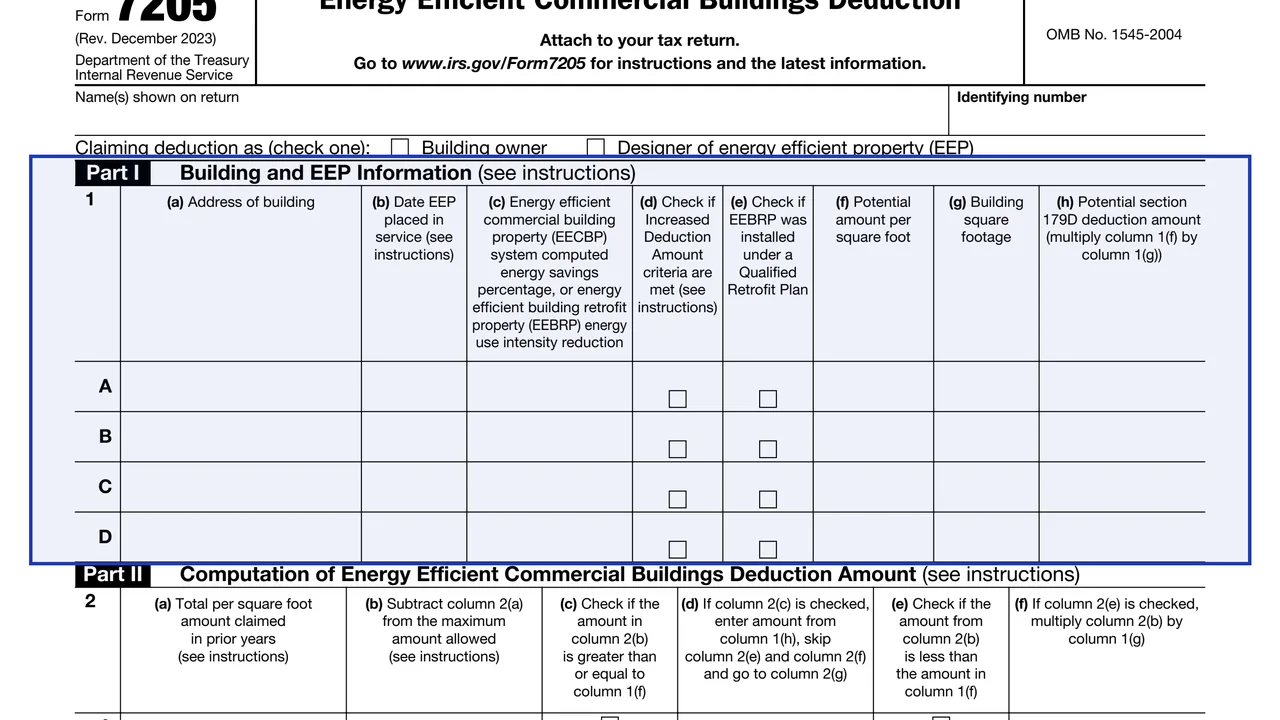
Name(s) shown on the return, identifying number, and the choice of claiming the deduction as building owner or as designer of energy efficient property.
7205
Energy Efficient Commercial Buildings Deduction
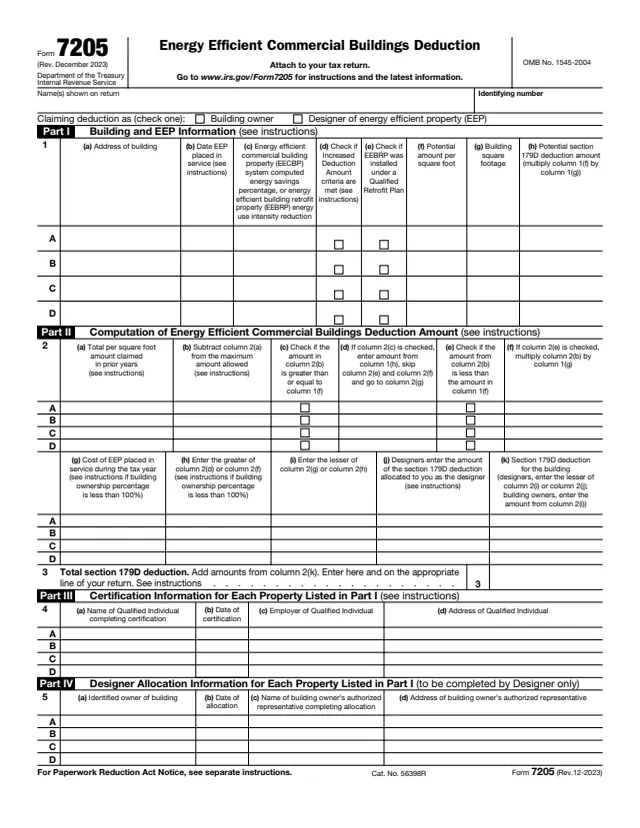
Form 7205, Energy Efficient Commercial Buildings Deduction, is used to calculate and claim the deduction under section 179D for qualifying energy efficient commercial building property placed in service during the tax year. It also identifies the filer as the building owner or the designer, and gives information on the person who performed the certification and the person who completed any allocation.
The About page says qualified business entities and individuals use the form. It is attached to the filer's tax return, and the total deduction on line 3 is also entered on the appropriate line of that return.
The instructions say to keep using this December 2023 revision for property placed in service after December 31, 2022, and the December 2022 revision for property placed in service before January 1, 2023. They also say the deduction was terminated for property the construction of which begins after June 30, 2026. You can fill out the PDF free in your browser on this page and download it without an account.
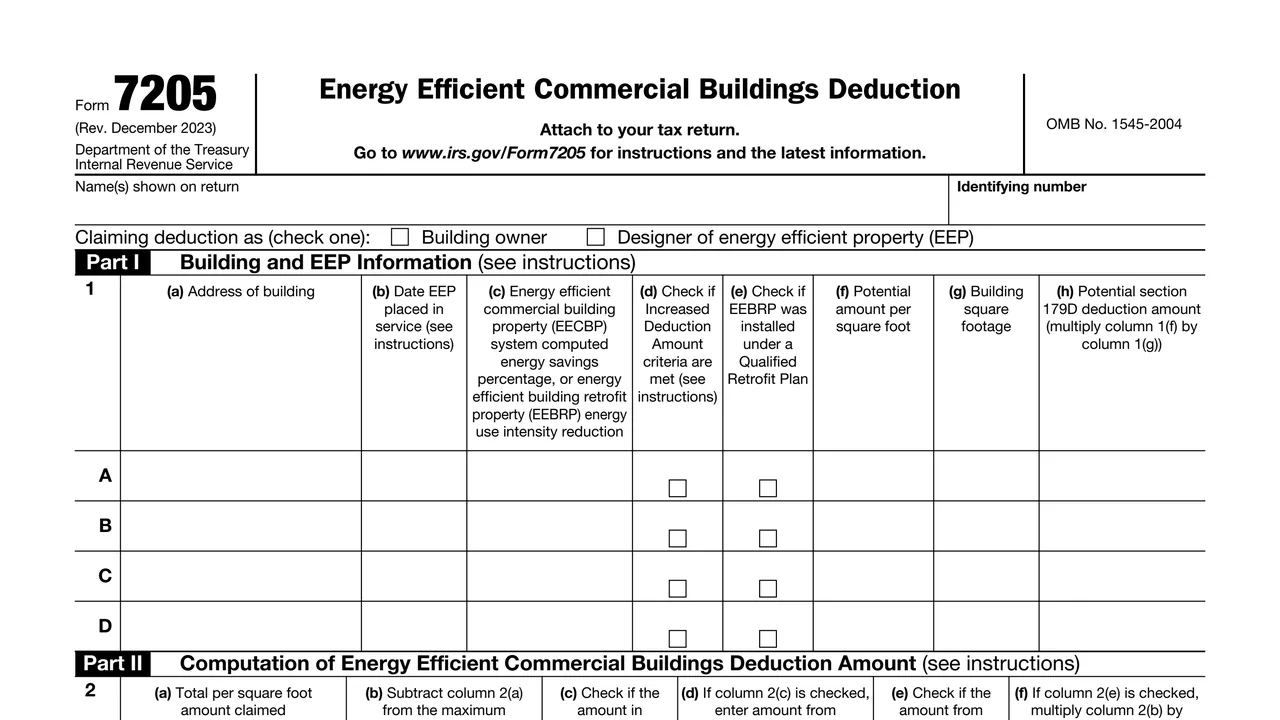
Name(s) shown on the return, identifying number, and the choice of claiming the deduction as building owner or as designer of energy efficient property.
Up to four buildings on rows A to D: address, date placed in service, energy savings or energy use intensity reduction, increased deduction and retrofit plan boxes, amount per square foot, square footage and potential deduction.
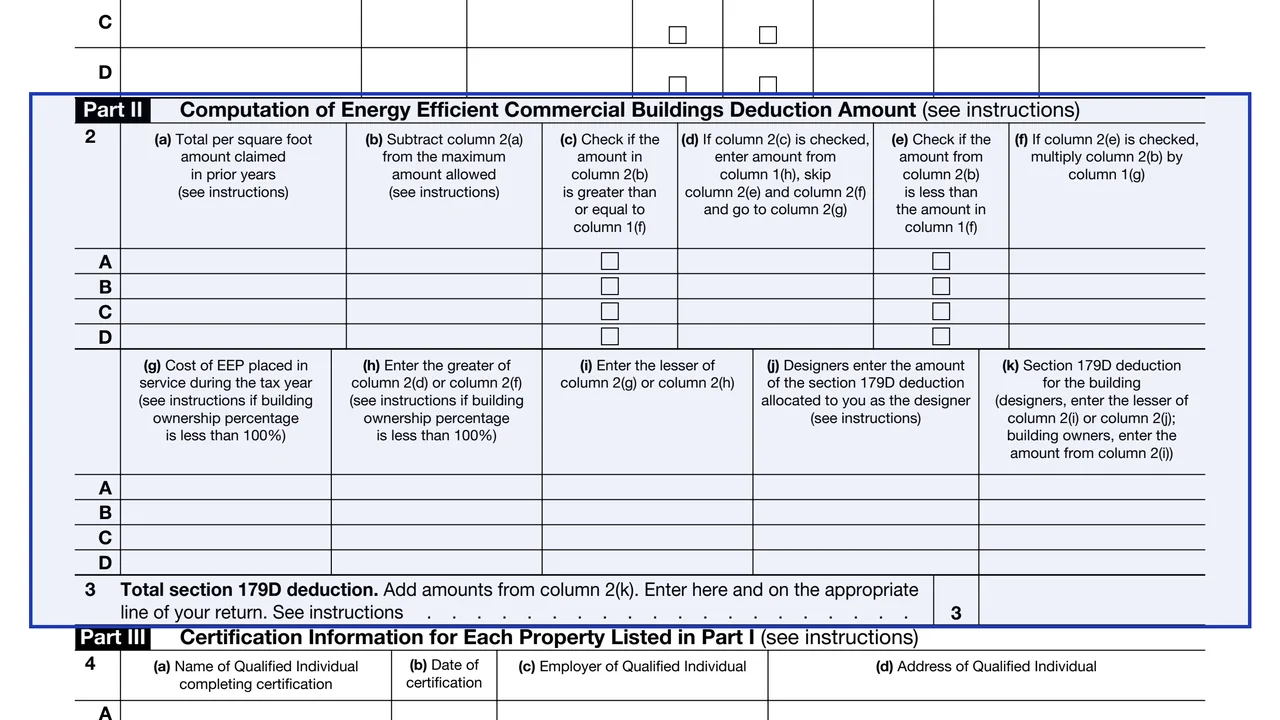
Columns (a) to (k) compare the potential amount with amounts claimed in prior years and the maximum allowed, then limit the deduction by the cost of the property.
The total section 179D deduction from column 2(k), also entered on the appropriate line of the tax return.
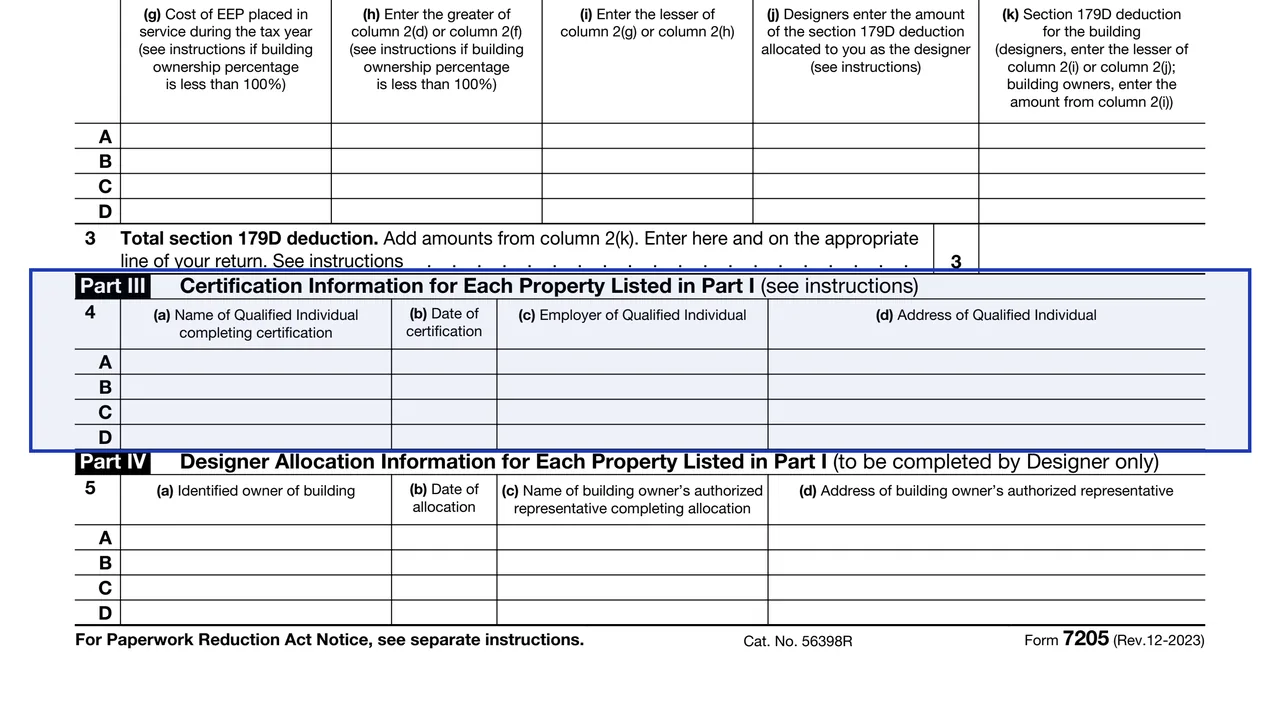
For each property, the name of the qualified individual who completed the certification, the date, their employer and address.
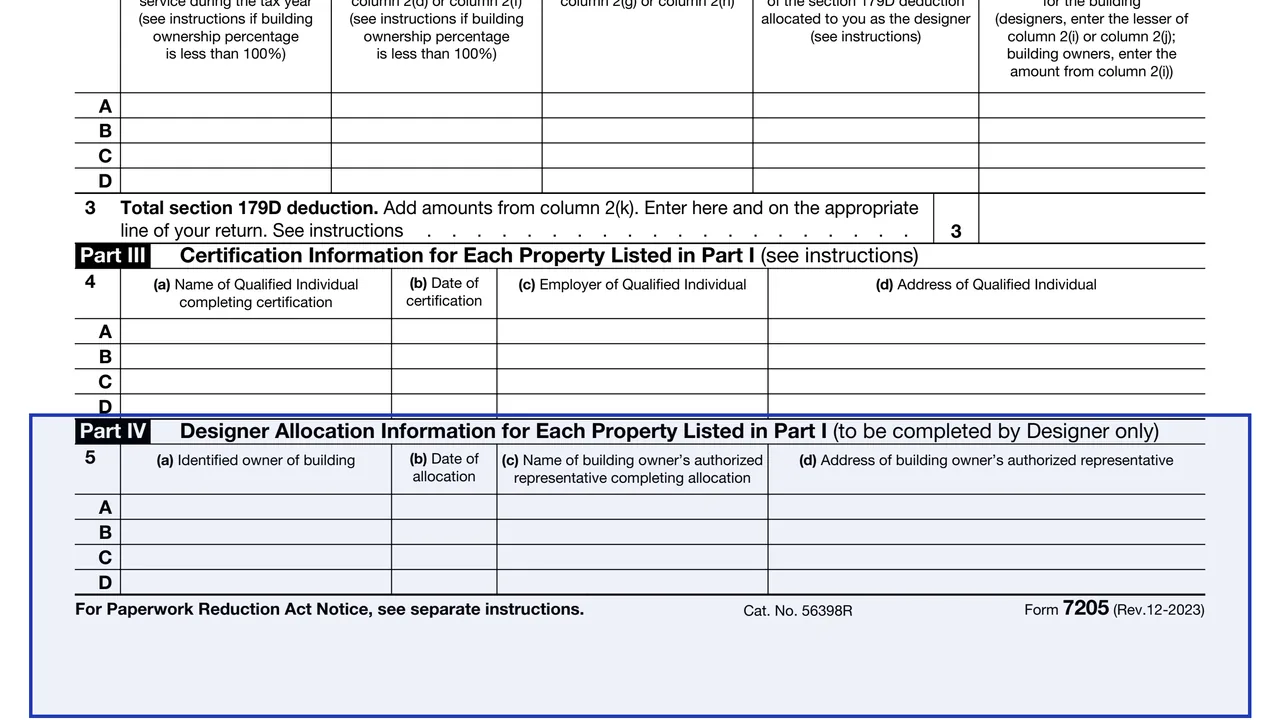
Completed by a designer only: the identified owner of the building, date of allocation, and the owner's authorized representative and address.
Check either "Building owner" or "Designer of energy efficient property (EEP)". The instructions say to check only one.
Enter the building name and address, the date the property was placed in service, and the energy savings percentage or the energy use intensity reduction, rounded to two decimal places. Keep buildings on separate rows.
Check (d) only if the increased deduction criteria are met, such as installation that began before January 29, 2023, or prevailing wage and apprenticeship requirements. Check (e) only for retrofit property installed under a qualified retrofit plan.
Figure the potential amount per square foot with the worksheet in the instructions, enter the building square footage, and multiply the two in column (h).
Enter the per square foot amount claimed for the building in the prior 3 tax years (4 if the deduction is allowable to the designer), subtract it from the maximum allowed, and enter the cost of the property, not the whole building. A designer enters the amount allocated in column (j).
Add column 2(k) on line 3 and carry it to the return; the instructions use Form 1120, line 25 as an example. List the certifier in Part III. Designers complete Part IV. For more than four properties, attach more forms but complete line 3 on only one.
You get the real form, filled in a browser tab, with nothing standing between you and the finished PDF.
The form says "Attach to your tax return." The line 3 total also goes on the applicable line of that return.
The instructions list, for tax years beginning on or after January 1, 2026, $5.94 per square foot when column 1(d) is checked and $1.19 when it is not. They say the maximums may be adjusted for inflation.
To claim the increased amount, the instructions say to attach a statement to the timely filed income tax return (including extensions) showing the prevailing wage and apprenticeship requirements are met.
The instructions say the basis of the property is reduced by the deduction allowed, and the building owner reduces basis by any deduction allocated to a designer.
The instructions say the deduction was terminated for property the construction of which begins after June 30, 2026.
1120
481 fields, 6 pages
7207
490 fields, 5 pages
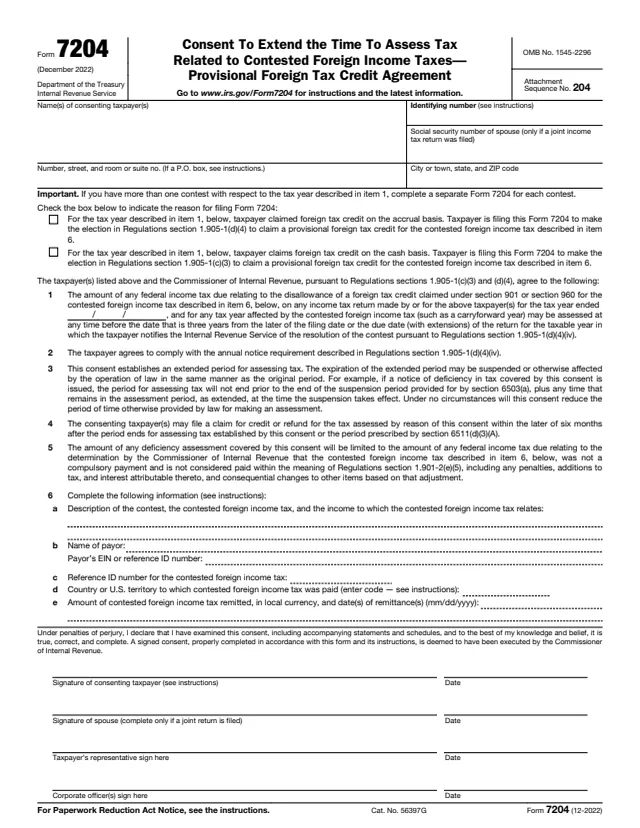
7204
18 fields, 1 page
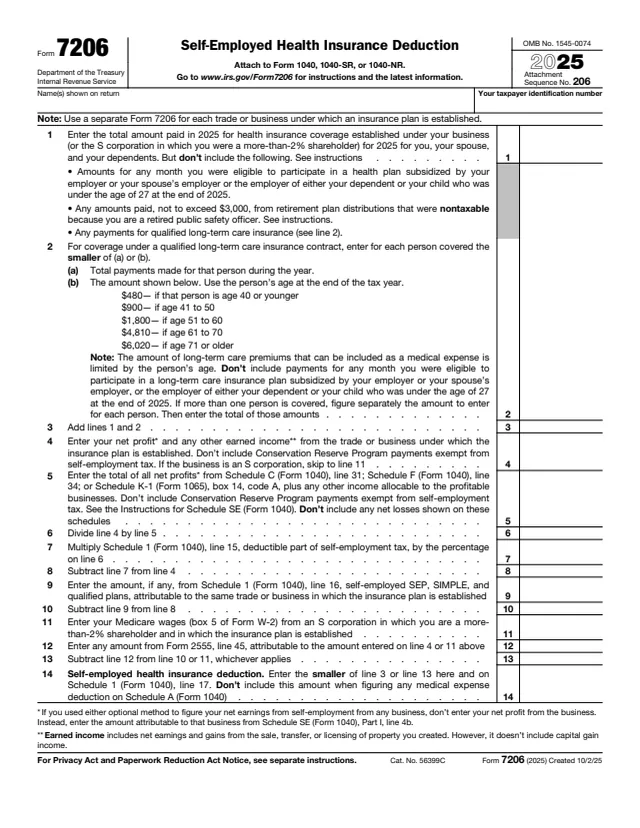
7206
16 fields, 1 page
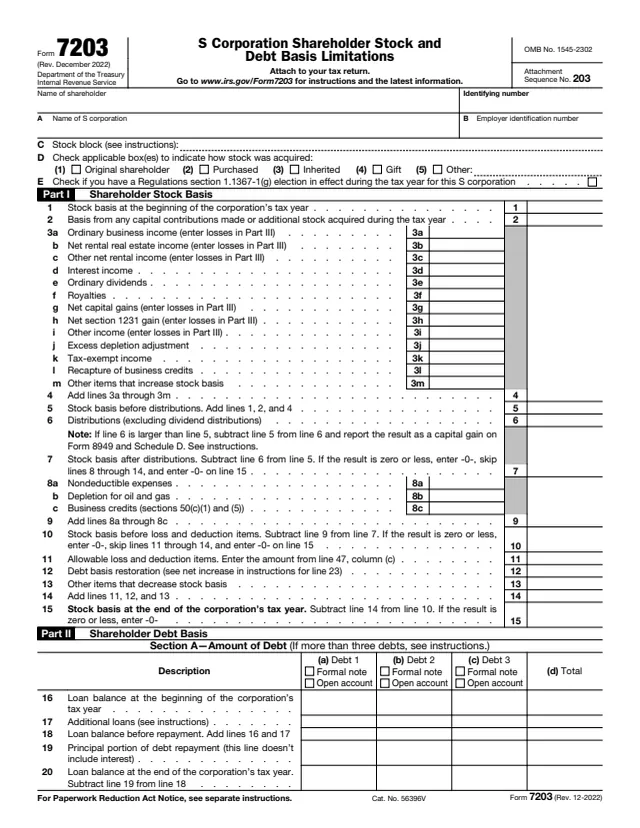
7203
188 fields, 2 pages
The instructions say individuals and business entities that qualify to claim the deduction for energy efficient property (EEP) placed in service during the tax year file Form 7205. The filer checks one status at the top.
No tool matches that search.
The instructions name commercial building owners, and designers of energy efficient property installed on or in buildings owned by specified tax-exempt entities, when the deduction is allocated to them in writing.
The instructions say to use the December 2023 revision for property placed in service after December 31, 2022, and the December 2022 revision for property placed in service before January 1, 2023.
Complete and attach as many Forms 7205 as needed. The instructions say to complete line 3 on only one of them, with the combined total for all properties.
The instructions say the cost of EEP does not include the total cost of the building or general renovation, and EEP does not include items such as ovens and fryers, manufacturing equipment, elevators or escalators, or exterior lighting.
A qualified individual, an unrelated licensed professional engineer or contractor, for commercial building property. For retrofit property, a qualified professional who is a licensed architect or licensed engineer.
The instructions say P.L. 119-21, commonly known as the One Big Beautiful Bill Act, terminated it for property the construction of which begins after June 30, 2026.