Line 1: health insurance paid
The total paid in 2025 for coverage established under the business, without months of eligibility for a subsidized employer plan, certain retired public safety officer amounts, or long-term care premiums.
7206
Self-Employed Health Insurance Deduction
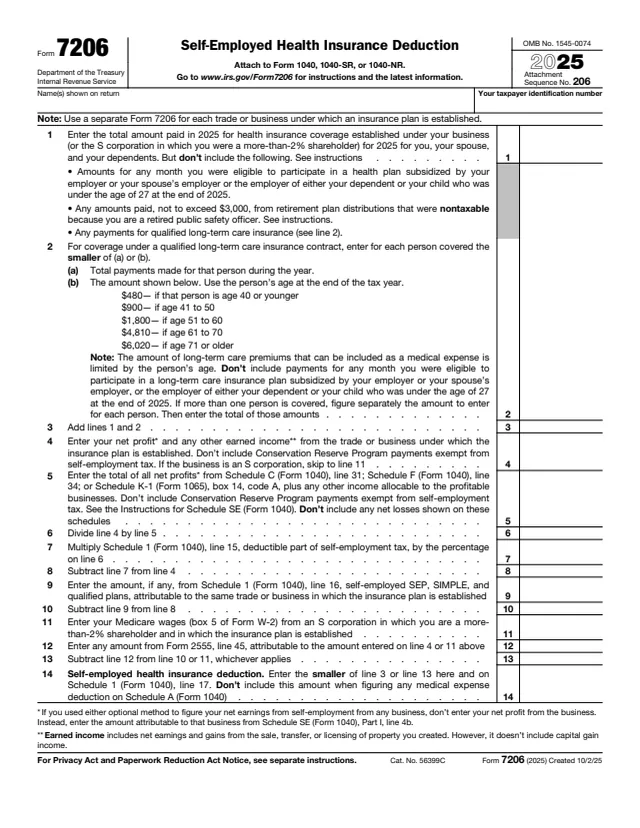
Form 7206, Self-Employed Health Insurance Deduction, is used to determine any amount of the self-employed health insurance deduction that may be reported on Schedule 1 (Form 1040), line 17. The 2025 form is attached to Form 1040, 1040-SR or 1040-NR.
The instructions say the insurance can include medical, dental and vision insurance and qualified long-term care insurance for the filer, a spouse and dependents, and a child who was under age 27 at the end of 2025 even if not a dependent. They also require that the insurance plan be established, or considered established, under the filer's business.
The instructions say the worksheet in the Form 1040 instructions can generally be used instead, and Form 7206 is used when there is more than one source of income subject to self-employment tax, Form 2555 is filed, or long-term care premiums are counted. You can fill out the PDF free in your browser on this page and download it without an account.
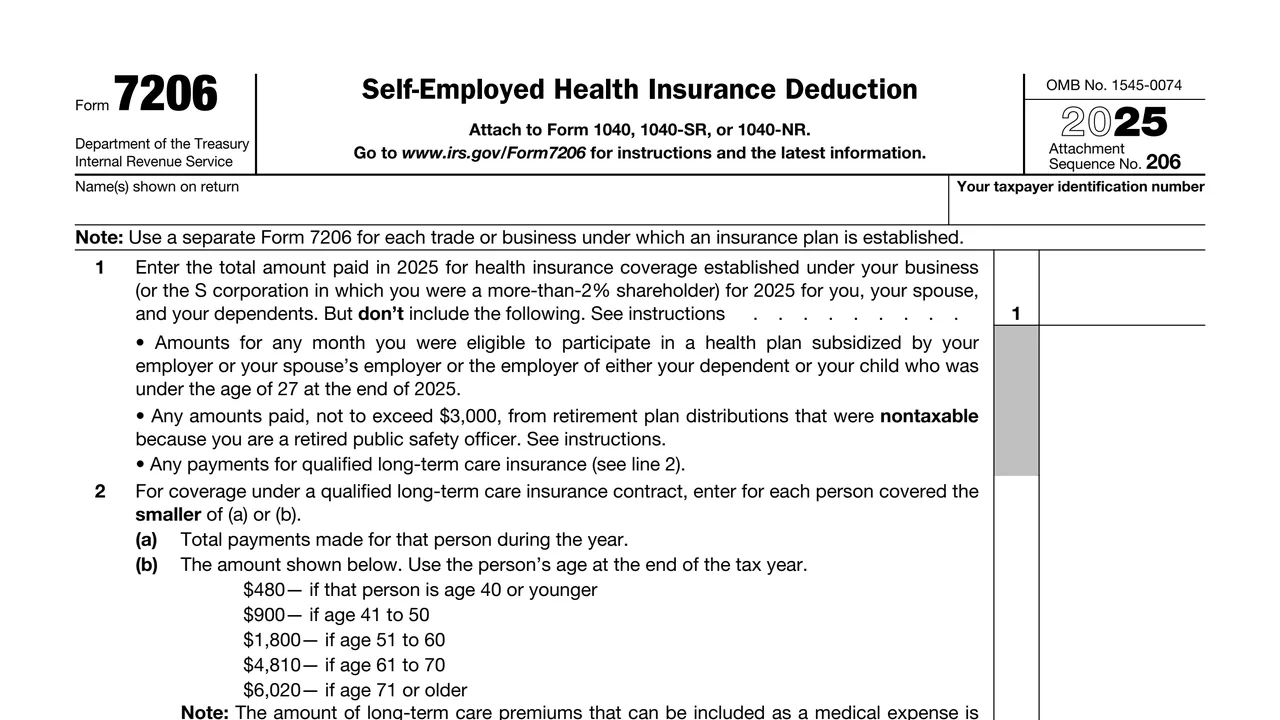
The total paid in 2025 for coverage established under the business, without months of eligibility for a subsidized employer plan, certain retired public safety officer amounts, or long-term care premiums.
For each person covered, the smaller of payments made or an age-based amount: $480 at 40 or younger, $900 at 41 to 50, $1,800 at 51 to 60, $4,810 at 61 to 70 and $6,020 at 71 or older.
Premiums are added on line 3. Lines 4 to 10 reduce net profit from the business by a share of the deductible self-employment tax and by SEP, SIMPLE and qualified plan contributions.
Medicare wages from box 5 of Form W-2 from the S corporation in which the filer is a more-than-2% shareholder and the plan is established.
Line 12 takes any related amount from Form 2555, line 45. Line 14 is the smaller of line 3 or line 13 and is the self-employed health insurance deduction.
The form says to use a separate Form 7206 for each trade or business under which an insurance plan is established. Enter the name(s) shown on the return and the taxpayer identification number.
Enter health insurance paid for 2025 on line 1, leaving out the listed exclusions. On line 2, figure each covered person's long-term care amount separately using their age at the end of the tax year, then enter the total.
Enter net profit and other earned income from the business on line 4; for an S corporation, skip to line 11. Line 5 totals net profits from Schedule C line 31, Schedule F line 34 or Schedule K-1 (Form 1065) box 14 code A. Then work through lines 6 to 10.
For an S corporation, enter Medicare wages from box 5 of Form W-2 from the corporation in which the filer is a more-than-2% shareholder and the plan is established.
Enter any amount from Form 2555, line 45, tied to line 4 or 11, and subtract it on line 13. Line 14 is the smaller of line 3 or line 13; it also goes on Schedule 1 (Form 1040), line 17.
You get the real form, filled in a browser tab, with nothing standing between you and the finished PDF.
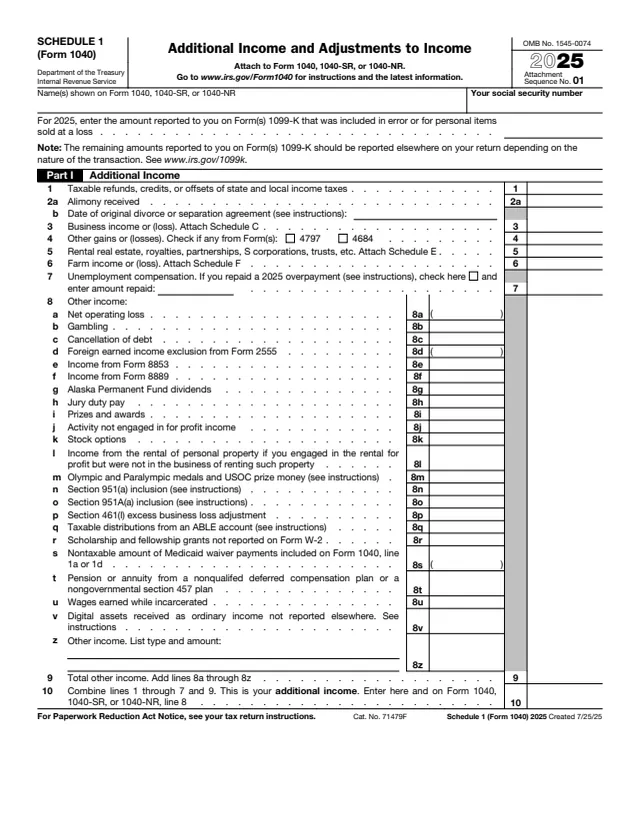
The form says "Attach to Form 1040, 1040-SR, or 1040-NR." The line 14 amount is reported on Schedule 1 (Form 1040), line 17.
The form says not to include the line 14 amount when figuring any medical expense deduction on Schedule A (Form 1040). The instructions say premiums not deductible on line 17 can be included as medical expenses on Schedule A when itemizing.
The instructions say the deduction is not subtracted when figuring net earnings for self-employment tax from the business under which the plan is established.
The instructions point to Pub. 974 when the plan was obtained through the Marketplace and advance payments of the premium tax credit were made or the credit is claimed.
The instructions point members of the clergy to Health Insurance Costs of Self-Employed Ministers in Pub. 517 for special rules.
1040
73 fields, 2 pages
1040
199 fields, 2 pages
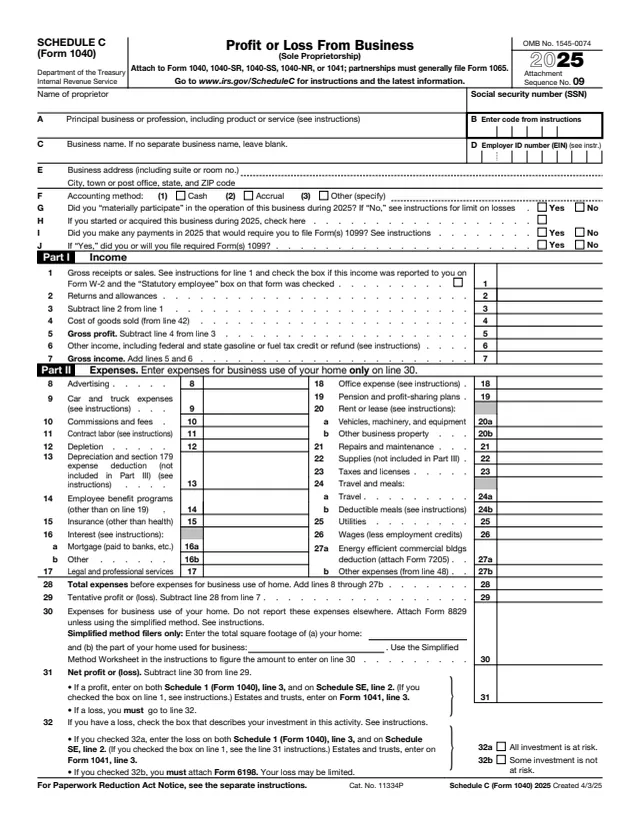
1040
105 fields, 2 pages
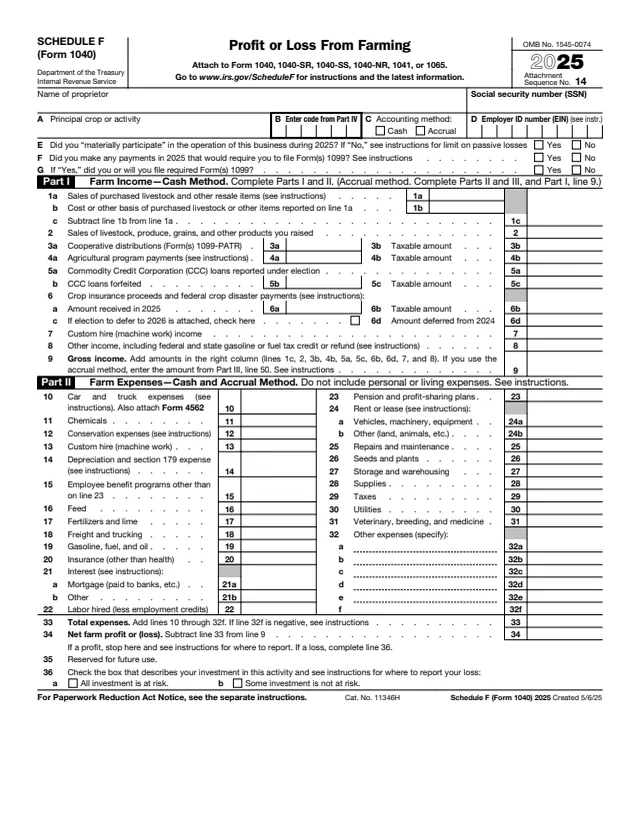
1040
89 fields, 2 pages
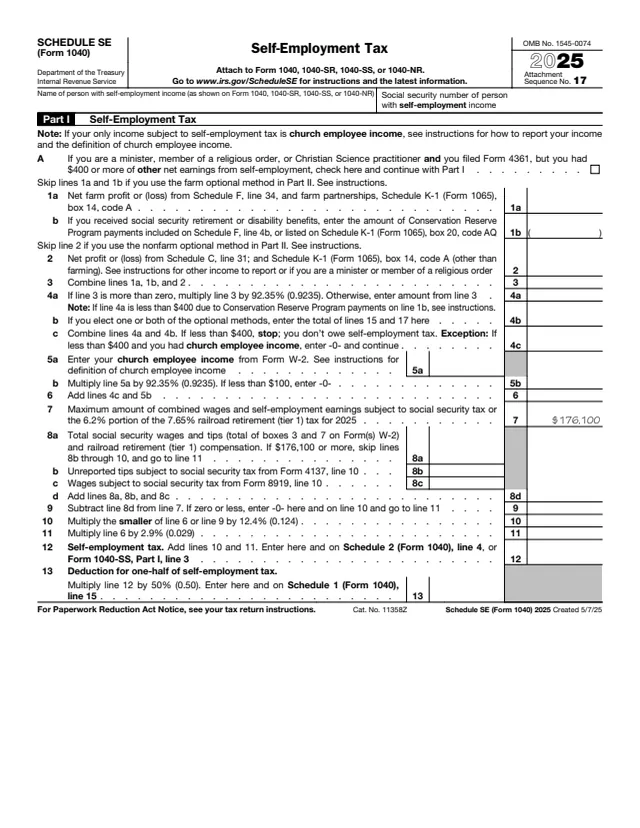
1040
27 fields, 2 pages
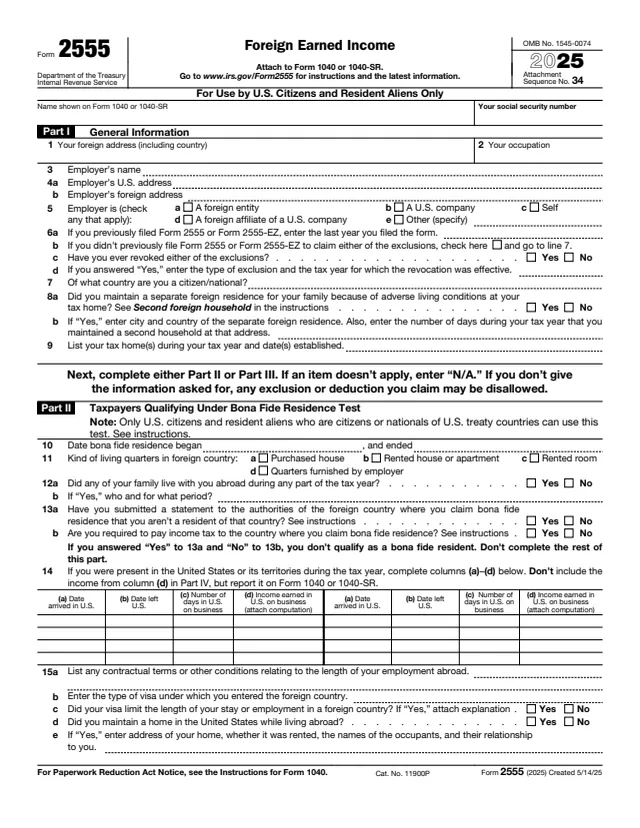
2555
160 fields, 3 pages
Form 7206 is completed by an individual and attached to their own Form 1040, 1040-SR or 1040-NR. The instructions list four situations, one of which applies.
No tool matches that search.
The instructions say the worksheet in the Form 1040 instructions can generally be used. Form 7206 is used when there is more than one source of income subject to self-employment tax, Form 2555 is filed, or long-term care premiums are counted.
Line 14 goes on Schedule 1 (Form 1040), line 17. The form is attached to Form 1040, 1040-SR or 1040-NR.
The instructions say the insurance can cover a child who was under age 27 at the end of 2025, even if the child was not a dependent.
The instructions say the deduction is not taken for any month the filer was eligible to participate in an employer subsidized health plan, including a spouse's, even without actually participating.
The instructions say Medicare premiums paid voluntarily to obtain insurance in the filer's name that is similar to qualifying private health insurance can be used to figure the deduction.
The instructions say a separate Form 7206 figures each plan's net earnings limit, with that business's premiums and net profit or wages on each form.