Taxpayer information
Taxpayer name(s), address, city, state and ZIP code.
12256
Withdrawal of Request for Collection Due Process or Equivalent Hearing
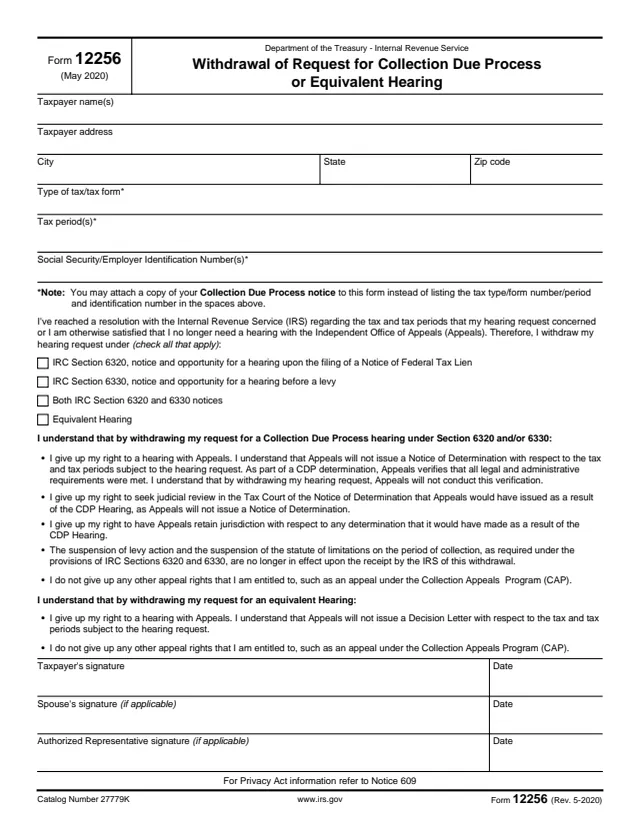
Form 12256 withdraws an earlier request for a Collection Due Process (CDP) hearing or an equivalent hearing with the IRS Independent Office of Appeals. Its statement says the taxpayer has reached a resolution with the IRS about the tax and periods the hearing request concerned, or is otherwise satisfied that a hearing with Appeals is no longer needed.
The taxpayer checks which request is withdrawn: under IRC Section 6320 (a hearing upon the filing of a Notice of Federal Tax Lien), IRC Section 6330 (a hearing before a levy), both, or an equivalent hearing. The form then lists, in its own words, what the taxpayer gives up, such as the Notice of Determination or Decision Letter and Tax Court review of a CDP determination. It also says other appeal rights, such as the Collection Appeals Program (CAP), are not given up.
The form has no separate instructions and prints no mailing address. You can fill out Form 12256 free in your browser on this page and download the result without an account.
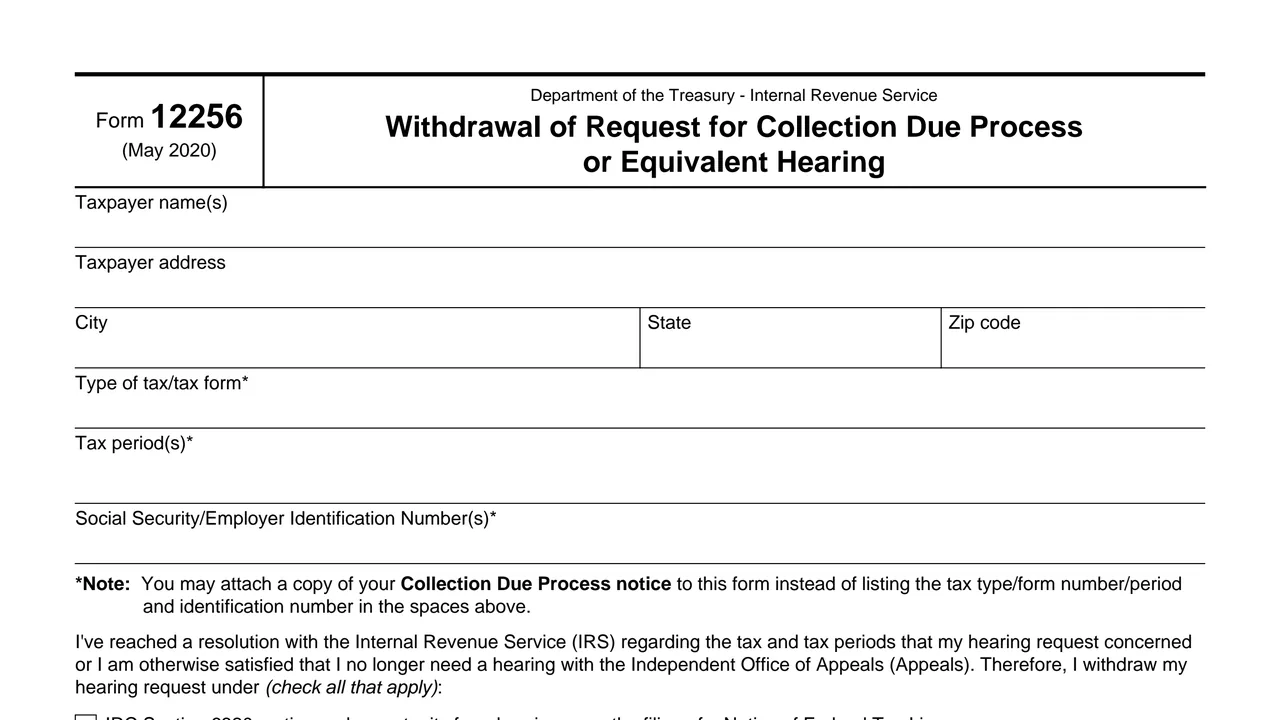
Taxpayer name(s), address, city, state and ZIP code.
Type of tax or tax form, tax period(s) and SSN or EIN. The form's note says a copy of the CDP notice can be attached instead of listing these.
Check boxes for IRC Section 6320, IRC Section 6330, both Section 6320 and 6330 notices, or an equivalent hearing.
Statements covering the Appeals hearing and Notice of Determination, Tax Court review of that determination, retained Appeals jurisdiction, and the end of the levy and collection statute suspensions.
The hearing with Appeals and the Decision Letter for the tax and periods in the request.
Taxpayer, spouse (if applicable) and authorized representative (if applicable), each with a date.
Enter the taxpayer name(s) and the address, city, state and ZIP code.
Enter the type of tax or form number, the tax periods and the SSN or EIN, or attach a copy of the Collection Due Process notice instead, as the form's note allows.
Check all that apply: Section 6320, Section 6330, both notices, or Equivalent Hearing.
Review the statements for the hearing type checked. The form says the suspension of levy action and of the collection statute ends when the IRS receives the withdrawal.
The taxpayer signs and dates. A spouse and an authorized representative sign if applicable.
You get the real form, filled in a browser tab, with nothing standing between you and the finished PDF.
The form says the suspension of levy action and the suspension of the statute of limitations on the period of collection are no longer in effect upon receipt by the IRS of the withdrawal.
The form says the taxpayer does not give up other appeal rights, such as an appeal under the Collection Appeals Program (CAP).
For a CDP withdrawal, the form says Appeals will not conduct its verification that all legal and administrative requirements were met.
The form does not print a mailing address, fax number or deadline.
For Privacy Act information, the form refers to Notice 609.
The form is signed by the taxpayer who asked for the hearing, by a spouse if applicable, and by an authorized representative if applicable. Its statements are addressed to the IRS and its Independent Office of Appeals.
No tool matches that search.
The form says Appeals will not issue a Notice of Determination, Tax Court review of that determination is given up, and the levy and collection statute suspensions end when the IRS receives the withdrawal.
No. The form says other appeal rights, such as an appeal under the Collection Appeals Program (CAP), are not given up.
The form's note says a copy of the Collection Due Process notice can be attached instead of listing the tax type, form number, period and identification number.
Yes. The form has an Equivalent Hearing box. It says withdrawing gives up the hearing with Appeals and the Decision Letter for the tax and periods in the request.
The form has a spouse's signature line marked if applicable.