Items 1 and 2: basis and equivalent hearing
Boxes for a filed Notice of Federal Tax Lien and a Notice of Proposed or Actual Levy (both can be checked), and a box asking for an equivalent hearing if the request is not timely for a CDP hearing.
12153
Request for a Collection Due Process or Equivalent Hearing
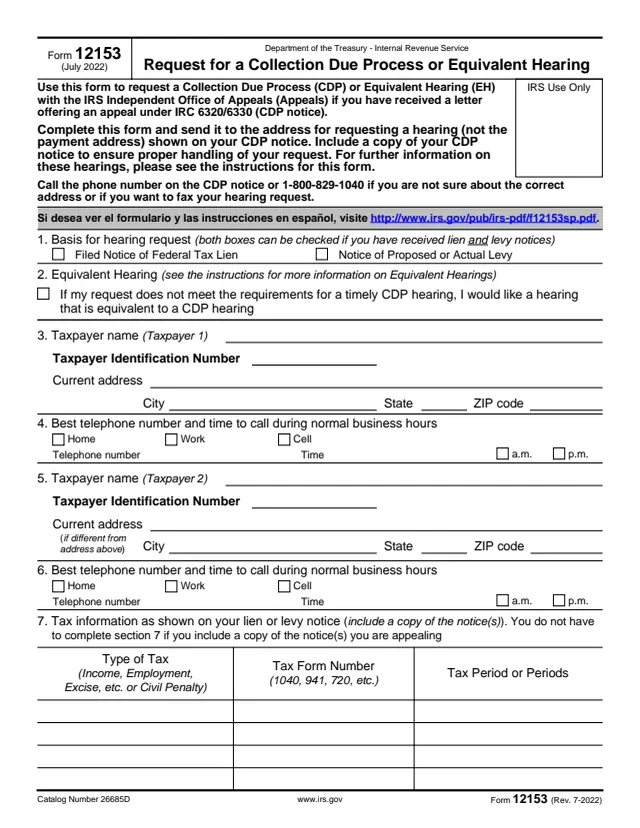
Form 12153 is the IRS Request for a Collection Due Process or Equivalent Hearing. The form says to use it to request a Collection Due Process (CDP) or Equivalent Hearing (EH) with the IRS Independent Office of Appeals (Appeals) after receiving a letter offering an appeal under IRC 6320/6330, which the form calls a CDP notice.
The form goes to the address for requesting a hearing shown on the CDP notice, not the payment address, with a copy of the notice. It asks for the basis of the request (a filed Notice of Federal Tax Lien, a Notice of Proposed or Actual Levy, or both), the taxpayers' names and contact details, the tax periods involved, the reason for the hearing and any proposed collection alternative. Pages 3 and 4 explain CDP and equivalent hearings, lien resolutions and collection alternatives.
You can fill out Form 12153 free in your browser on this page and download it without an account.
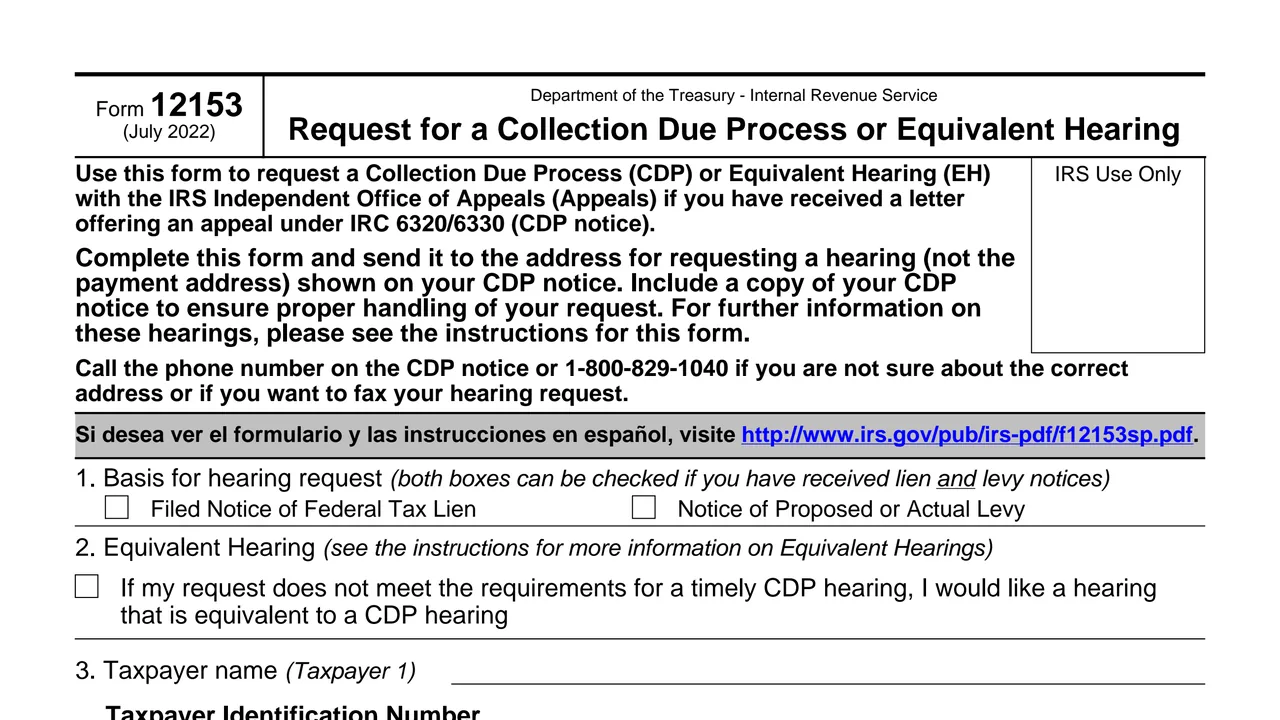
Boxes for a filed Notice of Federal Tax Lien and a Notice of Proposed or Actual Levy (both can be checked), and a box asking for an equivalent hearing if the request is not timely for a CDP hearing.
Name, taxpayer identification number, current address and best phone number and time to call for Taxpayer 1, and the same for Taxpayer 2 when there is one.
Type of tax, tax form number and tax period or periods from the lien or levy notice. The form says item 7 can be skipped if a copy of the notice is included.
Eight checkboxes, from not liable for the tax and innocent spouse relief to lien withdrawal, financial hardship, a collection alternative and other issues, plus space to explain.
Boxes for Installment Agreement, Offer in Compromise, Currently Unable to Pay and Other, with the financial statement exceptions listed below them.
Signature lines for Taxpayer 1, Taxpayer 2 and a representative, plus an IRS Use Only area for the employee who receives the request.
In item 1, check the lien box, the levy box or both, matching the notices received. Item 2 is checked only to ask for an equivalent hearing when the request does not meet the requirements for a timely CDP hearing.
Fill in items 3 and 4 for Taxpayer 1, and items 5 and 6 for a second taxpayer. Item 5 asks for an address only if it differs from Taxpayer 1's.
In item 7, enter the type of tax, the form number such as 1040, 941 or 720, and the periods from the notice, or include a copy of the notice instead.
Check one or more reasons in item 8 and explain. The form says a request will not be honored if no reason for the dispute is given, and more pages can be added.
Check a choice in item 9 when asking for a collection alternative. The form says a Form 433-A or 433-B financial statement is not required with the request, but early submission helps.
Sign in item 10. On a joint request both taxpayers sign. A representative signing for the taxpayer includes an executed Form 2848 unless one is already on file.
You get the real form, filled in a browser tab, with nothing standing between you and the finished PDF.
The form says to send it to the address for requesting a hearing shown on the CDP notice, not the payment address, and to include a copy of the notice.
The form says to call the phone number on the CDP notice or 1-800-829-1040 if unsure about the correct address or to fax the hearing request.
Page 3 lists them: for a lien notice, one year plus five business days from the filing date of the Federal Tax Lien; for a levy notice, one year from the date of the CDP levy notice.
The form says a timely request will prohibit levy action in most cases and suspend the 10-year collection period until the Appeals determination is final. An equivalent hearing does neither and cannot be taken to court.
The form says to keep a copy of the hearing request and proof of the date it was sent.
The form says a CDP levy hearing request, timely or equivalent, does not prohibit the IRS from filing a notice of federal tax lien.
433-A
515 fields, 8 pages
433-B
447 fields, 6 pages
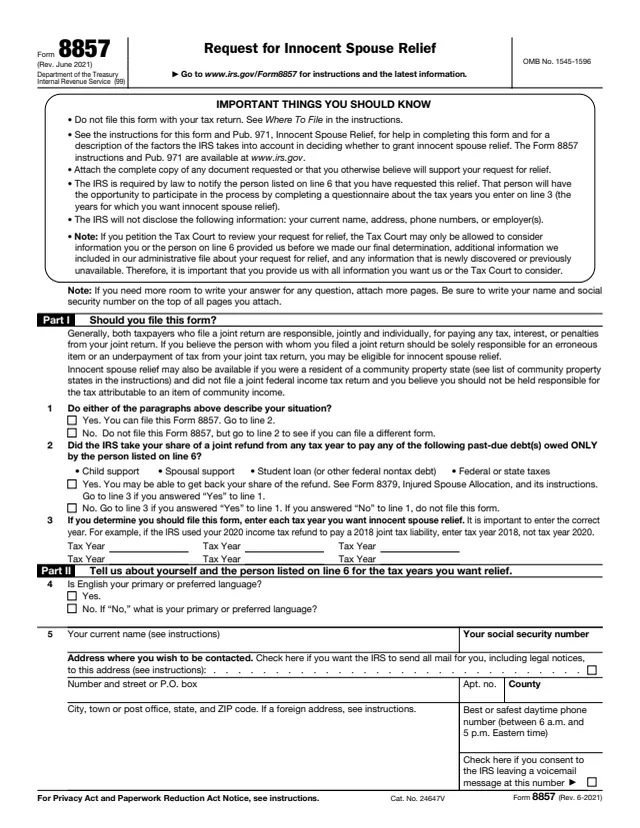
8857
208 fields, 6 pages
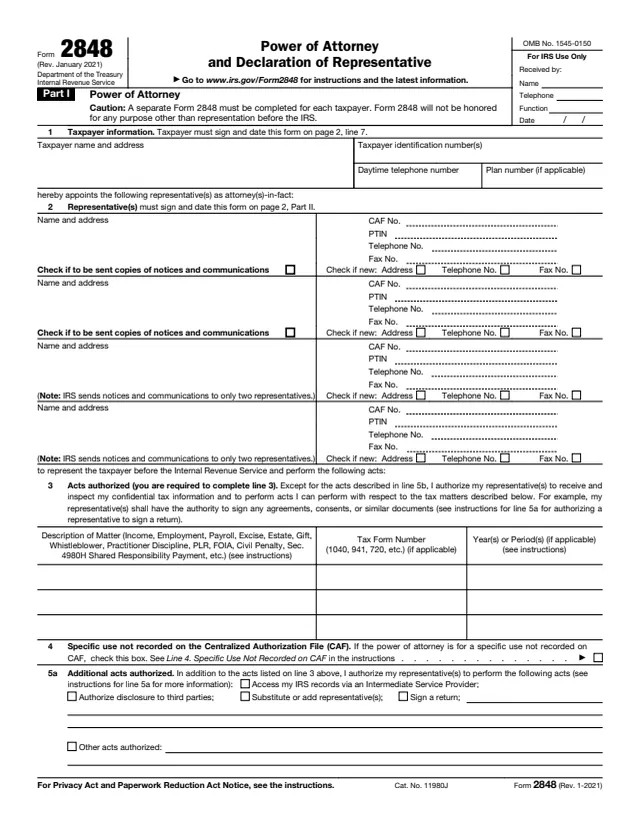
2848
92 fields, 2 pages
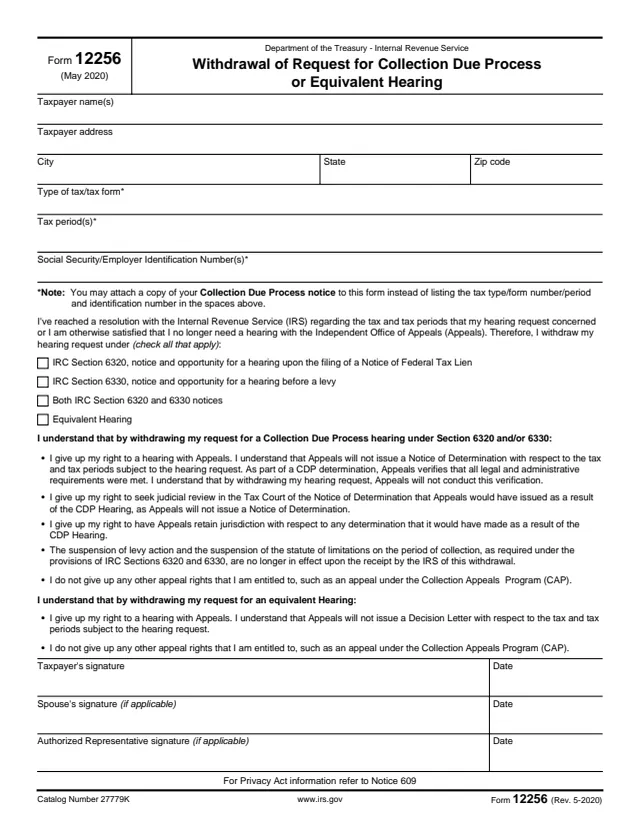
12256
18 fields, 1 page
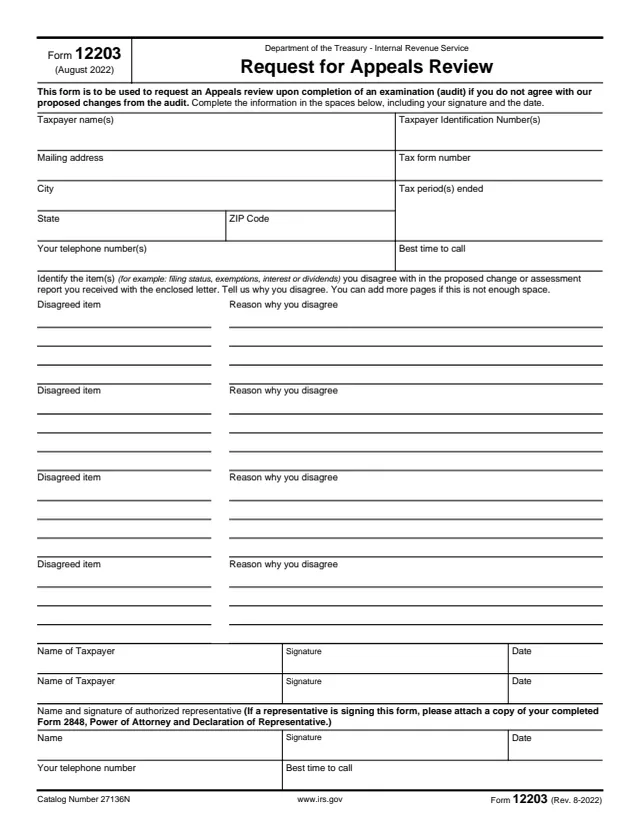
12203
31 fields, 2 pages
The form is completed by the taxpayer who received a CDP notice, or by a representative, and it goes to the IRS Independent Office of Appeals at the address on that notice.
No tool matches that search.
To the address for requesting a hearing shown on the CDP notice, not the payment address. The form asks for a copy of the notice to be included.
The form says an equivalent hearing is the same as a CDP hearing except it does not prohibit levy or suspend the 10-year collection period, and the Appeals decision cannot be contested in court.
The form says submitting a financial statement with Form 12153 is not required, but early submission helps get the quickest resolution when proposing a collection alternative.
Yes. The form has a representative's signature line and asks for an executed Form 2848 unless one is already on file. The taxpayer or the representative signs, not both.
Item 8 has a box for it. Page 3 says Form 8857, Request for Innocent Spouse Relief, has to be completed for an innocent spouse request to be considered.
Yes. The form says the Spanish form and instructions are at irs.gov/pub/irs-pdf/f12153sp.pdf.