Recipient details
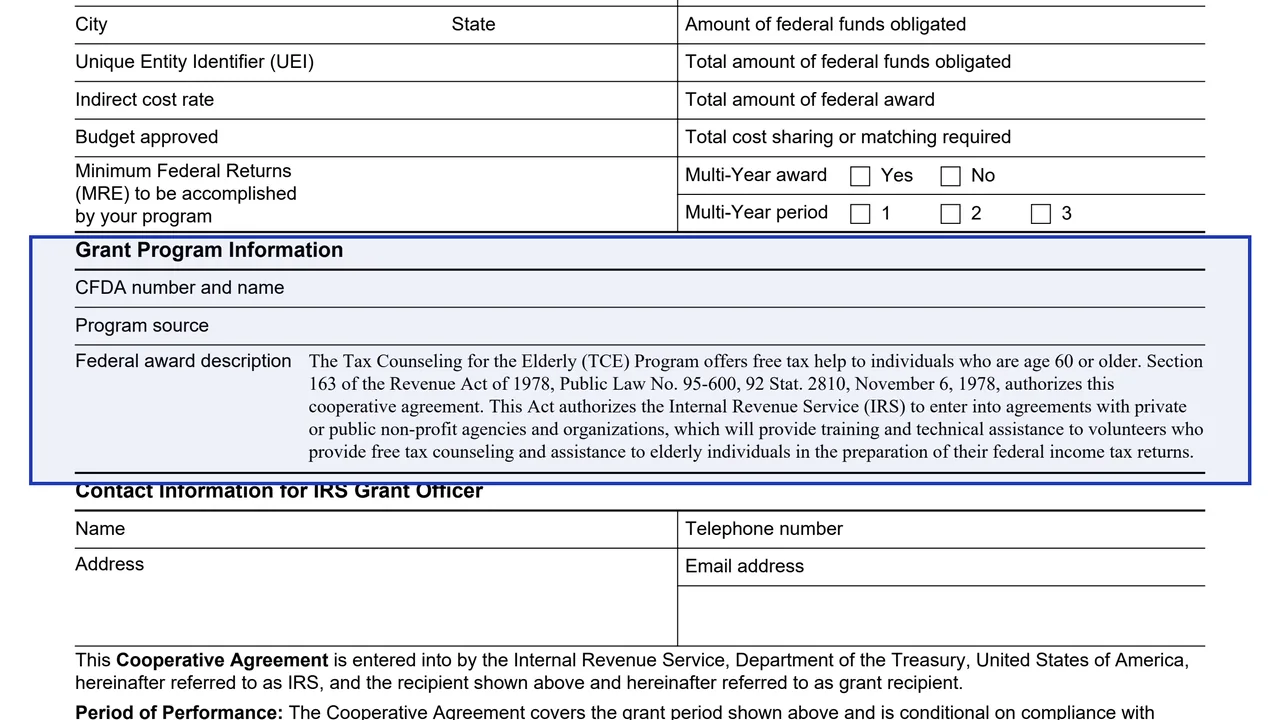
Recipient name, address, city and state, Unique Entity Identifier (UEI), indirect cost rate, budget approved, and the Minimum Federal Returns (MRE) to be accomplished by the program.
9661
Cooperative Agreement
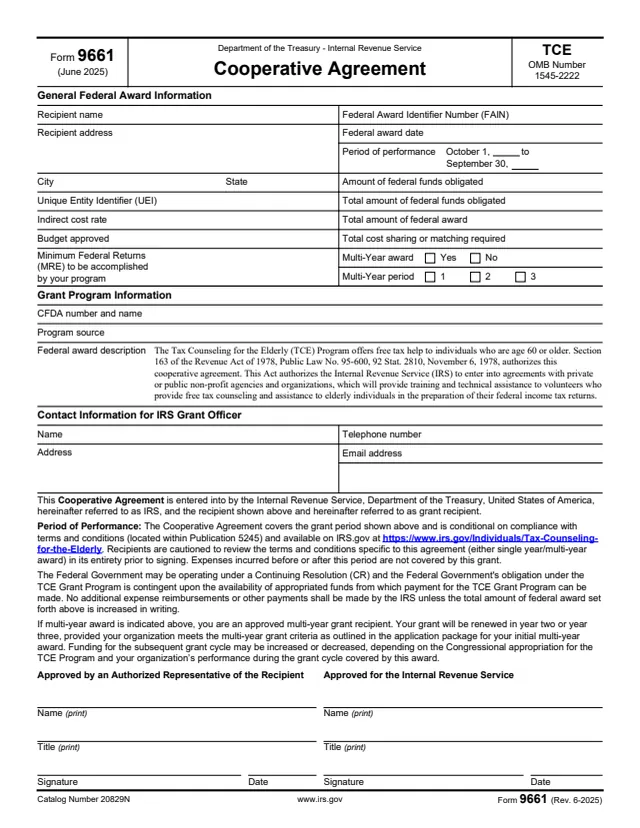
Form 9661 is the Cooperative Agreement between the Internal Revenue Service and an organization that receives a grant under the Tax Counseling for the Elderly (TCE) Program. The form describes the TCE Program as free tax help for individuals who are age 60 or older. It cites Section 163 of the Revenue Act of 1978, which it says authorizes the IRS to enter into agreements with private or public non-profit agencies and organizations that provide training and technical assistance to volunteers who help elderly individuals prepare their federal income tax returns.
The form is not something a person seeking tax help fills out. It records a grant award: the recipient's details, the Federal Award Identifier Number (FAIN), the period of performance, the federal funds obligated, any cost sharing or matching required and whether the award is multi-year. An authorized representative of the recipient and an official for the IRS each sign it.
The form says the agreement is conditional on compliance with the terms and conditions located within Publication 5245. You can fill out the PDF free in your browser on this page and download it without an account.
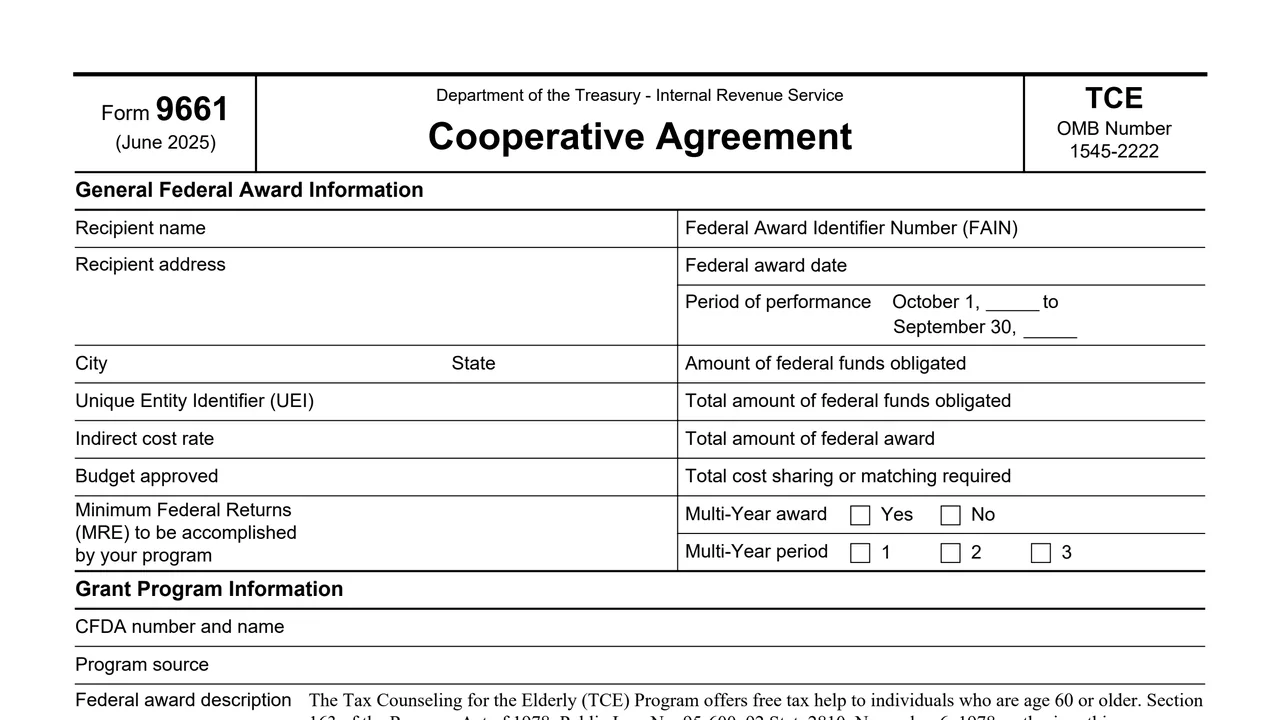
Recipient name, address, city and state, Unique Entity Identifier (UEI), indirect cost rate, budget approved, and the Minimum Federal Returns (MRE) to be accomplished by the program.
Federal Award Identifier Number (FAIN), federal award date, period of performance from October 1 to September 30, federal funds obligated, total federal award, total cost sharing or matching required, and the multi-year award boxes.
CFDA number and name, program source, and the federal award description of the TCE Program and its authority under Section 163 of the Revenue Act of 1978.
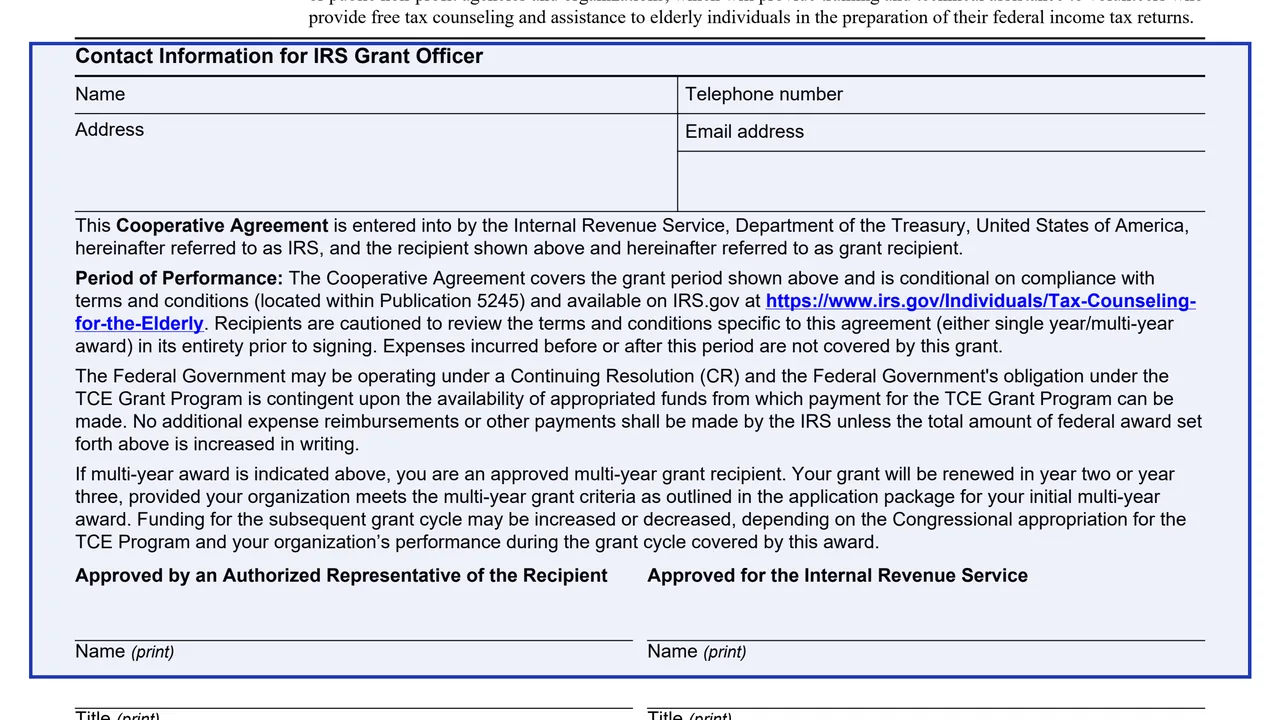
Name, address, telephone number and email address of the IRS grant officer.
Paragraphs on the period of performance, Publication 5245, a possible Continuing Resolution and multi-year renewal, then side-by-side approval boxes for the recipient and the IRS.
Gives the legal right to ask for the information as 5 U.S.C. 301, the OMB control number 1545-2222 and an estimated time of 30 minutes.
Enter or check the recipient name, address, UEI, FAIN, federal award date, period of performance and each dollar amount in the General Federal Award Information block.
Check Yes or No, and mark the multi-year period 1, 2 or 3. The form says a recipient with a multi-year award is renewed in year two or three if it meets the multi-year criteria in its initial application package.
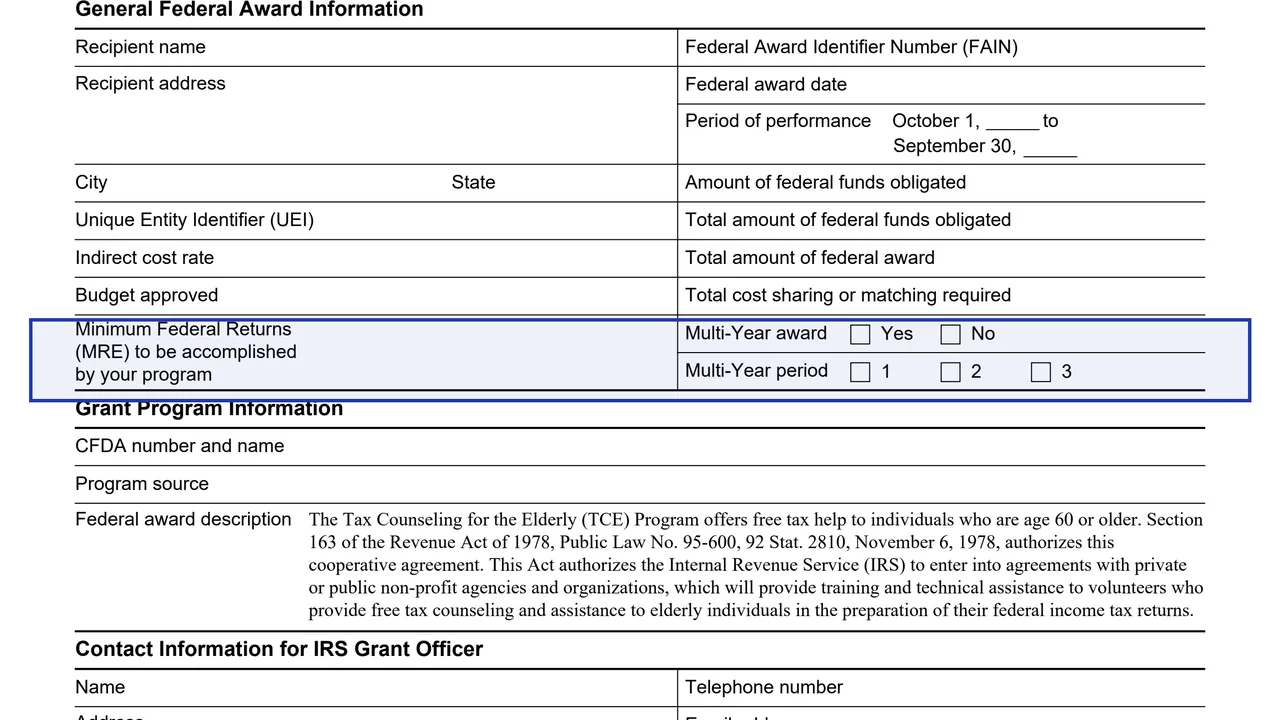
Enter the CFDA number and name and the program source. The federal award description is printed on the form.
The form says recipients are cautioned to review the terms and conditions specific to the agreement, single year or multi-year, in their entirety prior to signing. It says they are located within Publication 5245.
The recipient's authorized representative prints a name and title, signs and dates.
The IRS official prints a name and title, signs and dates in the box headed "Approved for the Internal Revenue Service."
The form has no separate instructions and does not say which party enters each field. These steps follow the order of the form.
You get the real form, filled in a browser tab, with nothing standing between you and the finished PDF.
The form says the agreement covers the grant period shown and that expenses incurred before or after this period are not covered by the grant.
The form says the government may be operating under a Continuing Resolution and its obligation is contingent on available appropriated funds. No additional payments are made unless the total federal award is increased in writing.
The form says funding for a later grant cycle may be increased or decreased, depending on the Congressional appropriation for TCE and the organization's performance.
The form prints no mailing address and has no separate instructions. Its contact block is for the IRS grant officer's name, address, telephone number and email address.
Page 2 says the response is voluntary, but if the information is not provided the IRS may not be able to use the person's assistance in its volunteer programs.
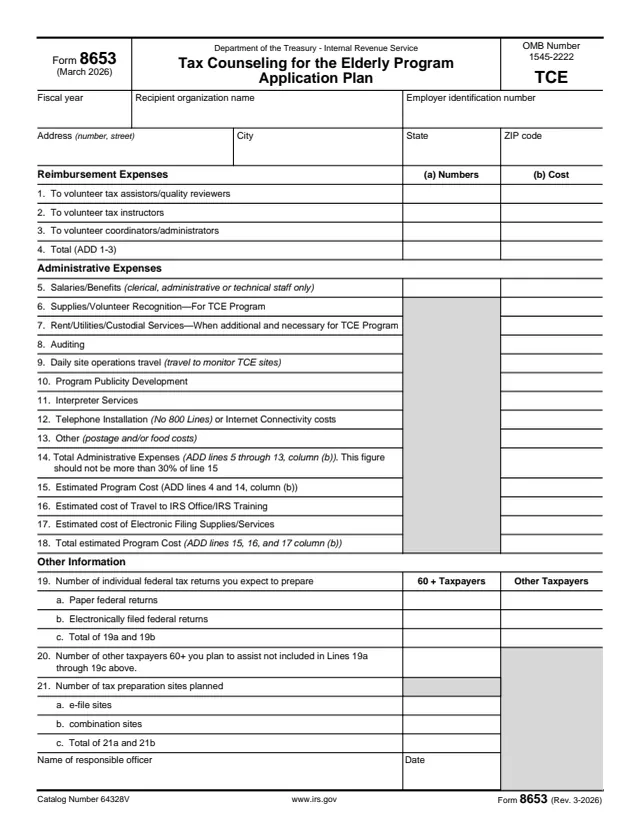
8653
42 fields, 2 pages
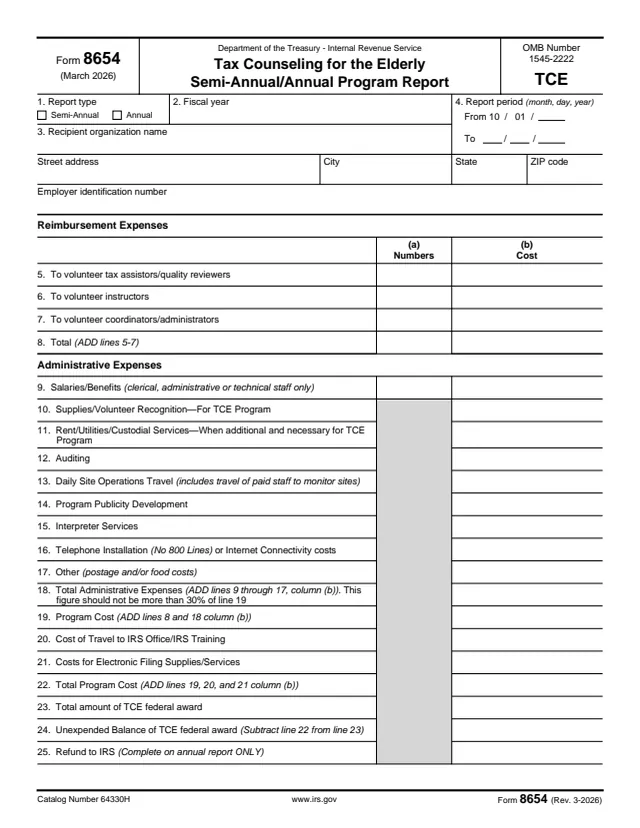
8654
57 fields, 3 pages
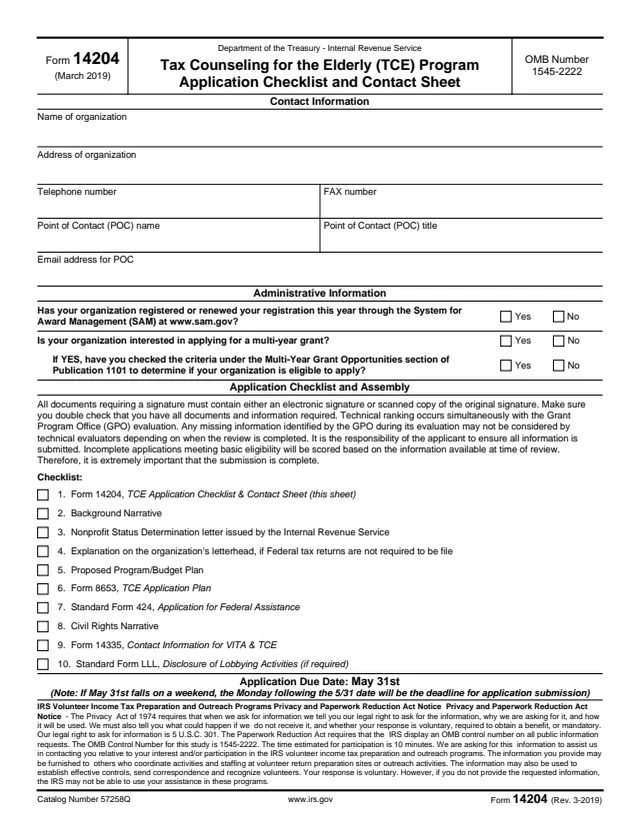
14204
24 fields, 1 page
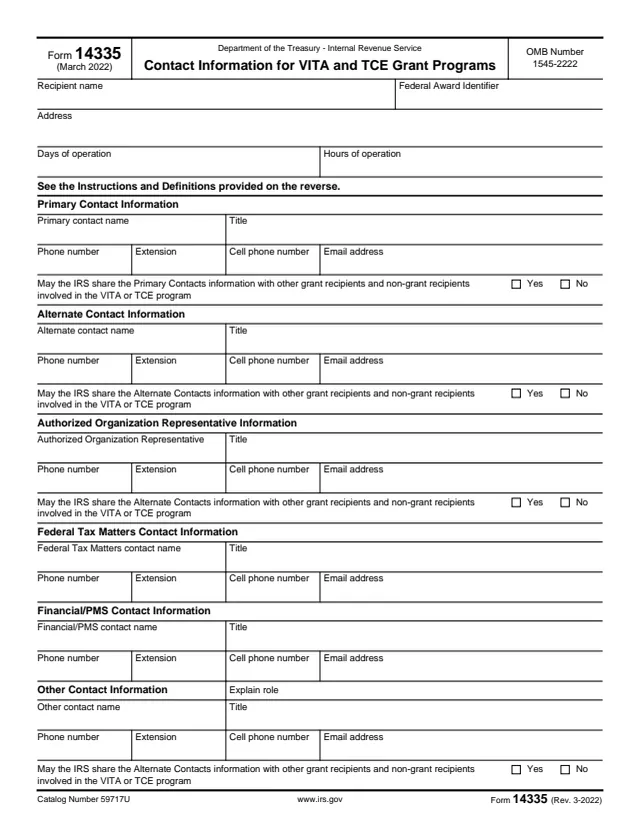
14335
68 fields, 2 pages
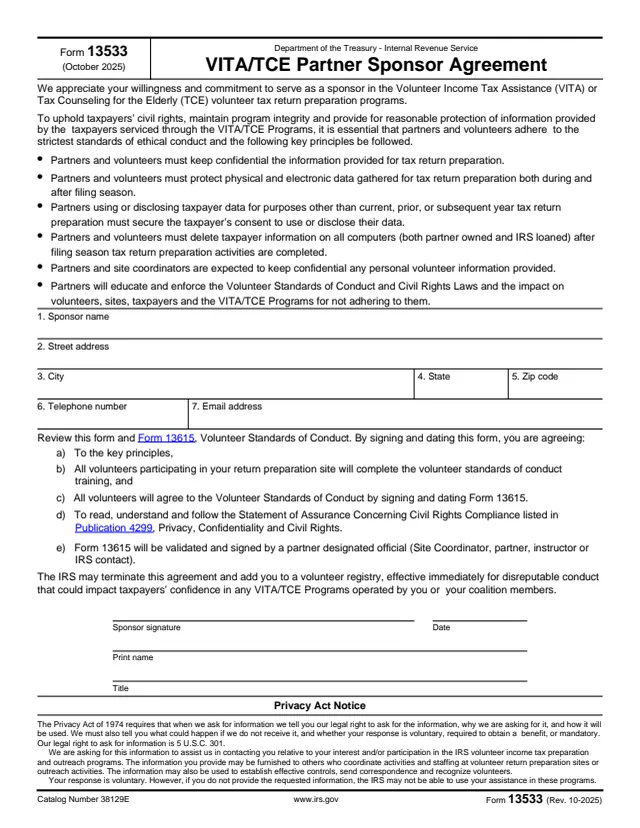
13533
13 fields, 1 page
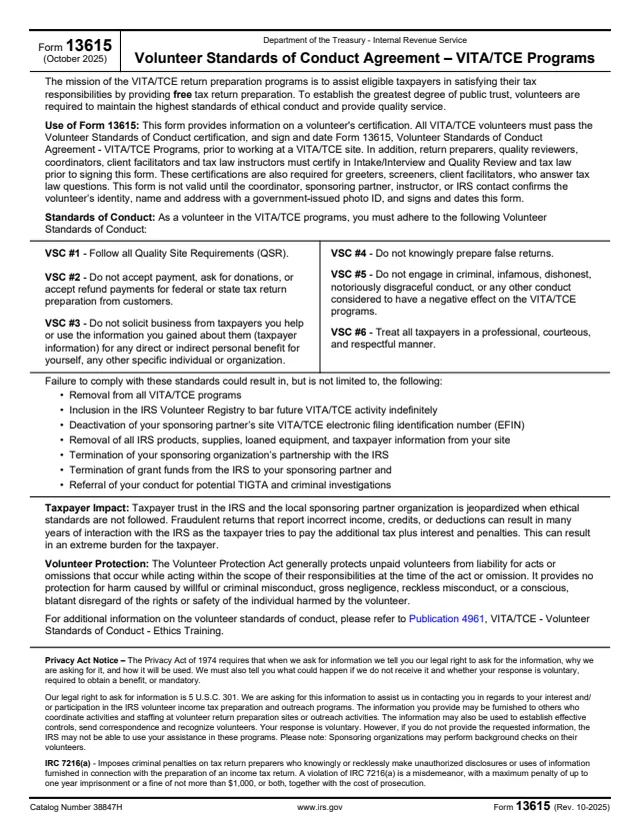
13615
76 fields, 2 pages
The form is an agreement between two parties: the IRS and the grant recipient shown on it. Individuals who get free tax help through TCE do not complete or sign it.
No tool matches that search.
No. It is an agreement between the IRS and a TCE grant recipient. The award description says the TCE Program itself offers free tax help to individuals who are age 60 or older.
An authorized representative of the recipient and an official approving for the Internal Revenue Service. Each prints a name and title, signs and dates.
The grant period shown on the form, which prints a period of performance running from October 1 to September 30. The form says expenses before or after that period are not covered.
The form says they are located within Publication 5245 and available on IRS.gov on the Tax Counseling for the Elderly page.
The form says no additional expense reimbursements or other payments are made unless the total amount of federal award is increased in writing.