Part I: Applicable Taxpayer Determination
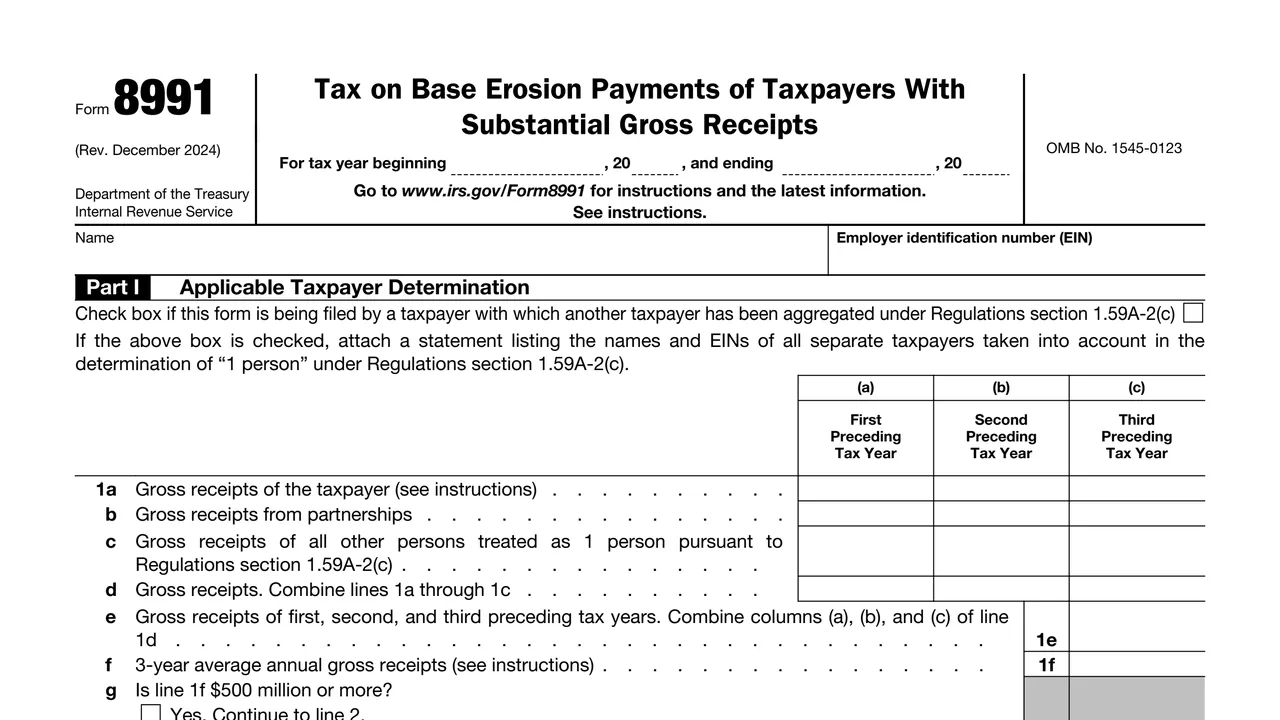
Lines 1a to 1g hold gross receipts for the first, second and third preceding tax years. Lines 2a to 2p figure the base erosion percentage.
8991
Tax on Base Erosion Payments of Taxpayers With Substantial Gross Receipts
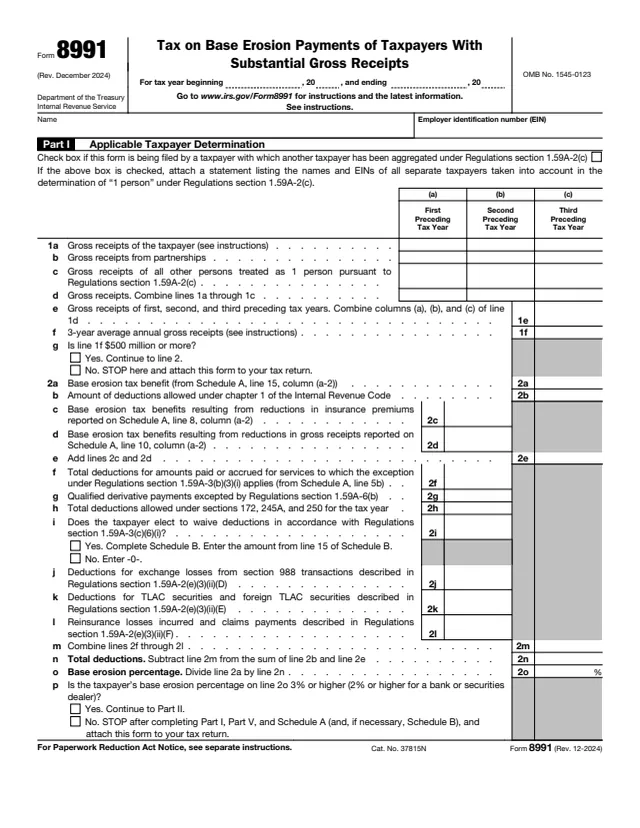
Form 8991 is the IRS form for the Base Erosion and Anti-Abuse Tax (BEAT) of section 59A. The IRS says taxpayers use it to calculate tax on base erosion payments with substantial gross receipts of $500 million or more annually. The instructions say to use it to determine a taxpayer's base erosion minimum tax amount for the year.
The form first tests whether the corporation is an applicable taxpayer: a 3-year average of gross receipts, then a base erosion percentage. If both tests are met, it figures modified taxable income, the adjusted regular tax liability and the base erosion minimum tax amount. Schedule A lists base erosion payments and tax benefits, Schedule B reports waived deductions and Schedule C covers credits.
The instructions say the BEAT operates as a minimum tax. You can fill out Form 8991 free in your browser on this page and download the result without an account.
Lines 1a to 1g hold gross receipts for the first, second and third preceding tax years. Lines 2a to 2p figure the base erosion percentage.
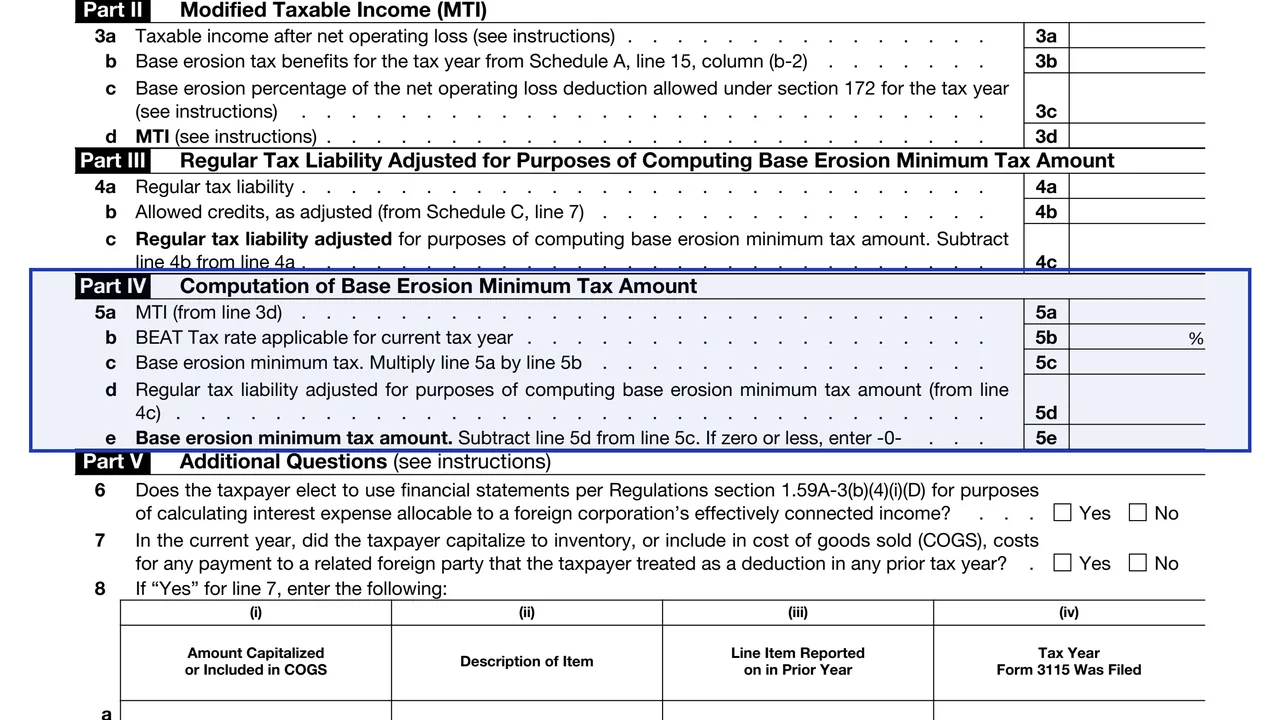
Lines 3a to 3d add base erosion tax benefits and a share of the net operating loss deduction to taxable income.
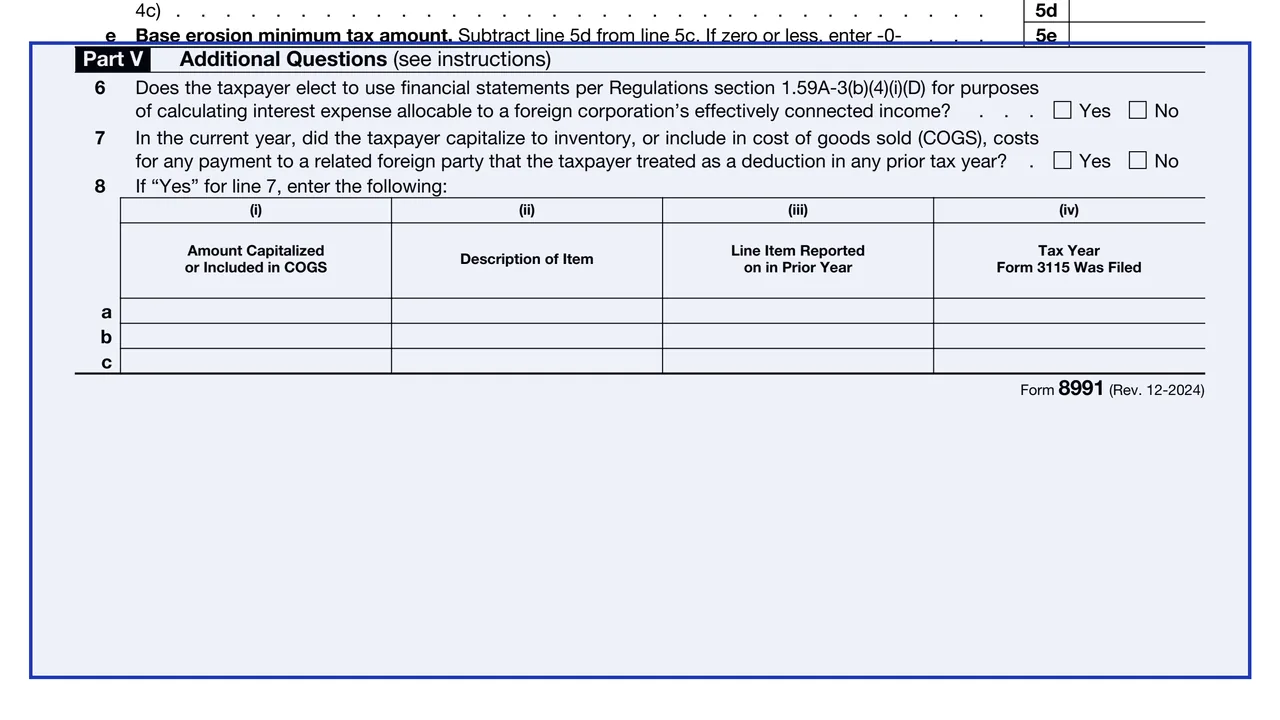
Part III adjusts regular tax liability for allowed credits. Part IV applies the BEAT rate to modified taxable income and subtracts the adjusted regular tax.
Line 6 asks about a financial statement election for interest expense. Lines 7 and 8 ask about prior deductions later capitalized to inventory or cost of goods sold.
Base erosion payments and tax benefits by type, such as rents and royalties, services, interest and derivative payments, for the aggregate group and the taxpayer.
Schedule B lists deductions being waived for the tax year. Schedule C figures the credits that reduce regular tax liability in computing the base erosion minimum tax amount.
Enter the tax year, the name and the EIN. If the filer was aggregated with another taxpayer, check the box and attach the statement of names and EINs.
Enter gross receipts for each of the 3 preceding tax years and the average on line 1f. The form says that if line 1f is not $500 million or more, stop and attach the form to the tax return.
Complete Schedule A and carry line 15 to line 2a. Line 2p asks whether the base erosion percentage is 3% or higher (2% or higher for a bank or securities dealer).
Figure modified taxable income on lines 3a to 3d, then subtract the allowed credits from Schedule C, line 7, from regular tax liability on line 4c.
The instructions give the line 5b rate as 10% for tax years beginning during 2019 through 2025 and 10.5% for 2026 or later. Line 5e is the base erosion minimum tax amount.
Answer lines 6 and 7. If line 7 is Yes, line 8 asks for the item, the amount capitalized, the line reported on in the prior year and the tax year Form 3115 was filed.
You get the real form, filled in a browser tab, with nothing standing between you and the finished PDF.
The instructions say to attach Form 8991 to the income tax return (or, if applicable, exempt organization business income tax return) and file by the due date (including extensions) for that return.
The instructions say to enter the line 5e amount on the applicable tax return, for example Schedule J, line 1f, for a filer of Form 1120.
The instructions point to Question 22, Schedule K, Form 1120; Item DD, Form 1120-F; Question 14, Schedule M, Form 1120-L; Question 15, Schedule I, Form 1120-PC; and Question 16, Schedule K, Form 1120-C.
The instructions say not to enter "See Attached" or "Available Upon Request" in place of an entry. Extra sheets use the same size and format as the printed form.
A corrected Form 8991 is filed with an amended tax return. The instructions say to write "Corrected" at the top and attach a statement identifying the changes.
The IRS About page lists a clarification dated 14-SEP-2026 on expenditures charged to capital account, and an update dated 25-MARCH-2025 for Part II, line 3a.
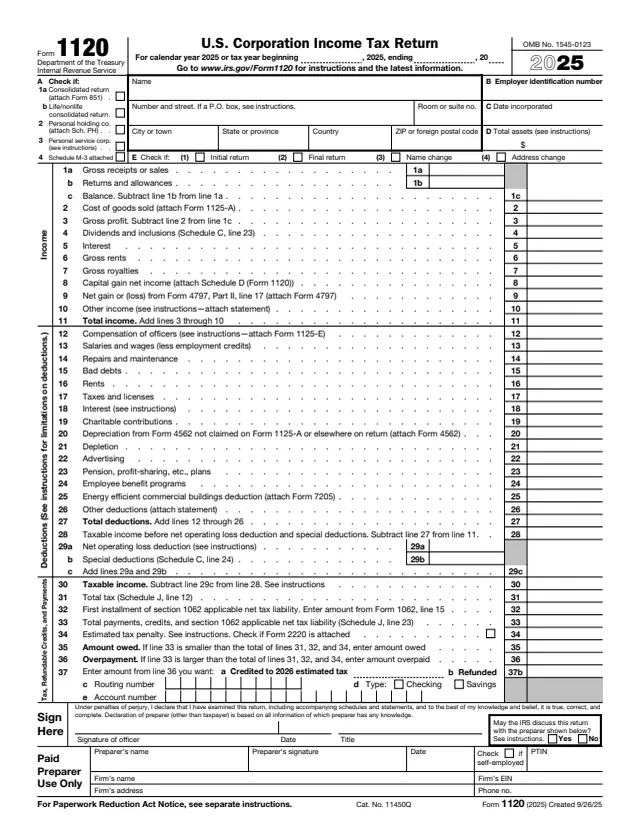
1120
481 fields, 6 pages
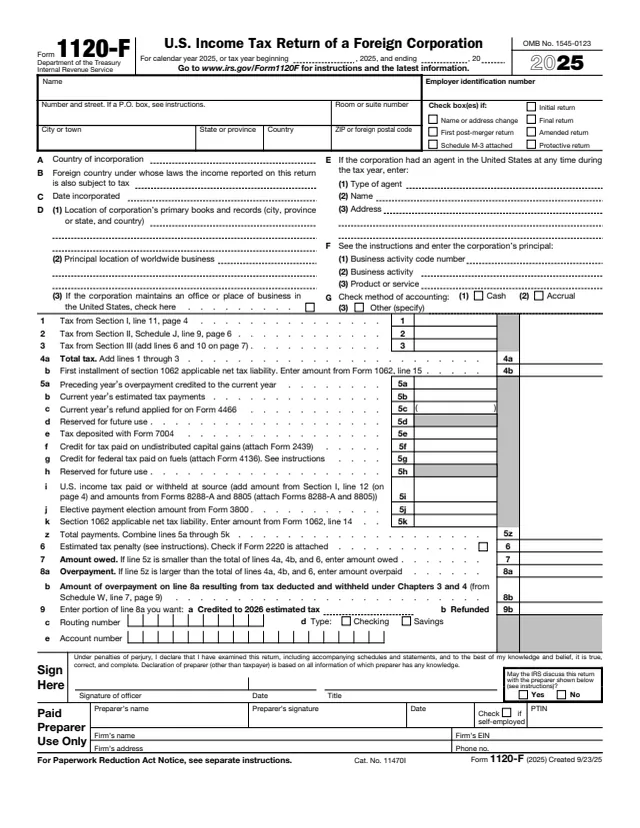
1120-F
527 fields, 9 pages
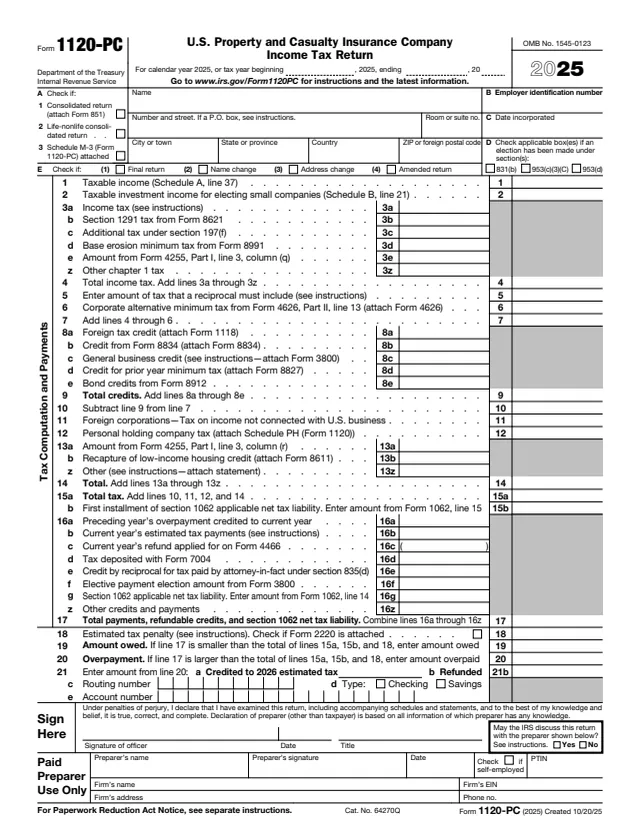
1120-PC
565 fields, 9 pages
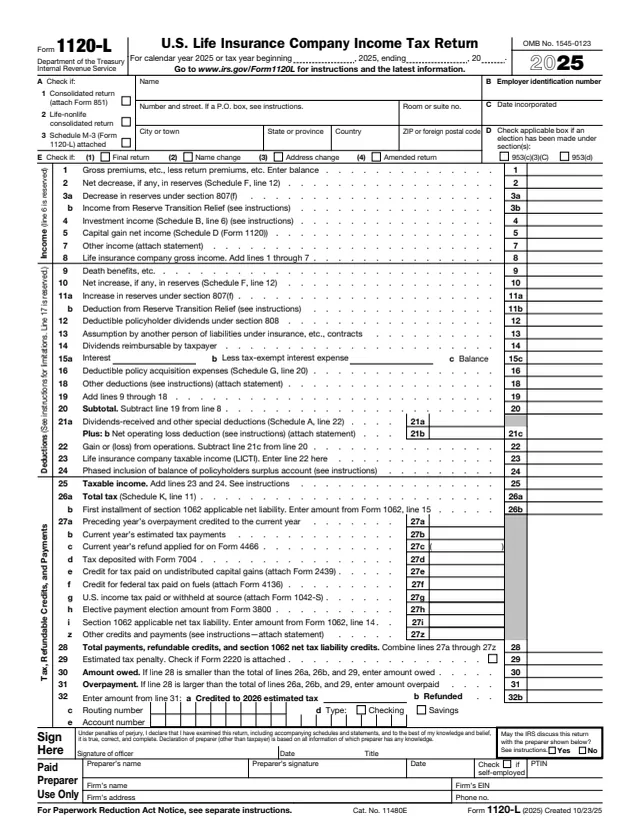
1120-L
337 fields, 6 pages
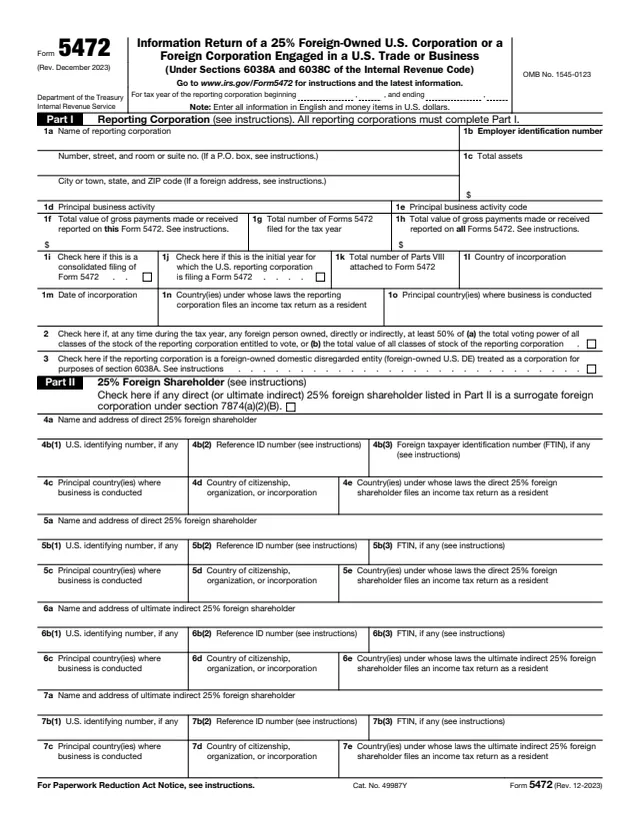
5472
143 fields, 3 pages
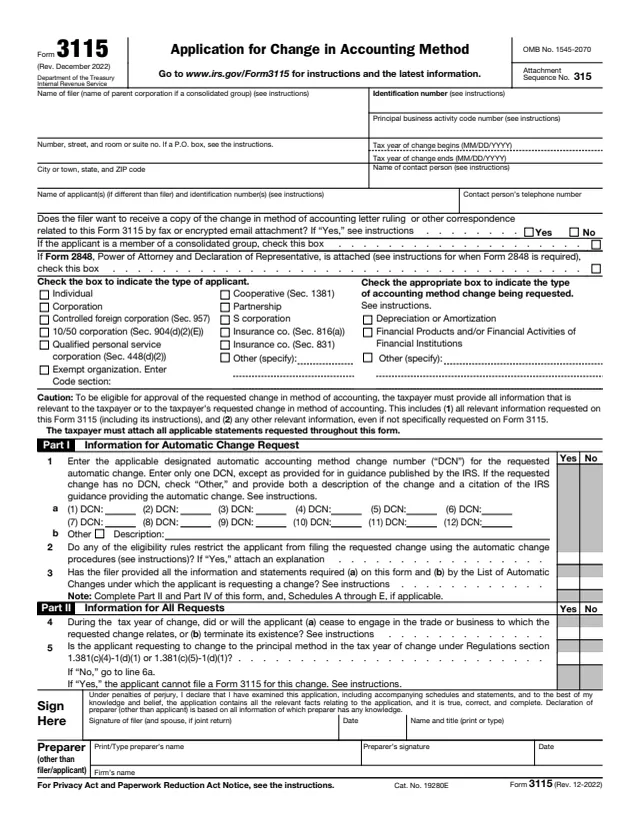
3115
294 fields, 8 pages
Form 8991 is filed by corporations, not individuals. The instructions say any corporation, other than a RIC, a REIT or an S corporation, that has (or is a member of an aggregate group that has) annual gross receipts of at least $500 million in 1 or more of the 3 preceding tax years ending with the preceding tax year must file it.
No tool matches that search.
The instructions describe the Base Erosion and Anti-Abuse Tax of section 59A as a tax generally levied on certain large corporations that make deductible payments to foreign related parties. It operates as a minimum tax.
The instructions say a corporation, other than a RIC, a REIT or an S corporation, with (or in an aggregate group with) annual gross receipts of at least $500 million in 1 or more of the 3 preceding tax years ending with the preceding tax year.
The instructions say that if line 1g is checked No, the filer is not subject to the section 59A tax, does not complete the remaining lines and attaches Form 8991 to the tax return.
If line 2p is No, the instructions say to skip Parts II to IV, complete Part V and Schedule A (and Schedule B if needed), skip Schedule C and attach the form to the tax return.
The instructions list 5% for tax years beginning during 2018, 10% for 2019 through 2025 and 10.5% for 2026 or later, each increased by 1% for a member of an affiliated group that includes a bank or a registered securities dealer.
The PDF prints Rev. December 2024 and the instructions print Revised: 12/2025. The IRS About page links both as the current products.