Header
Name(s) shown on return and identifying number. The form is attached to the tax return as attachment sequence No. 142.
8896
Low Sulfur Diesel Fuel Production Credit
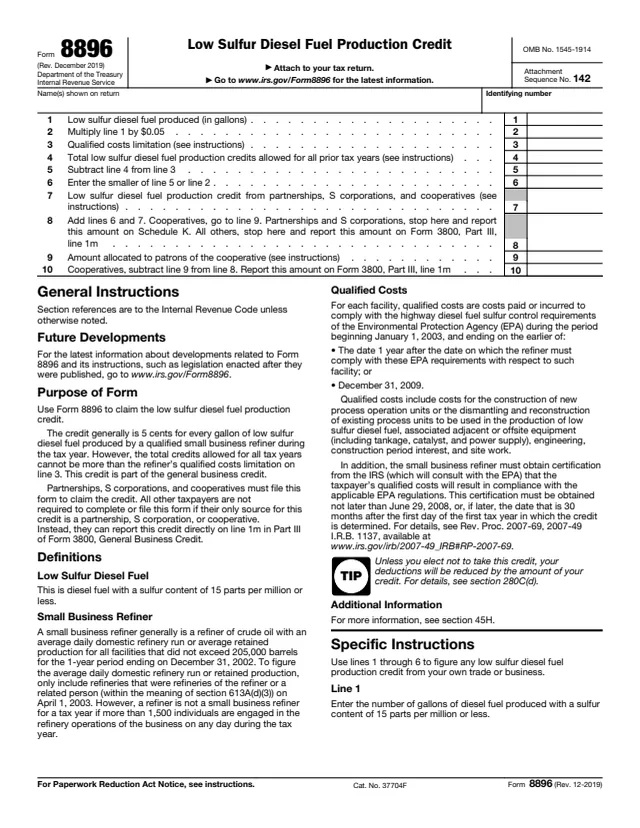
Form 8896 is used to claim the low sulfur diesel fuel production credit. The IRS About page says qualified small business refiners use this form. The instructions say the credit generally is 5 cents for every gallon of low sulfur diesel fuel produced by a qualified small business refiner during the tax year, and that the total credits allowed for all tax years cannot be more than the refiner's qualified costs limitation on line 3. The credit is part of the general business credit.
The form defines low sulfur diesel fuel as diesel fuel with a sulfur content of 15 parts per million or less. The form says to attach it to the tax return, and its general and line instructions are printed on the form itself.
You can fill out Form 8896 free in your browser on this page and download the result without an account.
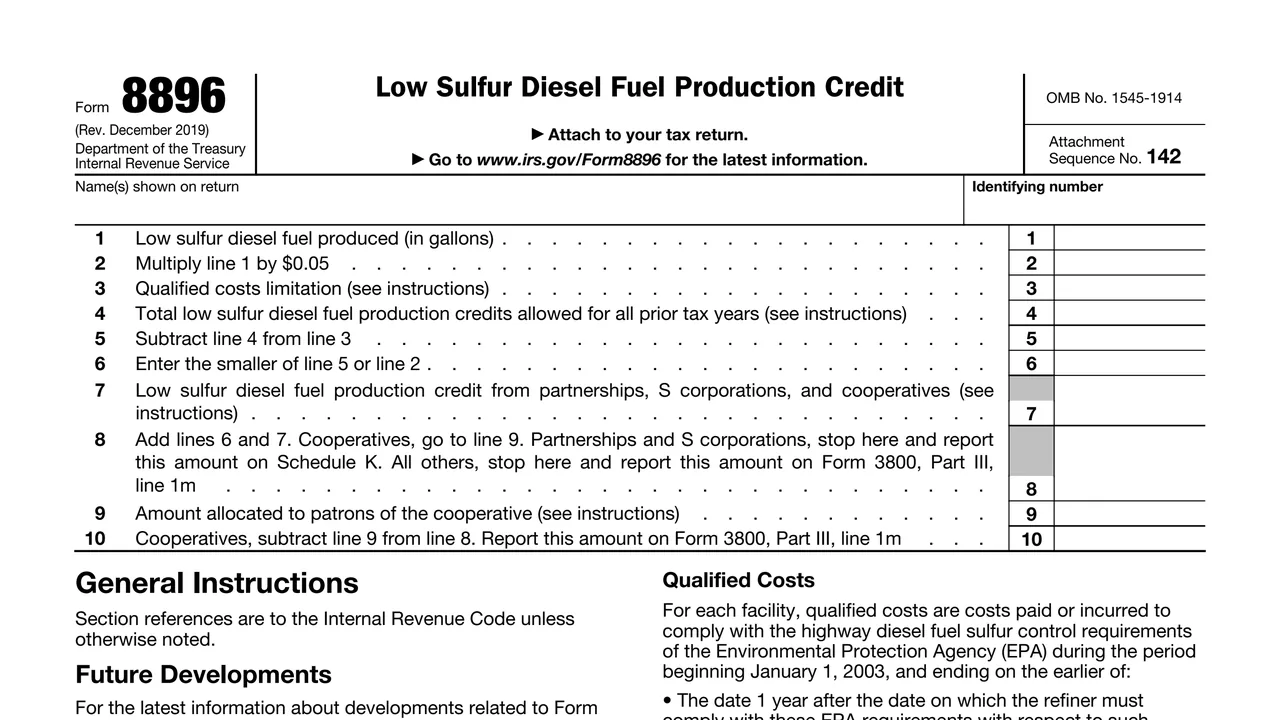
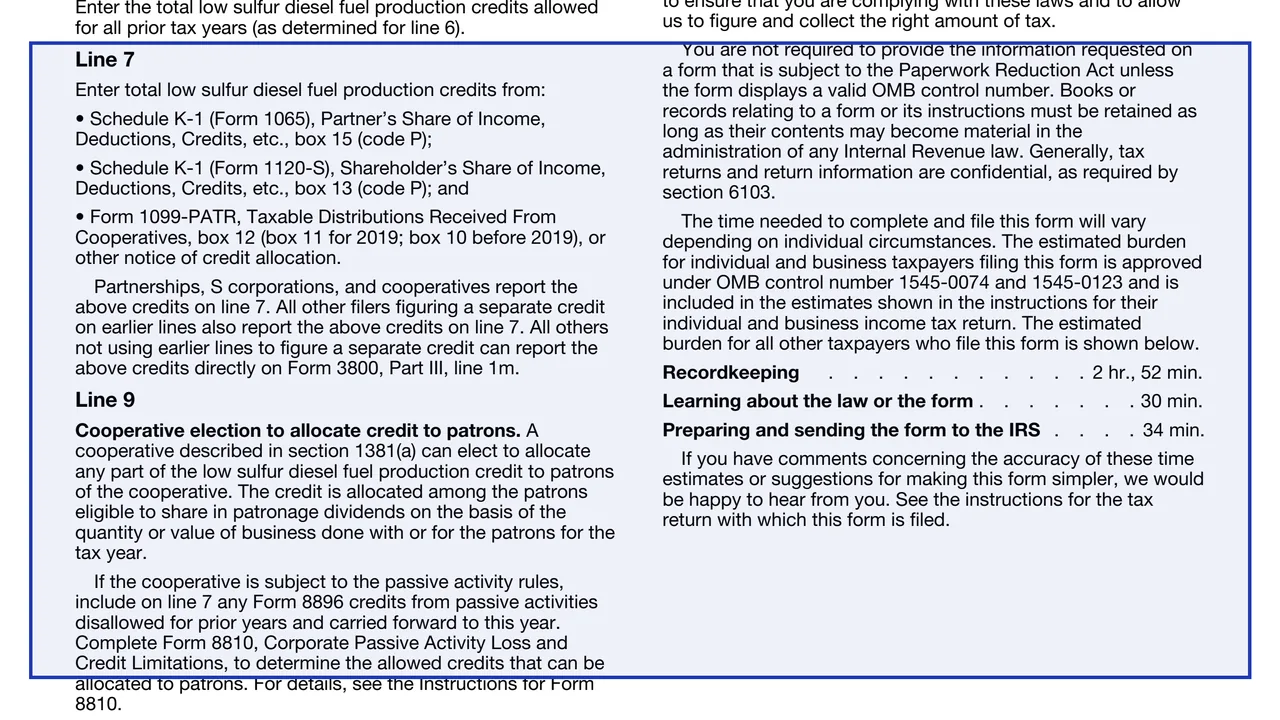
Name(s) shown on return and identifying number. The form is attached to the tax return as attachment sequence No. 142.
Line 1 holds the gallons of low sulfur diesel fuel produced. Line 2 multiplies line 1 by $0.05.
Line 3 is the qualified costs limitation and line 4 the credits allowed for all prior tax years. Line 5 subtracts line 4 from line 3, and line 6 takes the smaller of line 5 or line 2.
Credits from partnerships, S corporations and cooperatives, as shown on Schedule K-1 (Form 1065), Schedule K-1 (Form 1120-S) or Form 1099-PATR.
Line 8 adds lines 6 and 7. Line 9 is the amount allocated to patrons of a cooperative, and line 10 subtracts line 9 from line 8.
General instructions with the definitions of low sulfur diesel fuel, small business refiner and qualified costs, then specific instructions for lines 1, 3, 4, 7 and 9.
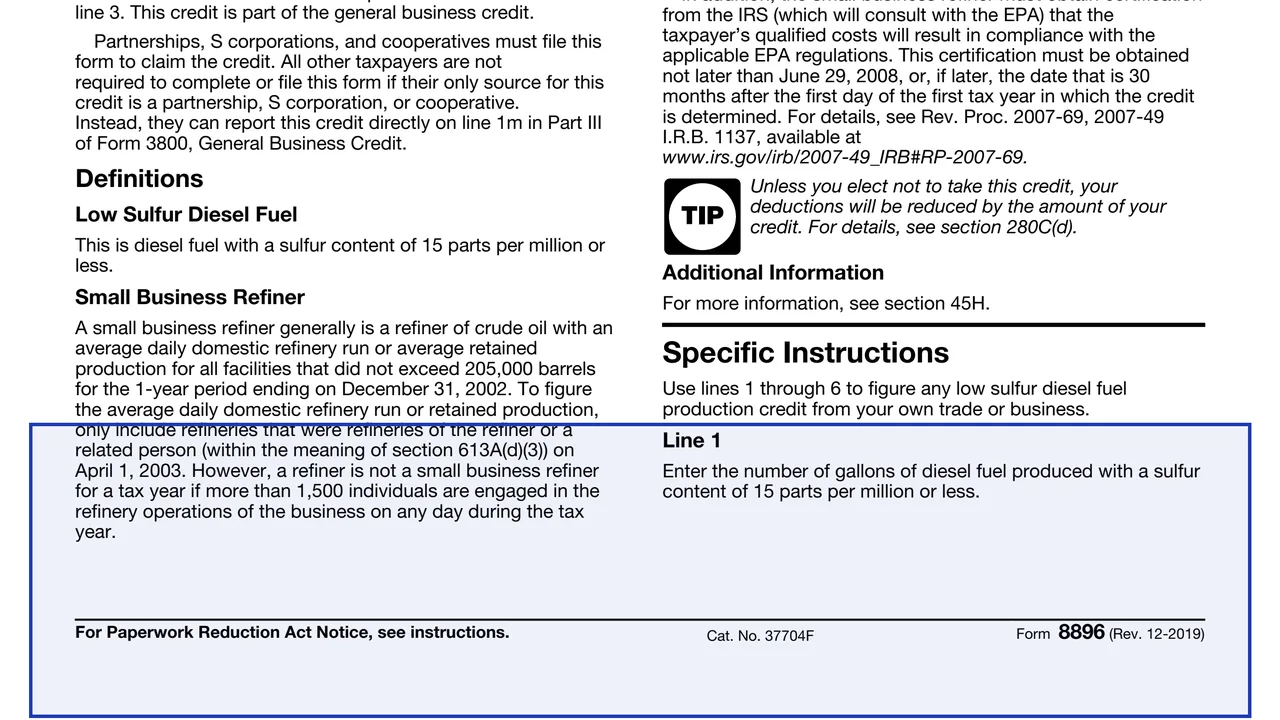
Enter the number of gallons of diesel fuel produced with a sulfur content of 15 parts per million or less.
The instructions say to enter 25% of the qualified costs for the facility that produced the fuel on line 1 if average daily domestic refinery runs were not more than 155,000 barrels for the 1-year period ending on December 31, 2002. Above 155,000 barrels the 25% is reduced, and the instructions show a worked example.
Enter the total credits allowed for all prior tax years on line 4, as determined for line 6. Subtract line 4 from line 3 on line 5, then enter the smaller of line 5 or line 2 on line 6.
Enter credits from Schedule K-1 (Form 1065), box 15 (code P), Schedule K-1 (Form 1120-S), box 13 (code P), and Form 1099-PATR, box 12 (box 11 for 2019, box 10 before 2019), or another notice of credit allocation.
Add lines 6 and 7. The form says cooperatives go to line 9, partnerships and S corporations report the amount on Schedule K, and all others report it on Form 3800, Part III, line 1m.
A cooperative described in section 1381(a) can elect to allocate any part of the credit to its patrons by completing line 9. Line 10 subtracts line 9 from line 8 and is reported on Form 3800, Part III, line 1m.
The instructions say lines 1 through 6 figure any credit from the filer's own trade or business.
You get the real form, filled in a browser tab, with nothing standing between you and the finished PDF.
The form says to attach it to the tax return. The final amount goes to Schedule K for partnerships and S corporations, and to Form 3800, Part III, line 1m for all others.
The instructions say the IRS certification is obtained not later than June 29, 2008, or, if later, the date that is 30 months after the first day of the first tax year in which the credit is determined.
Qualified costs are costs paid or incurred to comply with the EPA highway diesel fuel sulfur control requirements from January 1, 2003, to the earlier of 1 year after the refiner's EPA compliance date for the facility or December 31, 2009.
The form's tip says that unless the filer elects not to take this credit, deductions are reduced by the amount of the credit. See section 280C(d).
The instructions say the election is effective only if made on a timely filed return (including extensions) and the cooperative designates the apportionment in a written notice or on Form 1099-PATR mailed to its patrons. Once made, it cannot be revoked.
A cooperative that timely filed without the election can still make it on an amended return within 6 months of the due date (excluding extensions), with "Filed pursuant to section 301.9100-2" written on it.
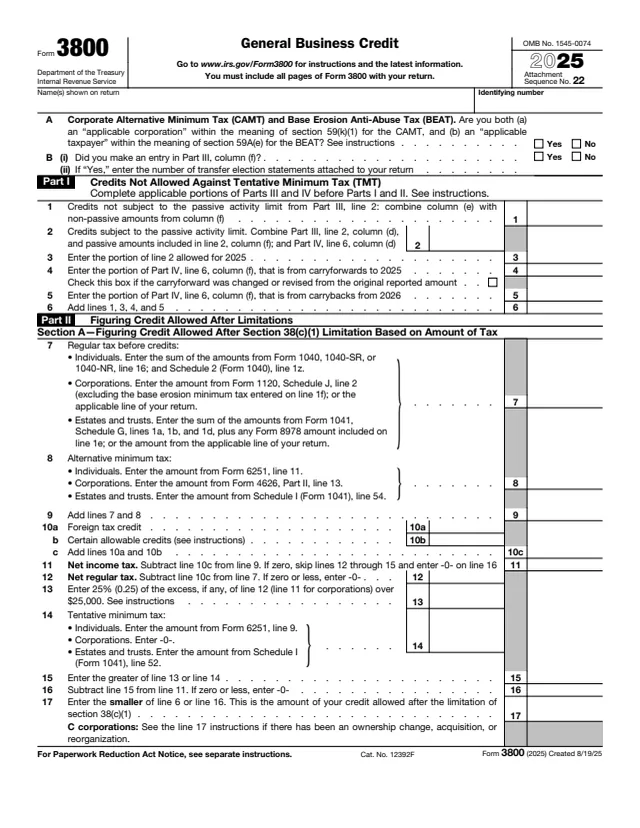
3800
1,921 fields, 9 pages
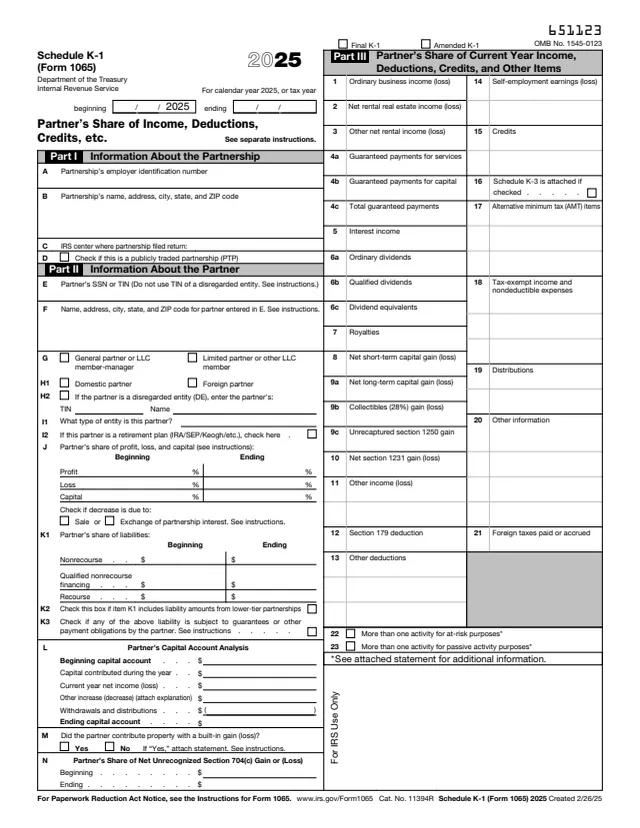
1065
111 fields, 1 page
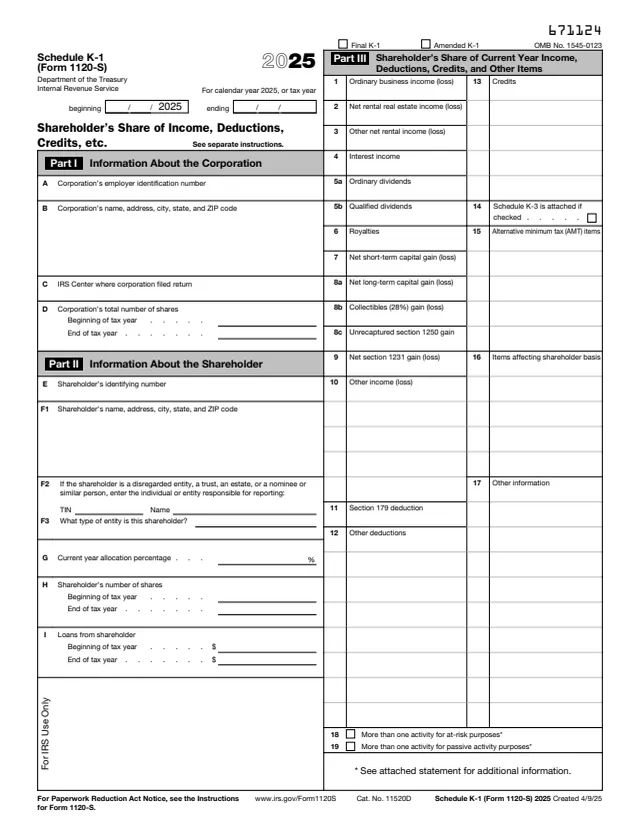
1120-S
114 fields, 1 page
1099-PATR
46 fields, 4 pages
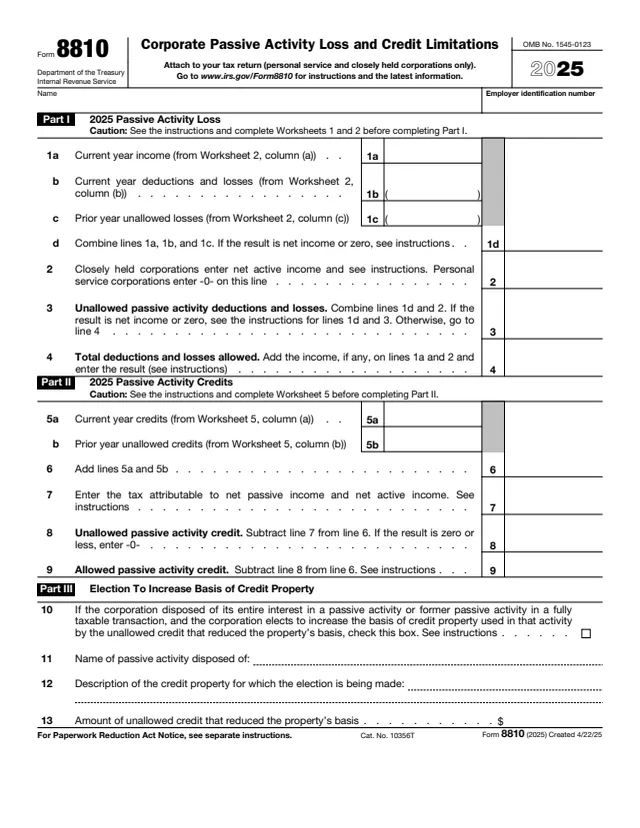
8810
20 fields, 1 page
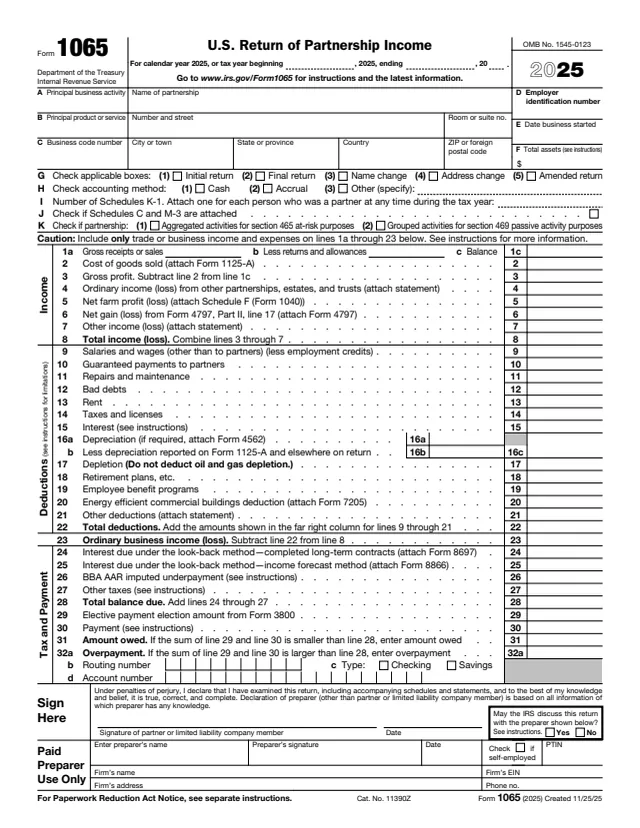
1065
440 fields, 6 pages
The IRS About page says qualified small business refiners use this form to claim the credit.
No tool matches that search.
The IRS About page says qualified small business refiners use this form to claim the low sulfur diesel fuel production credit.
The instructions say the credit generally is 5 cents for every gallon of low sulfur diesel fuel produced during the tax year, limited in total by the qualified costs limitation on line 3.
The form defines it as diesel fuel with a sulfur content of 15 parts per million or less.
The instructions say other taxpayers whose only source for this credit is a partnership, S corporation or cooperative are not required to complete or file the form. They can report the credit directly on Form 3800, Part III, line 1m.
They are printed on the form itself, on pages 1 and 2. The IRS About page links no separate instructions.
No. The form says to attach it to the tax return.