Header
The name or names shown on the return and the owner's identifying number.
8609-A
Annual Statement for Low-Income Housing Credit
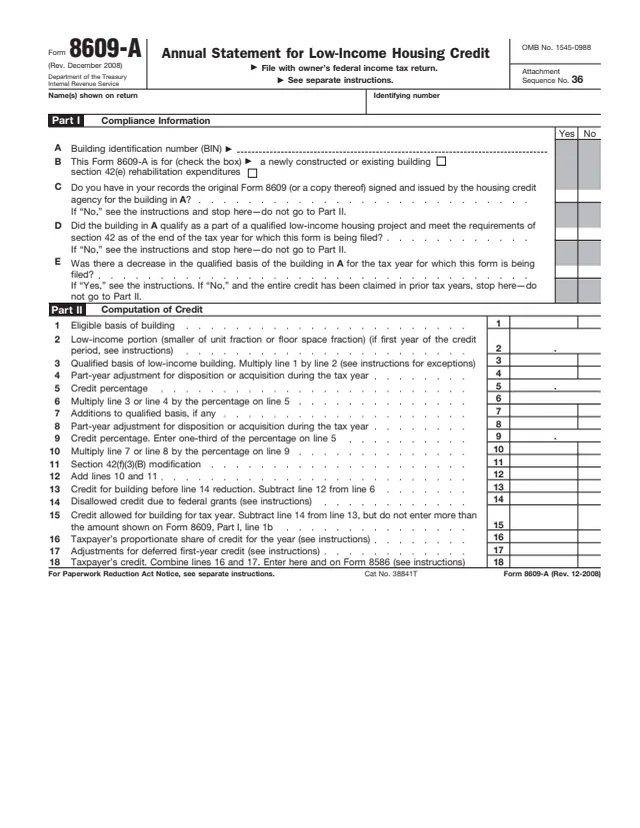
Form 8609-A is the Annual Statement for Low-Income Housing Credit. The IRS says building owners file it to report compliance with the low-income housing provisions for each year of the 15-year compliance period, and to calculate the low-income housing credit.
The form has two parts. Part I asks compliance questions about one building, identified by its building identification number (BIN) from Form 8609. Part II computes the credit for that building for the tax year, and the result on line 18 goes to Form 8586. The form says to file it with the owner's federal income tax return.
The current form is the December 2008 revision. Its separate instructions were revised in December 2025. You can fill out Form 8609-A free in your browser on this page and download the result without an account.
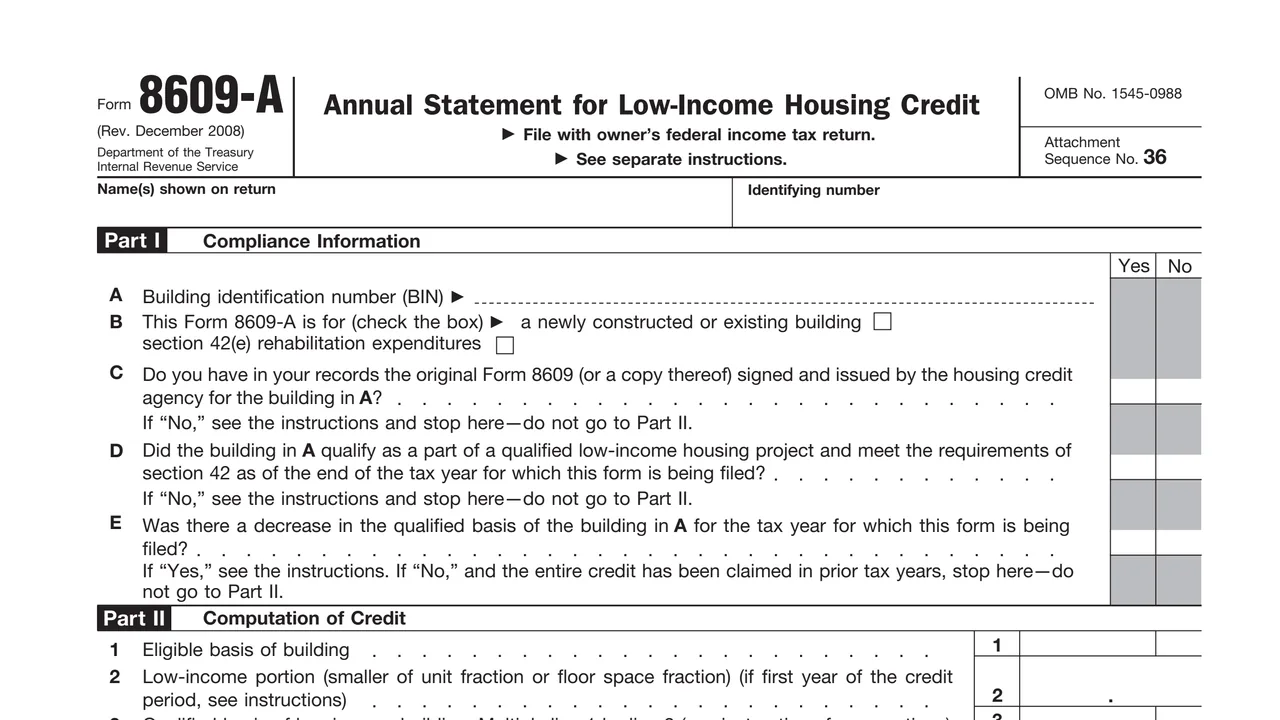
The name or names shown on the return and the owner's identifying number.
The building identification number (BIN), and a box showing whether the form is for a newly constructed or existing building or for section 42(e) rehabilitation expenditures.
Yes or no questions: whether the original signed Form 8609 is in the owner's records, whether the building met the section 42 requirements at year end, and whether its qualified basis decreased.
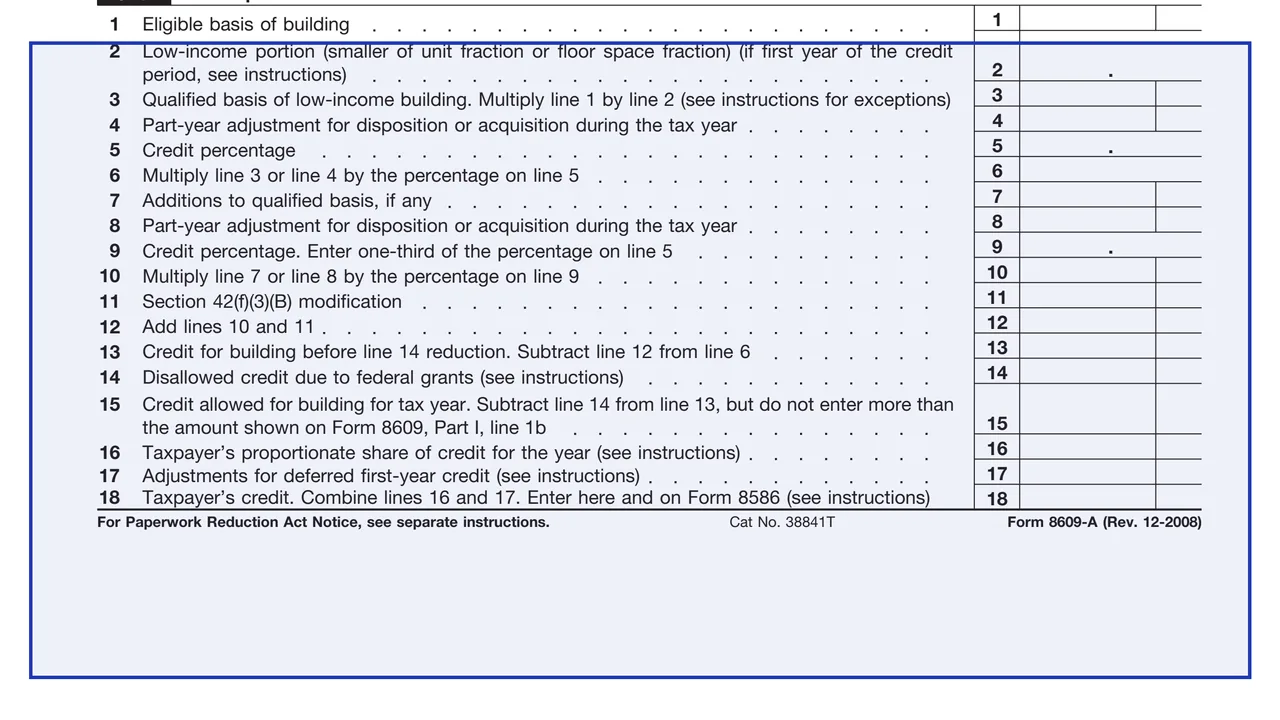
Eligible basis, the low-income portion, qualified basis, a part-year adjustment for a disposition or acquisition, the credit percentage, and the resulting credit.
Additions to qualified basis, their part-year adjustment, a credit percentage of one-third of line 5, and the section 42(f)(3)(B) modification.
The credit before the federal grant reduction, the disallowed credit, the credit allowed for the building, the taxpayer's share, deferred first-year credit, and the taxpayer's credit.
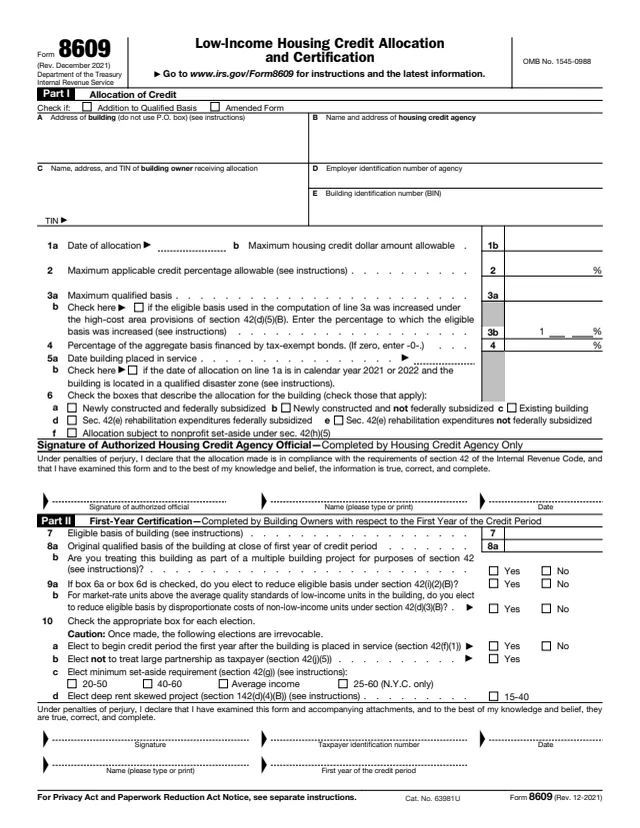
The instructions say to enter the BIN from Part I, item E, of Form 8609. In item B, check the box for a newly constructed or existing building, or for rehabilitation expenditures, which get their own Form 8609-A.
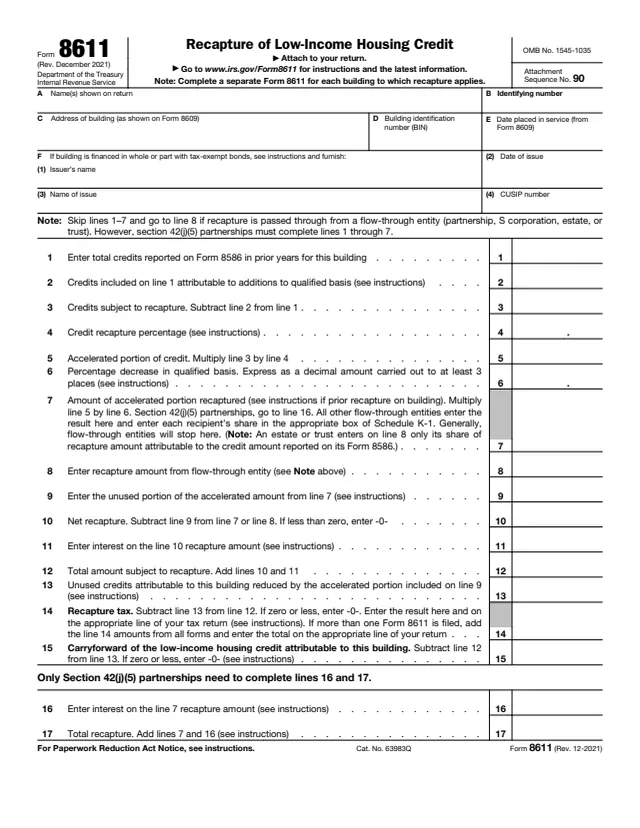
The form says that a No answer to item C or item D means stop and do not go to Part II. For item E, a Yes points to the line 2 instructions and to Form 8611 for possible recapture.
Line 1 is generally the eligible basis from Form 8609, line 7. Line 2 is the smaller of the unit fraction or floor space fraction, shown as a decimal to at least four places, such as .5000. The first credit year uses a modified percentage.
Multiply line 1 by line 2 for line 3. Enter zero on line 4 if the building was owned all year. Line 5 is the credit percentage from Form 8609, Part I, line 2, as a decimal, for example 0.0813 for 8.13%.
The instructions say to skip lines 7 through 12 when no credit is claimed for additions to qualified basis. Otherwise line 9 is one-third of line 5, and line 11 comes from the Line 11 Worksheet in the instructions.
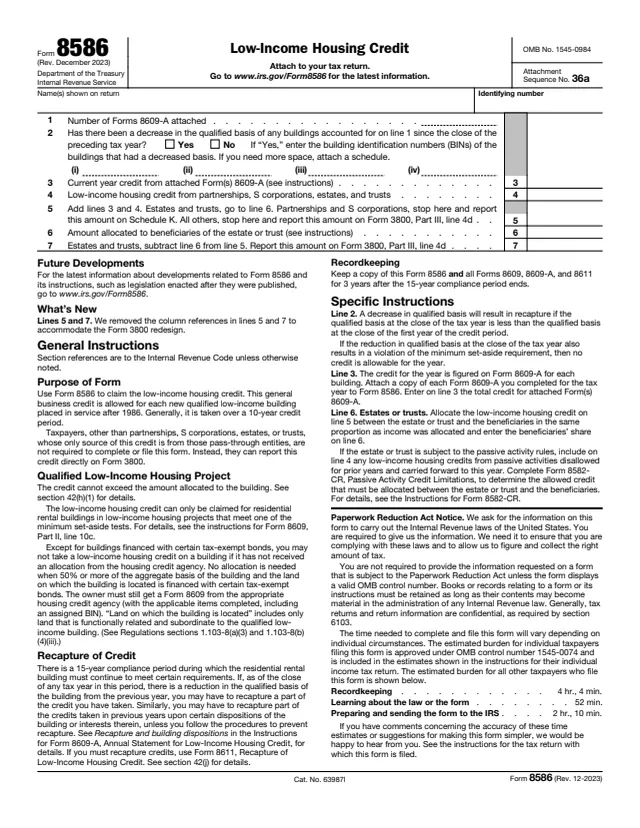
Line 14 reduces the credit for federal grants. Line 15 may not be more than Form 8609, Part I, line 1b. Line 16 is the owner's share, line 17 adds any deferred first-year credit, and line 18 goes to line 3 of Form 8586.
You get the real form, filled in a browser tab, with nothing standing between you and the finished PDF.
The form says to file it with the owner's federal income tax return. A pass-through entity that owns the building attaches it to the entity's own return.
The instructions say the building owner files Form 8609-A for each year of the 15-year compliance period.
The instructions say an owner claiming the credit without a completed Form 8609 signed and dated by an authorized official of the housing credit agency, and without submitting Form 8609 (Parts I and II) to the IRS, is subject to having the credit disallowed.
If the qualified basis decreased from the close of the previous tax year, the instructions point to Form 8611, Recapture of Low-Income Housing Credit.
The instructions say that on a change of ownership the seller should give the new owner a copy of Form 8609 with Parts I and II complete, so the new owner can substantiate the credit.
The instructions say Form 8609-A is filed by the owner of a low-income housing building, once for each year of the 15-year compliance period.
No tool matches that search.
The instructions say the building owner files it to report compliance with the low-income housing provisions and calculate the low-income housing credit.
No. The instructions say the entity completes Form 8609-A, and a partner, shareholder or beneficiary files only Form 8586, using the information from Schedule K-1.
For each year of the 15-year compliance period, according to the instructions.
The form says to see the instructions and stop, without going to Part II. For item D, the instructions also point to Form 8611 to find out whether part of the credit allowed in prior years is recaptured.
The form says to enter it on Form 8586. The instructions name line 3 of Form 8586.
Yes. The IRS About page lists the Rev. December 2008 form as the current revision. Its separate instructions were revised in December 2025.