Header
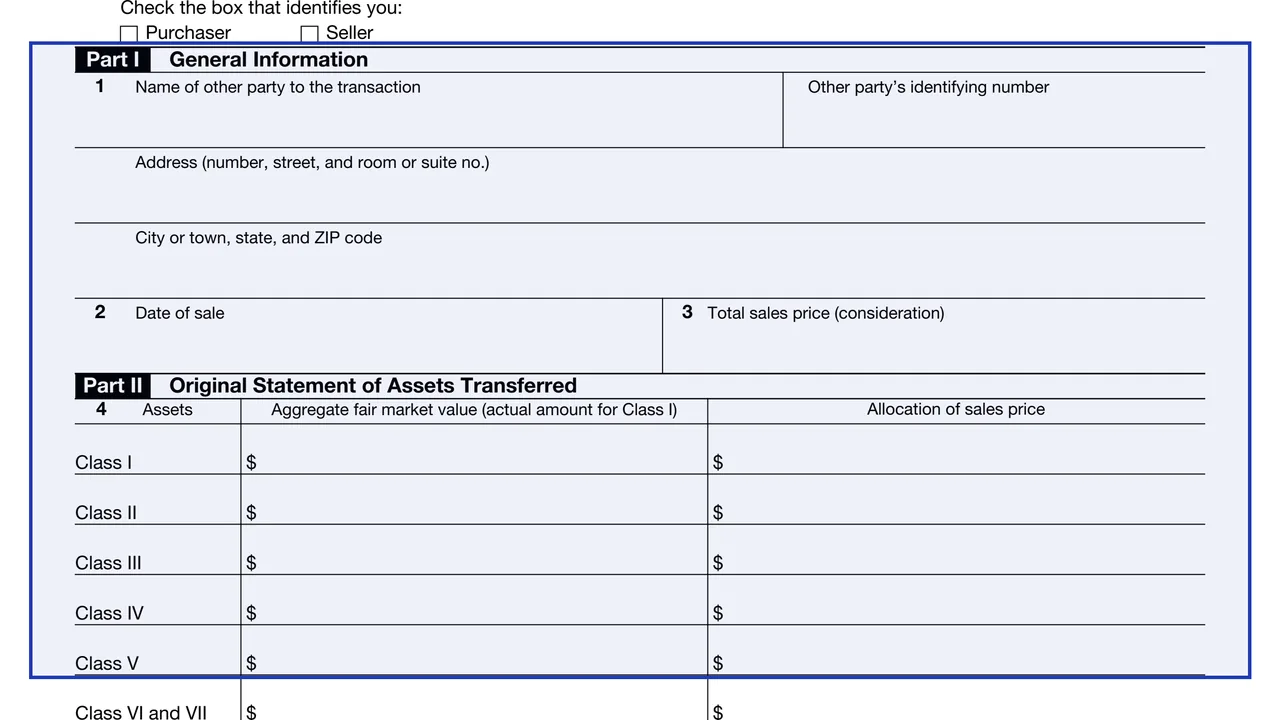
Name and identifying number as shown on the return, and a box to check for Purchaser or Seller.
8594
Asset Acquisition Statement Under Section 1060
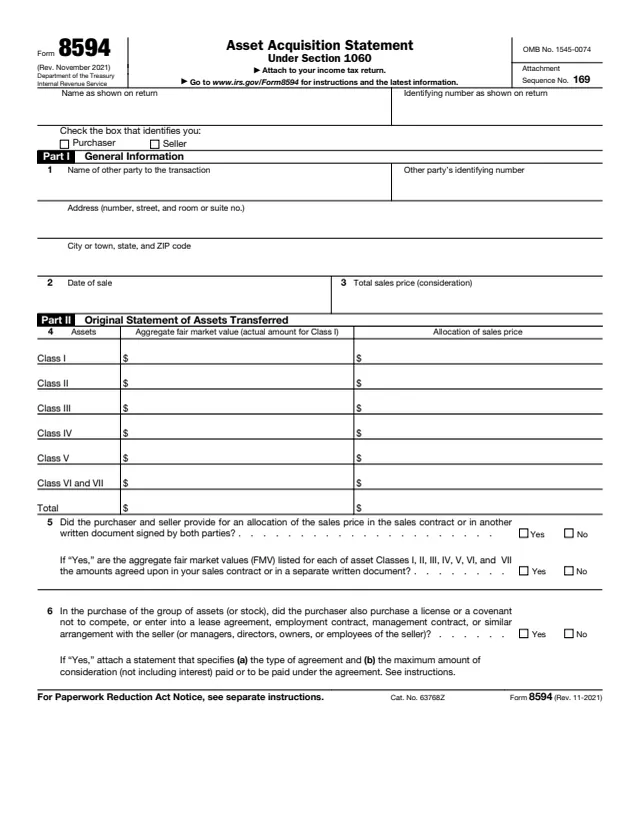
Form 8594 is the Asset Acquisition Statement Under Section 1060. The IRS says both the seller and purchaser of a group of assets that makes up a trade or business use it to report such a sale if goodwill or going concern value attaches, or could attach, to the assets and the purchaser's basis is determined only by the amount paid for them.
The form records the other party, the date of sale, the total sales price and how that price is allocated across seven asset classes, from Class I (cash and general deposit accounts) to Class VII (goodwill and going concern value). A supplemental statement in Part III reports a later increase or decrease in the price.
The form says to attach it to the income tax return of the purchaser or seller filing it. You can fill out Form 8594 free in your browser on this page and download the result without an account.
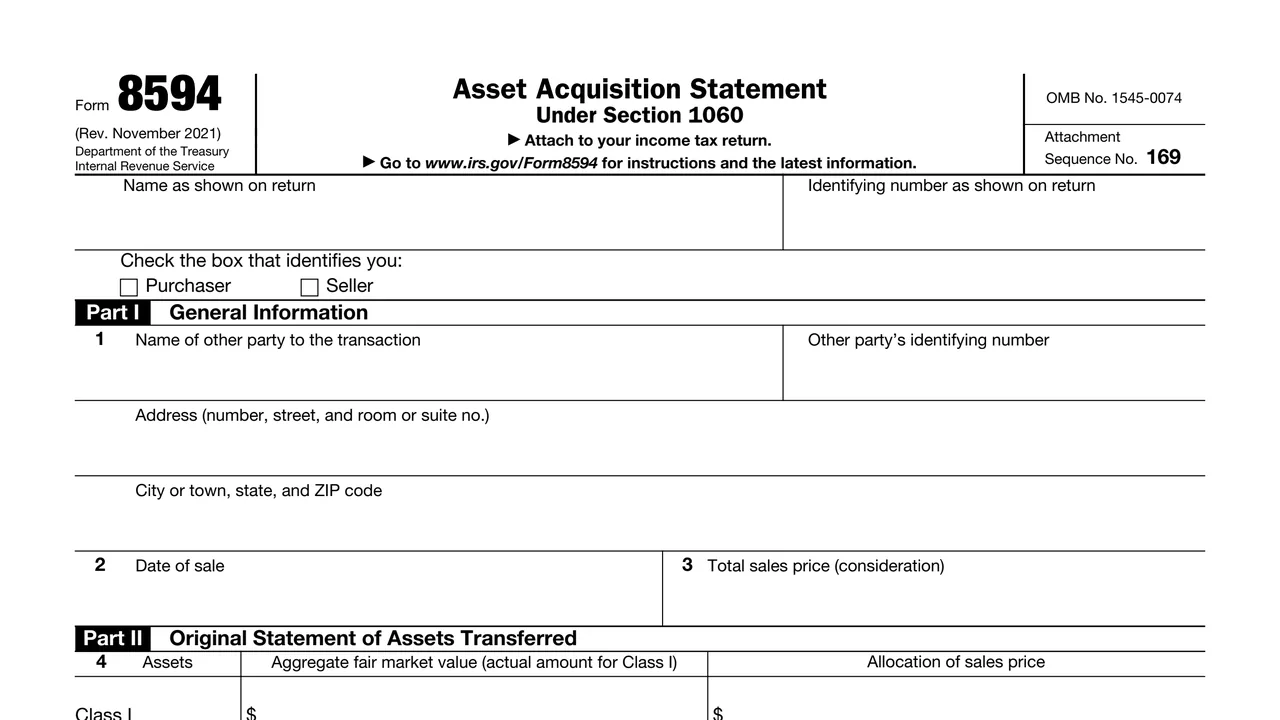
Name and identifying number as shown on the return, and a box to check for Purchaser or Seller.
Line 1 takes the other party's name, identifying number and address. Line 2 is the date of sale and line 3 the total sales price (consideration).
A table with the aggregate fair market value and the allocation of the sales price for Classes I to V and for Classes VI and VII combined, with totals.
Yes or No questions on whether the parties agreed an allocation in writing, and whether the purchaser also bought a license or covenant not to compete or entered a lease, employment, management or similar contract with the seller.
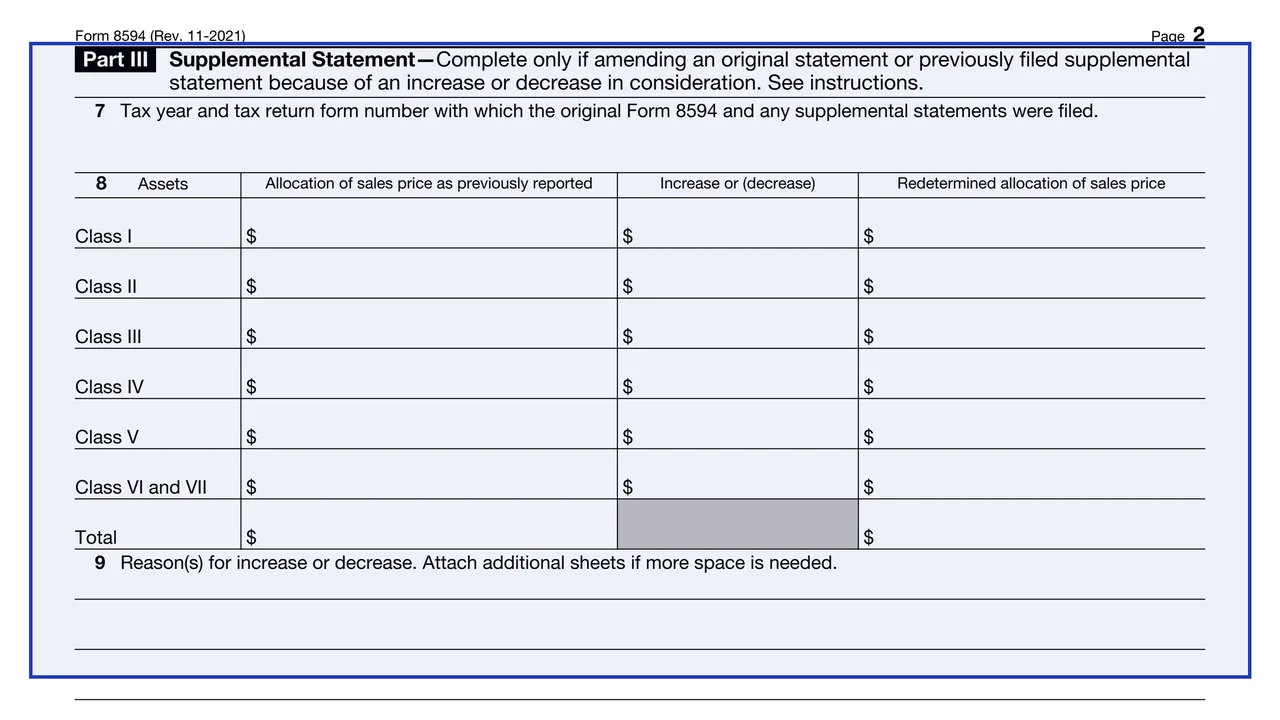
Line 7 names the tax year and return the original was filed with. Line 8 shows each class's prior allocation, the increase or decrease and the redetermined allocation. Line 9 gives the reasons.
Enter your name and taxpayer identification number (TIN), then check the box for Purchaser or Seller.
Enter the other party's name, address and TIN. The instructions say to use a social security number for an individual or sole proprietor and an employer identification number for a corporation, partnership or other entity.
Enter the date the sale of the assets occurred and the total consideration transferred for the assets.
For each class, enter the total fair market value of the assets and the total allocation of the sales price. Classes VI and VII are entered as one combined amount.
Answer both questions. If line 6 is Yes, the form says to attach a statement giving the type of agreement and the maximum consideration, not including interest, paid or to be paid under it.
Complete Parts I and III on a new Form 8594 for each year an increase or decrease occurs, give the reasons, and enter the year and form the original was filed with, for example "2021 Form 1040".
The instructions say an original statement uses Parts I and II, and a supplemental statement uses Parts I and III.
You get the real form, filled in a browser tab, with nothing standing between you and the finished PDF.
The form says to attach it to your income tax return. It is not mailed on its own.
The instructions say to generally attach it to the return for the year in which the sale date occurred. A supplemental statement goes with the return for the year the increase or decrease is taken into account.
The instructions describe the residual method: reduce the consideration by Class I assets, allocate the rest to Classes II to VI in order, then to Class VII.
The instructions say the amount allocated to an asset, other than a Class VII asset, cannot exceed its fair market value on the purchase date.
The instructions say penalties may apply under sections 6721 through 6724 if a correct Form 8594 is not filed by the due date of the return and reasonable cause cannot be shown.
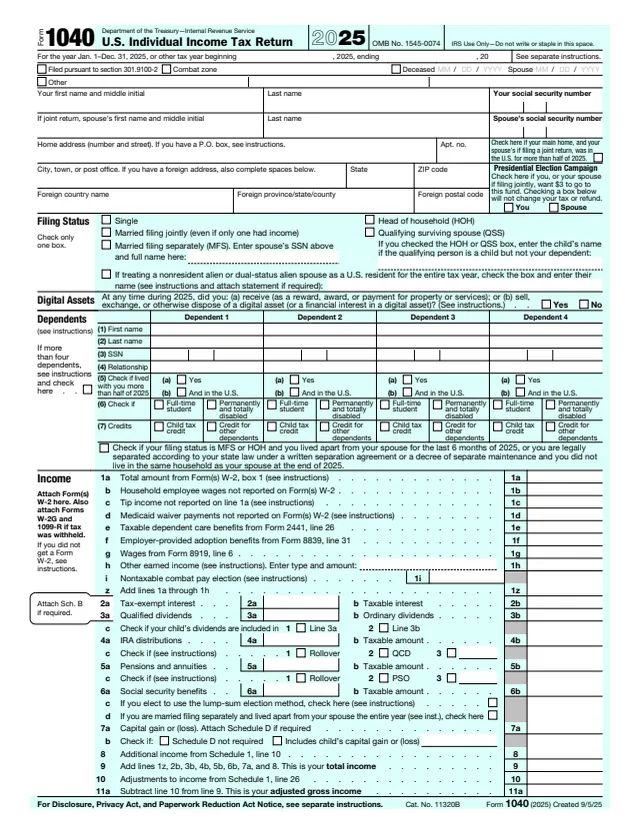
1040
199 fields, 2 pages
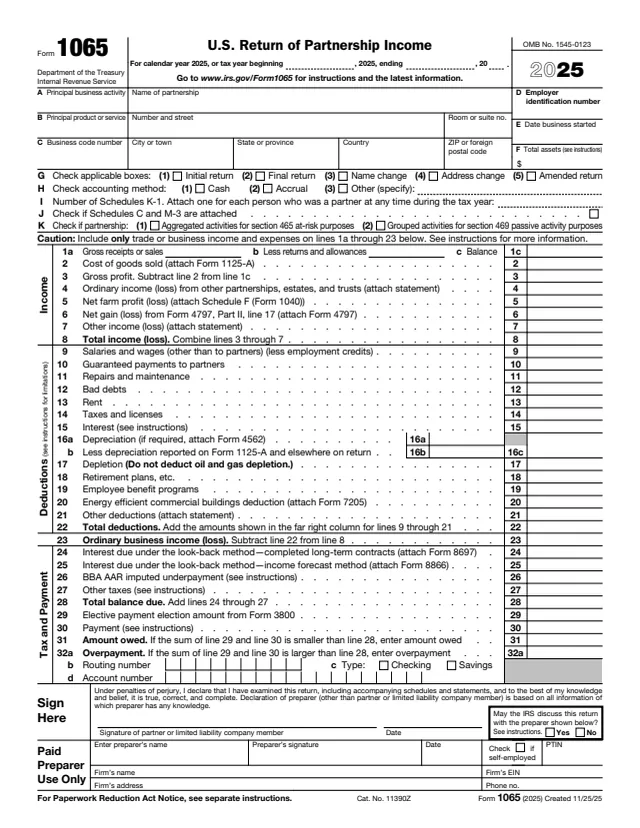
1065
440 fields, 6 pages
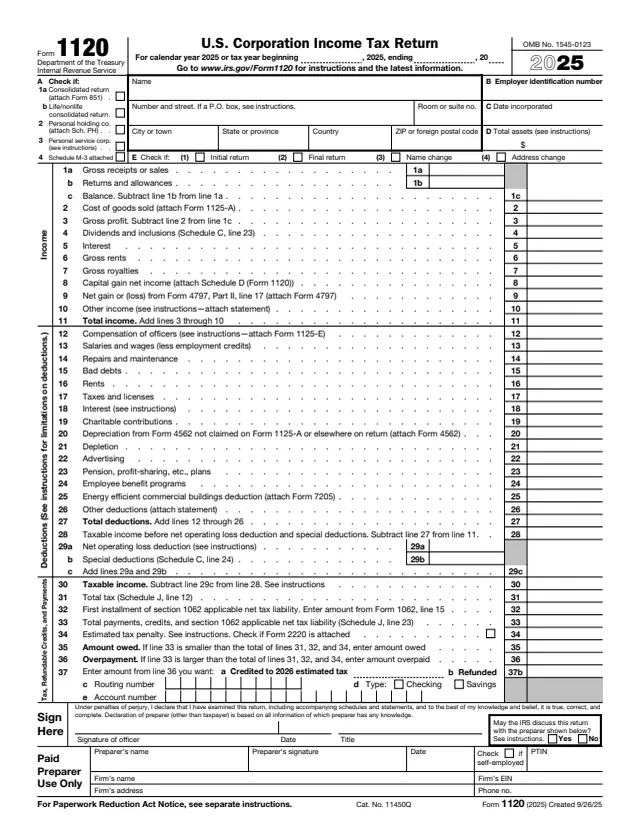
1120
481 fields, 6 pages
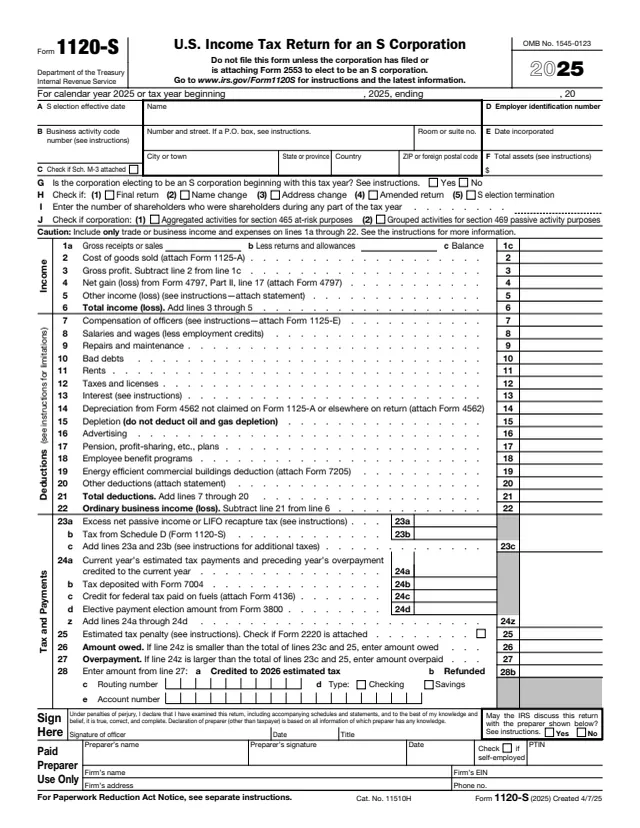
1120-S
390 fields, 5 pages
1041
173 fields, 3 pages
5471
437 fields, 6 pages
The instructions say that, generally, both the purchaser and seller file Form 8594 and attach it to their income tax returns when a group of assets that makes up a trade or business is transferred and the purchaser's basis is determined wholly by the amount paid.
No tool matches that search.
The instructions say that, generally, both the purchaser and seller file Form 8594 and attach it to their own income tax returns.
The instructions define Class I as cash and general deposit accounts, Class II as actively traded personal property, certificates of deposit and foreign currency, Class III as mark-to-market assets and debt instruments, Class IV as inventory, Class V as all other assets, Class VI as section 197 intangibles other than goodwill and going concern value, and Class VII as goodwill and going concern value.
The affected party completes Parts I and III on a new Form 8594 and attaches it to the return for the year the increase or decrease is taken into account.
The instructions list a transfer of a partnership interest as an exception, but say the purchaser files Form 8594 when the purchase is treated as a purchase of partnership assets that make up a trade or business.
Whether the purchaser also bought a license or covenant not to compete, or entered a lease, employment contract, management contract or similar arrangement with the seller. A Yes answer needs an attached statement.