Page 1, Parts I and II
Part I, lines 1 to 6, figures the tax, credits and balance due. Part II, lines 7 to 9, is the statement in support of suspension for this and the prior period.
2290
Heavy Highway Vehicle Use Tax Return
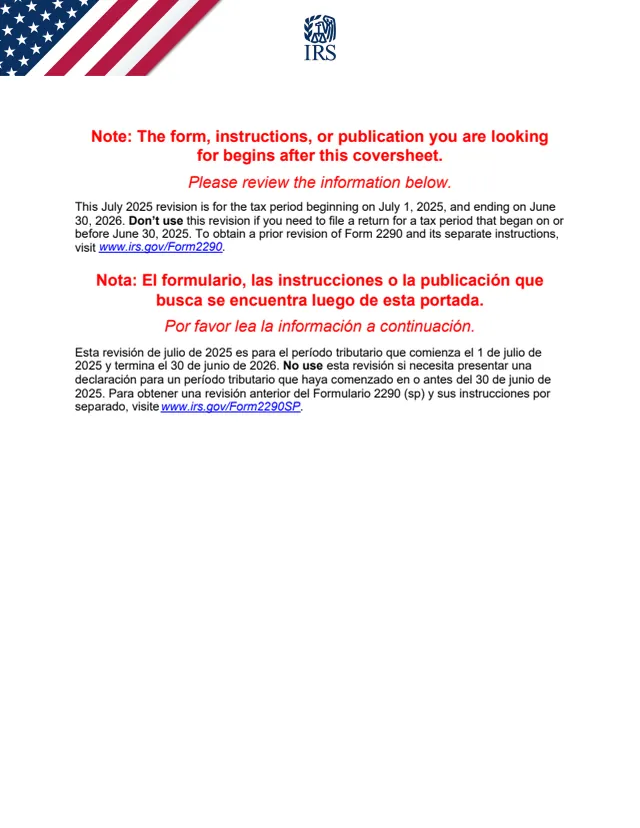
This is the July 2025 revision of Form 2290, Heavy Highway Vehicle Use Tax Return, an older edition kept for its own tax period. The PDF cover sheet says this revision is for the tax period beginning on July 1, 2025, and ending on June 30, 2026, and not to use it for a tax period that began on or before June 30, 2025. The IRS About Form 2290 page links the current revision and all Form 2290 revisions.
The IRS describes Form 2290 as the return used to figure and pay the tax on highway motor vehicles with a taxable gross weight of 55,000 pounds or more, to claim suspension of the tax for vehicles expected to be used 5,000 miles or less (7,500 miles or less for agricultural vehicles), and to claim credits for vehicles destroyed, stolen, sold or used under those limits.
The PDF bundles the return, two copies of Schedule 1 (Form 2290) and the Form 2290-V payment voucher. You can fill out this edition free in your browser on this page and download the result without an account.
Part I, lines 1 to 6, figures the tax, credits and balance due. Part II, lines 7 to 9, is the statement in support of suspension for this and the prior period.
Categories A through V, from 55,000 pounds ($100.00 annual tax) to over 75,000 pounds ($550.00). Logging vehicles have their own columns. Category W lists suspended vehicles.
In this revision, Part I of Schedule 1 lists the vehicles being reported, by VIN and category, with category W for suspended vehicles.
In this revision, Part II summarizes the vehicles: line a total reported, line b suspended in category W, line c taxable vehicles.
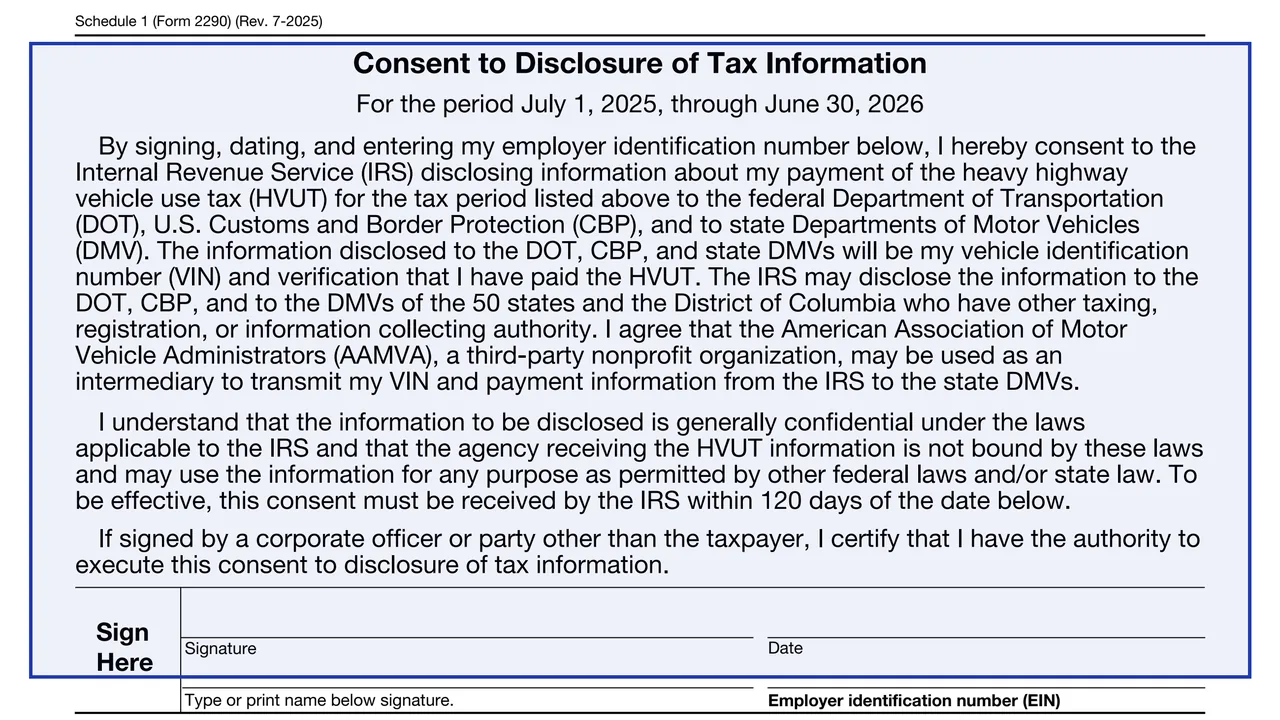
A signed consent lets the IRS share the VIN and proof of payment with the Department of Transportation, U.S. Customs and Border Protection and state DMVs.
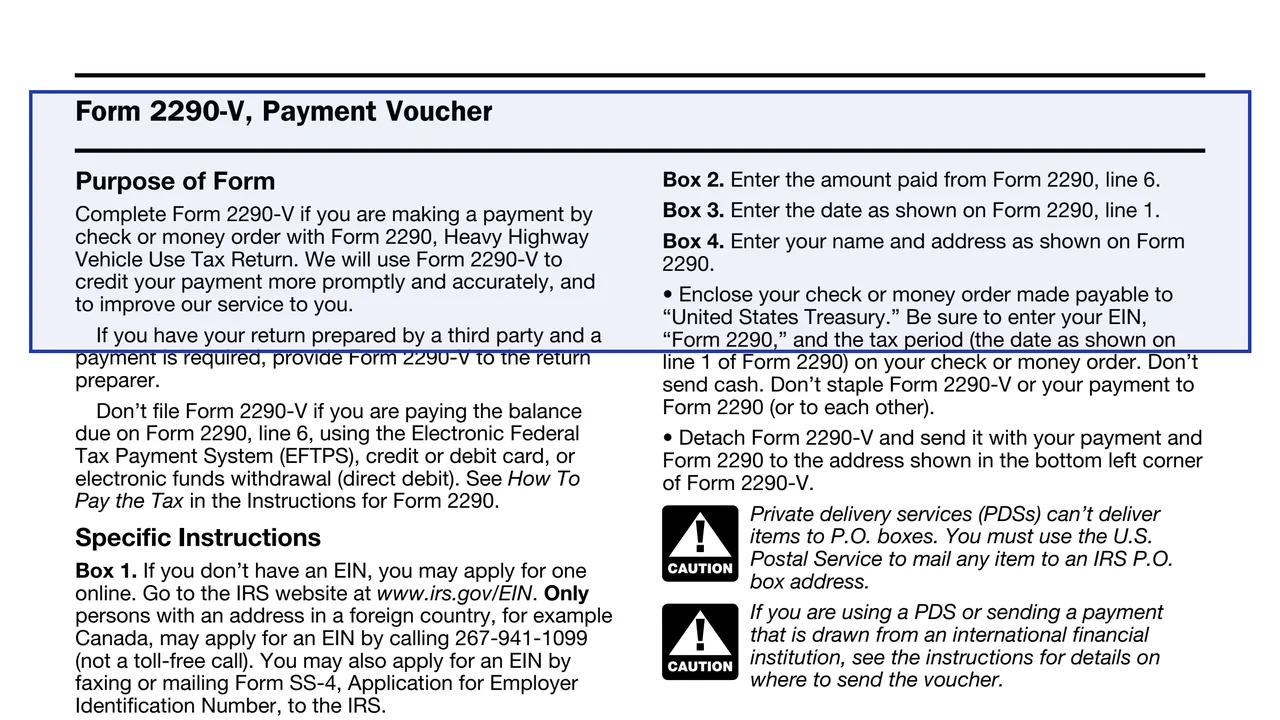
The payment voucher for a check or money order, with the EIN, amount, the date from line 1, and name and address.
Enter the name, EIN and address, and check Address Change, VIN Correction, Amended Return or Final Return only when the form's own description of that box applies.
Enter 202507 if the vehicles were used on public highways during July 2025. If not, the form points to a table in the instructions.
Count vehicles by category, multiply by the annual or partial-period tax, and enter the column (4) total on line 2.
Add any tax from a weight increase, subtract credits with supporting documentation attached, and check EFTPS or credit or debit card on line 6 if paying that way.
Check the mileage box on line 7 for suspended vehicles. Use lines 8a, 8b and 9 for vehicles suspended on the 2024 to 2025 return.
Complete both copies of Schedule 1, listing vehicles in Part I and the totals in Part II, and enter the month of first use. Then sign and date the return.
You get the real form, filled in a browser tab, with nothing standing between you and the finished PDF.
The July 2025 voucher says to send Form 2290, the voucher and payment to Internal Revenue Service, P.O. Box 932500, Louisville, KY 40293-2500.
Make it payable to "United States Treasury" and enter the EIN, "Form 2290" and the tax period from line 1. The voucher says not to send cash or staple the payment.
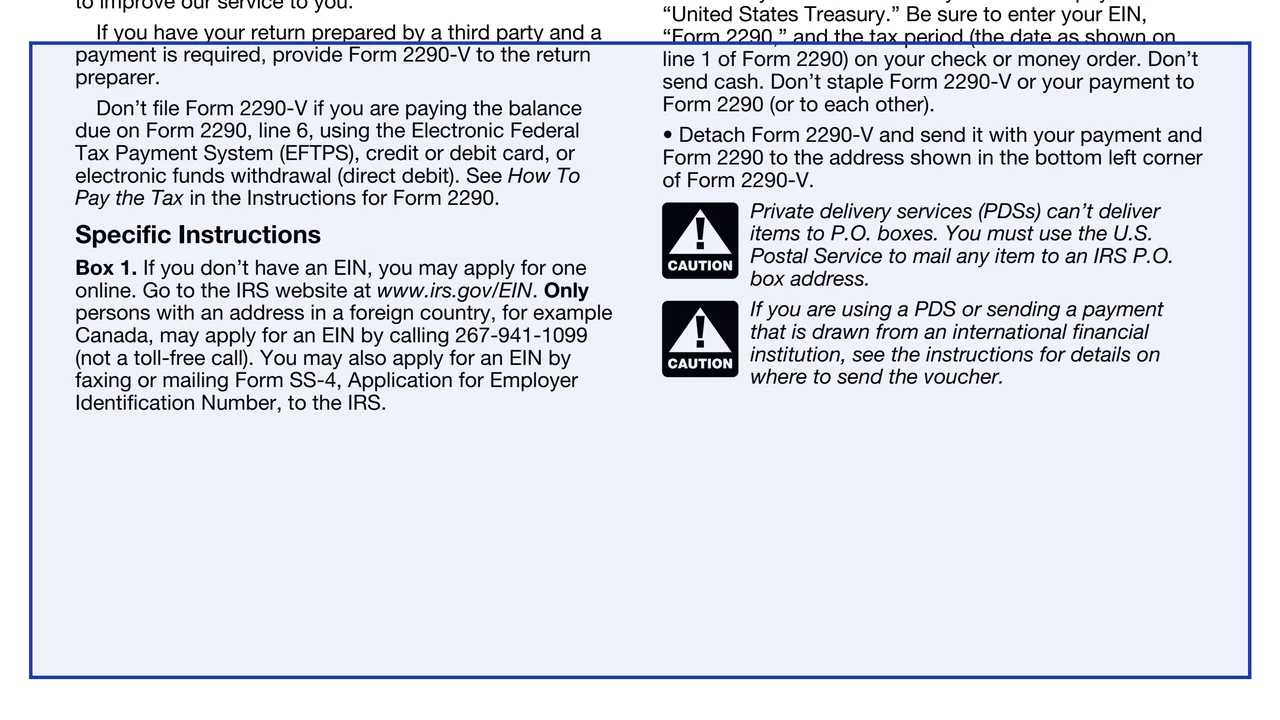
The voucher page says not to file Form 2290-V when paying the line 6 balance through EFTPS, credit or debit card, or electronic funds withdrawal.
The voucher page says private delivery services can't deliver items to P.O. boxes, so items for an IRS P.O. box address go through the U.S. Postal Service.
Schedule 1 says one copy will be stamped and returned for use as proof of payment when registering vehicles with a state.
The voucher page says to apply online at www.irs.gov/EIN. Only persons with a foreign address may apply by calling 267-941-1099 (not a toll-free call), or fax or mail Form SS-4.
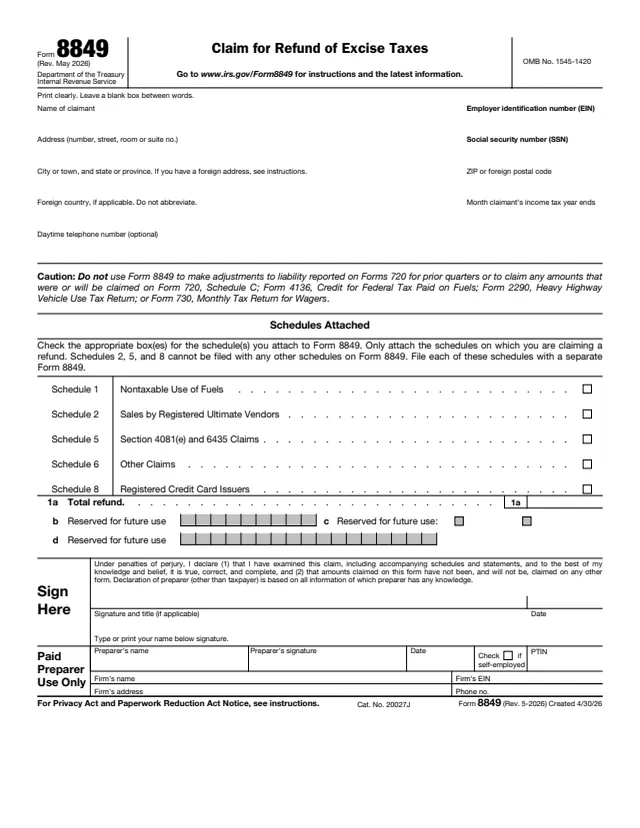
8849
27 fields, 4 pages
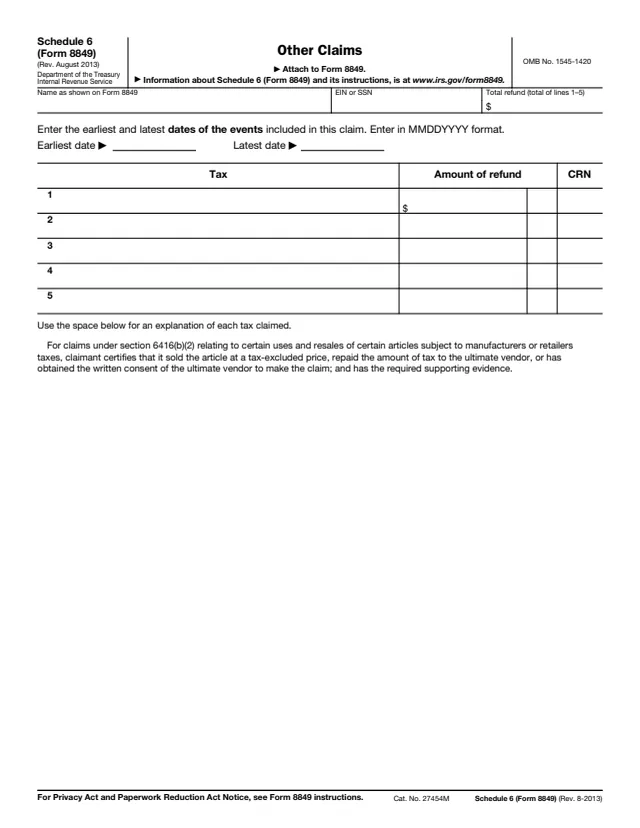
8849 Sch. 6
26 fields, 1 page
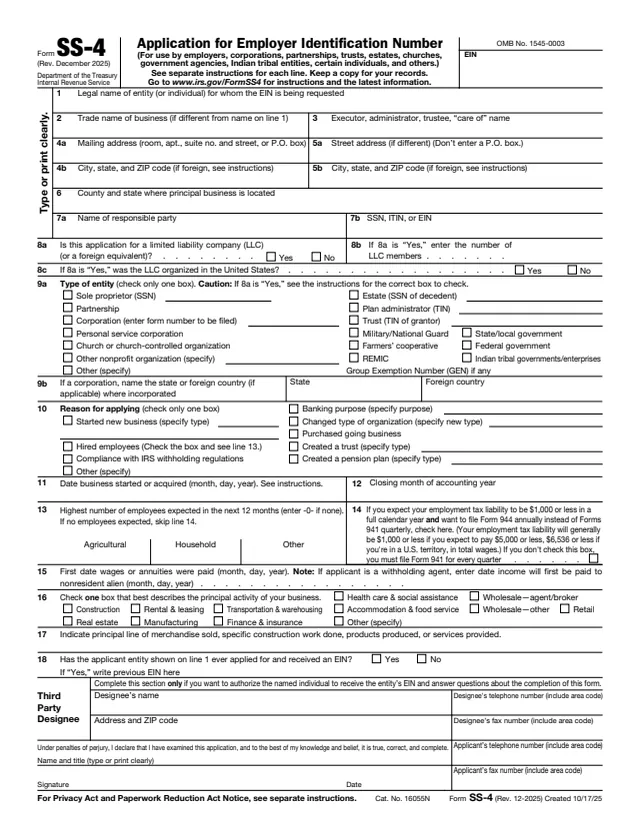
SS-4
89 fields, 2 pages
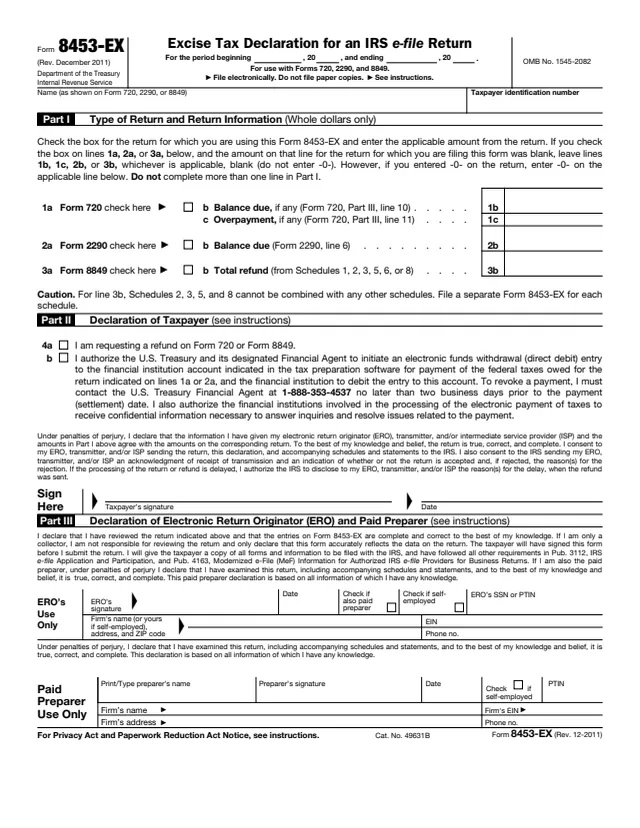
8453-EX
29 fields, 2 pages
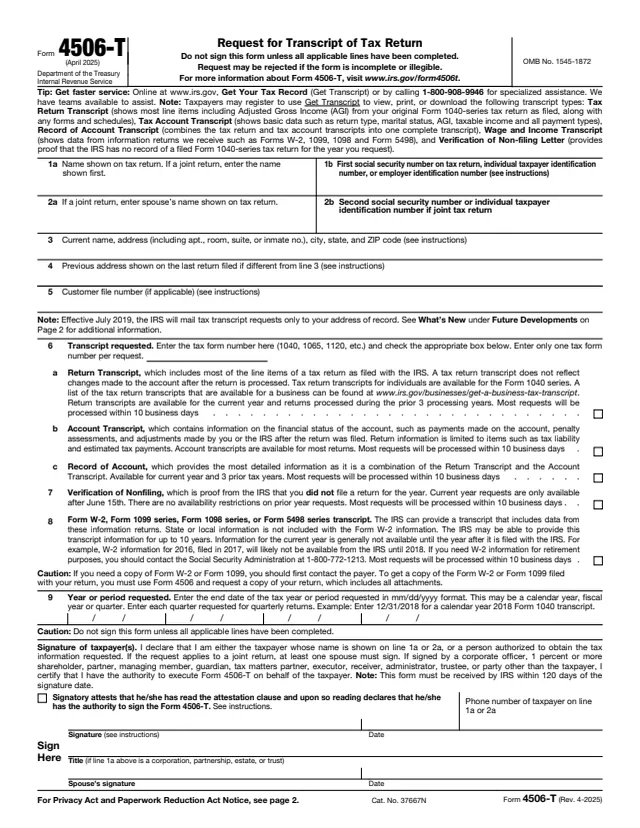
4506-T
29 fields, 2 pages
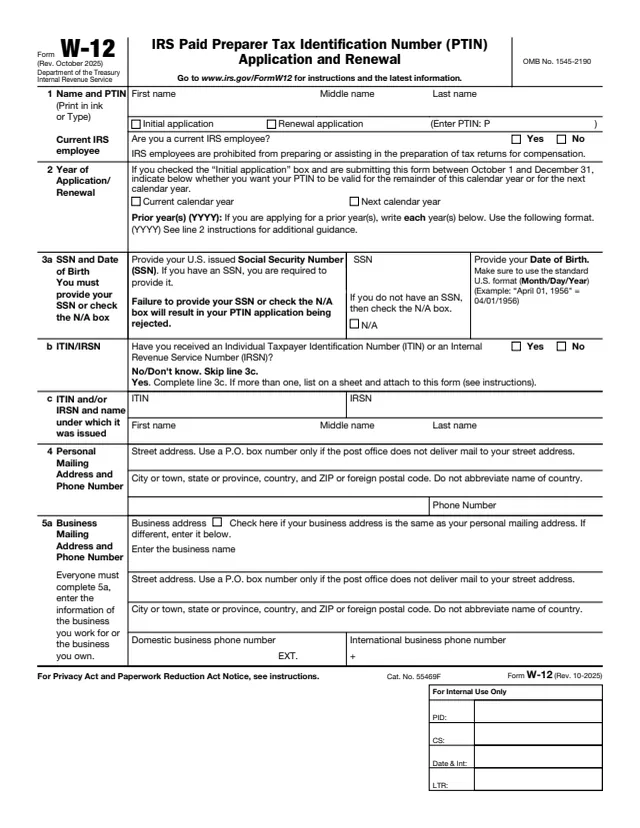
W-12
85 fields, 3 pages
The form is filed with the IRS by the person in whose name a taxable heavy highway vehicle is registered. This edition applies to vehicle use in the period July 1, 2025, through June 30, 2026.
No tool matches that search.
The cover sheet says the July 2025 revision is for the tax period beginning on July 1, 2025, and ending on June 30, 2026.
The cover sheet says not to use this revision for a tax period that began on or before June 30, 2025. The IRS About Form 2290 page links the current revision and all Form 2290 revisions.
In the July 2025 Schedule 1, Part I lists the vehicles by VIN and category and Part II gives the summary lines a, b and c.
Page 2 shows an annual tax of $100.00 for category A (55,000 pounds) up to $550.00 for category V (over 75,000 pounds). Logging vehicles run from $75.00 to $412.50.
It lets the IRS share the VIN and verification that the tax was paid with the Department of Transportation, U.S. Customs and Border Protection and state DMVs. It says it must be received by the IRS within 120 days of the date signed.