Section I: Requestor's Information
Name, taxpayer identification number, any other names used in the prior six years, a contact number and the best hours to call.
14402
Internal Revenue Code (IRC) Section 6702(d) Frivolous Tax Submissions Penalty Reduction
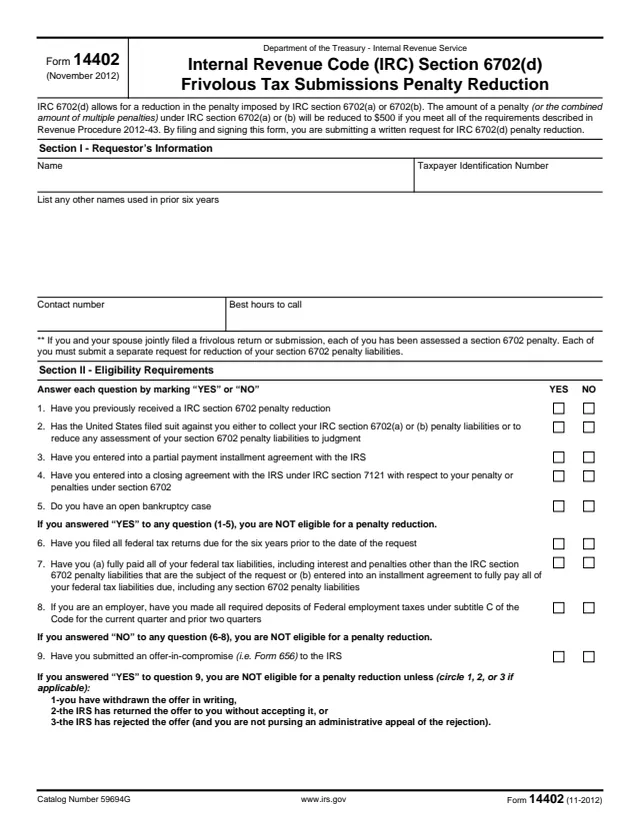
Form 14402 is a written request to reduce unpaid frivolous tax submissions penalties assessed under Internal Revenue Code section 6702(a) or (b). The form says the amount of the penalty, or the combined amount of multiple penalties, will be reduced to $500 if all of the requirements described in Revenue Procedure 2012-43 are met.
The instructions on pages 3 and 4 say any person may use Form 14402 to request a reduction of unpaid section 6702 penalty liabilities. They also say not to use it to challenge the merits of a penalty or to ask for a refund of penalties already paid. The form has five sections: requestor information, nine eligibility questions, payment information, the penalties to be reduced, and a declaration under penalties of perjury.
You can fill out the PDF free in your browser on this page and download it without an account.
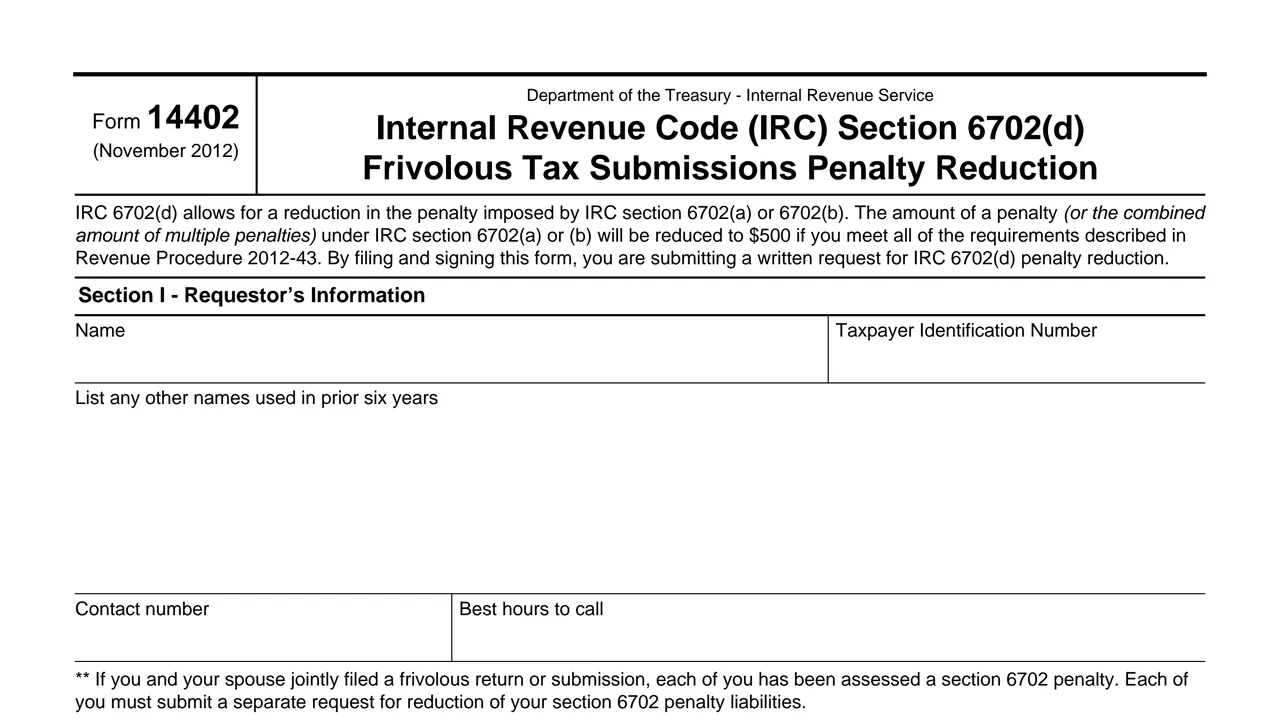
Name, taxpayer identification number, any other names used in the prior six years, a contact number and the best hours to call.
Nine YES or NO questions. The form says a YES to any of questions 1 to 5, or a NO to any of questions 6 to 8, means the request is not eligible.
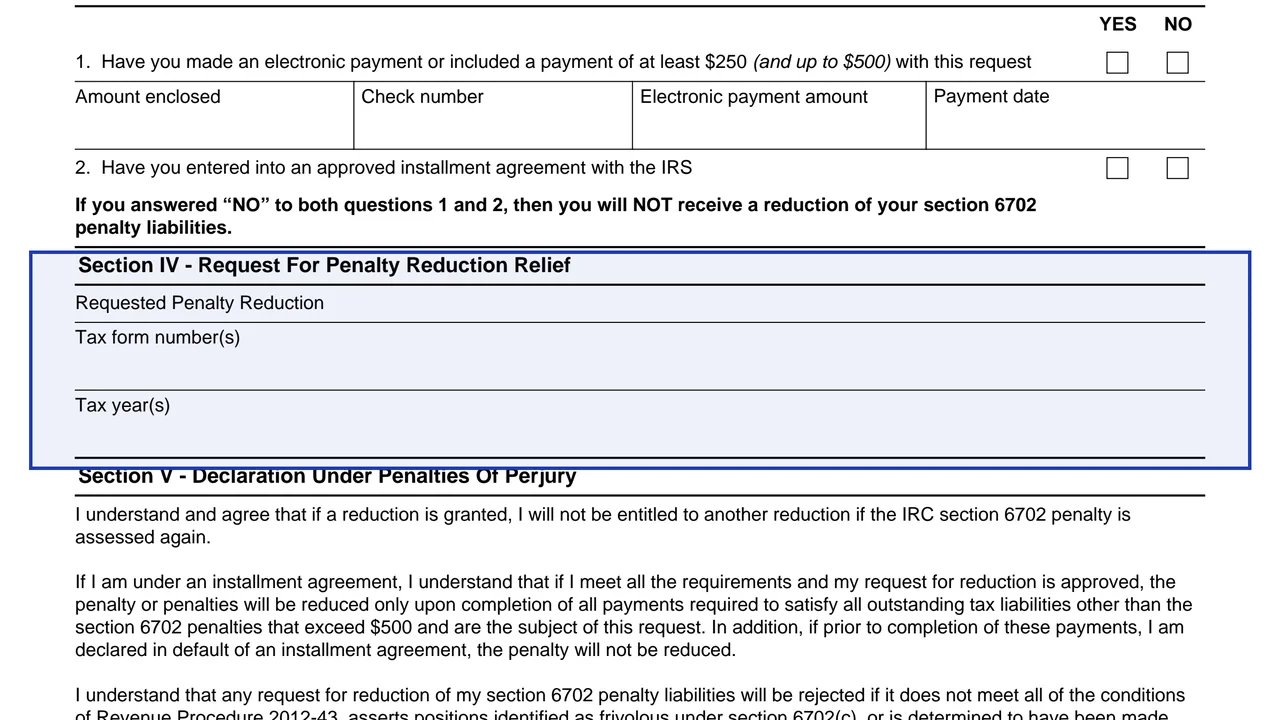
Asks whether a payment of at least $250 (and up to $500) was made or enclosed, with the amount, check number, electronic payment amount and date, and whether an approved installment agreement is in place.
The tax form numbers and tax years of the penalties the request covers.
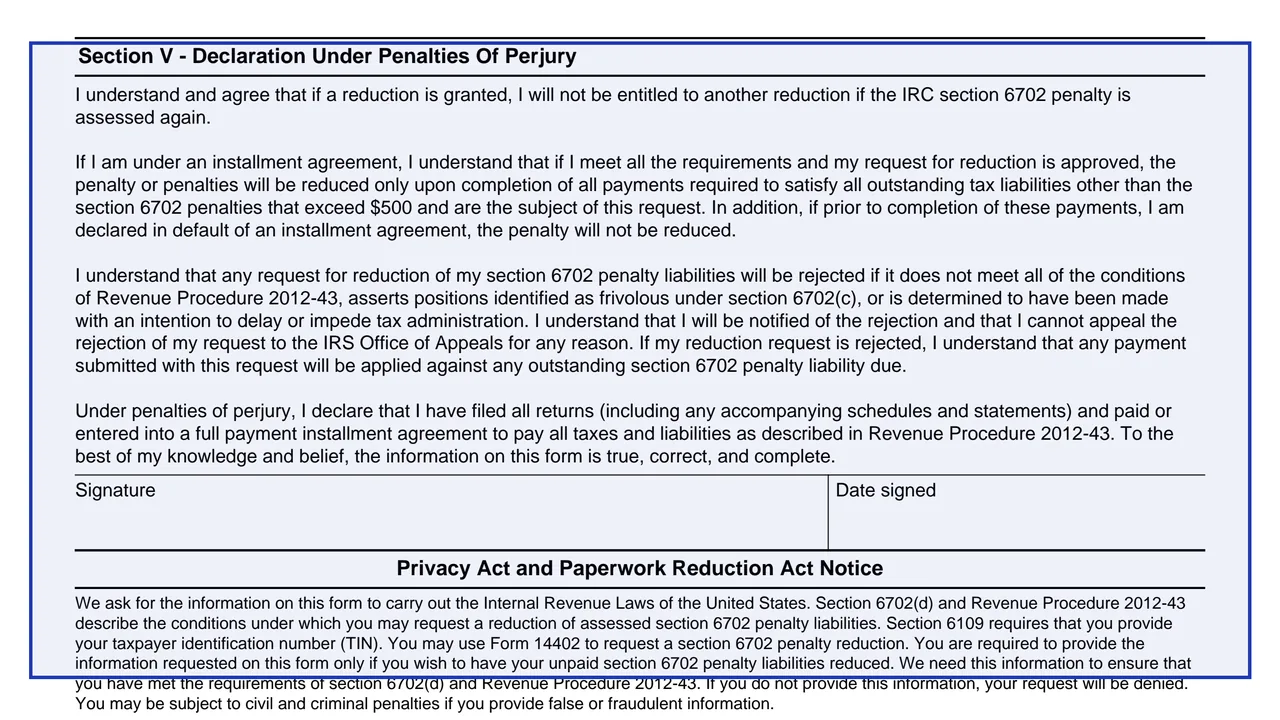
Statements about one reduction only, installment agreements and rejected requests, followed by the signature and date signed.
Purpose of the form, who can file, the mailing address, and notes for every eligibility question and for the payment section.
Enter the name, Social Security number or other taxpayer identification number, any other names used in the prior six years, a contact number and the best hours to call. The instructions say the IRS uses these to find the account and ask questions.
Mark YES or NO for every question, as the instructions say. For question 2, the instructions say to mark NO unless a Department of Justice complaint filed in United States District Court to collect the tax was served.
If an offer in compromise (Form 656) was submitted, mark YES and circle 1, 2 or 3 if the offer was withdrawn in writing, returned without acceptance, or rejected with no administrative appeal pending.
Mark whether a payment of at least $250 and up to $500 was made or enclosed and fill in its details, then mark whether an approved installment agreement is in place. The form says a NO to both means no reduction.
List the tax form numbers and tax years of the section 6702 penalties the request covers.
Read the declaration, then sign and enter the date signed.
You get the real form, filled in a browser tab, with nothing standing between you and the finished PDF.
The instructions give this address: Internal Revenue Service, Frivolous Return Program, 1973 N Rulon White Blvd. M/S 4450, Ogden, UT 84404.
The form says the minimum payment is $250.00 unless the requestor is in compliance with a full payment installment agreement. The instructions say a payment is applied to the unpaid section 6702 penalties whether or not the request is granted.
The instructions say that if the entire $500 balance is paid with the request and it is granted, interest accrued on the section 6702 penalties will be abated. A smaller payment leaves the rest of the reduced penalty, plus interest, still due.
Under a full payment installment agreement, the instructions say the $500 can be paid through the agreement, and the reduction happens only when all other outstanding tax liabilities are paid.
The declaration says a rejection cannot be appealed to the IRS Office of Appeals, and any payment sent is applied to outstanding section 6702 penalties.
The instructions say the IRS treats a written statement with the same information as a Form 14402 submission if it is filed under Revenue Procedure 2012-43 and these instructions.
The person who was assessed the section 6702 penalty completes and signs the form. The IRS Frivolous Return Program receives it.
No tool matches that search.
A reduction of unpaid frivolous tax submissions penalties under section 6702(a) or (b). The form says the penalty, or the combined penalties, is reduced to $500 if all requirements of Revenue Procedure 2012-43 are met.
No. The instructions say not to use it to challenge the merits of a section 6702 penalty. They mention paying the penalty and filing a refund claim, or raising the issue in a Collection Due Process hearing.
The form says the minimum payment is $250.00 unless the requestor is in compliance with a full payment installment agreement. The instructions describe a payment of at least $250 but not more than $500.
No. The form says that when spouses jointly filed a frivolous return or submission, each was assessed a section 6702 penalty and each sends a separate request.
The instructions list Internal Revenue Service, Frivolous Return Program, 1973 N Rulon White Blvd. M/S 4450, Ogden, UT 84404.
The declaration says a rejected request cannot be appealed to the IRS Office of Appeals for any reason.
The declaration says a person granted a reduction is not entitled to another one if the section 6702 penalty is assessed again, and question 1 asks about prior reductions.