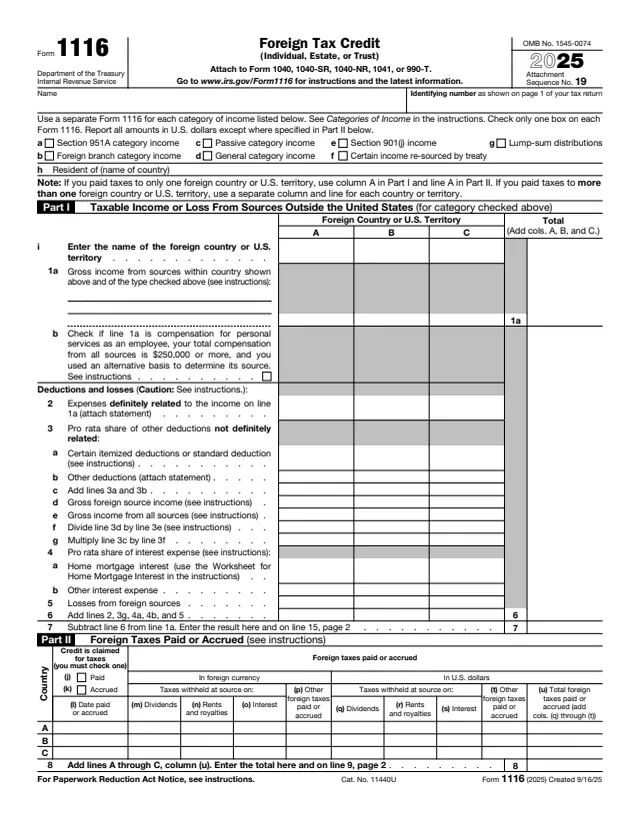
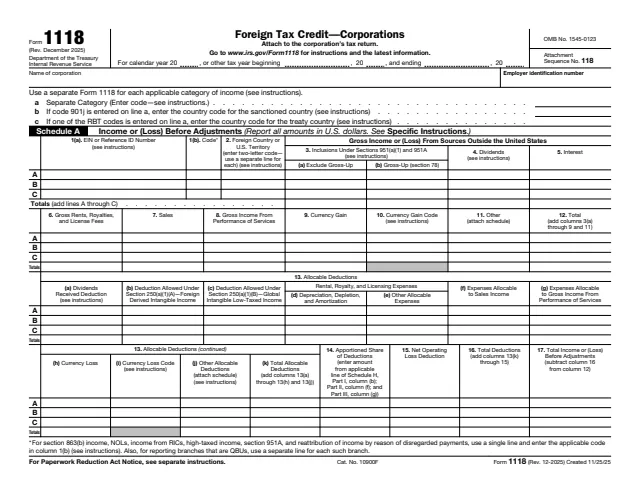
Tax year
The calendar year, or the fiscal year with the month and year it begins and ends.
1117
Income Tax Surety Bond
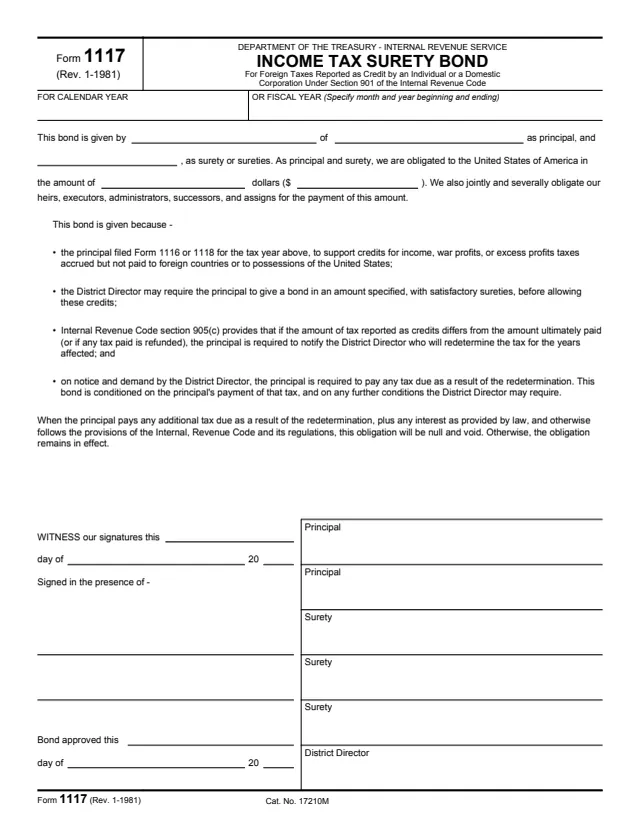
Form 1117, Income Tax Surety Bond, is a bond "For Foreign Taxes Reported as Credit by an Individual or a Domestic Corporation Under Section 901 of the Internal Revenue Code." The taxpayer, called the principal, and one or more sureties obligate themselves to the United States for the dollar amount stated on the bond.
The form says the bond is given because the principal filed Form 1116 or 1118 to support credits for foreign taxes accrued but not paid, and the District Director may require a bond with satisfactory sureties before allowing those credits. Under section 905(c), if the tax reported as credit differs from the amount ultimately paid, or tax paid is refunded, the principal notifies the District Director, who redetermines the tax. The bond is conditioned on payment of any tax due from that redetermination.
This is the January 1981 revision, and the PDF carries no separate instructions. You can fill out Form 1117 free in your browser on this page and download it without an account.
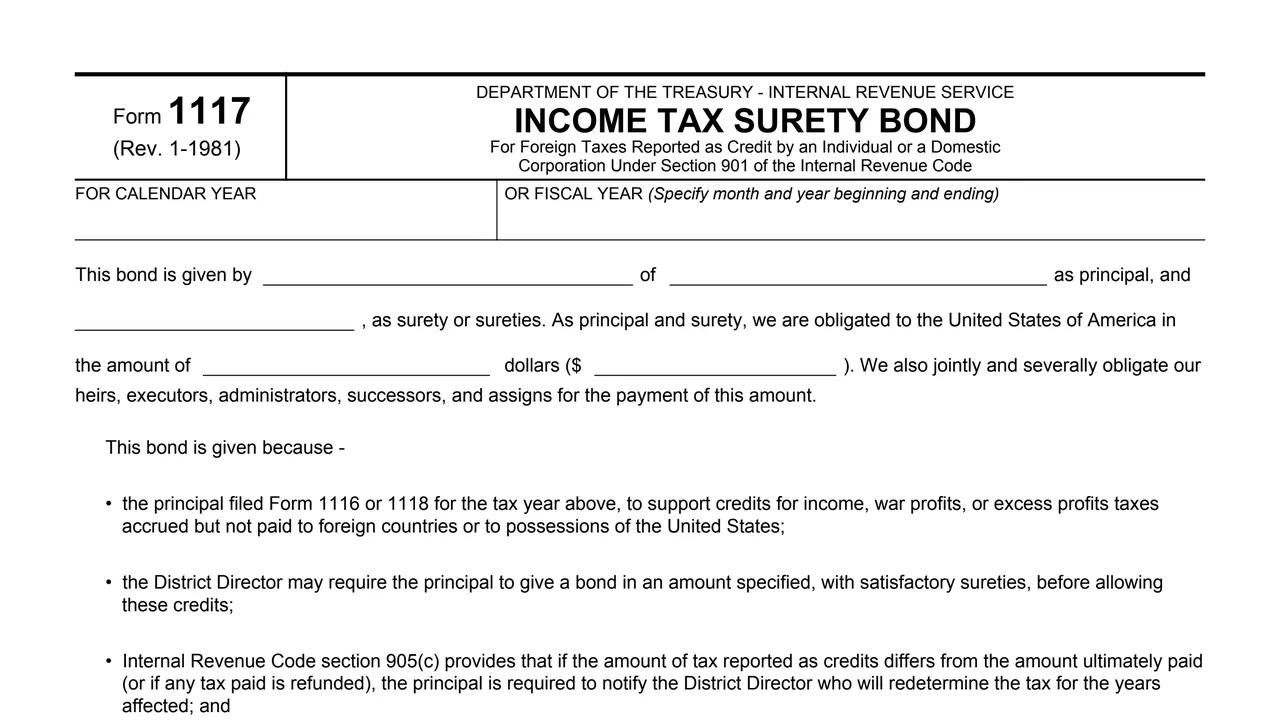
The calendar year, or the fiscal year with the month and year it begins and ends.
The name and address of the principal, the surety or sureties, and the bond amount written in words and in dollars.
Four statements: the Form 1116 or 1118 filing, the District Director's authority to require a bond, the section 905(c) redetermination, and payment on notice and demand.
The obligation becomes null and void when the principal pays any additional tax due from the redetermination, plus any interest as provided by law, and otherwise follows the Code.
The witness date, two principal signature lines, three surety lines, the signed in the presence of line, and the District Director's approval.
Enter the calendar year, or the month and year the fiscal year begins and ends.
Enter the principal's name and address, and the name of each surety.
Enter the amount in words and in figures. The form says the District Director may require a bond in an amount specified.
Enter the day, month and year, then the principal and each surety sign in the presence of a witness.
The bond approved lines are labeled for the District Director, with the day and year of approval.
You get the real form, filled in a browser tab, with nothing standing between you and the finished PDF.
The PDF prints no filing address and no instructions. The form names the District Director as the official who may require the bond and approves it.
The form prints no due date. It describes a bond that may be required before the foreign tax credits are allowed.
The form says the obligation becomes null and void when the principal pays any additional tax due from the redetermination, plus any interest as provided by law.
The PDF posted at irs.gov is the January 1981 revision (Rev. 1-1981) and has no About page or separate instructions.
The bond is given by the taxpayer as principal together with one or more sureties, and it is approved on the IRS side.
No tool matches that search.
It is a surety bond for foreign taxes reported as a credit under section 901 by an individual or domestic corporation, when those taxes were accrued but not paid.
The principal and one or more sureties, in the presence of a witness. The form has a separate line for approval by the District Director.
The form says the District Director may require the principal to give a bond in an amount specified, with satisfactory sureties.
When the principal pays any additional tax due from the section 905(c) redetermination, plus interest as provided by law, and otherwise follows the Code, the form says the obligation is null and void.
The PDF carries no separate instructions. The bond's own text explains why it is given and when it ends.