Payer, policyholder and insured
The payer's name, address, telephone number and TIN, the policyholder's TIN, name and address, the insured's TIN, name and address, and the account number.
1099-LTC
Long-Term Care and Accelerated Death Benefits
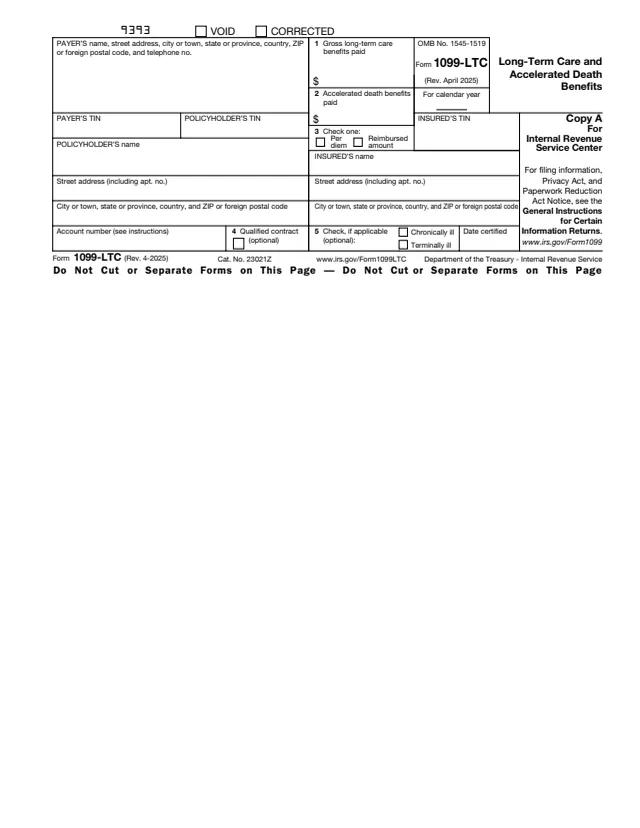
Form 1099-LTC, Long-Term Care and Accelerated Death Benefits, is an information return. The IRS About page says to file it for any long-term care benefits paid, including accelerated death benefits, and that payers include insurance companies, governmental units, and viatical settlement providers.
The instructions say long-term care benefits means payments under a product advertised, marketed, or offered as long-term care insurance, whether qualified or not, and accelerated death benefits paid under a life insurance contract or by a viatical settlement provider. Payments are reported only if the policyholder is an individual.
The payer files Copy A with the IRS, gives Copy B to the policyholder and gives Copy C to the insured. The instructions say that because of the very low volume of paper Forms 1099-LTC, the form is available in an online fillable format, and a filer qualified to file on paper may send the black-and-white Copy A printed from the IRS website with Form 1096. You can fill it out free in your browser on this page and download it without an account.
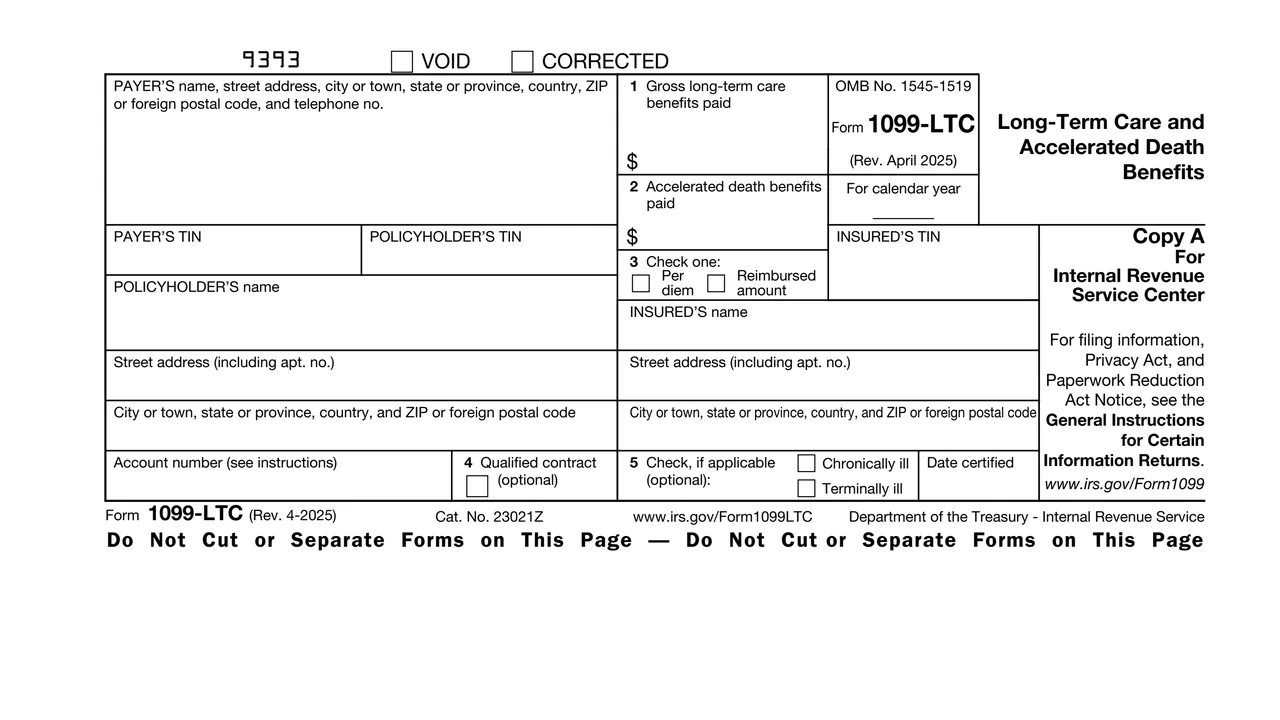
The payer's name, address, telephone number and TIN, the policyholder's TIN, name and address, the insured's TIN, name and address, and the account number.
Gross benefits paid under a long-term care insurance contract during the year.
Gross accelerated death benefits paid during the year.
Two checkboxes showing whether the box 1 or box 2 amount was paid on a per diem basis or as reimbursement of actual long-term care expenses.
Box 4 marks a qualified contract. Box 5 marks whether the insured was chronically ill or terminally ill and gives the date certified.
Enter the name, address and TIN of the policyholder and of the insured. The instructions say no reporting is required if the policyholder is not an individual.
Enter gross long-term care benefits paid this year other than accelerated death benefits, including amounts paid to the insured, the policyholder and third parties. The instructions say the payer is not required to determine whether benefits are taxable.
Enter gross accelerated death benefits paid this year to or for an insured certified as terminally or chronically ill, including amounts a viatical settlement provider paid for the sale or assignment of the death benefit.
Check per diem for payments on any periodic basis without regard to actual expenses, or reimbursed amount for payments of actual expenses incurred. For accelerated death benefits paid for a terminally ill person, the instructions say not to check a box.
Optional. Check it if the benefits are paid from a qualified long-term care insurance contract. The instructions say a contract issued after 1996 is qualified if it meets the requirements of section 7702B.
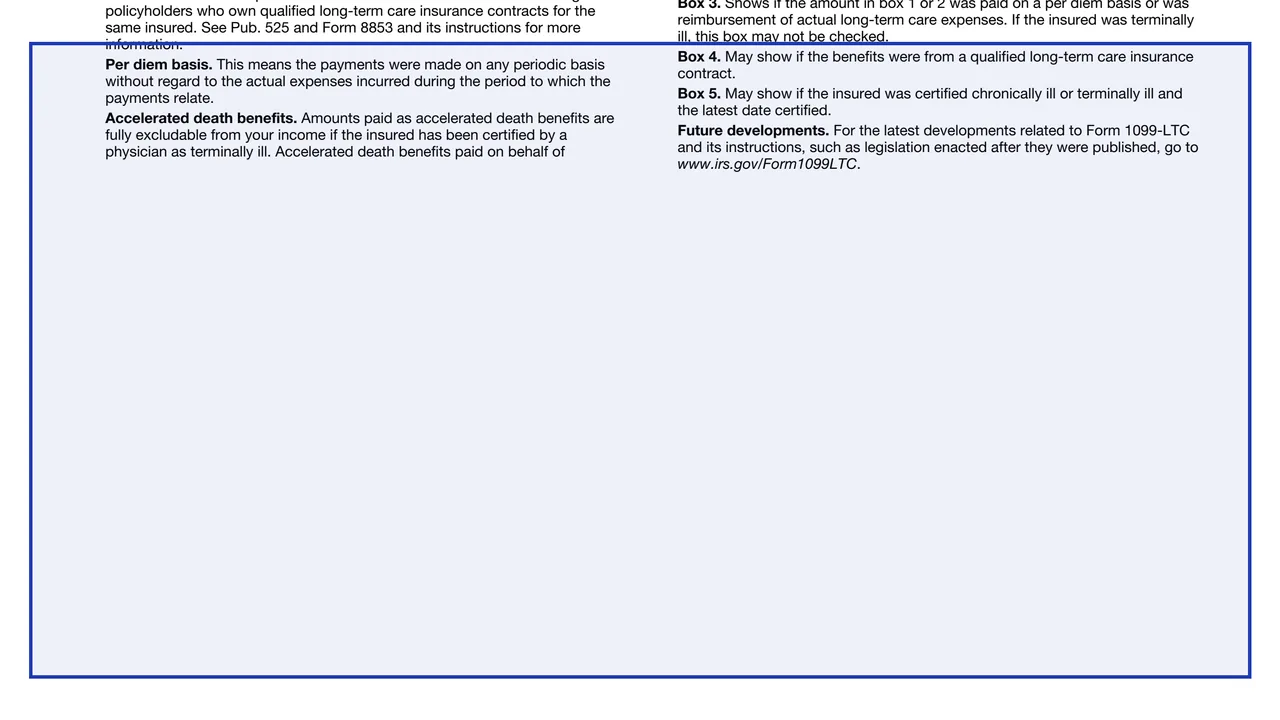
Optional. Check chronically ill or terminally ill and enter the latest date certified. Leave it blank if the insured was neither.
You get the real form, filled in a browser tab, with nothing standing between you and the finished PDF.
Copy A goes to the IRS, Copy B to the policyholder and Copy C to the insured. If the policyholder is also the insured, the instructions say to use Copy B, with Copy C optional.
For this form only, the instructions say a filer qualified to file on paper may send the black-and-white Copy A printed from the IRS website with Form 1096. Otherwise follow the procedures for filing electronically.
Benefits from each contract may go on a separate form. The instructions also allow benefits under multiple contracts on one form if the same information, other than the amount, applies to each contract.
Recipient TINs may be truncated on payee statements but not on documents filed with the IRS. The instructions say a payer's TIN may not be truncated on any form.
The instructions point to the current General Instructions for Certain Information Returns for filing dates, electronic reporting, corrections and penalties.
8853
38 fields, 2 pages
1096
55 fields, 3 pages
1099-SA
33 fields, 3 pages
1099-R
257 fields, 9 pages
1099-H
45 fields, 3 pages
The payer of the benefits files the form. The policyholder and the insured each receive a copy.
No tool matches that search.
The payer of long-term care benefits or accelerated death benefits, such as an insurance company, a governmental unit or a viatical settlement provider.
Copy C goes to the insured. The form says that if the insured is not the policyholder, Copy C is for information only because these payments are not taxable to the insured.
The form says it means the payments were made on any periodic basis without regard to the actual expenses incurred during the period.
The instructions describe someone certified at least annually by a licensed health care practitioner as unable to perform at least two daily living activities without substantial assistance for at least 90 days, or as requiring substantial supervision due to severe cognitive impairment.
The instructions describe someone certified by a physician as having an illness or physical condition that can reasonably be expected to result in death in 24 months or less after the date of certification.
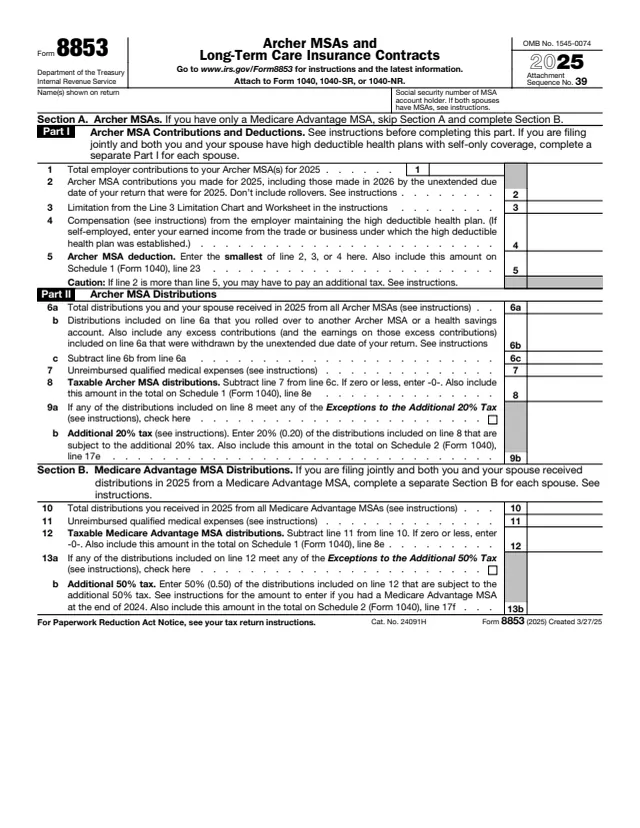
The policyholder instructions point to Pub. 525 and to Form 8853 and its instructions, including for the per diem exclusion limit.