Filer and recipient boxes
The filer's name, address, phone and TIN, the recipient's TIN, name and address, the account number, the CUSIP number and the applicable checkbox on Form 8949.
1099-DA
Digital Asset Proceeds from Broker Transactions
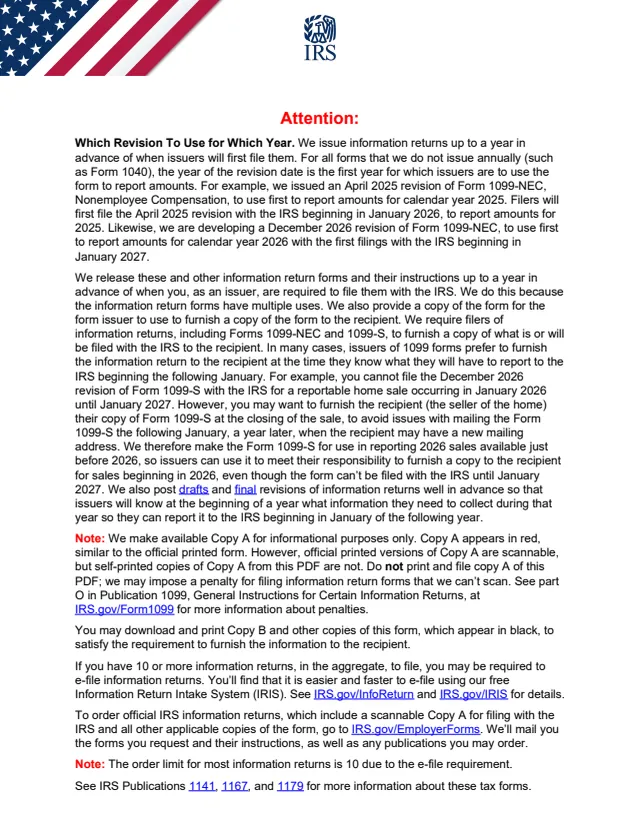
Form 1099-DA, Digital Asset Proceeds From Broker Transactions, is an information return. The IRS About page says it is used to report digital asset proceeds from broker transactions. The 2026 instructions say that for each sale of digital assets a broker has effected for customers after 2025, the broker completes Form 1099-DA, and basis information is reported for digital assets that are covered securities.
The broker files Copy A with the IRS and gives Copy B to the customer, called the recipient. Copy 1 is for a state tax department and Copy 2 is filed with the recipient's state income tax return when required. The recipient instructions on the form say that a person who received a Form 1099-DA generally sold, exchanged, or otherwise disposed of a financial interest in a digital asset.
This page hosts the 2026 form. The form says Copy A from this PDF is for information only because self-printed copies are not scannable. You can fill out Copies B, 1 and 2 free in your browser on this page and download them without an account.
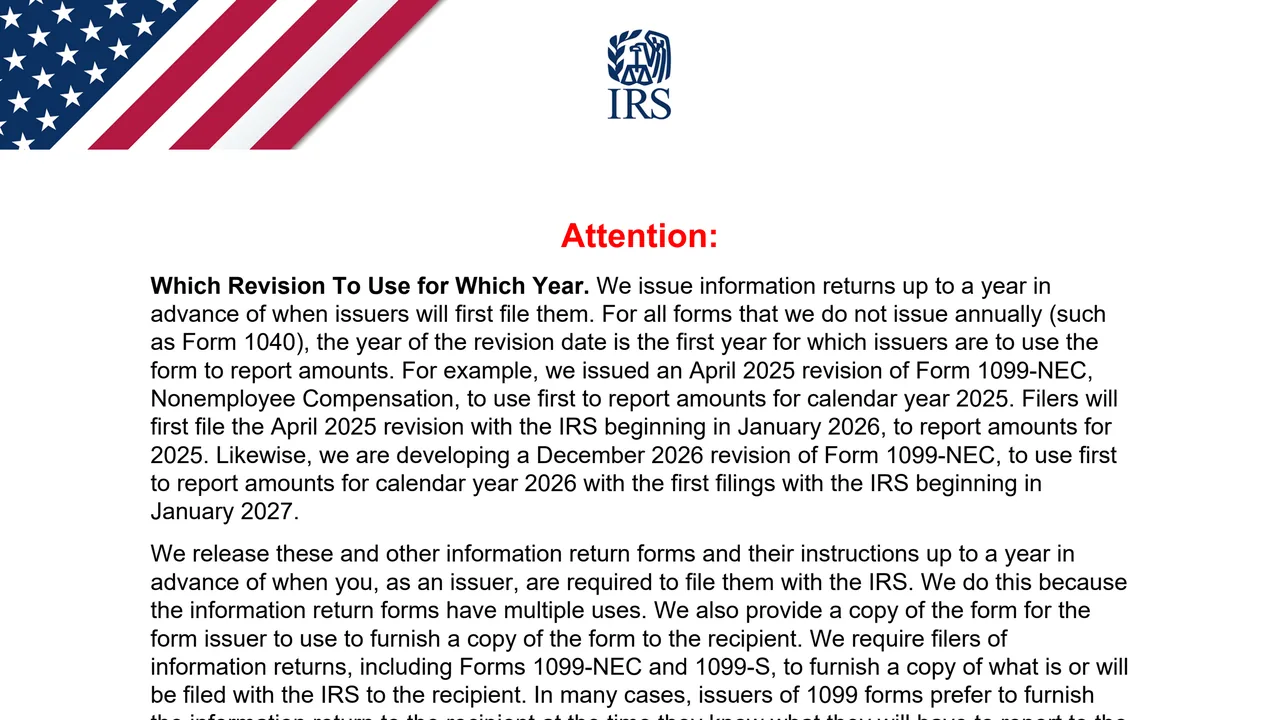
The filer's name, address, phone and TIN, the recipient's TIN, name and address, the account number, the CUSIP number and the applicable checkbox on Form 8949.
The code for the digital asset, the name of the digital asset and the number of units.
Date acquired, date sold or disposed, proceeds, cost or other basis, accrued market discount and wash sale loss disallowed.
Basis reported to IRS, gross or net proceeds, QOF, federal income tax withheld, loss not allowed, short-term, long-term or ordinary gain or loss, cash only, customer-provided acquisition information and noncovered security.
Aggregate reporting for qualifying stablecoins or specified NFTs, the number of transactions, first sales by a creator or minter, and units transferred in with the transfer-in date. Boxes 10 and 13 are reserved.
State name, state identification number and state tax withheld, with room for two states.
Enter one code: G or H for a short-term transaction and J or K for a long-term one, depending on whether basis is reported to the IRS, or Y when the holding period is unknown.
Enter the nine-character digital token identifier issued by the Digital Token Identifier Foundation (DTIF), or "999999999" if the asset is not registered, the asset's full name, and the number of units to 18 decimal places.
Enter dates in MM/DD/YYYY format. The instructions say box 1d is left blank if the assets were acquired on a variety of dates or an optional reporting method is used.
Enter gross proceeds reduced by digital asset transaction costs, such as transaction fees, commissions and transfer taxes. Check Net proceeds in box 3a if proceeds were reduced by option premiums, otherwise Gross proceeds.
Enter the adjusted basis. For a noncovered security the broker may check box 9 and leave boxes 1d, 1g, 1h, 1i and 6 blank. Box 2 is checked when basis is reported to the IRS.
Enter backup withholding. The instructions say to use Form W-9 to request the recipient's TIN, or the appropriate Form W-8 for foreign recipients.
You get the real form, filled in a browser tab, with nothing standing between you and the finished PDF.
Copy A goes to the IRS, Copy B to the recipient, Copy 1 to a state tax department when it requires a paper copy, and Copy 2 to the recipient for a state income tax return.
The form says not to print and file Copy A of this PDF because self-printed copies are not scannable. Official forms can be ordered at IRS.gov/EmployerForms.
The form says a filer with 10 or more information returns, in the aggregate, may be required to e-file, and points to the free Information Return Intake System (IRIS).
The instructions point to the current Pub. 1099, General Instructions for Certain Information Returns, for who must file, when and where to file, corrections, statements to recipients and penalties.
The instructions say to report each transaction on a separate Form 1099-DA, with exceptions such as a broker fee paid in the same digital asset and the optional methods for stablecoins and NFTs.
Filers may truncate the recipient's TIN on payee statements, but not on documents filed with the IRS. The instructions say a filer's TIN may not be truncated on any form.
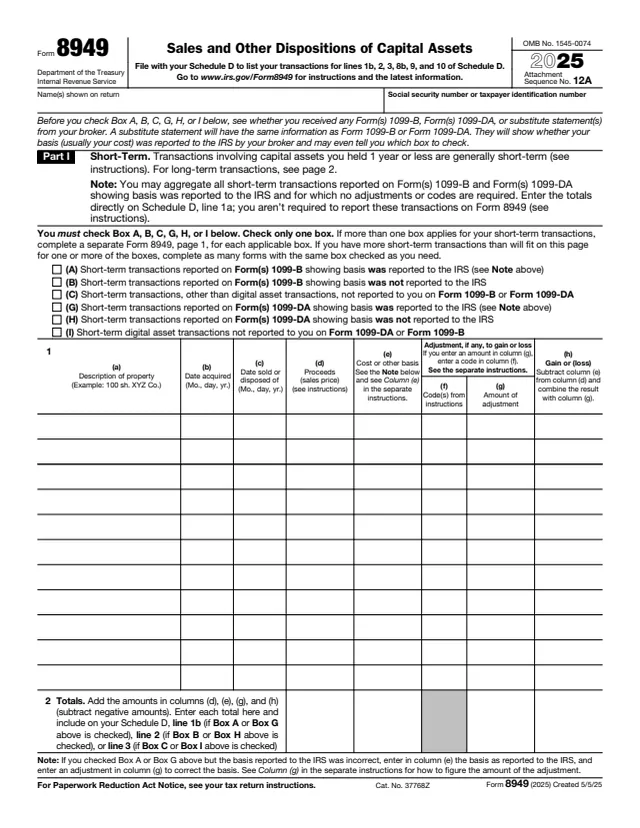
8949
202 fields, 2 pages
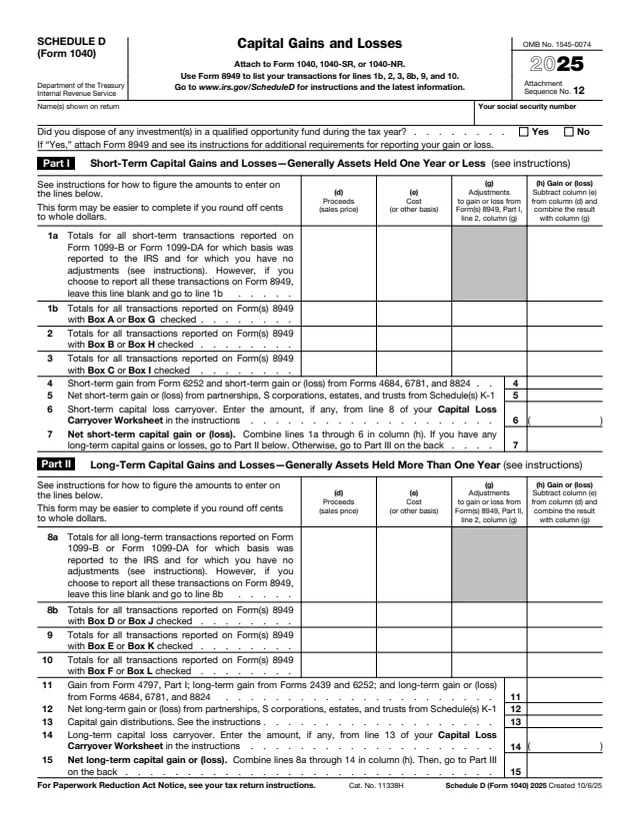
1040
55 fields, 2 pages
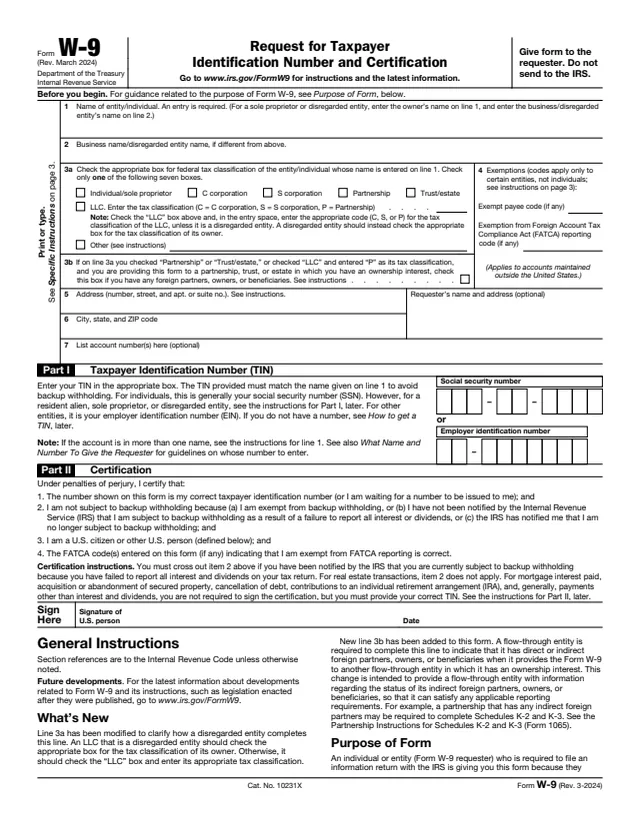
W-9
23 fields, 6 pages
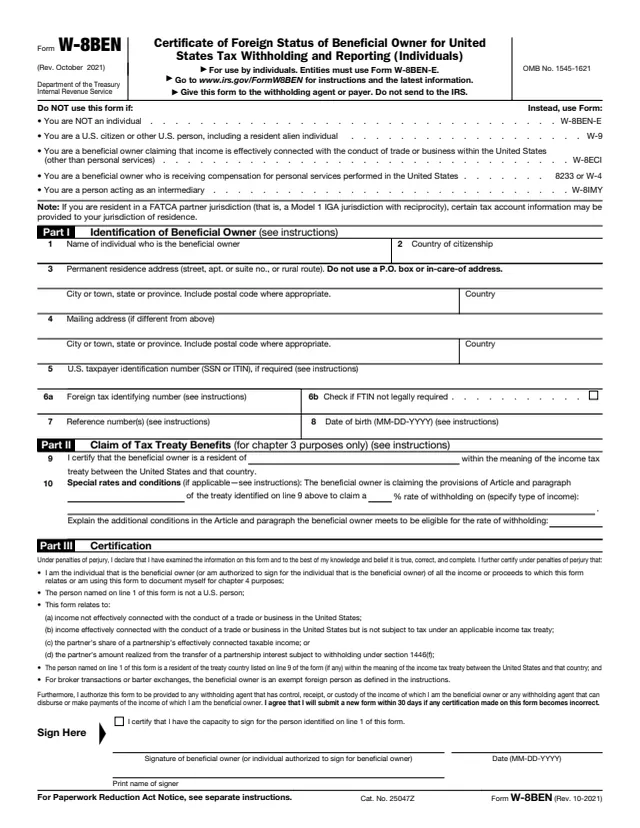
W-8
23 fields, 1 page
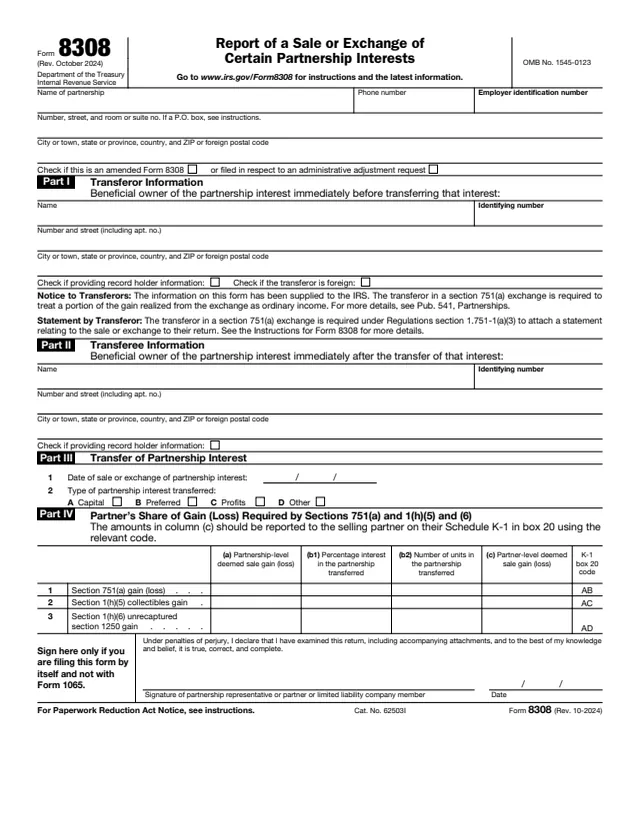
8308
40 fields, 1 page
1099-DIV
140 fields, 6 pages
Brokers complete and file the form and furnish copies to their customers. The customer receives Copy B, which the form marks "Keep for your records."
No tool matches that search.
A broker. The instructions say that generally only a U.S. digital asset broker is required to report on Form 1099-DA.
The recipient instructions say box 1g may be blank for a noncovered security when basis was unknown to the filer or the assets were acquired before 2026, and that a blank box 1g means basis comes from your own books and records.
No. The instructions say not to report rewards and staking payments on Form 1099-DA.
The form says boxes 1d, 1e, 1g, 1h, 1i, 2, 3a, 3b, 5, 6, 8, 9, 12a and 12b may be blank if the broker reports qualifying stablecoins or specified NFTs using an optional reporting method.
The instructions list de minimis rules: $600 for the year for PDAP sales by processors of digital asset payments, $10,000 for designated sales of qualifying stablecoins, and $600 for specified NFTs.
The instructions say a sale of a digital asset that is also a security for which Form 1099-B would be required should generally be reported on Form 1099-DA, with three exceptions.