Part I: Reporting Authority
The lender's name, employer identification number, address and room or suite.
8329
Lender's Information Return for Mortgage Credit Certificates (MCCs)
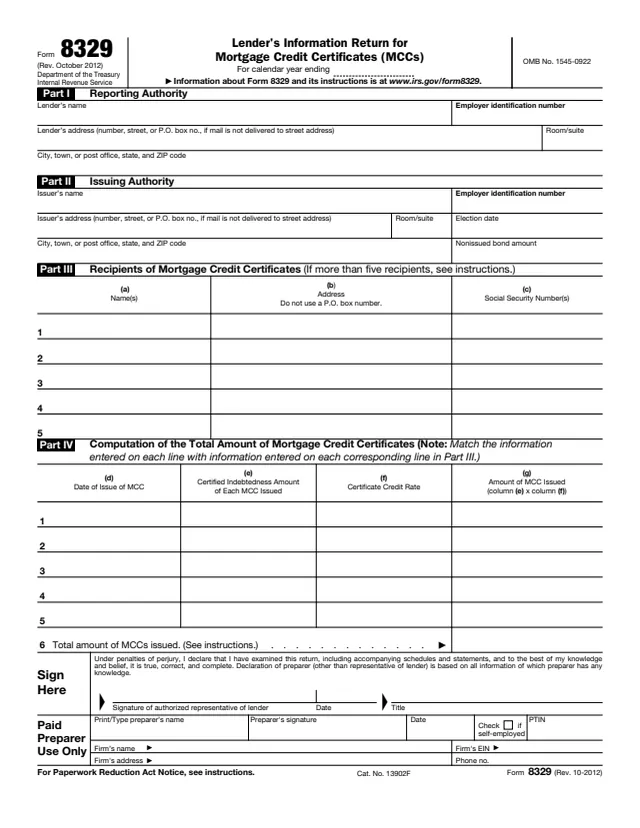
Form 8329 is the information return a mortgage lender files to report mortgage credit certificates (MCCs) to the IRS. The IRS says lenders of certified indebtedness amounts file it to provide information regarding the issuance of MCCs under Internal Revenue Code section 25. The instructions describe an MCC as a certificate issued under a qualified mortgage credit certificate program by a state or political subdivision that has authority to issue qualified mortgage bonds, to help finance a taxpayer's principal residence.
The return covers a calendar year. The instructions say a separate Form 8329 is filed for each issue of MCCs for which the lender made mortgage loans during the year. It names the lender, the issuing authority, each MCC holder and the amount of each MCC issued.
This is a lender's return, not a form the homebuyer files. The current version is Rev. October 2012, and its instructions are printed on page 2 of the PDF. You can fill out Form 8329 free in your browser on this page and download it without an account.
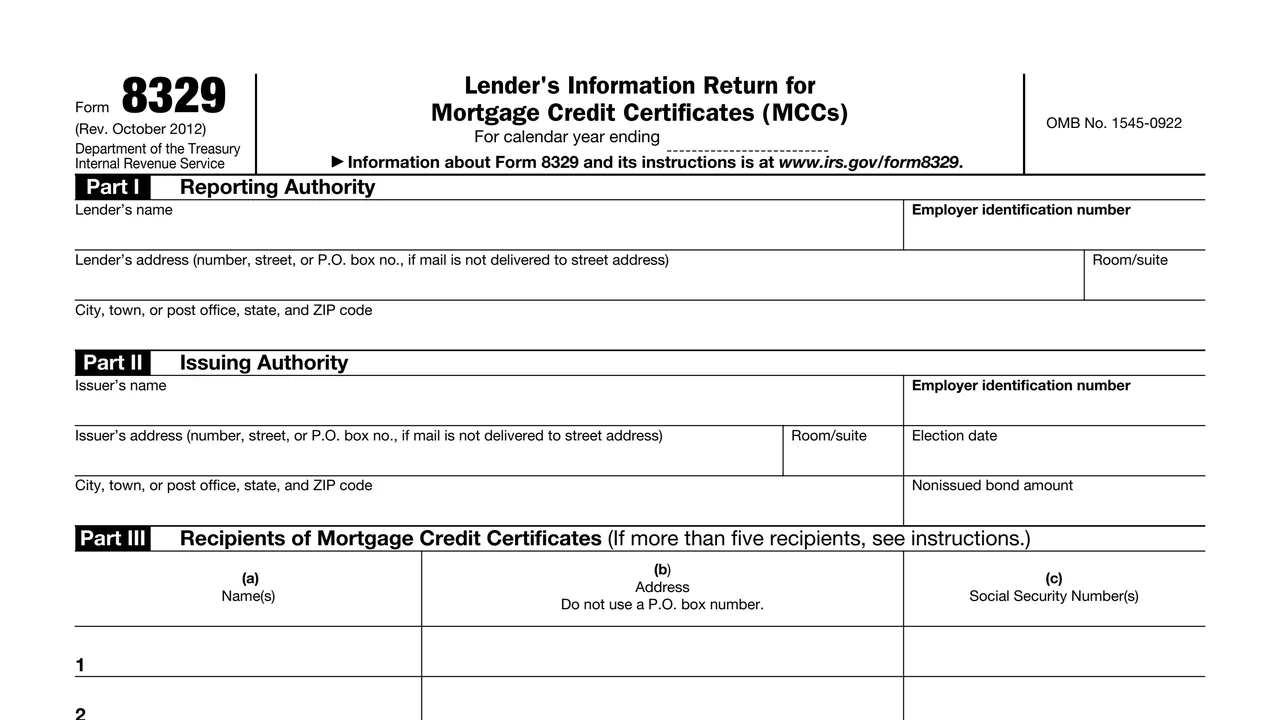
The lender's name, employer identification number, address and room or suite.
The issuer's name, employer identification number and address, plus the election date and the nonissued bond amount.
Five lines with column (a) name(s), column (b) the property address, where a P.O. box is not allowed, and column (c) Social Security number(s).
Five matching lines with column (d) date of issue of the MCC, (e) certified indebtedness amount, (f) certificate credit rate and (g) amount of MCC issued, which is column (e) times column (f).
The total of column (g) for the lender's loans under the issuer's MCC program for the calendar year, including any attachments.
The signature of the lender's authorized representative with date and title, and the Paid Preparer Use Only area with PTIN and firm details.
Enter the calendar year at the top, then the lender's name, employer identification number and address. The address line allows a P.O. box only if mail is not delivered to the street address.
Enter the issuer's details. The election date is the date the issuing authority elected to issue MCCs in lieu of qualified mortgage bonds. The nonissued bond amount is the bond authority it converted into authority to issue MCCs.
On each line, enter the MCC holder's name, listing all holders on one line if the MCC names more than one, then the property's street address and the holders' Social Security numbers. The instructions say not to use a P.O. box.
Enter the date the issuer issued the certificate, not the loan date. For a reissued MCC, the instructions show the format "Reissued, July 25, 2008." Enter the certified indebtedness amount and credit rate, then multiply them for column (g).
Total column (g) on line 6. With more than five MCCs, attach a statement formatted like Form 8329, or use extra Forms 8329 as statements and draw an X across Parts III and IV of the transmittal form.
The lender's authorized representative signs and enters the date and title. A paid preparer signs, enters a PTIN and gives a copy of the return to the lender.
You get the real form, filled in a browser tab, with nothing standing between you and the finished PDF.
The instructions say to file Form 8329 with the Department of the Treasury, Internal Revenue Service Center, Ogden, UT 84201.
The instructions say to file by January 31 following the close of the calendar year in which the lender made certified indebtedness loans. The IRS may grant an extension if there is reasonable cause for not filing on time.
The instructions say a person required to file may be subject to a $200 penalty for each form not filed by the due date. The maximum penalty is $2,000.
The certificate credit rate is the rate the issuer specifies on the MCC. The instructions say it cannot be less than 10% nor more than 50%.
The instructions say the aggregate amount of certificates under a single MCC program may not exceed 25% of the nonissued bond amount, citing section 25(d)(2).
Entering the loan date or a preliminary approval date in column (d), using a P.O. box in Part III, and leaving the totals from attached statements out of line 6.
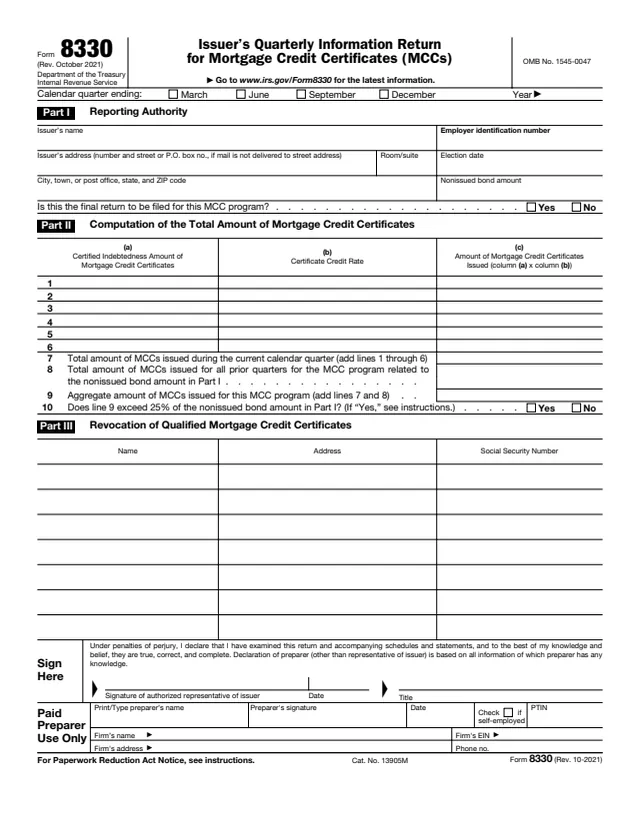
8330
66 fields, 2 pages
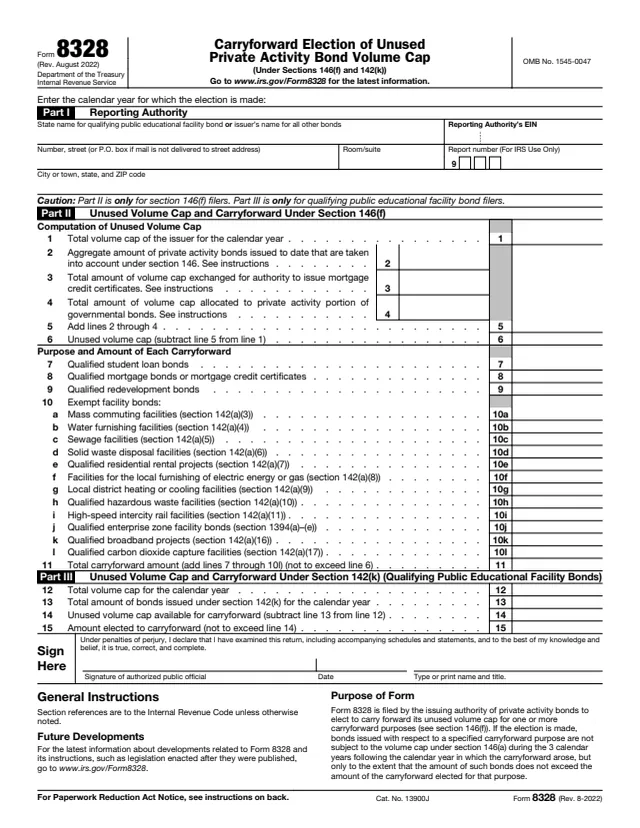
8328
34 fields, 2 pages
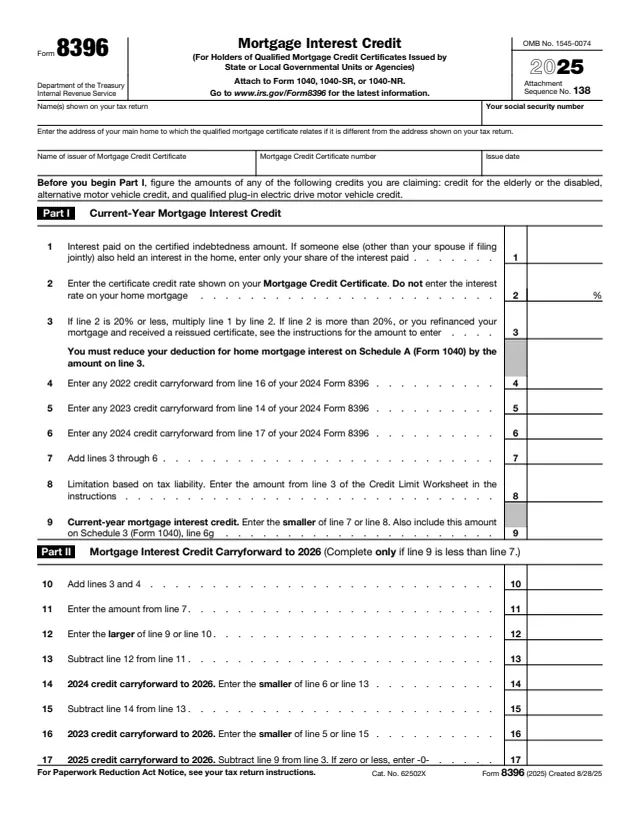
8396
26 fields, 2 pages
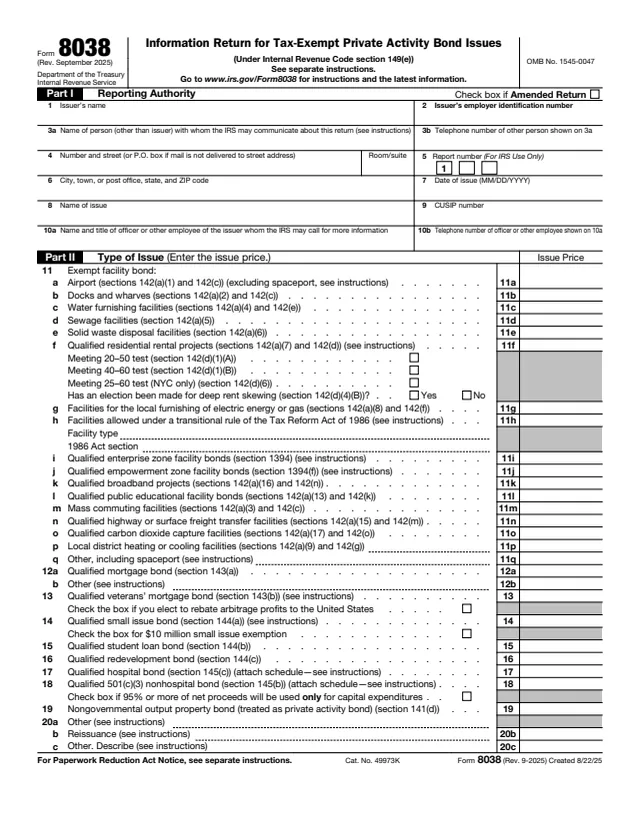
8038
137 fields, 3 pages
The instructions say any person who makes a loan that is a certified indebtedness amount on any MCC must file Form 8329. The completed return goes to the IRS.
No tool matches that search.
The instructions say any person who makes a loan that is a certified indebtedness amount on any mortgage credit certificate files it. It is a lender's return, not a form the MCC holder files.
The instructions say by January 31 following the close of the calendar year in which the lender made certified indebtedness loans.
With the Department of the Treasury, Internal Revenue Service Center, Ogden, UT 84201, according to the instructions.
The instructions say to report the extra certificates on an attached statement formatted like Form 8329, or to use additional Forms 8329 as statements behind one signed transmittal form.
Column (g) is the certified indebtedness amount in column (e) multiplied by the certificate credit rate in column (f).
The instructions say $200 for each form not filed by the due date, with a maximum penalty of $2,000.