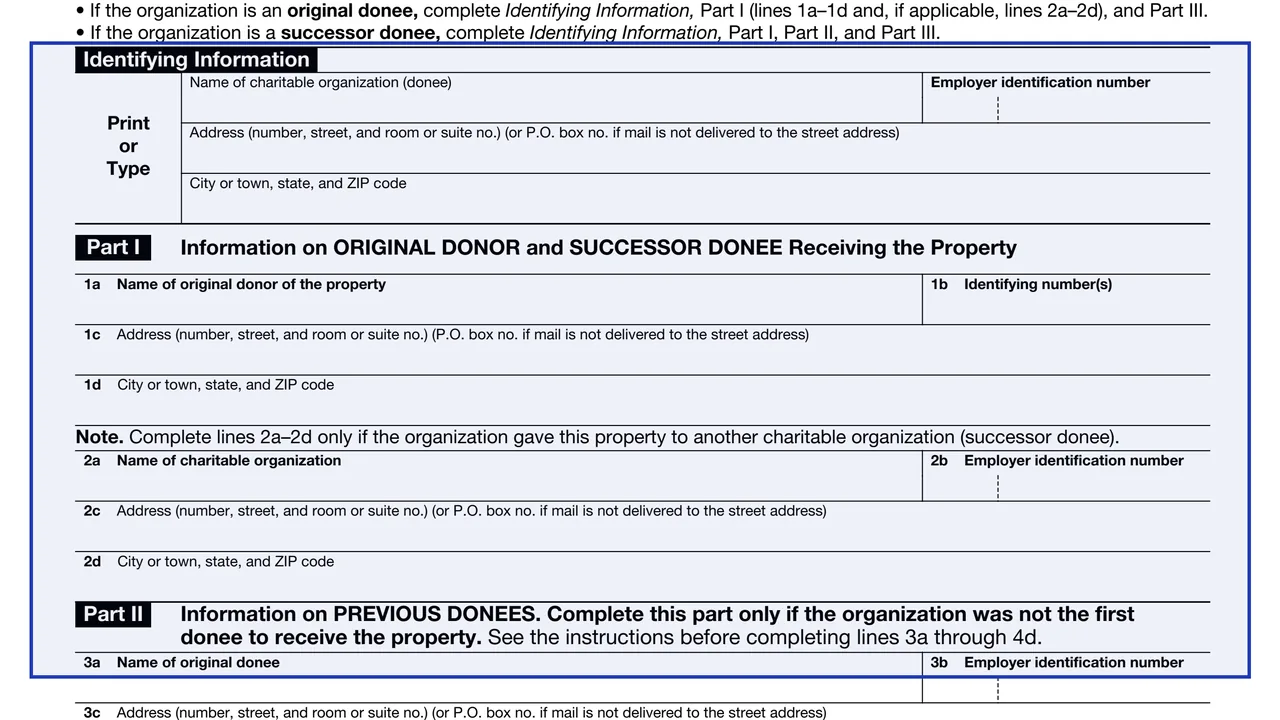
Identifying Information
The name, employer identification number and address of the charitable organization (donee) filing the form.
8282
Donee Information Return
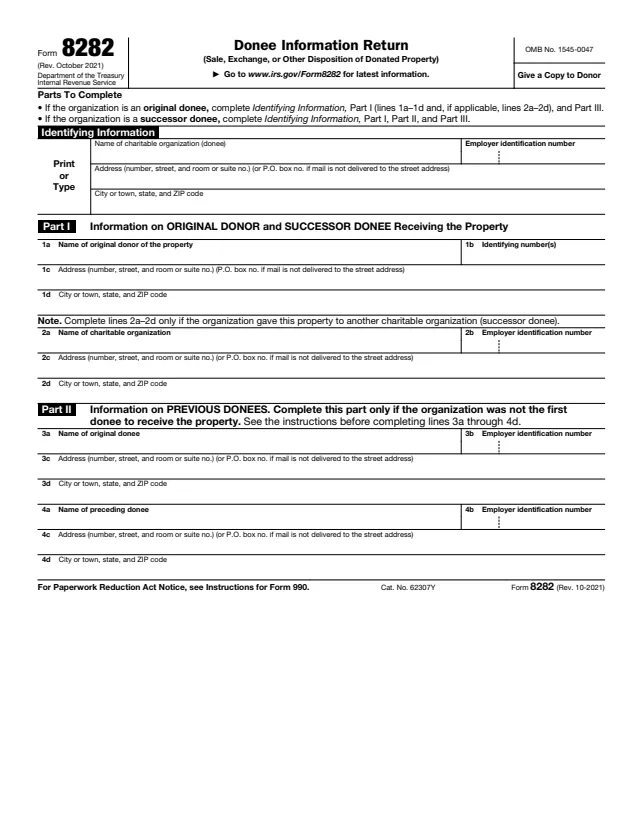
Form 8282 is an information return for charitable organizations, not for donors. The instructions say donee organizations use it to report information to the IRS and donors about dispositions of certain charitable deduction property made within 3 years after the donor contributed the property.
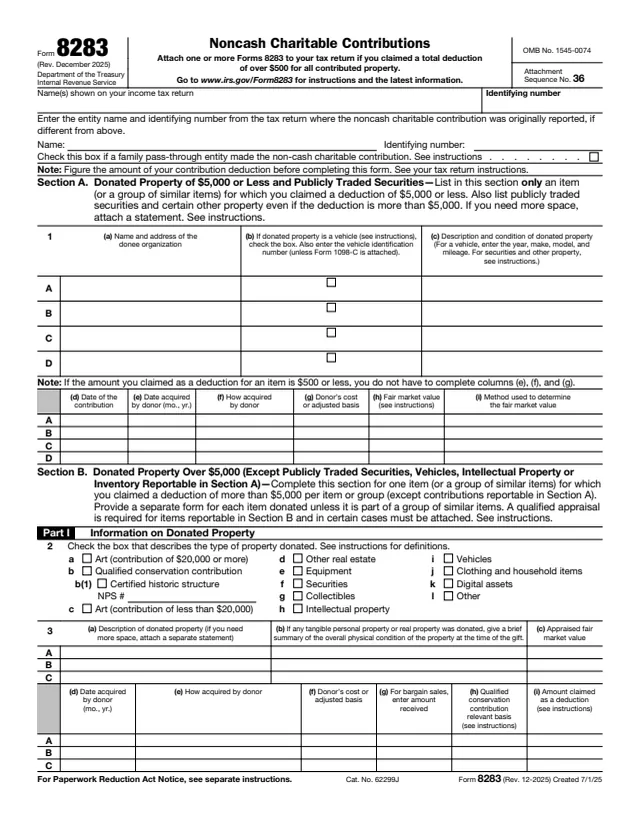
Charitable deduction property is the property listed in Section B of Form 8283. The instructions define it as donated property, other than money and publicly traded securities, with a claimed value over $5,000 per item or group of similar items. The organization files Form 8282 with the IRS and, as the top of the form says, gives a copy to the donor.
The form has four parts: the original donor and any successor donee, previous donees, the donated property and its disposition, and a certification about how the property was used. You can fill out the PDF free in your browser on this page and download the result without an account.
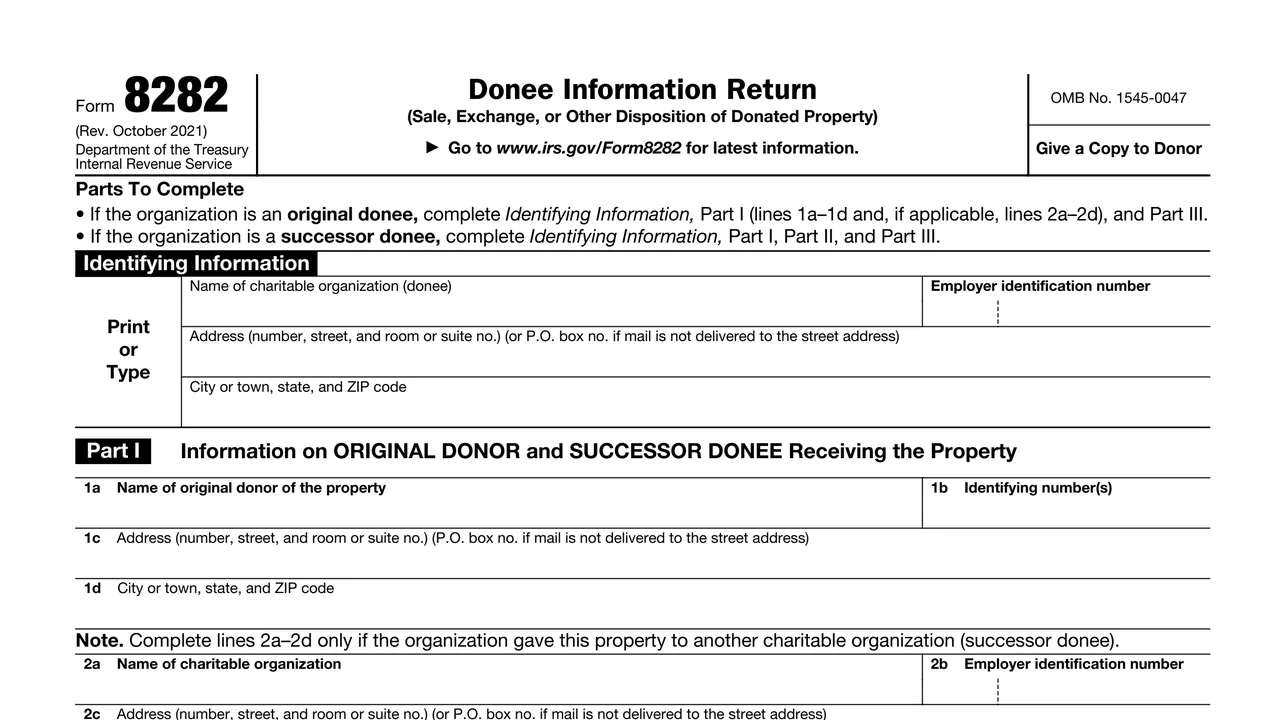
The name, employer identification number and address of the charitable organization (donee) filing the form.
Lines 1a to 1d hold the original donor's name, identifying number and address. Lines 2a to 2d hold the charity that received the property from this organization, if any.
Only for an organization that was not the first donee. Lines 3a to 3d name the original donee and lines 4a to 4d name the preceding donee.
Up to four items, A to D. Columns 1 to 4 describe each item, whether the whole interest was disposed of, and whether its use was related to the exempt purpose. Lines 5 to 8 give dates and the amount received.
A statement made under penalties of perjury and the penalty under section 6720B about the use of tangible personal property, signed by an officer.
The final declaration for the whole return, with the officer's signature, title, date and typed or printed name.
Enter the organization's name, EIN and address. The form says to use a P.O. box only if mail is not delivered to the street address.
Enter the original donor's name and last known address. The instructions say the identifying number on line 1b may be an EIN or a social security number and should match the number on page 2 of Form 8283.
Fill in lines 2a to 2d only if the organization gave the property to another charity. Part II is for successor donees: a second donee completes lines 3a to 3d, a third or later donee completes lines 3a through 4d.
Describe each item in detail and how the organization used it. The instructions ask for the vehicle, hull or aircraft identification number for a motor vehicle, boat or airplane. Column 3 is Yes if the use was related to the exempt purpose.
For each item, enter the date the organization received it, the date the original donee received it, the date of the sale or other disposition, and the amount received.
The instructions say to sign the certification when the property is tangible personal property and the answer to question 3 is Yes, or No with an intended use that became impossible or infeasible. The form is not valid unless an officer signs it.
You get the real form, filled in a browser tab, with nothing standing between you and the finished PDF.
The instructions say to send Form 8282 to the Department of Treasury, Internal Revenue Service Center, Ogden, UT 84201-0027.
The instructions say to file within 125 days after the date of disposition. If the organization later learns the substantiation requirements applied, it files within 60 days after the date it becomes aware it was liable.
A copy goes to the original donor. If the property went to a successor donee, the instructions say a copy of this Form 8282 goes to that donee within 15 days after the organization files it.
If the form is filed by the due date, the instructions say to enter the organization's name, address and EIN and complete at least Part III, columns 1, 2, 3 and 4, and Part IV.
The instructions say the failure to file penalty is generally $50 per form. A $10,000 penalty may apply for fraudulently identifying property as having a use related to the exempt purpose (section 6720B).
The instructions say the organization keeps a copy of Section B of Form 8283 in its records.
The instructions say original and successor donee organizations file Form 8282 if they sell, exchange, consume, or otherwise dispose of charitable deduction property within 3 years after the date the original donee received it. Donors do not file it; they receive a copy.
No tool matches that search.
The instructions say original and successor donee organizations file it when they sell, exchange, consume or otherwise dispose of charitable deduction property within 3 years after the original donee received it.
No. The organization files it with the IRS. The form says to give a copy to the donor, and the instructions say the copy goes to the original donor of the property.
The instructions say within 125 days after the date of disposition, or within 60 days after the organization becomes aware it was liable when it had no earlier reason to believe the rules applied.
The instructions define it as donated property, other than money and publicly traded securities, with a claimed value over $5,000 per item or group of similar items. It is the property listed in Section B of Form 8283.
Yes. The instructions list items the donor stated on Form 8283 were worth not more than $500, and items consumed or distributed without consideration in carrying out the organization's exempt purpose.
The instructions say the form is not valid unless it is signed by an officer of the organization, with the officer's title and the date signed.