Part I: Issuer Information
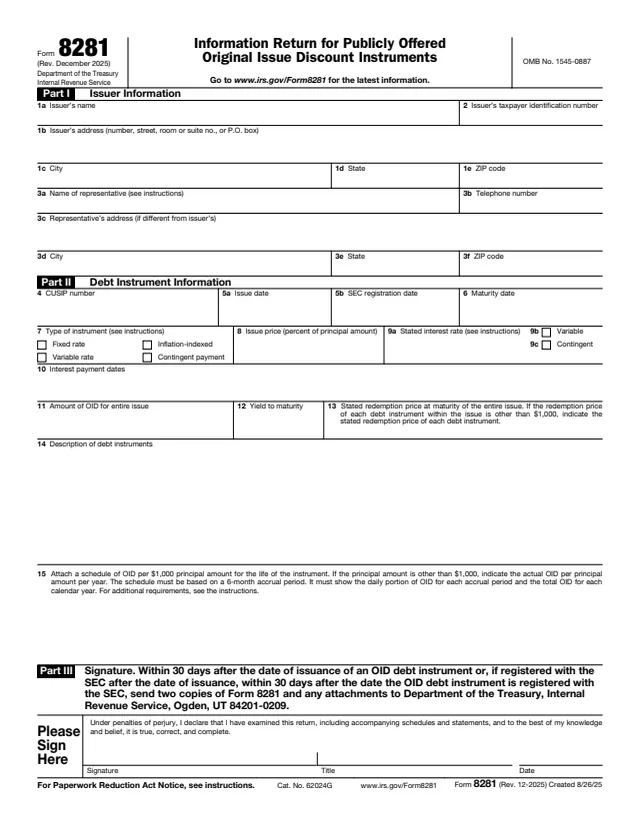
Boxes 1a to 1e for the issuer's name and address, box 2 for its taxpayer identification number, and boxes 3a to 3f for a representative's name, phone and address.
8281
Information Return for Publicly Offered Original Issue Discount Instruments
Form 8281, Information Return for Publicly Offered Original Issue Discount Instruments, is filed by issuers of publicly offered debt instruments having original issue discount (OID) to provide the information required by section 1275(c).
The instructions say this reporting was designed to help the IRS collect and publish the OID information brokers and middlemen need to provide information returns to holders of OID debt instruments. Since 1984 the IRS has compiled the information reported on Form 8281 and made it public in the OID tables, found at www.irs.gov/Pub1212. The form asks for issuer details, the terms of the debt instrument and an attached schedule of OID for the life of the instrument. The instructions are printed in the same PDF. This is the December 2025 revision.
You can fill out the PDF free in your browser on this page and download it without an account.
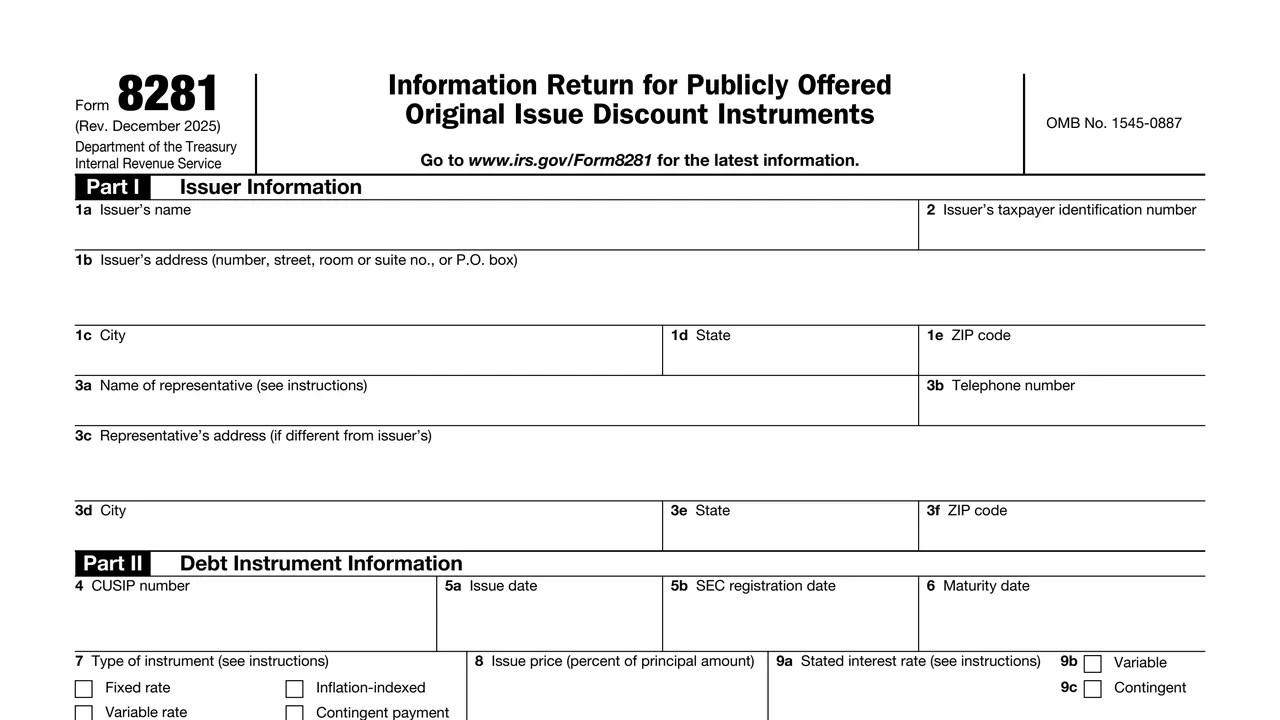
Boxes 1a to 1e for the issuer's name and address, box 2 for its taxpayer identification number, and boxes 3a to 3f for a representative's name, phone and address.
The CUSIP number, the issue date, the SEC registration date and the maturity date.
Type of instrument (fixed rate, variable rate, inflation-indexed or contingent payment), issue price as a percent of principal, stated interest rate and interest payment dates.
The amount of OID for the entire issue, the yield to maturity, the stated redemption price at maturity and a description of the debt instruments.
An attached schedule of OID per $1,000 principal amount for the life of the instrument, based on a 6-month accrual period.
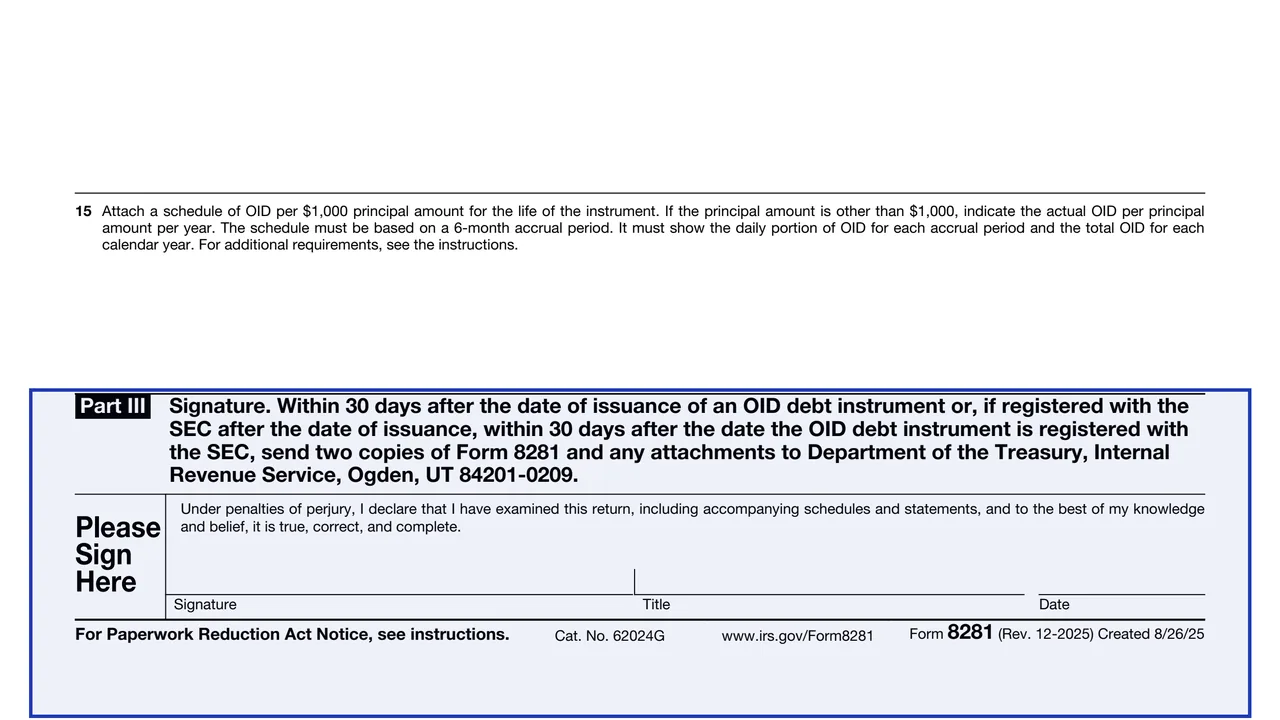
The filing deadline and mailing address, the declaration under penalties of perjury, and the signature, title and date.
For serial obligations, complete boxes 1 through 3 and attach a list with boxes 4 through 15 for each obligation in the series. For all other obligations, complete all boxes. To revise a filed form, write "Revised" across the top and staple a copy of the earlier form to it.
Enter the CUSIP number, the date the issue was first sold to the public at the issue price, the SEC registration date if the instruments weren't registered at issuance, and the maturity date.
Check the type of instrument. Enter the issue price as a percent of principal: the instructions' example is $900 on a $1,000 principal, entered as 90. A percent of 100 or more is explained in box 14.
Enter the annual stated rate, or "0" if zero, and check variable or contingent if it applies. Enter the interest payment dates, the OID for the entire issue and the yield to maturity rounded to two decimal points, based on semiannual compounding.
Enter the stated redemption price at maturity of the entire issue. Describe the instrument, including terms such as put or call options, and say whether it is part of an investment unit, an exchange offering or a serial issue. Two copies of the prospectus may be given instead.
Attach two copies of the OID schedule showing the daily portion of OID for each accrual period and the total OID for each calendar year, and explain how a variable or contingent rate is set. Then sign with your title and the date.
You get the real form, filled in a browser tab, with nothing standing between you and the finished PDF.
Within 30 days after the date of issuance, or, if registered with the SEC after issuance, within 30 days after the SEC registration date. A separate Form 8281 is filed for each issue.
Two copies of Form 8281 and any attachments go to the Department of the Treasury, Internal Revenue Service, Ogden, UT 84201-0209.
The instructions say an issuer who fails to file on time is subject to a penalty of 1% of the aggregate issue price unless the failure is due to reasonable cause and not willful neglect. The maximum penalty for any issue is $50,000.
For each year an instrument is outstanding, items such as the issuer's name, CUSIP number, issue and maturity dates, yield and OID per $1,000 of maturity value are published in the OID tables at www.irs.gov/Pub1212.
The instructions point to Pub. 1212, Guide to Original Issue Discount (OID) Instruments, for more on OID instruments and the reporting rules.
The instructions say the form is filed by the issuer of a publicly offered debt instrument having OID, such as a bond, debenture or note. The IRS then publishes the information for brokers, middlemen and the public.
No tool matches that search.
The issuer of a publicly offered debt instrument having original issue discount, such as a bond, debenture or note.
Within 30 days after the date of issuance, or within 30 days after SEC registration if the instrument was registered after it was issued.
Two copies and any attachments go to the Department of the Treasury, Internal Revenue Service, Ogden, UT 84201-0209.
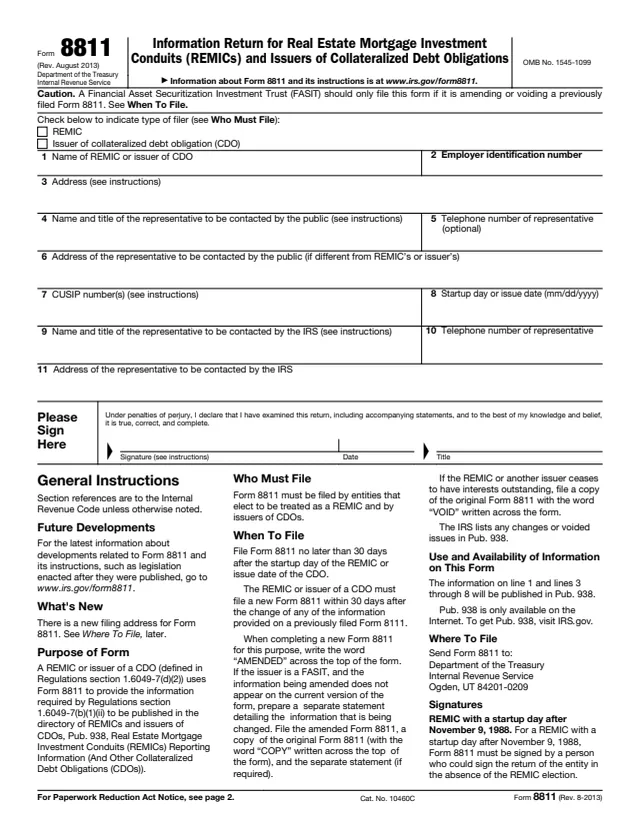
No. The instructions say REMICs and issuers of collateralized debt obligations file Form 8811 instead.
The instructions list 1% of the aggregate issue price, up to $50,000 for any issue, unless the failure is due to reasonable cause and not willful neglect.
Yes. The instructions say the IRS publishes items from Form 8281 in the OID tables at www.irs.gov/Pub1212.