Taxpayer information
Names and address, SSN, ITIN or EIN for the taxpayer and spouse, phone numbers, and the help box with two IRS phone numbers and a write-to address.
433-D
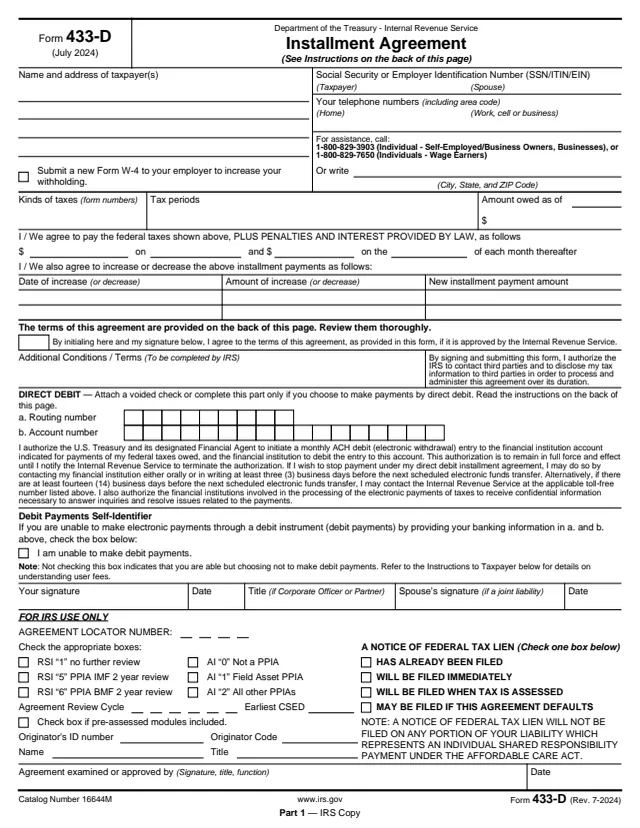
Installment Agreement (Spanish Version)
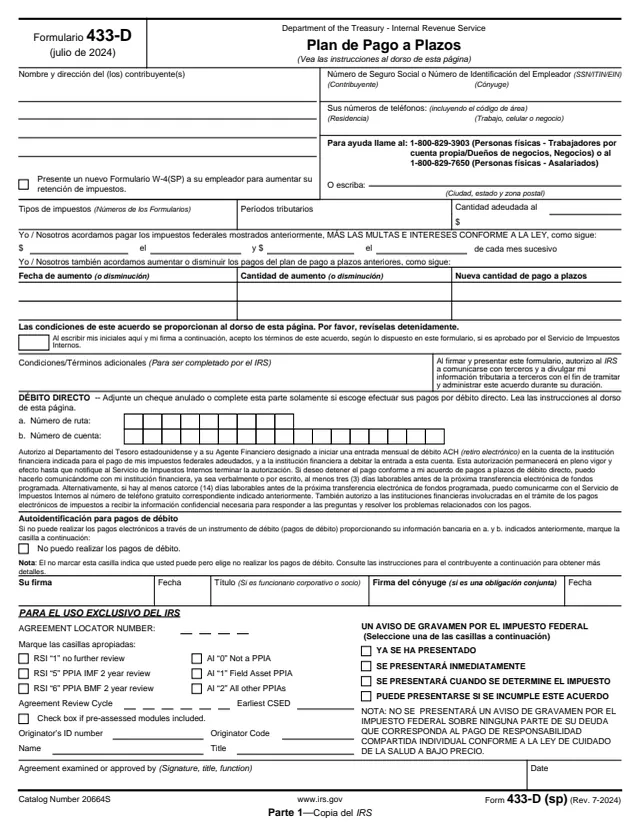
Form 433-D (sp) is the Spanish version of Form 433-D, Installment Agreement. The IRS prints it in Spanish, under the title "Plan de Pago a Plazos", for taxpayers who read Spanish. It is the agreement to pay the federal taxes shown on it, plus penalties and interest provided by law, in monthly payments: the kinds of taxes, tax periods, amount owed, the first payment, the monthly amount and day, and any planned increase or decrease.
The PDF holds Part 1, the IRS copy ("Copia del IRS"), and Part 2, the taxpayer's copy ("Copia del Contribuyente"), followed by the taxpayer instructions and the conditions of the agreement, all in Spanish. The For IRS Use Only area keeps some English codes and labels, such as the agreement locator number and the review codes. The help box also says to give your employer a new Form W-4(SP) to increase tax withholding.
This is the July 2024 revision (Rev. 7-2024), dated "julio de 2024" in its header. The English edition is Form 433-D. The PDF can be filled out free in the browser on this page and downloaded without an account.
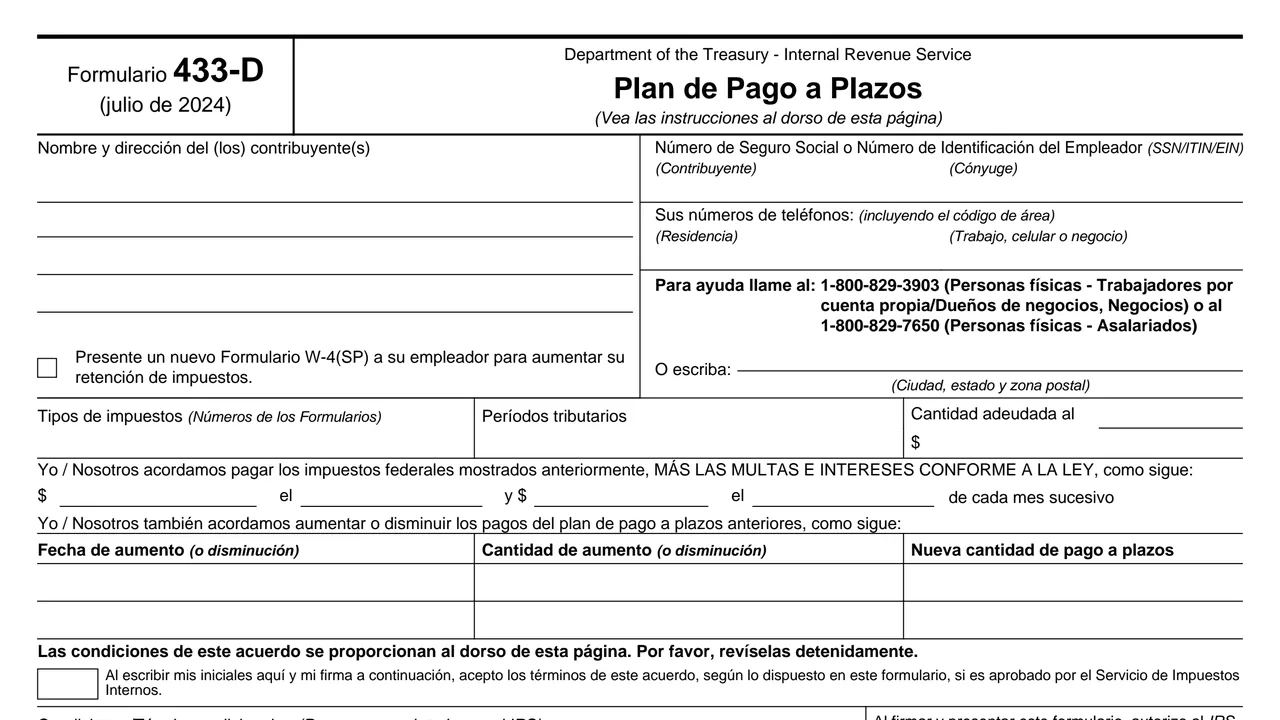
Names and address, SSN, ITIN or EIN for the taxpayer and spouse, phone numbers, and the help box with two IRS phone numbers and a write-to address.
Kinds of taxes (form numbers), tax periods, amount owed as of a date, the first payment and its date, the monthly payment and its day, and any increase or decrease.
A box to initial accepting the terms, and an authorization for the IRS to contact third parties and disclose tax information to them to process and administer the agreement.
Routing number (a) and account number (b), the ACH debit authorization, and the self-identifier box "No puedo realizar los pagos de débito" (I am unable to make debit payments).
Taxpayer signature and date, title if a corporate officer or partner, and the spouse's signature and date if the liability is joint.
Agreement locator number, review codes, earliest CSED, the Notice of Federal Tax Lien boxes and the approval signature.
If an IRS employee has not filled them in, enter your name (and your spouse's for a joint return), current address, the SSN or EIN that applies to the tax liability, and phone numbers.
Enter the partial payment you can make now, the monthly amount (or the amount set by IRS staff), and the payment day, which the instructions say is the same day each month, from the 1st to the 28th.
Attach a voided check or fill in lines a and b. The instructions say the routing number starts with 01 to 12 or 21 to 32, and the account number can have up to 17 characters.
Check the box only when debit payments are not possible. The form says leaving it unchecked means the taxpayer can make debit payments but chooses not to.
Initial the terms box, sign and date, and return Part 1 to the IRS. Part 2 is the taxpayer's copy with the conditions and the payment checklist.
You get the real form, filled in a browser tab, with nothing standing between you and the finished PDF.
The instructions say to return Part 1 to the IRS at the address on the letter that came with it or the address shown in the help box on the front.
The form lists a $178 user fee for a non-direct debit agreement and $107 for a direct debit agreement. For low-income taxpayers (at or below 250% of federal poverty guidelines) it lists a reduced fee of $43, with waiver and refund rules. It says lower user fees may be available online at www.IRS.gov/cuenta.
The form lists an $89 reinstatement fee if a defaulted plan is reinstated, reduced to $43 for low-income taxpayers, and the reduced fee is waived with debit payments.
The checklist says to make the check or money order payable to "United States Treasury" and write the SSN or EIN, the type of tax, the tax period and "Installment Agreement" on each payment.
The conditions say all federal tax returns are filed and taxes paid on time, refunds are applied to the amount owed, and the IRS can cancel the plan for missed payments, unpaid new tax debt or financial information not provided.
The form says the plan may require a supervisor's approval, and the IRS may file a Notice of Federal Tax Lien if one has not been filed, but not for the Affordable Care Act individual shared responsibility payment.
433-D
168 fields, 4 pages
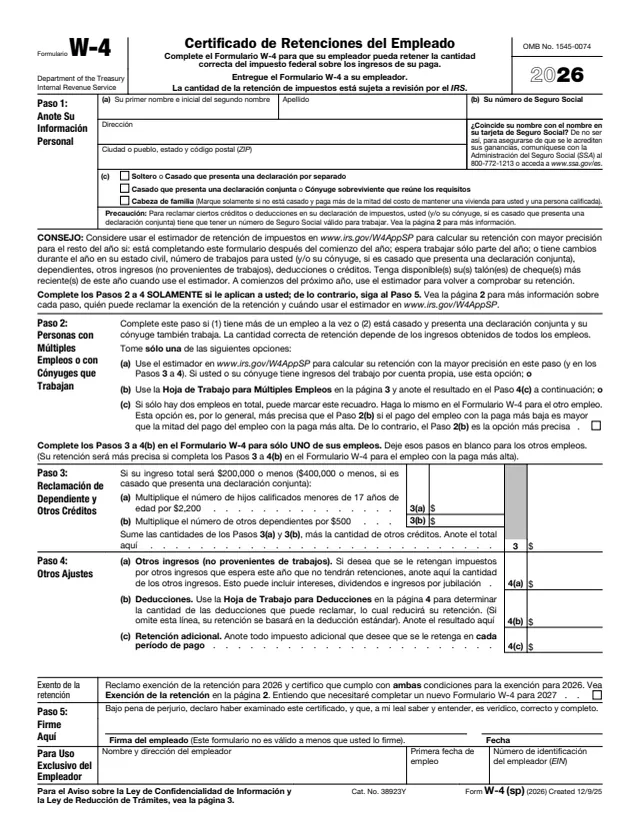
W-4
48 fields, 5 pages
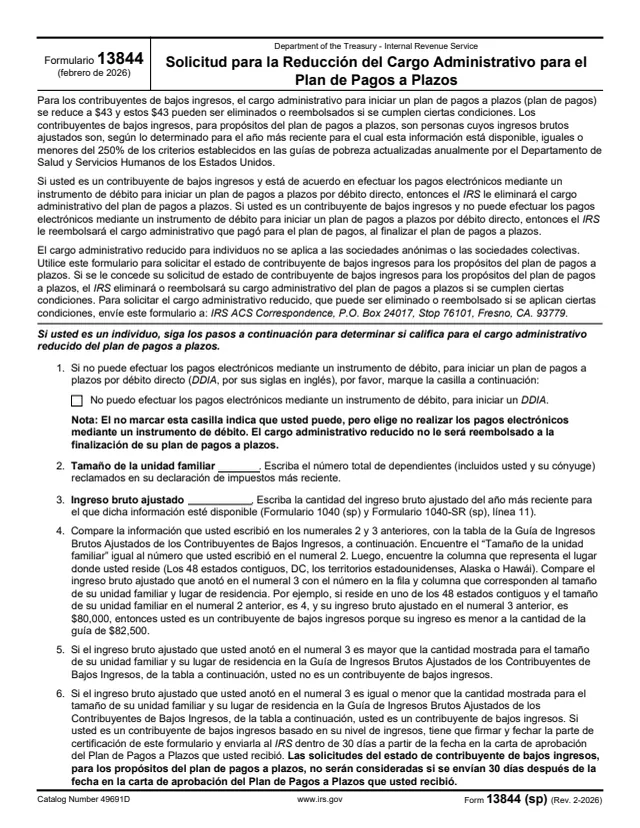
13844
9 fields, 2 pages
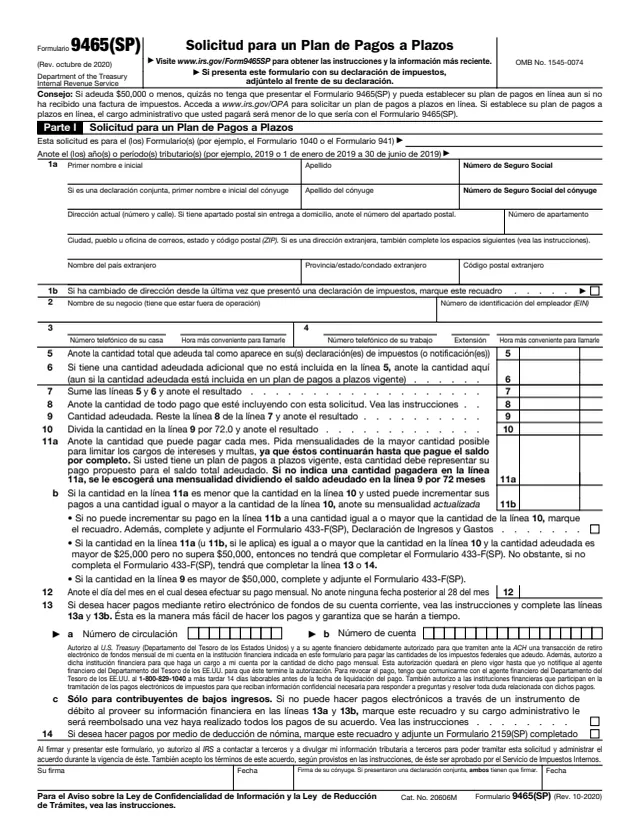
9465
79 fields, 2 pages
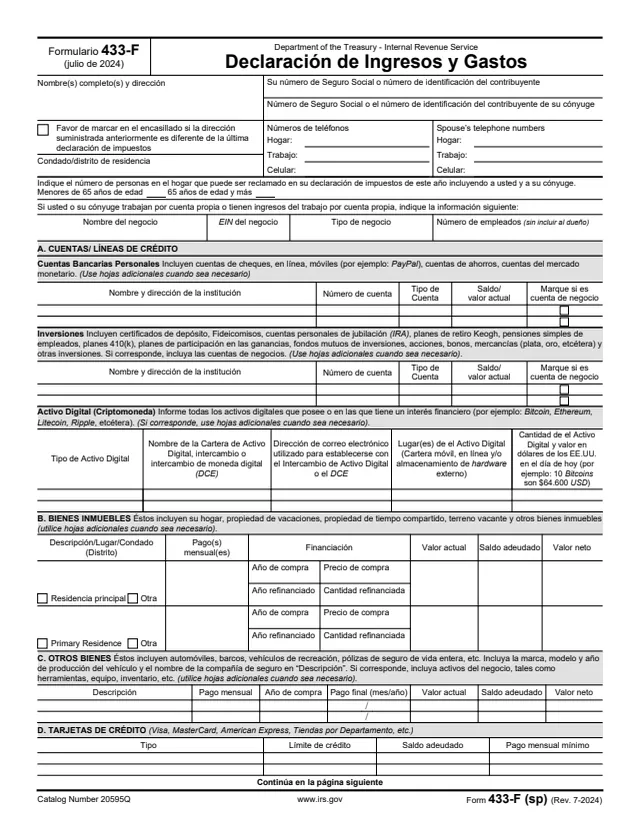
433-F
213 fields, 4 pages
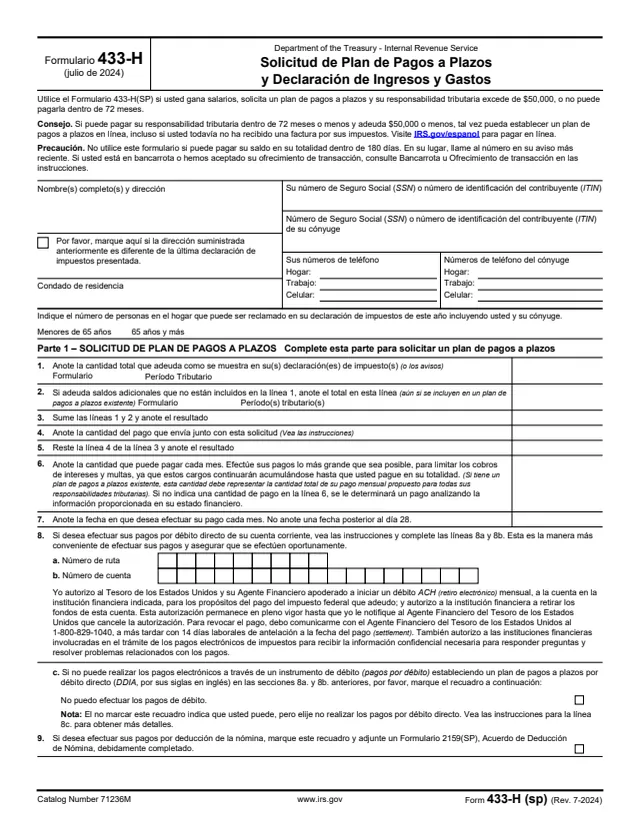
433-H
283 fields, 9 pages
The taxpayer signs the agreement, and the spouse also signs for a joint liability. Some spaces may be filled in by an IRS employee, and the IRS approves it.
No tool matches that search.
Spanish. The agreement, instructions and conditions are in Spanish. Some codes and labels in the For IRS Use Only area, and the catalog number and footer, are in English.
Yes. Form 433-D, Installment Agreement, is the English edition.
The IRS. The form says the taxpayer accepts its terms if the agreement is approved by the Internal Revenue Service, and that the plan may require a supervisor's approval.
The instructions say the payment date is the same day each month, from the 1st to the 28th, and that the IRS has to receive the payment by that date.
1-800-829-3903 for self-employed individuals, business owners and businesses, and 1-800-829-7650 for individuals who are wage earners.
The form says the taxpayer may contact the financial institution at least three business days before the next scheduled transfer, or the IRS at the toll-free number if there are at least fourteen business days before it.
The conditions say it stays in effect until the liabilities, including penalties and interest, are paid in full, the statutory period for collection expires, or the agreement ends.