Section 1: personal information
Lines 1a to 3c: names, address, county, phone numbers, marital status, SSN or ITIN, dates of birth, other household members and dependents, and any outside business interest.
433-A
Collection Information Statement for Wage Earners and Self-Employed Individuals (Spanish Version)
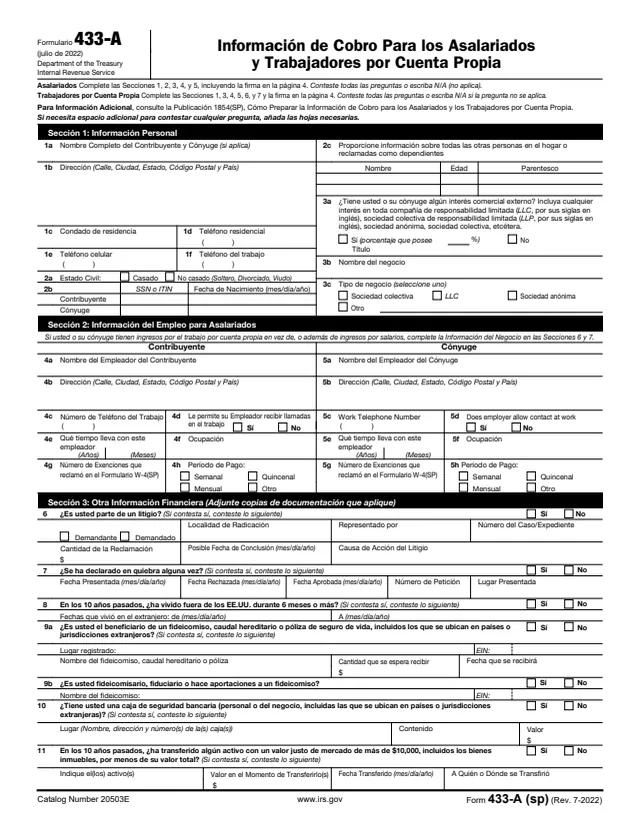
Form 433-A (sp) is the IRS Spanish version of Form 433-A, Collection Information Statement for Wage Earners and Self-Employed Individuals. Its Spanish title is "Información de Cobro Para los Asalariados y Trabajadores por Cuenta Propia". It gives the IRS a picture of a person's household, job, assets, debts and monthly income and expenses. This edition is Rev. 7-2022, dated "julio de 2022" in its header.
The section headings, questions and notes are in Spanish. A few labels stay in English, such as lines 5c and 5d for the spouse's work phone and the Account Number column for business bank accounts, along with the catalog number and the footer "Form 433-A (sp) (Rev. 7-2022)".
The form has no separate instructions. For more information it points to Publicación 1854(SP), "Cómo Preparar la Información de Cobro para los Asalariados y los Trabajadores por Cuenta Propia". The English edition is Form 433-A. You can fill out the PDF free in your browser on this page and download it without an account.
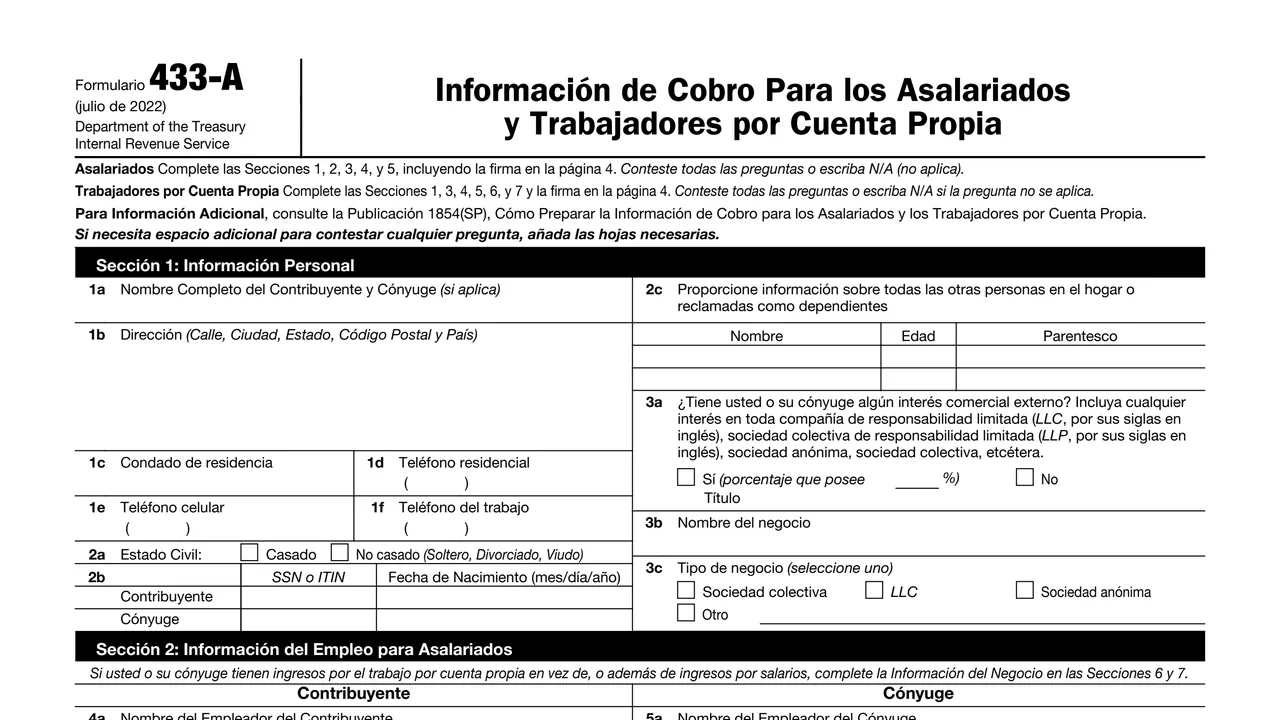
Lines 1a to 3c: names, address, county, phone numbers, marital status, SSN or ITIN, dates of birth, other household members and dependents, and any outside business interest.
Lines 4a to 5h: employer, address and phone for the taxpayer and spouse, contact at work, time with the employer, occupation, exemptions claimed on Form W-4(SP) and pay period.
Lines 6 to 11: lawsuits, bankruptcy, living outside the U.S. 6 months or more in the past 10 years, trusts and estates, safe deposit boxes, and transfers of assets worth more than $10,000 for less than full value.
Lines 12 to 19: cash, bank accounts, investments, digital assets, available credit, life insurance, real property, vehicles and other personal assets, domestic and foreign.
Income on lines 20 to 34, living expenses on lines 35 to 49 and the net difference on line 50, then the certification and signatures.
Lines 51 to 66 cover business details, payment processors, cards accepted, business cash and bank accounts, receivables and business assets. Lines 67 to 89 cover monthly business income and expenses.
The labels are in Spanish. The items below give their English meaning and follow this edition's line numbers.
Wage earners use Sections 1 to 5. Self-employed individuals use Sections 1, 3, 4, 5, 6 and 7. Answer every question or write N/A, and add sheets if more space is needed.
Enter personal, household and employment details, then answer the yes or no questions on lines 6 to 11. Section 3 says to attach copies of applicable documentation.
List each account, investment, digital asset, credit line, policy, property and vehicle, including those in foreign countries or jurisdictions, and fill in each total line.
Self-employed filers pick a period of the past 3, 6, 9 or 12 months and enter average monthly business income and expenses. Line 89 goes to line 23 of Section 5, and the form says to enter 0 there if line 89 is a loss.
Enter monthly amounts in U.S. dollars. Footnote 1 says to multiply weekly gross wages by 4.3, biweekly gross wages by 2.17 and gross wages paid twice a month by 2.
The taxpayer and, where it applies, the spouse sign and date the certification on page 4, which is made under penalty of perjury.
You get the real form, filled in a browser tab, with nothing standing between you and the finished PDF.
The form does not print a mailing address or a deadline. It says that after the IRS reviews it, you may be asked to verify the assets, liens, income and expenses reported.
The form lists previously filed tax returns, pay statements, self-employment records, bank and investment statements, loan statements and bills or statements for recurring expenses.
Private school tuition, public or private college expenses, charitable contributions, voluntary retirement contributions and payments on unsecured debts, unless shown to be necessary for health and welfare or the production of income. Publicación 1854(SP) has the exceptions.
If net business income or net rental income is a loss, the form says to write 0 and not a negative number.
The form says its information is covered by the Privacy Act and Paperwork Reduction Act notices already provided to the taxpayer.
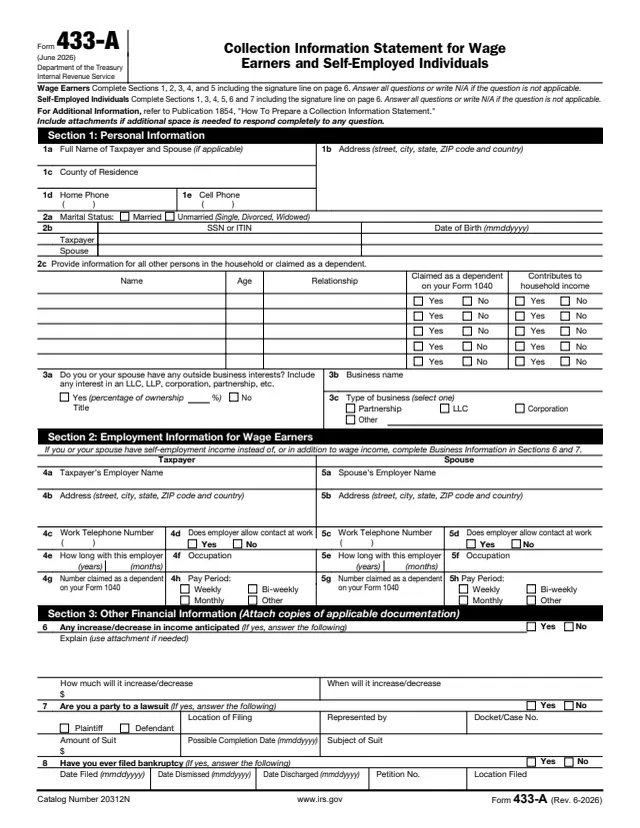
433-A
515 fields, 8 pages
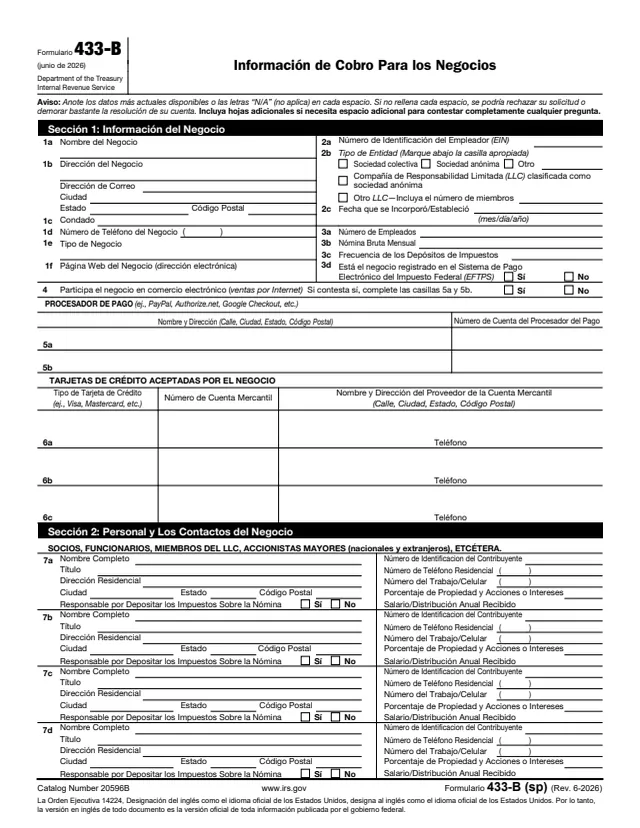
433-B
453 fields, 6 pages
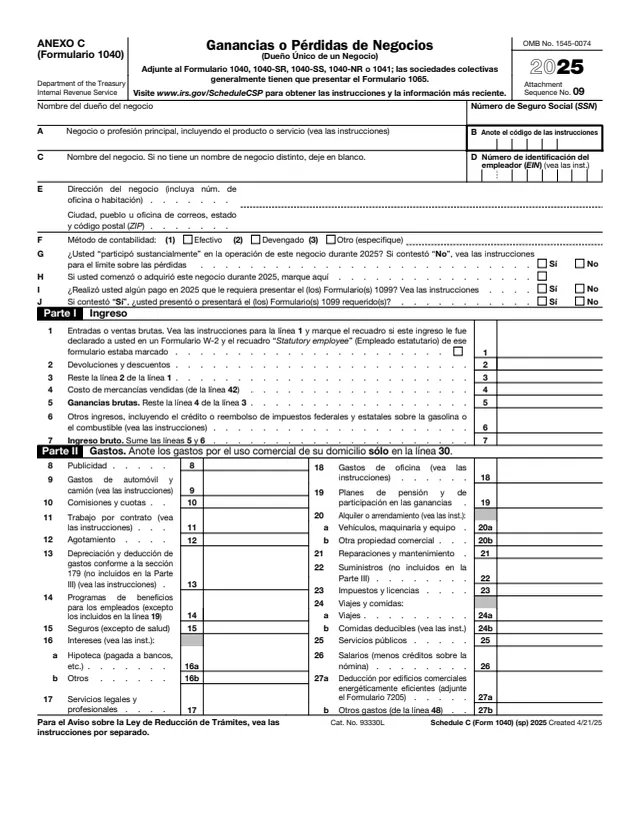
1040
105 fields, 3 pages
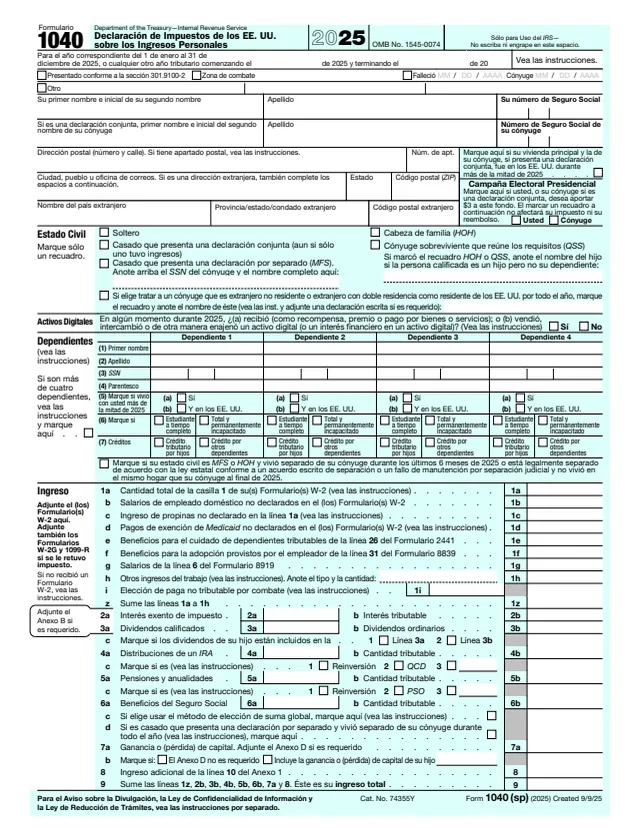
1040
199 fields, 2 pages
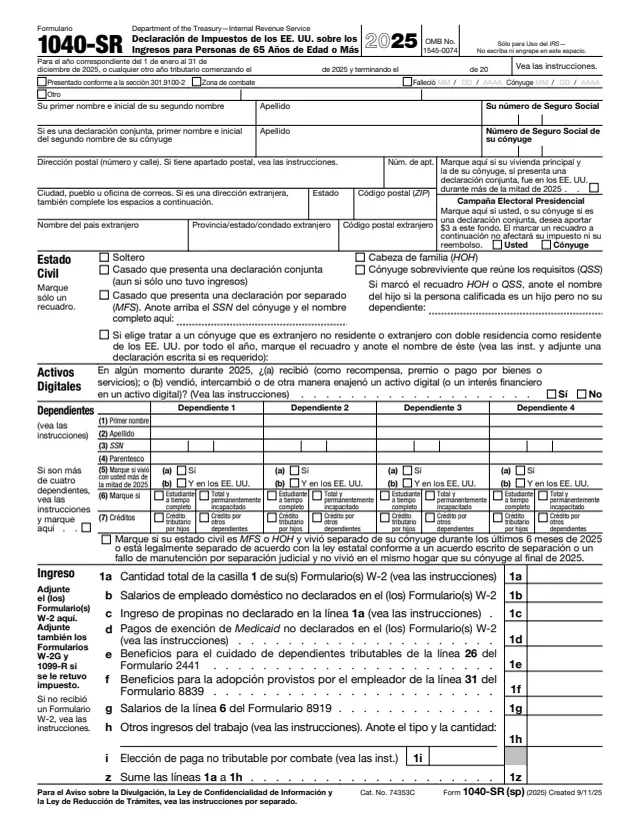
1040-SR
200 fields, 4 pages
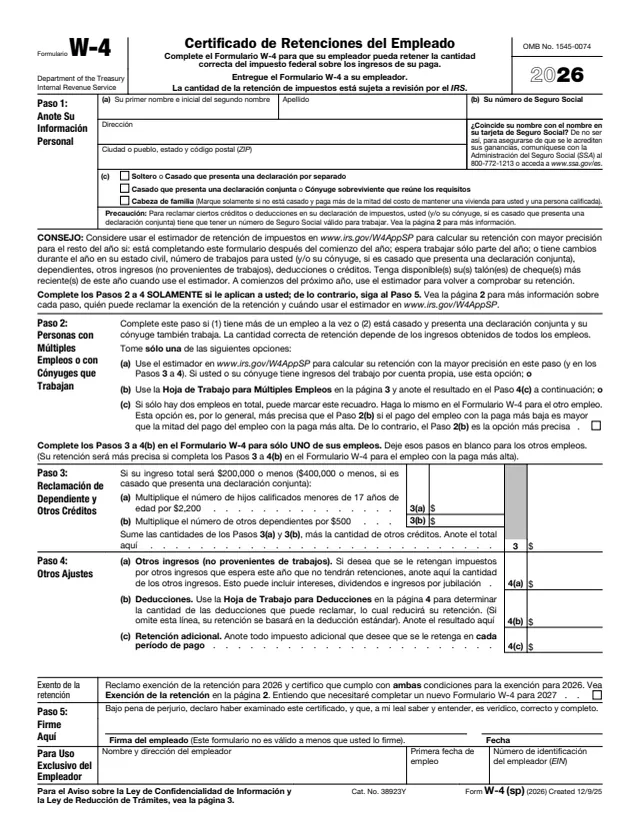
W-4
48 fields, 5 pages
The form is completed by an individual taxpayer, and by a spouse where it applies, for the IRS. The form says the IRS reviews it once completed. It does not print a mailing address.
No tool matches that search.
Spanish, with a few labels left in English, such as lines 5c and 5d and the footer. The English edition is Form 433-A.
The form says wage earners complete Sections 1, 2, 3, 4 and 5, and self-employed individuals complete Sections 1, 3, 4, 5, 6 and 7, both signing on page 4.
Line 51 says those entities complete Form 433-B (SP). Sections 6 and 7 are for a sole proprietorship that files Schedule C.
The form says to multiply weekly gross wages by 4.3, biweekly gross wages by 2.17 and gross wages paid twice a month by 2. Its example is $425.89 x 4.3 = $1,831.33.
Yes. Lines 14c to 14e ask about virtual currency, NFTs and smart contracts, who has access to the private keys, and their value in U.S. dollars. The form says to attach a statement with the public key of each virtual currency, if applicable.
The form points to Publicación 1854(SP), "Cómo Preparar la Información de Cobro para los Asalariados y los Trabajadores por Cuenta Propia".