Part I: service office information
Office name, address (street, city, state, ZIP code), site identification number (SIDN), office coordinator name, and office contact name and phone number.
14446
Virtual VITA/TCE Taxpayer Consent (Chinese-Simplified Version)
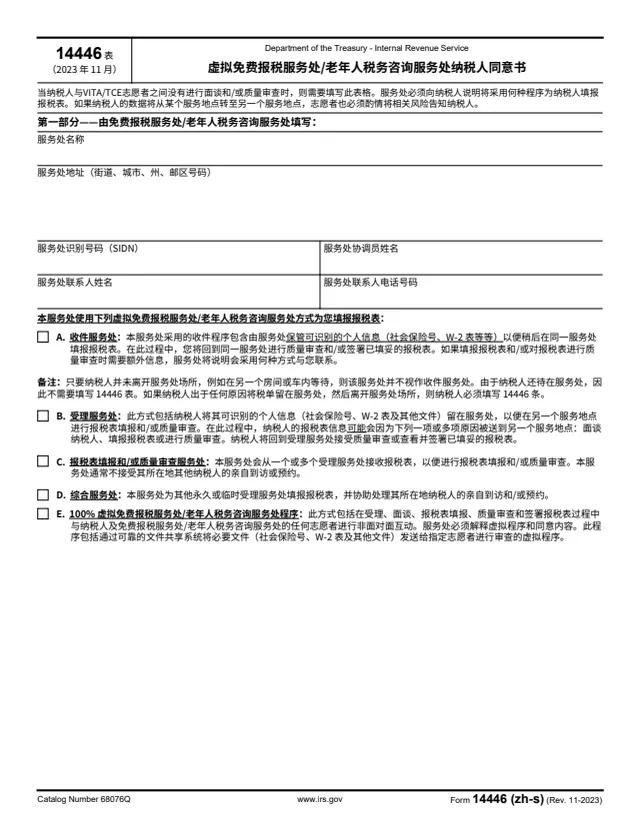
Form 14446 (zh-s) is the Simplified Chinese version of Form 14446, Virtual VITA/TCE Taxpayer Consent. The PDF is printed in Simplified Chinese characters under the title 虚拟免费报税服务处/老年人税务咨询服务处纳税人同意书, which spells out VITA/TCE in Chinese as free tax filing service site and tax counseling for the elderly service site. The IRS lists it as the Chinese-Simplified Version, for taxpayers who read Simplified Chinese. The English edition is Form 14446.
The Chinese text says the form is needed when the face to face interview and/or quality review does not take place between the taxpayer and the VITA/TCE volunteer. The service office (服务处) fills in Part I and Part II. The taxpayer answers the review question in Part III, says whether they agree to the virtual process, and signs.
You can fill it out free in your browser on this page and download the result without an account.
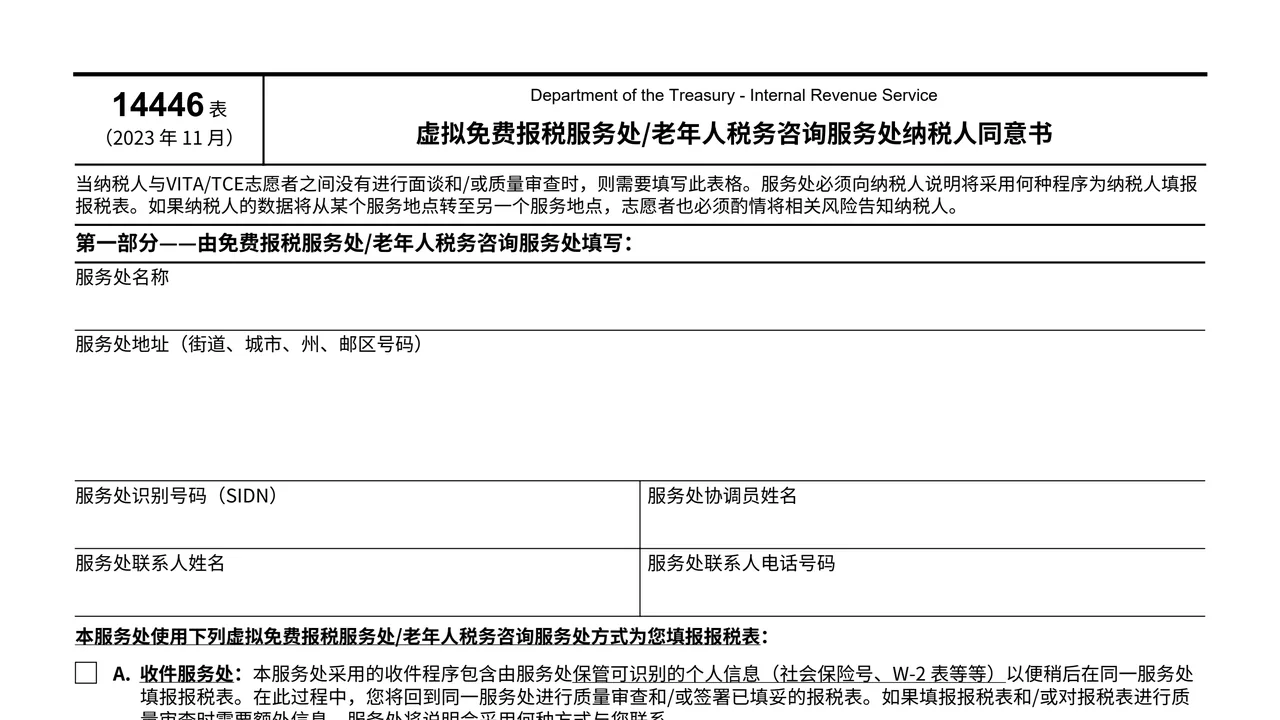
Office name, address (street, city, state, ZIP code), site identification number (SIDN), office coordinator name, and office contact name and phone number.
Receiving (drop off) office, intake office, return preparation and/or quality review office, combination office, and the 100% virtual process.
Eleven numbered items, each with guiding questions in parentheses: appointments, the taxpayer's consent, intake, identity checks with photo ID and Social Security cards/ITIN, interview, preparation, communication, quality review, sharing, signing and e-filing.
The form says IRS staff spot check free tax filing service sites, the office makes needed corrections, and declining does not affect its services. The boxes are 是 (Yes) and 否 (No).
Says federal law may not protect return information from further use or distribution if the non-IRS virtual systems are hacked or damaged, and that the offices are run by IRS sponsored partners.
A Yes or No on using the office's virtual process, then printed name, date of birth, date, phone, email, and an electronic or printed signature, for the taxpayer and the spouse.
The service office enters its name, address, SIDN, coordinator, contact name and phone, then marks each virtual method, A to E, that it uses.
The office explains how it will assist the taxpayer remotely under each of the 11 processes. Item 2 asks how the 14446 is signed, received and stored, and item 11 asks whether e-filing happens immediately or at the end of the day.
Check 是 or 否 on letting IRS staff review the return for accuracy if the office that prepared it is selected.
Check 是 or 否 on using the office's virtual process, enter printed name, date of birth, date, phone and email, then sign electronically or in print.
On a married filing jointly return, the spouse's name goes in the second column, with date of birth, date, phone, email and a signature.
You get the real form, filled in a browser tab, with nothing standing between you and the finished PDF.
The Chinese text says page three of the form is kept at the service office with all other required documents. No IRS mailing address appears on the form.
The disclosure says consent is valid for the time specified, or for one year from the date of signing when no period is specified.
The Chinese text says the office may not be able to prepare the return today under this process.
The form names the Treasury Inspector General for Tax Administration (TIGTA), by phone at 1-800-366-4484 or by email at [email protected].
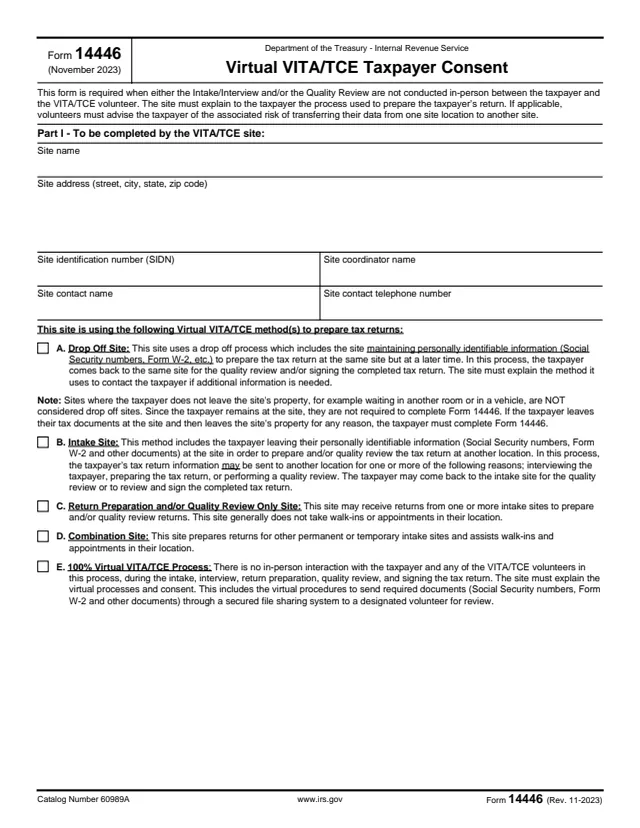
Form 14446 is the English edition. The Simplified Chinese version keeps the same form number, with the (zh-s) tag and Rev. 11-2023 in its footer.
14446
41 fields, 3 pages
14446
41 fields, 3 pages
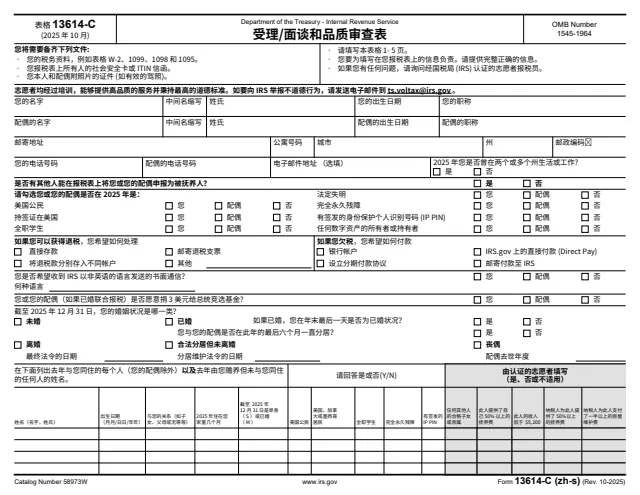
13614-C
297 fields, 6 pages
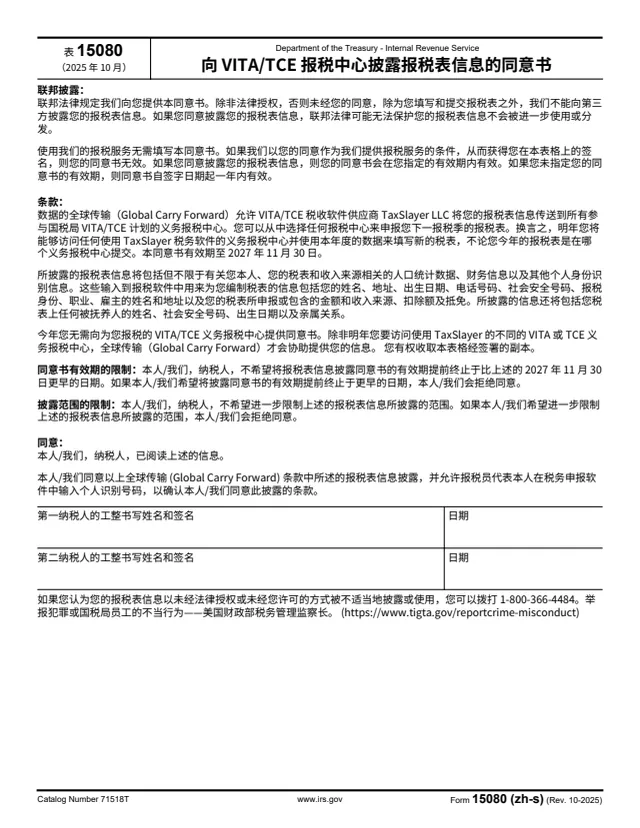
15080
5 fields, 1 page
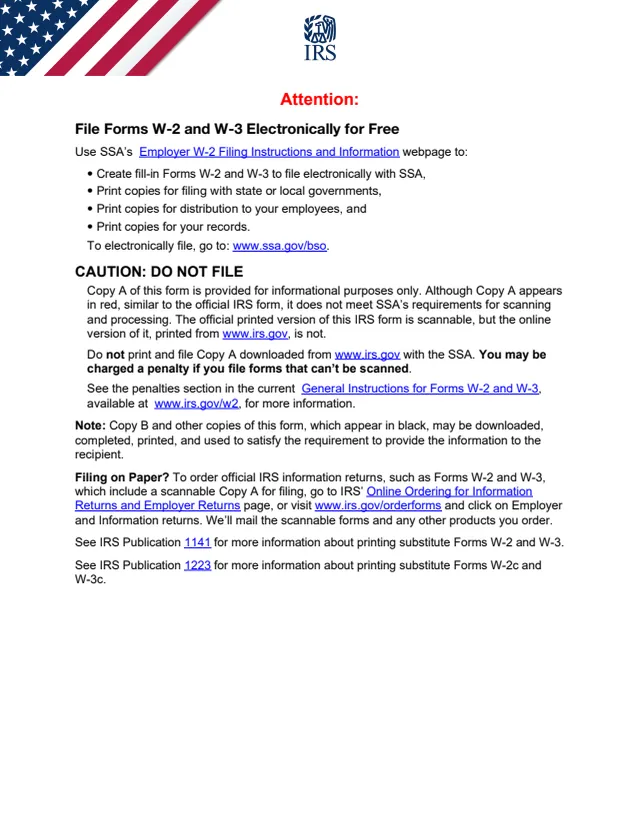
W-2
568 fields, 11 pages
The service office (site) handles Parts I and II, and the taxpayer handles Part III. The form says page three is kept at the service office with all other required documents.
No tool matches that search.
Chinese, in Simplified characters. The IRS file is named f14446cs.pdf, and the footer reads Form 14446 (zh-s) (Rev. 11-2023), Catalog Number 68076Q.
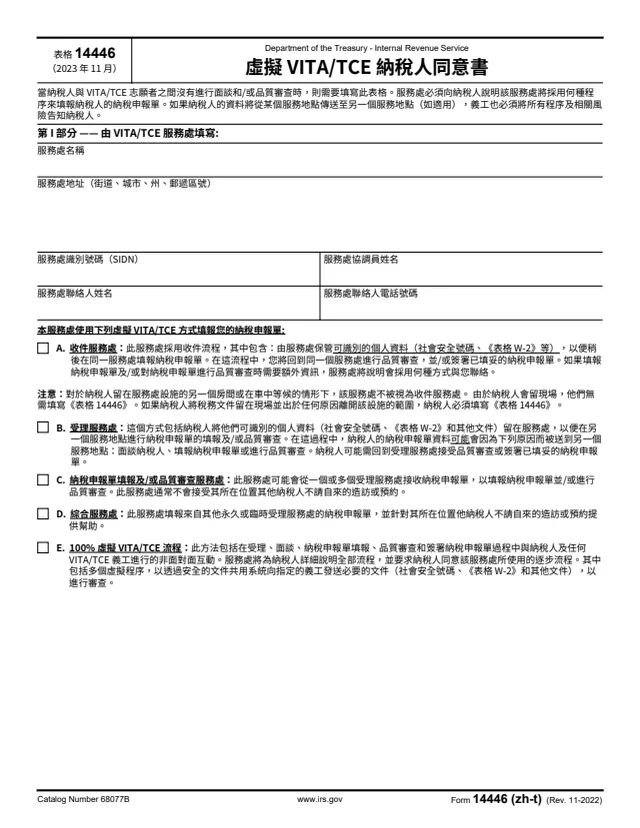
Form 14446 (zh-t) uses Traditional characters and keeps VITA/TCE in Latin letters in its title. This edition uses Simplified characters and spells VITA/TCE out in Chinese.
The service office (site) completes Part I and Part II. The taxpayer, and the spouse on a joint return, completes Part III and signs.
The form says page three is kept at the service office with all other required documents.
For the time specified. If no period is specified, the form says it is valid for one year from the date of signing.
The form lists TIGTA at 1-800-366-4484 or [email protected].