Header
Taxpayer's name and address, an "In reply refer to" box, the tax year, the last four digits of the Social Security number and the principal place of employment.
9210
Alien Status Questionnaire
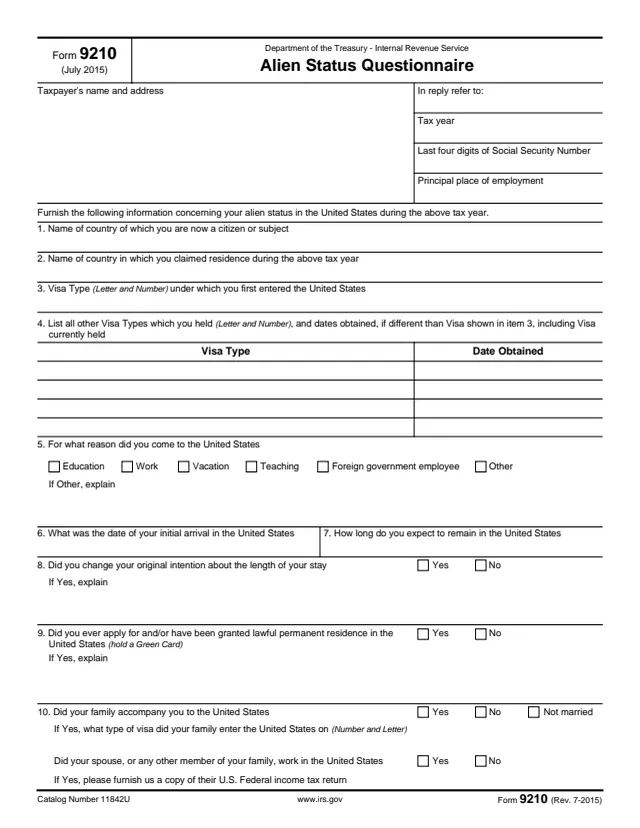
Form 9210, Alien Status Questionnaire, is an Internal Revenue Service form that asks a taxpayer about their alien status in the United States during one tax year. The form says: "Furnish the following information concerning your alien status in the United States during the above tax year."
Its 15 numbered items cover citizenship and claimed residence, every visa type held and when it was obtained, the reason for coming to the United States, the first arrival date and expected length of stay, any application for lawful permanent residence, family members, U.S. employment, foreign income tax returns and every arrival and departure date. The top of the form holds the taxpayer's name and address, the tax year, the last four digits of the Social Security number, the principal place of employment and an "In reply refer to" box.
The taxpayer signs a certification under penalty of perjury. You can fill out the PDF free in your browser on this page and download it without an account.
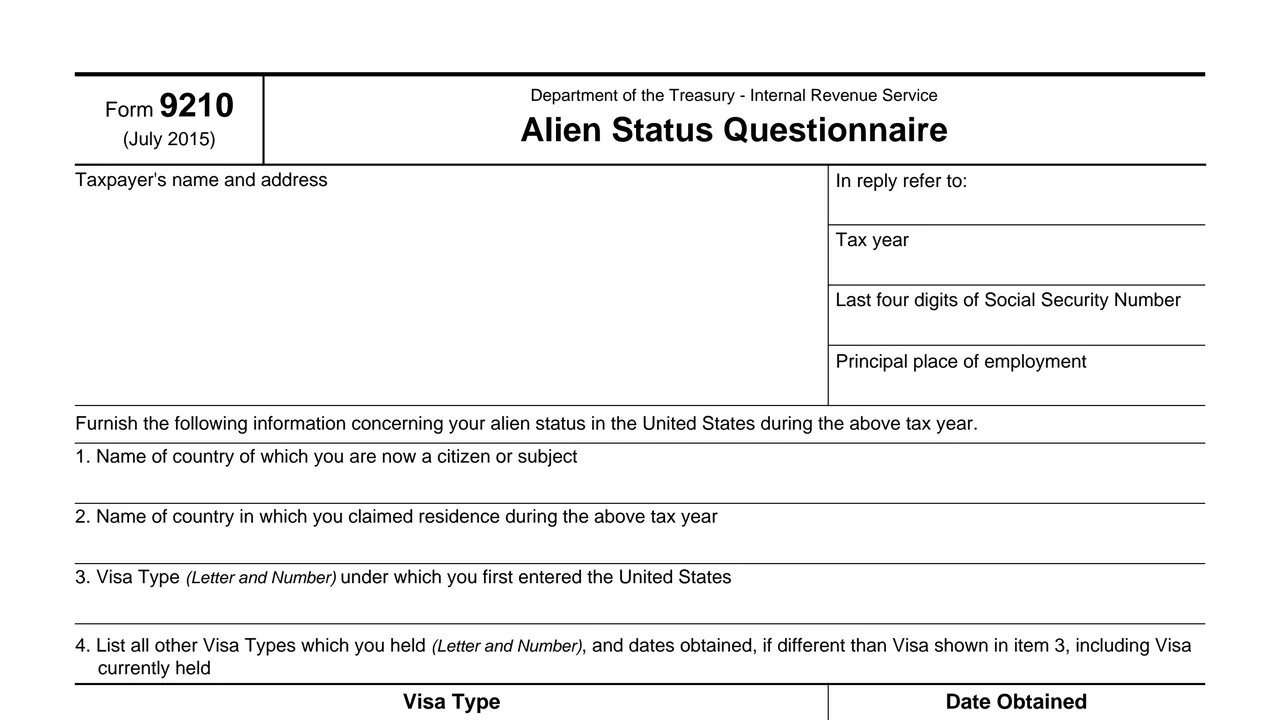
Taxpayer's name and address, an "In reply refer to" box, the tax year, the last four digits of the Social Security number and the principal place of employment.
Country of citizenship, the country where residence was claimed for the tax year, the visa type of first entry, and a table of every other visa type with the date obtained, including the visa held now.
Reason for coming (education, work, vacation, teaching, foreign government employee or other), first arrival date, expected stay, any change of plan, any green card application, and family.
U.S. employment and its limits, the employer's name and address, any foreign income tax return filed while a resident in the United States, and whether the employer is the same as abroad.
Whether the taxpayer left the United States, intent to return, a reentry permit and its expiration date, giving up U.S. residence, the final departure date, and a table of every arrival and departure with its purpose.
A remarks space, then the certification under penalty of perjury that the statement is true, correct and complete, with the taxpayer's signature and date.
Enter or confirm the name and address, the tax year, the last four digits of the Social Security number and the principal place of employment.
Name the country of citizenship and the country where residence was claimed for the tax year. Give each visa as letter and number, and list every other visa with the date it was obtained.
Check the reason for coming and explain Other. Give the first arrival date and expected stay. Items 8 and 9 ask for an explanation on Yes. Item 10 asks for the family's visa type and, if a family member worked, a copy of their federal return.
Answer the employment questions and give the employer's name and address. Item 12 asks for a copy of any foreign income tax return. Item 14 asks about departures, reentry permits and income earned outside the United States in the year of final departure.
List all dates of arrival in and departure from the United States since the first arrival, with the purpose of each departure. Use Remarks for anything else.
Sign and date the certification. It states, under penalty of perjury, that the statement was examined and is true, correct and complete to the best of the signer's knowledge and belief.
You get the real form, filled in a browser tab, with nothing standing between you and the finished PDF.
The form is from the Department of the Treasury, Internal Revenue Service, and asks the taxpayer to "furnish us" the information. It prints no mailing address.
The form prints no due date.
A copy of the U.S. federal income tax return of a spouse or family member who worked in the United States (item 10), and a copy of any foreign income tax return filed while a resident in the United States (item 12).
The form has one signature line, for the taxpayer, under a certification made under penalty of perjury.
The form is addressed to the taxpayer named at the top and asks about "your alien status". The taxpayer answers and signs, and the answers go back to the IRS, which the form calls "us".
No tool matches that search.
It collects information about a taxpayer's alien status in the United States during one tax year, such as citizenship, visas, purpose and length of stay, employment and travel dates.
The taxpayer. The form has one signature line, under a certification made under penalty of perjury.
Yes. It asks for a copy of the U.S. federal income tax return of a family member who worked in the United States, and a copy of any foreign income tax return filed while a resident in the United States.
No. The header asks for the last four digits of the Social Security number.
No. The PDF prints neither. It has an "In reply refer to" box at the top.
This page uses Form 9210 (Rev. 7-2015). The top of the form shows July 2015.