Name, SSN and addresses
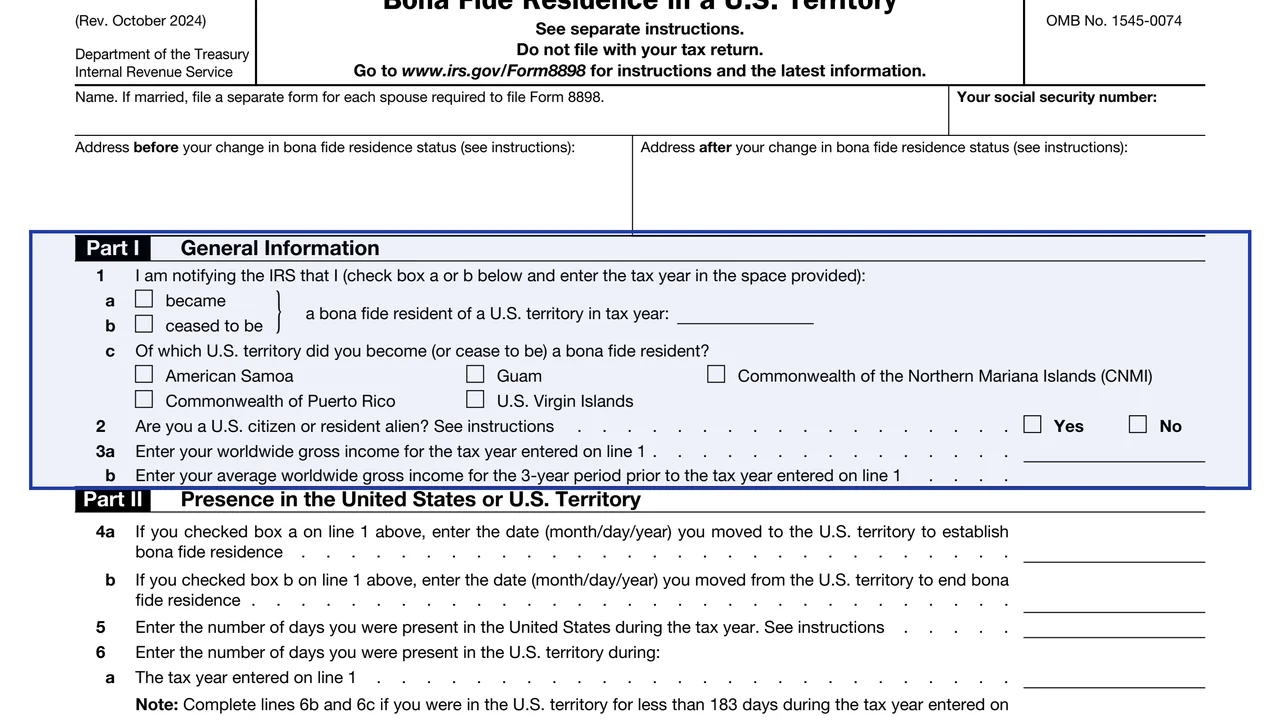
Your name and Social Security number, the address before your change in bona fide residence status and the address after it.
8898
Statement for Individuals Who Begin or End Bona Fide Residence in a U.S. Possession
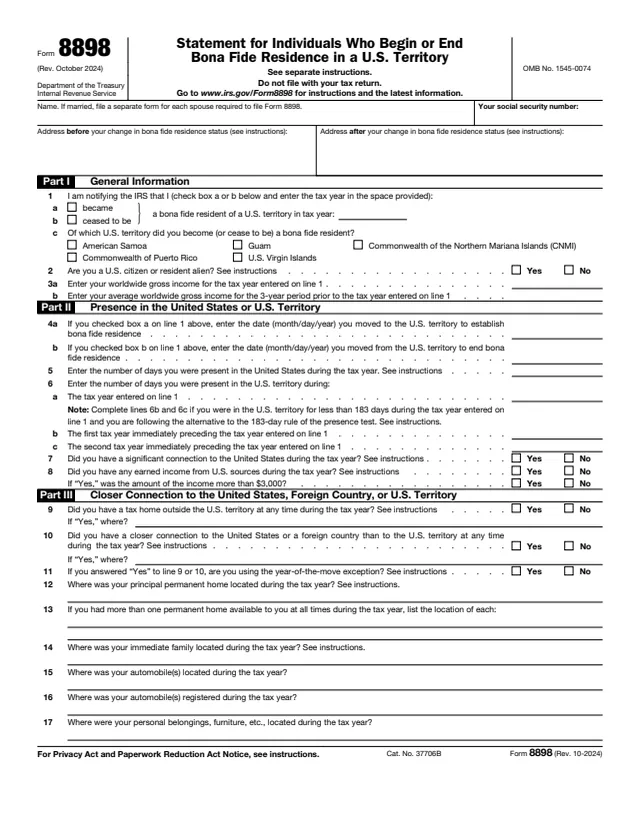
Form 8898, Statement for Individuals Who Begin or End Bona Fide Residence in a U.S. Territory, notifies the IRS that a person became or ceased to be a bona fide resident of a U.S. territory under Internal Revenue Code section 937(c). The instructions list the territories for this purpose: American Samoa, Guam, the Commonwealth of the Northern Mariana Islands (CNMI), the Commonwealth of Puerto Rico, and the U.S. Virgin Islands.
This is the October 2024 revision, which replaced the term "possession" with "territory". It asks about worldwide gross income, days of presence, tax home, closer connection and source of income, the facts the instructions use for the presence, tax home and closer connection tests. The form says "Do not file with your tax return." It is mailed on its own to the IRS in Austin, Texas.
You can fill out Form 8898 free in your browser on this page and download the result without an account.
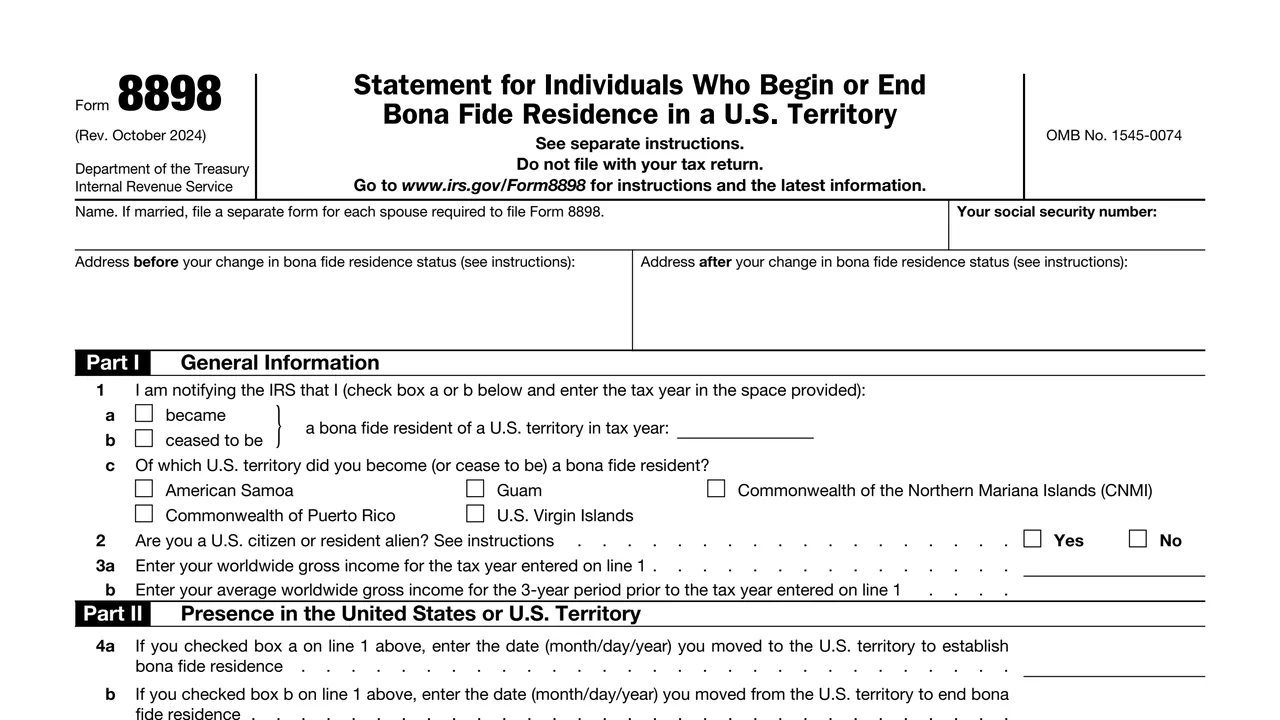
Your name and Social Security number, the address before your change in bona fide residence status and the address after it.
Whether you became or ceased to be a bona fide resident and in which tax year, which territory, U.S. citizen or resident alien status, and worldwide gross income.
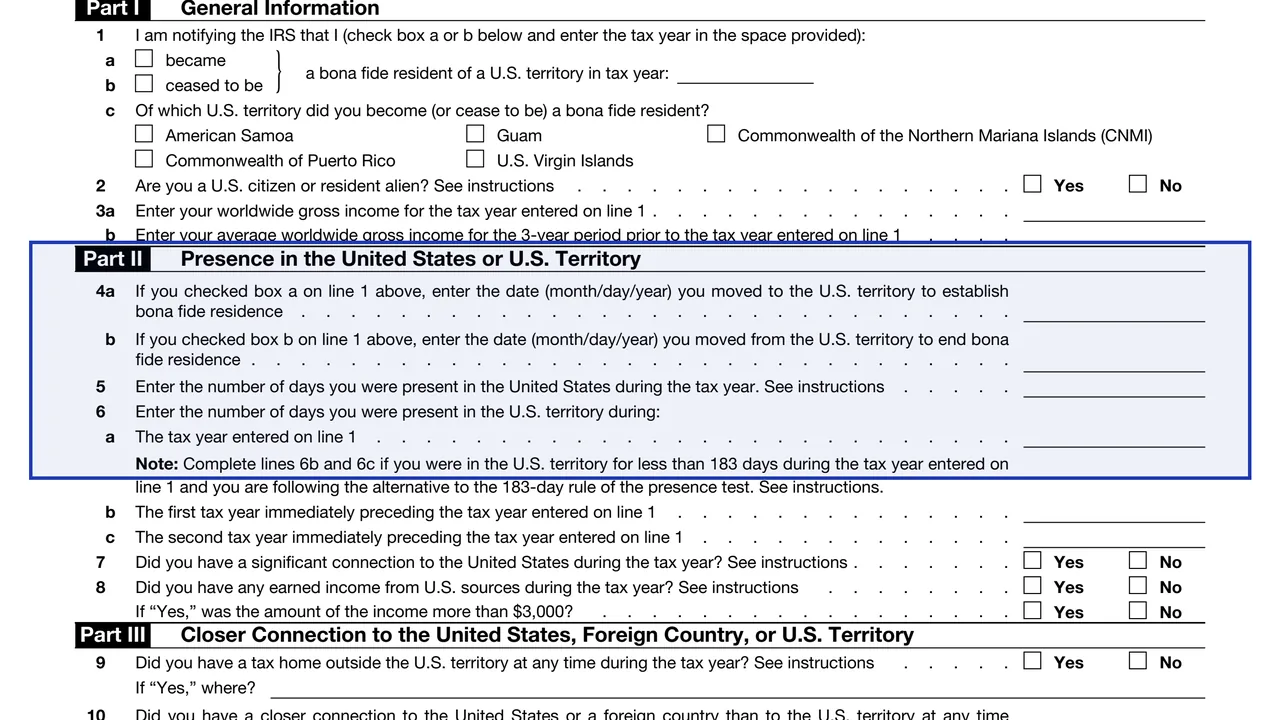
Move dates, days present in the United States and in the territory, any significant connection to the United States, and earned income from U.S. sources.
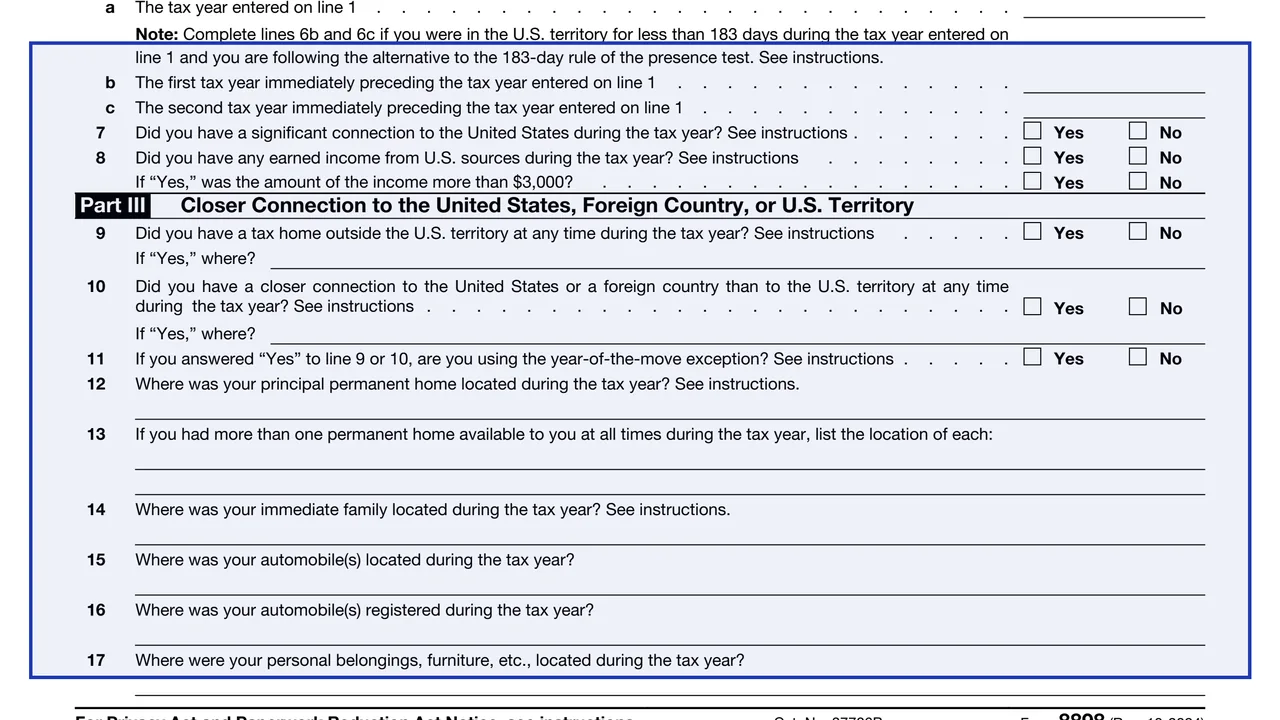
Tax home, closer connection, the year-of-the-move exception, permanent home, family, cars, belongings, banks, driver's licenses, voter registration, homestead exemption, documents and investments.
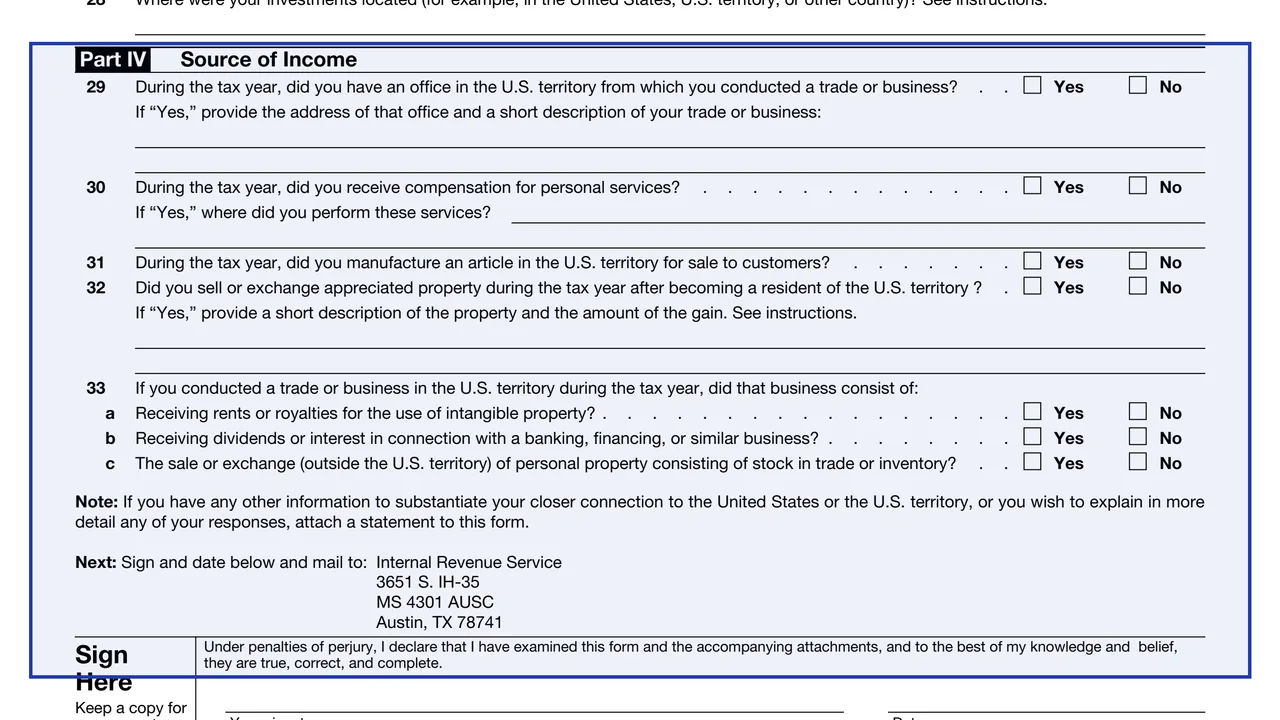
Any office in the territory used for a trade or business, where personal services were performed, manufacturing in the territory, and sales of appreciated property.
A signature and date under penalties of perjury, the Austin mailing address, and a note to keep a copy for your records.
On a joint return, the instructions say to enter only the name and SSN of the spouse whose information is reported. Enter the address before the change, and a different address for after it.
Check box a (became) or box b (ceased to be), enter the tax year of that position, and check the territory on line 1c.
Enter worldwide gross income for that tax year on line 3a. For line 3b, the instructions say to add worldwide gross income for each of the 3 prior years and divide the total by 3.0.
Enter the exact move date (month/day/year) on line 4a or 4b, then days present in the United States on line 5 and in the territory on line 6a. Lines 6b and 6c are for the alternative to the 183-day rule.
Answer each yes or no question and say where. The instructions say immediate family on line 14 means your spouse and minor children, and stocks and bonds on line 28 are located by where the company or debtor was formed.
Sign and date. The form says to attach a statement with any other information that supports your closer connection, or to explain any answer in more detail.
You get the real form, filled in a browser tab, with nothing standing between you and the finished PDF.
The form says to mail it to Internal Revenue Service, 3651 S. IH-35, MS 4301 AUSC, Austin, TX 78741. The instructions say not to send your tax return to that address.
The instructions say to file Form 8898 by the due date (including extensions) for filing Form 1040.
The form says "Do not file with your tax return."
The instructions say the IRS has a mobile friendly version of Form 8898 that can be completed and submitted online, described at IRS.gov/MobileFriendlyForms.
The instructions say a required filer who does not file, or leaves out or misstates required information, may be subject to a penalty of $1,000, unless the failure is due to reasonable cause and not willful neglect.
The form says to keep a copy for your records.
Individuals file it. The instructions say it is filed for the tax year in which worldwide gross income is more than $75,000 and one of the residence changes below applies.
No tool matches that search.
The instructions list American Samoa, Guam, the Commonwealth of the Northern Mariana Islands (CNMI), the Commonwealth of Puerto Rico, and the U.S. Virgin Islands.
No. The form says not to file it with your tax return. It is mailed separately to the IRS address in Austin, Texas printed on the form.
The form is filed for a tax year in which worldwide gross income is more than $75,000 and one of the listed residence changes applies. A spouse's income is not counted.
The instructions define it as all income received in money, goods, property and services, including income from sources outside the United States even if part or all of it can be excluded, before any deductions, credits or rebates.
No. The form and instructions say a separate Form 8898 is filed for each spouse required to file it.
The instructions list several ways to meet it, including being present in the territory for at least 183 days during the tax year, or being present in the United States for no more than 90 days.